Showing posts with label SF Playhouse. Show all posts

Monday, May 15, 2023

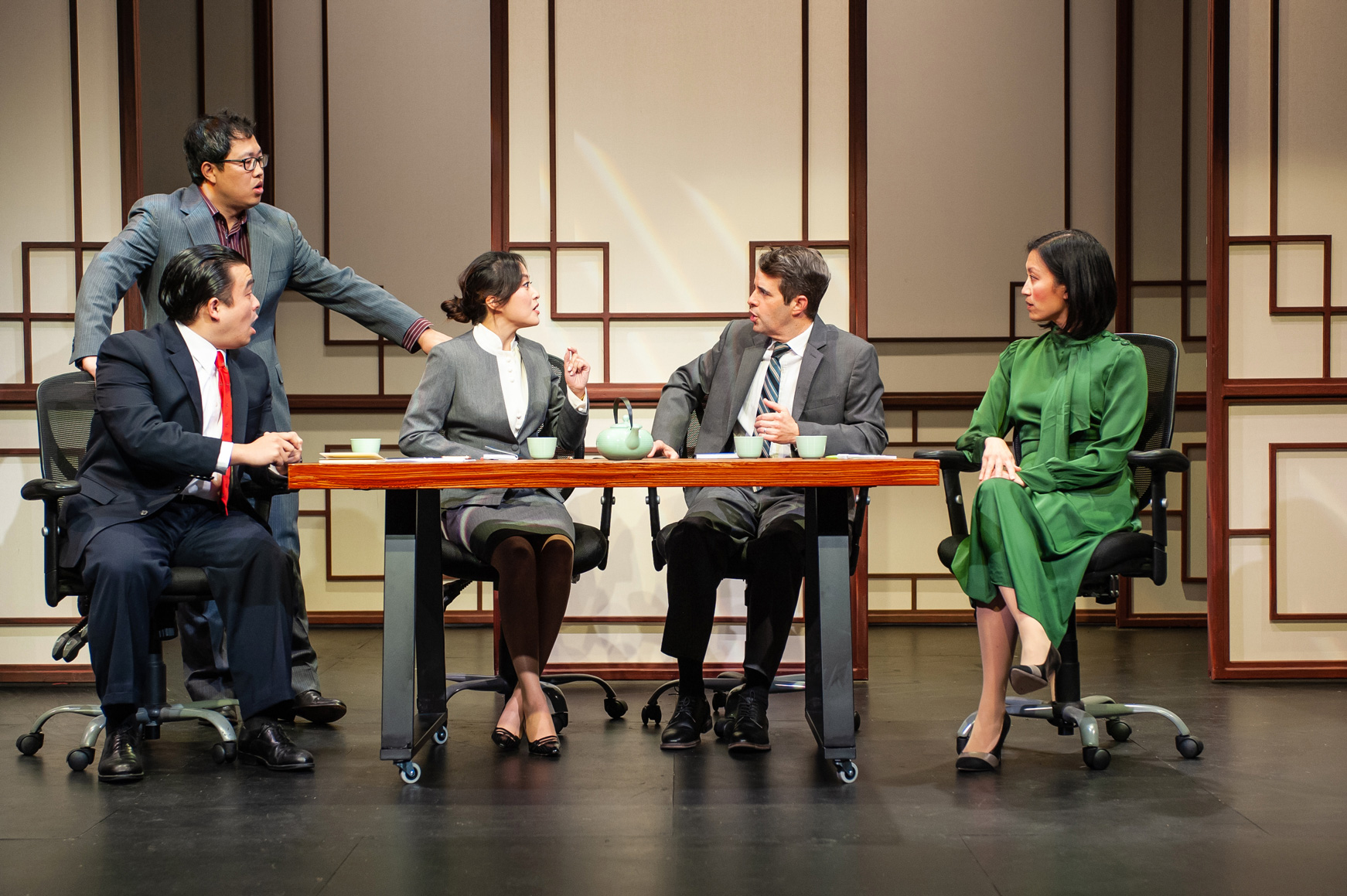
"Chinglish" at San Francisco Playhouse


SF Playhouse production photo by Jessica Palopoli

It's not often that we get to see a relatively new play twice, in very different incarnations. We saw David Henry Hwang's Chinglish at Berkeley Rep in 2012, and I recall liking it a lot (though this predates my blogging by several years, so I have no detailed notes on this). So I wasn't sure I needed to see the revival at SF Playhouse this year, but heck, we generally like shows there, and our friends were going, so why not?

Turns out the play has been extensively reworked, both to reflect more current geopolitics, but also to reframe the play from one written entirely in English to one largely spoken in Chinese, with the English translations projected onto the set. This makes the casting and production of the play much, much more difficult, and even though relatively few of the audience members in San Francisco will actually understand the Chinese, the crew has gone to great lengths to get it correct, down to the level of local dialect. The program notes on this are quite interesting! (But they no longer publish the program online, apparently, so you have to go see the show to read that.)

The Play

Chinglish centers on the CEO of a midwestern US sign company, Daniel, going to China to try to land the contract to put translated signs in a new, regional cultural center in China. Upon arriving he hires a local consultant, Peter, an expatriated Brit who has lived in China for about two decades and speaks the language fluently, to translate and to help him develop business relationships. Peter sets up meetings with the mayor of the town, Cai, and his assistant, Xi, who use a series of hilariously incompetent translators of their own.

Without spilling too many details, suffice it to say that all the players here have hidden agendas, and all of this is made more complex by the difficulties of understanding (and misunderstanding) another language. As some of the characters strike out on their own, trying to cut out the middlemen (both translators and parties with other interests), some new complications come to light.

The Production

First off, I was blown away by the Chinese in this play. A large portion of the dialogue takes place in Chinese, and according to the program notes, almost none of the cast speak Chinese natively, and none spoke the desired dialect. But from my perspective it came off nearly flawlessly. Not that I can judge the language per se, but it all seemed natural and fluent, and most importantly it all made sense in context. That seems like a big win.

Second, just a very strong cast, with particular emphasis on Matthew Bohrer (Peter), who has to carry off Chinese as well as two different British accents, Nicole Tung (Xi), who manages to sound as if English is very difficult for her, Alex Hsu (Cai) who manages to be broadly humorous without turning into a caricature, and Phil Wong (Bing and Judge Ju Geming), who shows great versatility and range.

And director Jeffrey Lo pulls it all together nicely. This was clearly a difficult show to put together, and it comes off very smoothly. The set (designed by Andrea Bechert) and the projections (by Spense Matubang) worked well, though some of the transitions were a bit needlessly clumsy, and the prjections got off a little at times. But on the whole, really good.

Mostly I was kind of overwhelmed by what an ambitious undertaking this play was--much more so than the English-only version I'd seen a decade ago--and how well it came out.And Robert Sokol's piece in the program detailing the work undertaken by Patrick Chew, the translator and cultural consultant for the production, was just outstanding.

Bottom Line

I thought this was an incredibly effective presentation of a thoughtful and difficult play. And more than almost any other revival/adaptation I can recall, this overhaul of the script into mixed languages was remarkably effective, and added a lot to what was already a pretty good script.

The quality of the production and Lo's direction were really effective. I have to say I recommend seeing this play quite strongly. Lucky for you, the play runs through June 10 (extended!), so you have lots of chances. Go see it!

Monday, January 16, 2023

"As You Like It" at SF Playhouse


SF Playhouse production photo by Jessica Palopoli
It's a musical adaptation of a Shakespeare play. Updated with some modern touches.

The Play

It's substantially Shakespeare's play As You Like It, with some extra gender-bending to give it a queer component as well as the gender-confusion that is built into Shakespeare's plot. And much of the script has been edited out, converted into songs in various popular genres to explain the parts of the plot that have been elided.

I found the juxtaposition of the modern songs and the Elizabethan text rather jarring, both from a stylistic standpoint and because the songs are pretty much all expository. As a wise character once noted, "nothing can kill a show like too much exposition."

The Production

The show is for the most part well done. The set design is pretty clean, so we have large spaces to represent the forest or Arden. I think my major criticism of the production itself would be that there is far too much standing around on the set. Someone starts singing, and they and everyone else sort of stand around, unless they happen to be dancing. Director Bill English needed to come up with some better blocking for a lot of the scenes.

And things are a bit heavy-handed when we're dealing with the usurping Duke Frederick. It seems unnecessary to play loud, martial music and have everyone goose-stepping. We get that he's an authoritarian. Of course, the script also undercuts that by having characters refer to him as "Your Duke-ness". WTF? Make up your minds whether we're supposed to take all of that seriously. Don't let the snark overwhelm the message of the show, folks!

Bottom Line

I didn't really care for the adaptation or the production. I thought most of the songs were pretty banal and the presentation heavy-handed. It's as if neither the adapters (Shaina Taub and Laurie Woolery) nor the director thought the audience would understand the show. Yet they kept long passages of Shakespeare's text, and no one got lost. It's not as if the show survived for 400 years by confusing people.

On the other hand, I appeared to be in the vast minority on this one. Most of the audience seemed to enjoy the show immensely. And indeed, it was well done, with a lot of obvious joy on the part of the cast. So I'd give it a passing grade, but not a rave. Seems like it could have been much better, either in the adaptation or in the production (or preferably, both!).

Monday, October 17, 2022

"Indecent" at San Francisco Playhouse

SF Playhouse production photo by Jessica Palopoli

 This is a play we really, really liked at Ashland, and since it was one of the last plays I actually wrote a blog about before I shut things down, I will refer you to that posting for information about the play itself, and I'll just talk about the current SF Playhouse production here.

The Production

I went into this with some trepidation. As you can see from my previous post, I really like this play, and the production at Ashland was excellent. SF Playhouse can do really good productions, but not always, and this is a particularly tricky play, what with all the Yiddish and other languages thrown in, and some obvious cultural issues one could trip over. Still, director Susi Damilano generally does a very good job, and in this case, she does not disappoint.

I'll note up front that the one role that is stable throughout the play, Lemml, the stage manager, was an understudy the night we attended. David Schiller did a terrific job, and had the program not contained an insert indicating that we had an understudy, I would never have known. And that's a good sign for the production as a whole, if one doesn't notice that a major role has been swapped out.

I liked the simple staging of the show, using suitcases as props for many things, and using the uncurtained wings as an area for actors and musicians to rest, change, and observe. I thought that fit the play very well. As with the production in Ashland, I had difficulty seeing some of the projected supertitles from my seat location at times. That seems like something that the designers could have addressed, as we were roughly in the middle of the orchestra section, and I suspect anyone closer to the stage would have had even more difficulty.

Bottom Line

This is a very good production of an excellent play. Of course you should go see it! It runs through November 5th at SF Playhouse.

I was encouraged, by the way, to see the theater much more full than it has been for other recent shows. The orchestra was nearly full, and there were people sitting up in the balcony. I suspect this is a result of both the easing of COVID restrictions (and a concurrent willingness of people to go into indoor spaces) and the quality of this show. In any case, go! See it! Bring your friends. This is the good stuff.

Monday, January 1, 2018

Best of 2017

I've been told that one of the requirements, now that I do a Theater Blog, is that I must commemorate the end of the year by doing a "Best Of" post to say what was best this year. Since 2017 was my first full year of Theater Blogging (Yep...we started in May of 2016!), this will be the first time I can really look back over a year of posts and opine on what really stuck with me, which is my criterion for "Best Of". Unless I decide it isn't. Stay tuned.

I will preface this with a side note that on the whole, 2017 was not a good year for me at all. Personally and professionally, this year has actually kind of sucked, and even my frequent respite at the ballpark was not its usual pick-me-up. But for the most part, theater--and particularly theater people--has truly kept me going. On the whole, the friends I have made through going to the theater and being involved with theater are some of the most positive, supportive people I have ever known. You know who you are, and thanks for being there for me.

Now then, theater stuff...

Best Plays/Productions

These are the plays that really stuck with me, for one reason or another. I'll list them in the order I saw them. No other ranking is implied unless I say so. I will include links to my original postings for each of them, in case you missed my musings the first time or just want to see if I lost my mind in between or something.

If I can find a theme to my "best" list, it's mostly that they almost all manage to tackle an issue that is pertinent to the day and explore it in a non-obvious way. 

"Hamlet" at Shotgun Players

Fortunately, the repertory portion of Shotgun's 2016-2017 season ended in January, and much of what I saw in January was more Hamlet. I believe I ended up seeing it about 18 times, with only one repeat casting. The shuffling of actors was amazing to watch and very educational. I learned a great deal about Hamlet and about theater from watching these shows, and my only regret is that I didn't manage to go more often. The seven actors plus one understudy deserve medals for performing in this show. And extra medals for the fact they were also performing in at least one additional repertory show each. It was just an extraordinary experience, the likes of which we are not likely to see on a Bay Area stage again any time soon.

"John" at ACT

This was the first show I felt really showed off the value of ACT's new second stage at the Strand Theater. The show was quirky, but it really kept me thinking about it for quite some time, and that's what good theater is about.

"Leni" at Aurora

Once again showing my fondness for the intimacy of small theater spaces, this little show in Aurora's second space really showcased the talents of actors Stacy Ross and Martha Brigham and brought some history to life in a thoughtful and timely way. It was an innovative and thought-provoking show, well directed by Jon Tracy.

"Sisters Matsumoto" at Center Rep

This was a very powerful and beautifully staged performance of a story that really resonated. Particularly having just seen TheaterFIRST's Beneath The Tall Tree, which also dealt with Japanese American internment, it was moving and thought-provoking and made me aware of aspects of that period and its aftermath that I hadn't been aware of.

"The Events" at Shotgun Players

My buddies at Shotgun really kind of went off the rails on some things these past couple of years. Staging The Events requires a different community choir on stage for each performance. As such, it was informative to see the play more than once (and I did). Not only did this help cement for me the value of seeing plays more than once (I also saw Hamilton for the second time around the same point), but it made me appreciate both the difficulty of incorporating different outside groups into a play and what that actually means to this particular show. This is a tough but important and certainly timely play about the resilience of both individuals and communities to sudden, shocking events.

 "As You Like It" at CalShakes

As the only comedy on the list, this seems a little odd (note that I have a separate section for comedies later). But I was moved and surprised by this CalShakes production. I usually don't expect much thought to ensue from a Shakespearean comedy, but Desdemona Chiang's interpretation of this play of mistaken identity broadened the issue to cover personal and gender identity, and did so smoothly in a fine production. This was also the start of a very strong season for CalShakes.

"Grandeur" at The Magic Theater

I went into this play knowing almost nothing about it, and left absolutely stupefied. Carl Lumbly exceeded even the lofty expectations I have of him, and the play was riveting. It's not earth-shakingly important, but it shows just how effective a small play can be. I was extremely fortunate to be sitting in the front row, in the seat closest to the chair where Lumbly sat for much of the play, so I got to watch him up close, and it was amazing.

"Mojada: A Medea in Los Angeles" at Oregon Shakespeare Festival

I would normally expect at least a couple of plays from our summer jaunts to Ashland to land on the "Best Of" list for a year, but this year wasn't overall that impressive up there. But Mojada was a knockout. The adaptation of the well-worn story of Medea is almost obvious in retrospect. The portrayal of undocumented immigrants trying to assimilate (or not) and the consequences for them personally and socially is excruciating, but very effective.

"An Octoroon" at Berkeley Rep

Everybody's trying to push your buttons this year, but this time Berkeley Rep got it right. It's a super complex script, as you might expect from a hotshot playwright who has won just about every award imaginable. What I didn't expect was that Berkeley Rep would find the right director and cast, and that that director would be Eric Ting, who had previously disimpressed me with his direction of Othello at CalShakes. This production was pretty much spot-on. We're still talking about it, almost six months later.

"black odyssey" at CalShakes

I would never have guessed at the start of the year that Eric Ting would direct even one, let alone two, of my favorite productions. But here he was, coming right off the triumph that was An Octoroon, directing local playwright Marcus Gardley's wonderful adaptation of "The Odyssey" into a story of African American life. And it packed the Bruns Amphitheater every show, bringing in rafts of people who do not normally make the trek to Orinda to see a play. This was terrific storytelling.

"The Farm" at TheatreFIRST

Another artist making his second appearance on the list is Jon Tracy. Having directed Leni for Aurora earlier in the year, he also re-adapted his adaptation of Orwell's "Animal Farm" for TheatreFIRST, and the result was delightful and moving. This modest production reminded us that we don't have to be big and fancy to tell an important story. The reboot of TheatreFIRST is having sort of uneven results, but The Farm was definitely a sign of what a dedicated bunch of theater artists can do with limited resources.

Comic Relief

Most of the plays that really stuck with me this year were dramas. Maybe it fit the rhythm of my own life, which had way too much drama in it this year. But there were funny plays that made an impression on me, and they deserve some recognition, even if they weren't overall the "best" things I saw this year.

"Noises Off!" at SF Playhouse

This is one of those kind of classic plays that I had always heard of by never seen. I love the intricacy of the plotting and staging, and felt that for once, the rotating stage at SF Playhouse really was an asset. And the play is just screamingly funny, both because of all the theater in-jokes and because of some real character development. I liked both the play and the production here very well.

"The Play That Goes Wrong " at Lyceum Theatre (NYC)

This play isn't nearly as deep as Noises Off!, but the production we saw in New York this fall was absolutely the funniest thing I've seen on stage in a long, long time. The comedic timing and the convoluted set design were truly impressive. I needed a good laugh, and this provided it.

Spectacles

This is a category I just made up to salute the shows that just make you drop your jaw a bit at the stagecraft. There were some pretty over-the-top productions out there, even if they weren't among the shows that I deemed "best" overall.

"Needles and Opium" at ACT
"Monsoon Wedding" at Berkeley Rep
"A Thousand Splendid Suns" at ACT
"The Black Rider" at Shotgun Players

I won't go into them in detail again. Suffice it to say that in each case I was less than delighted with the play, the message, the storytelling, or something. But in each case the stagecraft, design, music, dancing, lights, and so on were dazzling and worth recognizing.

Musicals

I saw a fair number of musicals this year, but none that really rose to the level of "best"-ness required to make the big list. But I thought I should mention the ones that stood out, because musicals can be special in their own right, and if they are your thing, this is important.

"Good Night, Good Night, Construction Site" at Bay Area Children's Theater
"Hamilton" (touring) at SHN San Francisco
"La Cage Aux Folles" at SF Playhouse

Other

I can't think of a category it really fits into, but Taylor Mac's A 24-Decade History of Popular Music at the Curran was like nothing I have ever seen before. I realize now that I never got around to writing up the portions of the show that I saw (I saw only the first two 6-hour segments, so didn't feel I could really comment on the show as a whole). This mash-up of musical theater, cabaret, drag show, and history lesson amazed me on a bunch of different levels. The subversive way Taylor Mac gets into the heads and under the skins of the audience while knocking out a really impressive array of popular tunes in ways probably never seen or conceived before just boggles the mind.

I truly have no words to describe the whole experience, and in any strict definition, it's not really "theater" per se, but it is, too. And it probably stuck with me more than any other performance I saw this year, so it needed to be included here.

Personal Bests

If you'll allow me to conclude with a moment of self-indulgence, there were two other productions that were particularly meaningful to me personally this year, so I just get to put them in the "Best Of" post as kind of a footnote.

My Professional Stage Debut

Yes, those loons at the Shotgun Players not only allow me to sit on their board, they also offered me a tiny role in their staged reading of Tom Stoppard's Rosencrantz and Guildenstern Are Dead last January. And hey, we sold out and got extended, so I had three glorious nights on stage with a bunch of real, professional actors, and I have the check to prove it.

This makes the list not because I was any great revelation on stage or because it changed my life or anything like that. But there were two important takeaways from  the experience: One, I got to see firsthand, close-up, just how real theater artists work. Rehearsing, dressing, blocking, designing and redesigning--all of it. It was glorious. And it gives me all the more respect for the work these people do, day in and day out, to produce these plays that I enjoy so much. But just as important, two, after seeing me onstage, my daughter said, "Well if Dad can do that, I can do that." And promptly signed up for her first real staged play.

Which obviously leads me to...

"Assassins" at Berkeley Playhouse Teen Stage

About six months after my little dalliance on stage, there was my daughter, singing and dancing and trying (futilely) to shoot Gerald Ford on the stage in the Julia Morgan Theater. It's still not one of my favorite plays ever, but she got out of it exactly what I hoped: she found a wonderful community of like-minded, creative, accepting people who share a love of making theater and support each other while they do it. She's now working on her second show, already signed up for another, and planning one more for the summer.

Which just goes to show, we can always handle more theater, so we obviously haven't reached the mythical "Too Much Theater" yet, and the quest must continue.
Friday, November 10, 2017

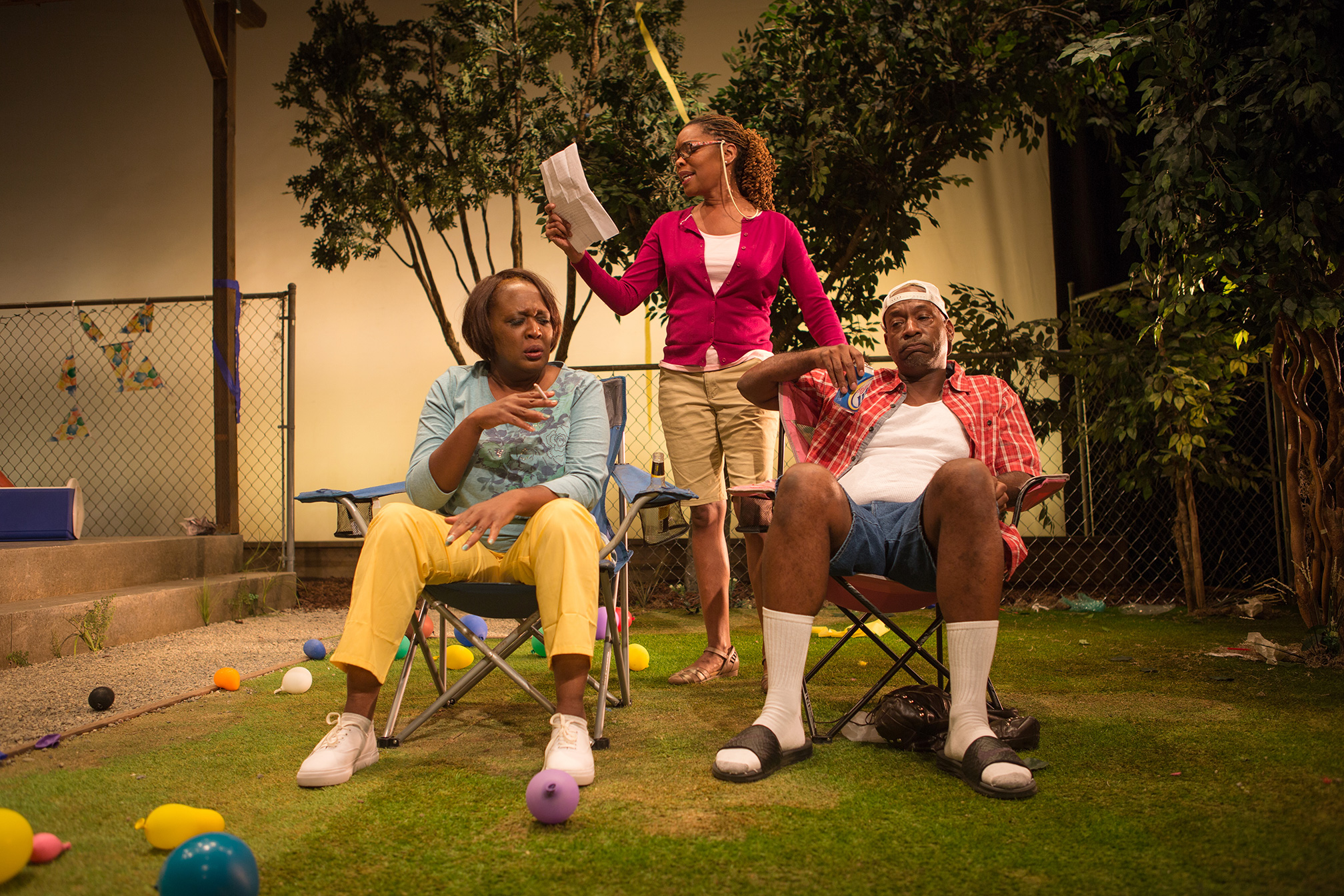
"Barbecue" at San Francisco Playhouse

SF Playhouse photo by Jessica Palopoli
This is a difficult play. I wish I had seen it a little earlier in its run, because there was a casting change for the last couple of weeks of the show, and it probably made a significant difference in the overall quality. But you go with what you got.

The play in question is Robert O'Hara's Barbecue, which takes place in a public park somewhere in Middle America around the present time. It's very clever in the way it does some things, but there are definitely some holes.

The Play

The play opens as a group of siblings begins to gather for a barbecue in the park, ostensibly as a celebration, but actually as a pretense to stage an intervention.  One of the siblings, Lillie Anne, has summoned the others (James T, Adlean, and Marie) to try to convince their sister Barbara to go into rehab. All of the siblings have issues, and many probably deserve to enter rehab themselves, but the opening scene establishes some of the background and relationships that have brought them to this stage.

As the first scene ends, the lights drop, and when they return we see exactly the same scenario, but all the actors have been replaced by doppelgangers. The obvious difference being that the first set of actors were all white, and the second all black.* The action continues as before, and we perhaps rethink some of our evaluations based on this change. Scenes alternate the two casts for the rest of the first act as we proceed into the actual intervention.

And then just as we get to the key moment at the end of the intervention (with the black family onstage), someone yells "Cut!" and everyone drops out of character, crew come onstage, and we realize that what we are seeing isn't what we thought we were seeing. We get to ponder that through intermission.

After intermission things change a bit, and we primarily see the two "Barbara" actresses interacting, starting with the white Barbara alone in the park, then joined by the black one. It becomes clear that the white Barbara is the "real" one, and the other is a famous actress who is evaluating whether to play Barbara in a film adaptation of Barbara's memoir, written in rehab.

[Spoilers here...look away if you must!] In the course of their discussion/negotiation, it becomes clear that Barbara's memoir is largely fictionalized, and was in fact inspired by reading a memoir while she was in rehab that inspired her recovery, but was also revealed to be fabricated. So we have layers on layers of fabrication and imitation and appropriation and ambition. Ultimately, everybody is trying to make a buck off of telling a story that might not be theirs, might not be true, and really, what does that matter?

I'd put this play in the trendy current genre of "gotcha" plays, where we are presented with a scenario that is ultimately revealed to be something entirely different, both within the play and to us. We've seen several plays like this over the last year or two, including Christopher Chen's Caught, Branden Jacobs-Jenkins' An Octoroon. When done right, it can be brilliant, and really make the audience evaluate their thinking and prejudices. But timing and chemistry onstage are in many ways as important as the writing, as the audience really has to buy into the set-up in order for the "gotcha" to work.

The Production

Which brings us to the production. This casting is particularly tricky, as the play needs two complete, coherent families. For the most part, this works pretty well here. The characters of Adlean (Jennie Brick and Edris Cooper-Anifowoshe) and James T (Clive Worsley and Adrian Roberts) slip back and forth pretty seamlessly. The Maries (Teri Whipple and Kehinde Koyejo) seem to have somewhat different approaches to their character. Lillie Anne (Anne Darragh and Halili Knox) is more of a problem; though both are good performances, they don't feel like the same character at all, really.

And then there is Barbara (Sally Dana and Margo Hall). The white Barbara was originally Susi Damilano, an SF Playhouse founder, producing director, and frequent performer. Damilano is a dynamic and accomplished actress who probably matched up well with the veteran Hall. Not taking anything away from Dana, but she doesn't have either the big stage presence of Damilano or the chemistry with Hall that comes from developing the roles over the course of the run. I found a lot of the post-intermission scenes just lacking in coherence and fire that seemed to be called for. It just felt off. So that's why I say I wish I'd seen the play a bit earlier, with the original casting. It's a tough call for an actor to come into the cast for the last two weeks of a run and try to maintain the quality of the production. It's not bad, but it doesn't feel like it's all it should be.

Other than that, I thought the production was quite good. Bill English's set design works well, evoking a public park that has probably seen some better days. And Hall directs as well as performing, which works pretty well because most of her scenes either don't have a lot of lines, or they have lines, but not many other characters.

Bottom Line

There is a lot going on in this play, but because each of the actors only plays about half of it, it's kind of hard to really get into any of them. And as noted above, when we do finally get two characters developing and working with each other the particular casting of this last couple of weeks has taken some of the air out of the balloon.

Still, there is plenty to think about in the play, even if the very nature of it makes it difficult to really settle in and evaluate it. We get to look at how we feel about characters of different races with exactly the same issues, for example. And we get some class consciousness as the big movie star confronts the rehabbed addict on her home turf, as well as the pretenses of the star who thinks she can just dictate who she is and what her background is; never mind what "facts" you might have read about her. Those are all pretty interesting, but all get a bit muddled. The concluding scene just adds a few more with some digs at Hollywood and the film-going public and their attitudes about race.

Ultimately I have a little trouble trying to decide which of these are actually important to the playwright and which are just incidental details that go into telling the story. And that's probably my biggest issue with these "gotcha" plays: by their nature, they are complex, and they also consciously undercut their own characters, plots, and messages. It's great to have plays that leave us asking questions, but it's also helpful to make sure we know which questions the playwright actually thinks are important.

Barbecue runs through this weekend (closes Saturday the 11th). It's worth seeing.

*I'm sure I could come up with better descriptions of the cast change than "white" and "black," but that is the essence of what we're looking at. We have the same family with essentially the same dynamics, just a different race. I will use the "black" and "white" shorthand because it's late and I'm tired.

Wednesday, August 9, 2017

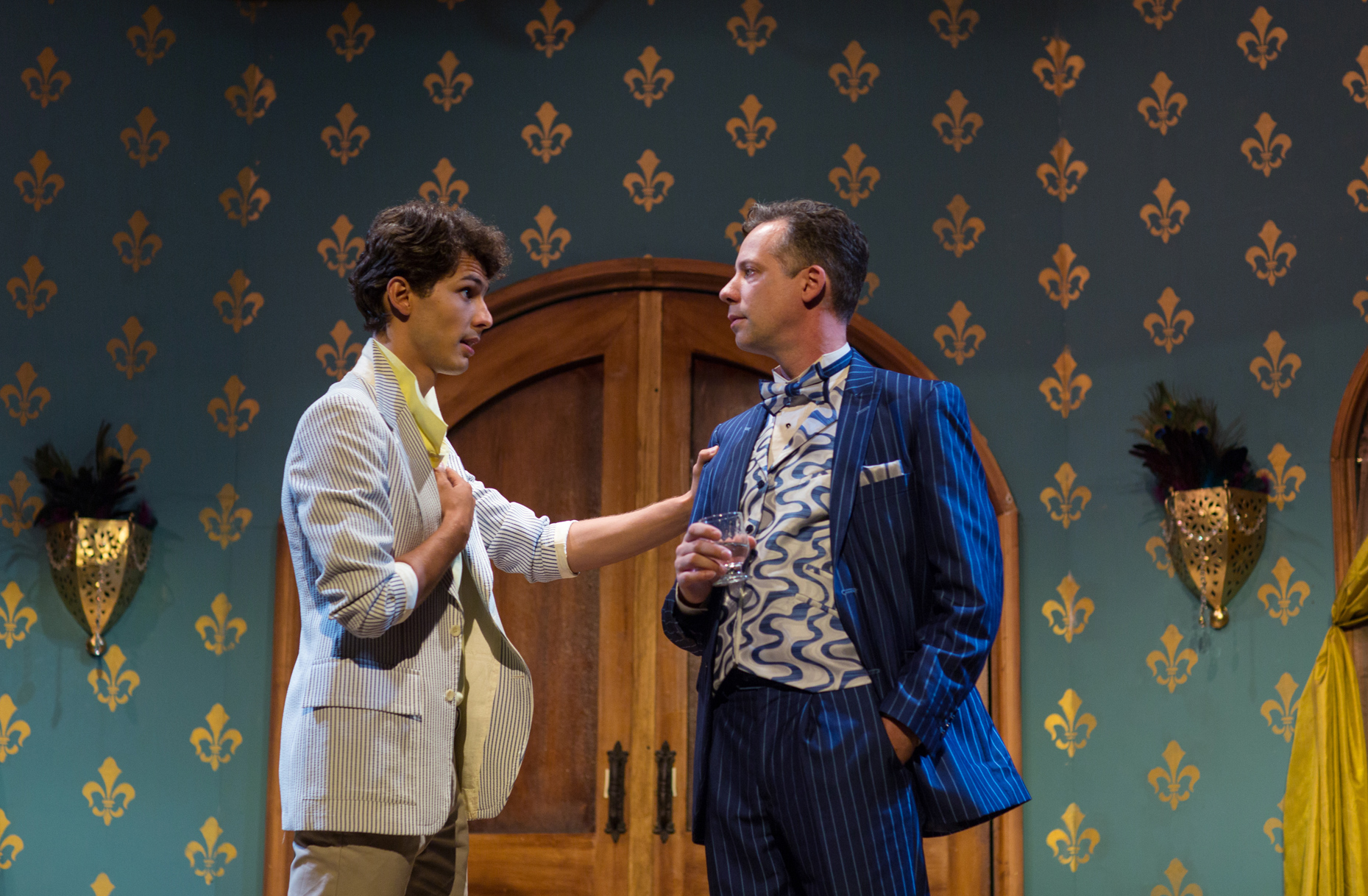
"La Cage Aux Folles" at SF Playhouse

SF Playhouse photo by Jessica Palopoli
Here's a nice change of pace: we saw this show rather early in its run, so you have plenty of time to go see it!

The last show of the SF Playhouse season was the fabulous musical, La Cage Aux Folles, which I don't think I had ever seen on stage before. It's odd, because I definitely know some of the songs, and of course I'm old enough to remember when the subject matter was kind of titillating, if not downright scandalous. Now, I have to say that a musical about gay parents and drag queens is pretty mainstream, especially in San Francisco.

The Play

Georges (Ryan Drummond) and Albin (John Treacy Egan) are an old married couple in St. Tropez with a son, Jean-Michel (Nikita Burshteyn), who wants to marry Anne (Samantha Rose). Pretty typical stuff, but for the fact that George is the MC at the nightclub downstairs from their house (the eponymous "La Cage aux Folles"), where Albin is the star performer "ZaZa" in a drag show. And it's time for the families of the young lovers to meet, and Anne's father, Edouard Dindon (Christopher Reber), is one of the leading "traditional family values" politicians in the country. He's literally been campaigning to shut down clubs such as the one downstairs.

So now Jean-Michel must navigate the territory of having his future in-laws visit for a day without offending them and causing them to call off the wedding. What ensues is a pretty straightforward family drama, about matters like what really makes a family: biology or behavior, and just how far a parent will go to accommodate a child.

Throw in some big production numbers populated by drag queens, ballads by ZaZa, and some costume hi-jinks, and you've got La Cage.

The Production

I will say up front that I thought the production was good. The acting is quite good, and the singing is excellent (particularly Egan as Albin/ZaZa). I liked Abra Berman's costume designs quite well (particularly Georges' vest, pictured above). The dancing is pretty good, considering they are rather constrained by the set design--there isn't a lot of space, so they take advantage of some aisles in the audience, which has mixed results. I kind of expected a bit more polish in the drag show, since there is no shortage of strong drag performers in the city. But ultimately I decided they were OK, and it actually wasn't that important to the show.

They've added a little runway extension, partway up the center aisle (which is tricky, because the aisle isn't straight to start with). It's an appropriate addition for the club scenes, though people near the front have to turn around to see, which is difficult. This is definitely a show to see from farther back. That would also help with one other issue: The main set that represents the interior of Georges and Albin's home is a couple of feet above the stage (in part so they can rotate the stage and have the front steps right outside the door, which is nice). But we can see under the floor, where they have tried to put a few stage lights as decoration, but really, it's just a distracting, empty space, and again it really affects people in the front rows.

So in that sense, Jacquelyn Scott's set design really isn't up to the standards I expect from SF Playhouse. And probably the most obvious solution to the distracting void under the floor would be to play up the flamboyant decorations of the interior, which really seemed quite tame. This was not the time for minimal set decoration! Way too restrained, particularly when we have the vivid personalities of Albin and the butler/maid, Jacob (Brian Yates Sharber). They would not live in a house as sedate as the one here. The characters even talk about how over-the-top the place is, though visually it doesn't match up.

But ultimately, that doesn't detract from the fine performances. I have to give kudos particularly to Egan, who manages to handle brilliantly the awkwardness of an effeminate man trying to not look feminine. Throughout the show, really, both as ZaZa and as various renditions of Albin, it's terribly tempting for that character to just take flight and start chewing the scenery. But showing consistent restraint here, Egan manages to make Albin a relatable character instead of a caricature, which is really the point. SF Playhouse insists their shows are all about us developing our empathy, and by making Albin so real, it's possible for even this old, straight guy to find a lot of common ground. Kudos to Egan and to director Bill English for making that work.

One other aspect of the staging I have to mention, because it was a nice touch: Every time the stage rotates, you get a little peek into a small alcove between the two sets, and there is always some kind of little vignette for you there, so look for it.

Bottom Line

I was thinking at the intermission that the show hadn't held up in the nearly 35 years since it first appeared, that the things that made it so novel in the 1980s just weren't very timely anymore, at least in San Francisco. But the second act turned me around completely. The very human, universal story about parents and their children (and pious hypocrites, of course!) warmed my heart in ways that a musical rarely does.

So I'm willing to overlook some of the other little shortcomings and focus on the strong acting and messaging. This is a much better show than I was expecting, and it still has a month to go in its run (through September 16). So go and have a good time!

Friday, June 23, 2017

"You Mean to Do Me Harm" at SF Playhouse

SF Playhouse photo by Ken Levin
Hard to follow a performance such as Grandeur,  but there we were the very next night, trying out several new things: the tiny Reuff Theater atop ACT's Strand Theater, SF Playhouse's "Sandbox Series," and a brand new, world premiere play by Christopher Chen, whose Caught we enjoyed last fall at Shotgun. Chen does not write simple plays, so we expected a lot.

The Reuff provides an intimate space for a play. It's really just a black box, which I gather can have seats added in various ways. For this production it had three rows of chairs set up on short risers around three sides, with the fourth the lighted backdrop you see in the photo above. It worked well for this play. In fact, the play would work in the round, too.

The Play

Two married, mixed-race couples meet up for drinks, and everybody has some kind of connection to at least one member of the other couple. Ben and Lindsey dated briefly in college a decade ago. Ben is about to start a new job at Daniel's startup company. Daniel and Samantha are both first-generation Chinese American. Some kind of offhand comments in the chit-chat that might have been a little flirtatious start a series of reactions and overreactions that cascade through the rest of the play.

As with Caught, I don't want to say too much about the plot because the revelation is all, and misunderstanding and reaction out of proportion is key to the action. Chen plays once again with both the tensions of cultural assimilation and racism and the difficulties of couples in relationships. The lines of communication go every which way in the course of the play, and the manipulations are terrific to follow.

I found it particularly fun the way Chen plays with the notions that run through everyone's heads in a conversation: "Did he really mean that? No, of course not!" And we just move on. But Chen lets his characters jump right in with their subconscious reactions, verbalizing trivial hurts and upsets that should just slide right off, and then lets the rest of the group react accordingly. It's really very clever, and fun to consider how much we really stifle in the course of everyday talk.

The Production

The whole play happens inside a paved square. Sometimes we have a table and chairs for our couples to have their drinks, but it can also be a cafe, a restaurant, an office, and so on. And the characters who are not in the scene are just off, on a little path, so you get to watch characters thinking about those who aren't in the scene while they look right at them. It's really quite a nice staging there: kudos to director Bill English and scenic designer Zoe Rosenfeld for pulling that off so well. In fact, it works so well that late in the play when first one, then another of the characters leaves the room, it's quite jarring (and not effective to my thinking). The continuous interactions of the characters, regardless of whether they are actually present in the scene, is a big part of what makes the play work.

The four actors are all very good, though I frankly found it a little hard to picture them as being in their early 30s. They seemed a bit too mature in their dress and mannerisms. But the dialogue flows smoothly and precisely for the most part, which is important given the precision of Chen's writing.

Bottom Line

It's a good new play, and obviously still evolving. We thought it was about 90 percent of the way to being terrific, mostly held back by the ending. Endings are always the hardest part, seemingly. Although I have to say we came up with what seemed like a more satisfying ending over dinner afterward.

All that said, I thought the piece was  well written and shows a lot of promise. I will be interested to see where it goes from here. The current run goes through July 2nd, and it's definitely worth seeing.

Saturday, June 3, 2017

"The Roommate" at SF Playhouse

SF Playhouse photo
Friday night in San Francisco. We don't seem to hit theaters in The City on Friday that often; more likely to be in Berkeley on Friday for some reason. The bars and restaurants were definitely more crowded than we usually see them mid-week, but the crowd at SF Playhouse seemed rather sparse. Maybe people had switched their tickets so they could go do something else. I gather there was some big comedy thing going on at Civic Center.

But we were there to see The Roommate, a somewhat quirky play by Jen Silverman about a woman who rents out a room in her house to a stranger who is somewhat less than forthcoming about her past.

The Play

Sharon (played by SF Playhouse co-founder Susi Damilano) is a woman living alone in a fairly large house in Iowa. To help make ends meet, she has taken in a roommate, Robyn. The play starts as Robyn (Julia Brothers) is moving in with her boxes of stuff. Robyn is reluctant to answer many questions from Sharon, abruptly changing the subject and making clear that she's got something to hide. She also won't let Sharon touch her boxes.

Frankly, the writing, particularly early on, is a bit rough. There is not much subtlety in the early portrayals of either character, though the actors do their best to paper over the rough patches in the script. Sharon is just a bit too pointedly, naively inquisitive, and Robyn a bit too furtive and evasive. In light of what we later learn about each of them, it's actually hard to justify either of those traits. We have to either believe that both characters are acting against their nature at the beginning, or that at least one of them changes almost instantly, which just suggests some weak writing.

On the whole, the story is a good one, and the characters pretty likable, but the early scenes are a bit hard to accept, and greatly increase the degree to which one has to suspend disbelief later on. On the whole, the plot seems pretty implausible, but still fun.

The Production

As usual at SF Playhouse, the production quality is high. Nina Ball's set is attractive (though I must say quite similar to several others I've seen recently, both by her and others), setting the house as a frame or outline, with only a few walls and features inside. This permits the lighting (by Robert Hand) and the wide open spaces of Iowa to engulf the play. Indeed, the two women seem quite alone in the middle of a vast, empty space.

Damilano manages to make Sharon a quite interesting character, though as written there is not a lot of interest there. She lives a very dull life, alone in her house since her son moved to New York and her husband "retired" from their marriage. Other than her reading club and weekly shopping, she is rather a shut-in, definitely sheltered. As her exposure to the more worldly Robyn gives her new experiences and shows her new possibilities, Sharon displays some depth that was previously hidden, and Damilano does a good job of making that feel plausible.

Brothers is good as Robyn, though somewhat less believable. Particularly early on, she seems a bit too much on edge, given what we learn about her later. And her set of expressions seems a little limited. Again, given what a chameleon her character is supposed to be, the facial and physical choices seem too limited.

Bottom Line

I thought it was a fun play, exploring the notions of what kinds of hidden depths people can discover when they allow themselves to step outside the limitations they and their society impose. And in a larger sense, we can see some of the roots of the political and social disaffection in the American Midwest, as exemplified in recent elections and the ongoing "opioid crisis."

It's not a brilliant play, but it's enjoyable, and it's certainly well done.

Thursday, May 4, 2017

"Noises Off" at SF Playhouse

SF Playhouse photo

I've been thinking it's time for a really fun play. Perhaps even a silly play. Just something to take my mind off life, work, and reality. Luckily, SF Playhouse came along with their production of Michael Frayn's Noises Off just in time.

There is really not much of substance to this show. There is no great social message or moral instruction here. But it is a very tightly-written, classic English farce that plays out wonderfully on the SF Playhouse stage. I'm sad that because of scheduling difficulties we saw it so late in its run. There are only about another week and a half in the run of this show, and it's well worth seeing.

The Play

My first exposure to Michael Frayn's work was seeing Copenhagen in London back in 1999. I recall hearing the description of the play and thinking that it was something I would really like, though I wasn't sure it would appeal to a broader audience. As it turned out, it was one of the sharpest plays I've ever seen, both keen writing and amazing acting, and it went on to win all sorts of awards both in London and eventually on Broadway.

Noises Off is not that kind of play.

It is a play about a play. The three acts are set at the last rehearsal before the show opens, another performance a month later, and then at the end of the tour. The play inside the play (called "Nothing On") is a very silly little farce itself, but each of the actors in it has something demonstrably wrong (the aging alcoholic actor, the clueless bimbo, the actor who has to question the reason for everything, etc.). As things play out, we also learn a lot about the personal histories, current problems, and interpersonal relationships of the cast and crew, all of which greatly complicate the rehearsal. By the curtain of Act I, we head off to intermission knowing that this won't end well, but with really no idea how far off the rails and in what direction it's going to go.

Needless to say, things don't improve much when we see the show in production a month later. But a lot of the fun comes from the fact that we're now seeing the same play, but from behind the scenery instead of in front. It's hilarious to see what the cast has to go through to get back onstage as things are unraveling backstage. And finally in the final act, it's really just a question of whether they'll get through it at all, with much hilarity.

It's all here: slapstick humor, mistaken identities, characters entering one door just as others depart through another. Classic farce.

The Production

I should say right up front: Finally, a great use of the turntable on the Playhouse stage. As I have often noted here, they seem to look for almost any reason to use it, often unnecessarily, and sometimes it detracts from their shows. But this play, where you need to see the action both in front of and behind the scenery, is perfect for a rotating set. And that said, it means the set design and props and such are all really important to the show, and they are quite well done. Indeed, if there is one thing this show requires, it's precision and consistency, and cast and crew pull that off nearly all the time. Scenic Designer George Maxwell, Properties Designer Jacquelyn Scott, and Costume Designer Abra Berman all did great work, and must have had a really good time doing it.

The cast is a good mix of some of the Playhouse regulars, other local actors, and some faces I wasn't familiar with. There was definitely a freshness to their interaction. I was particularly impressed with several of the portrayals. Monique Hafen did a remarkably consistent job as the not-very-clever Brooke, which cannot be easy. Patrick Russell as Garry was also quite good, and some of his physical stunts were just impressive. Craig Marker definitely played against type as a rather dense but stalwart actor.

The real key to the success of the play is timing, and most of the time, most of the actors had it down. There were a couple who didn't always quite keep the action moving at the breakneck clip it requires, but on the whole it worked brilliantly. Kudos to director Susi Damilano for keeping things lively.

I could nitpick a point or two, but really, the show worked. It kept us laughing throughout, and that's really all one can ask of a farce.

Bottom Line

I totally recommend this show as a good time. It runs through May 13, and is well worth seeing. I really wish I could find time to take my daughter, who loves this sort of show.

Probably my only critique is of the play itself, in that by the third act, the final dissolution of show and cast is almost an anticlimax. I'm not sure how it could be written or performed differently to avoid that, but at the end of the second act (the backstage view, mid-tour), the devolution of the show is really very satisfying, and seeing it all fly apart at the end is almost a little disappointing.

But not very--all in all, we left amused, satisfied, and in a good humor for the dinner that followed. And that's a good evening at the theater.

Check it out!

Thursday, February 9, 2017

"The Christians" at SF Playhouse

SF Playhouse photo by Jessica Palopoli
Tonight the rains paused long enough for a group of us to get to SF Playhouse to see Lucas Hnath's play, "The Christians." Anchored by local mainstay Anthony Fusco and the newly-omnipresent Lance Gardner, a cast of five actors is surrounded by a full choir to fill the pulpit of a megachurch in the theater to examine what happens when the pastor (Fusco) has a change of heart about some fairly fundamental matters of faith.

The Play

We begin with the start of the service at a megachurch, with the pastor's sermon serving to teach us the history of the congregation and how it has grown from humble beginnings to build and fill a church with thousands of members every week. And they have just paid off the mortgage on the church, which seems like reason to rejoice until the pastor confesses that he's been rethinking some of the key tenets of the church's beliefs.

This leads to a schism with one of the associate pastors (Gardner) sent away with a remnant of the congregation to start his own church. The pastor's wife, the board of elders, and the rest of the congregation are initially supportive, but eventually all start to question both the substance and the timing of the pastor's announcement. Conflict ensues as the church and the individuals all have to come to grips with where they stand on the matter.

In truth, the play is a bit thin. It starts pretty slowly (really: a sermon isn't exactly what I was looking for this Wednesday evening), augmented by several full hymns from the choir. By the time we learn what the whole matter is about, it's actually a little hard to get worked up about it or sustain the interest in how it will work out.

In the end, when the crowd has moved on and most of the individuals have, too, all we're left with is the pastor musing on the epistemology of belief and whether he can salvage any of his personal relationships while he figures out the rest.

Frankly, the play drags a bit, even at only 90 minutes. Absent the hymns and the final musings, there is maybe an hour of play, and even that seems a bit stretched. It just doesn't feel like there is really a whole play here.

The Production

The star of the show, really, is the set. Director and Set Designer Bill English has done a terrific job of creating a very credible church on the stage, and there is no need to adjust it for any of the occasional scenes that take place in the pastor's office or home. That all just works. The lighting changes are effective, if a bit heavy-handed. And the music is well done, despite the fact that it doesn't really advance the plot at all. It would have been sufficient to sing smaller bits of hymns and perhaps bring it down to background behind some action and dialog, rather than just having little musical interludes.

As much as I can see Fusco as the intellectual pastor having arrived at a crisis of faith, where I never got on board was as his role as the charismatic preacher of a megachurch. He comes across not as the comet shining along with its long tail, but more as the intellectual scholar. I'm supposed to believe he's been preaching fire and brimstone, and he seems more likely to rap over a cup of nice tea. They talk about his star power, but we never get to see or feel it.

 Another oddity in the performance is the fact that the characters are always talking into hand-held microphones. It works when they are preaching or testifying in church, but they continue the practice when speaking individually, including a conversation between the preacher and his wife in bed. I get that it's supposed to represent that this isn't real, that either the characters are always talking to a larger audience, or that it represents the tale as told by the preacher (as he also fills in narration at times). But mostly it just makes everything seem oddly affected, as if I'm viewing all the action from the far reaches of the back of the church, rather than the fairly intimate setting of the theater. By the end, it's just annoying.

Bottom Lines

Ultimately the play isn't very satisfying. The crisis of faith doesn't feel very much like a crisis, more like a problem to be mulled over and solved by a committee of scholars. But neither do we get very deep into the intellectual side of things (which is probably why it feels stretched, even in an hour-and-a-half). It seems like Hnath had some interesting notions and started to write a play about them, then got bored and just kind of tied it up and called it done. It wasn't.

But as usual, SF Playhouse does a nice job: the play is well designed and well acted (within the limitations noted above). I would like to see some more emotional range and/or intellectual depth, but this is what we get. Unfortunately (and also as usual), SF Playhouse misses on some of the little details that would make this a much better show overall. Some more subtlety in the lighting and sound might help, or some more imaginative and varied costuming.

Also, really: not having the concession staff dump out the recycled bottles out in the lobby in the middle of a quiet speech of Fusco's. It's only a 90-minute show: you can clean up after we leave. Also, maybe a little caffeine for the ushers before they start work. English and the box office staff are always friendly and lively, but most of the other volunteers and staff just kind of suck the energy out of the room. It's that kind of stuff that keeps SF Playhouse from being one of my favorite theaters: so much to like, and so many rough edges that don't need to be there.

If the subject of this play appeals to you, you might enjoy it, but otherwise, I think you'd be wise to pass this one.

Wednesday, December 14, 2016

"She Loves Me" at SF Playhouse

SF Playhouse photo by Jessica Palopoli
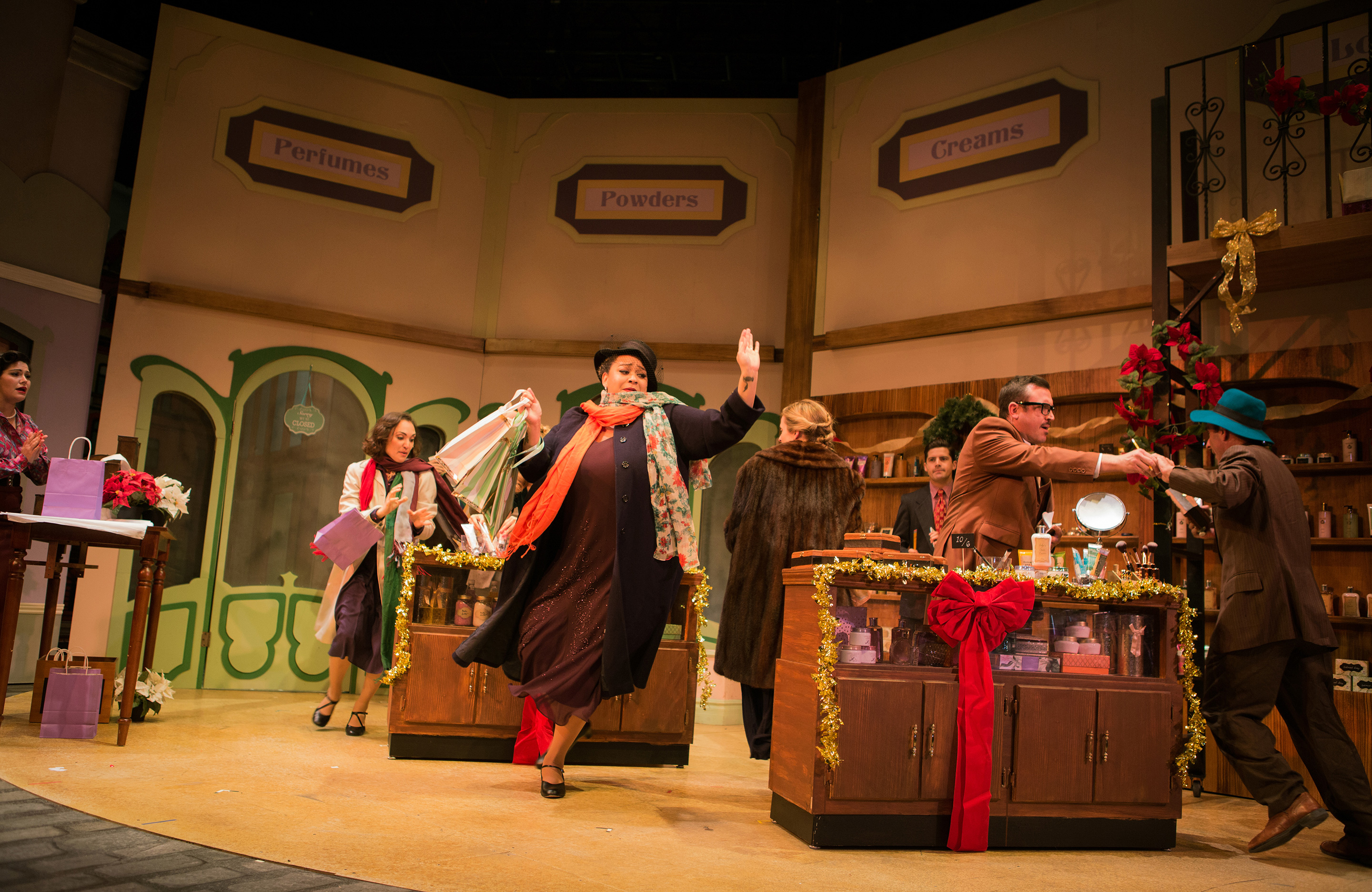
Yes, it's the holidays, which means not only am I going to the theater again, but I'm too busy to remember to blog about it! I feel a little like the frantic shoppers in the parfumerie pictured above, but I'll try to catch up.

SF Playhouse ("the empathy gym") does a couple of musicals as part of their mainstage season every year. This one is a revival of a play written in the early sixties, though set in Hungary in 1937. The play has some serious writers behind it, with the book by Joe Masteroff (better known for "Cabaret") and music and lyrics, respectively, by Jerry Bock and Sheldon Harnick (better known for "Fiddler on the Roof," written the very next year). And it had a successful revival on Broadway last year.

The Play

Top that off with a story line that seems terribly familiar, as the original Hungarian play by Miklos Laszlo has been adapted into at least three American movies (most recently, "You've Got Mail"), as well as this musical. It's a love story about a couple of coworkers who don't realize they are in love (or that they are correspondents through a "lonely hearts" club). Plenty of misunderstandings, but eventually it all works out (because this is Broadway in the 1960s).

It's a cute, if somewhat fluffy play. I like a lot of the supporting characters, and several of the tunes are pretty catchy. I ended up liking it pretty well, and it was well done (as I'll elaborate below), but there are a couple of issues I have with the play itself.

First is that there seems to be kind of an underlying bit of cruelty. The two main characters aren't equally clueless about their situation. Georg catches on sooner, but some of his treatment of Amalia before things settle down is just not very nice, and it really colors my view of the whole story. I guess my "empathy gym" lesson here is that some characters don't display much empathy.

Second is that I just don't get much "sizzle" between the lead characters. Maybe they were just a little low on energy the evening we saw the show (Wednesday, 12/7), but there just weren't any sparks when they were interacting; it was hard to see in person any of the attraction they were displaying in the letters they wrote and their reactions to them.

And third, the "happy ending" happens so fast, you could almost miss it. There's kind of a quick realization, a little kiss, and they walk off the stage and the lights dim. That's not much of a payoff at the end of the whole play. I blame this on the book: there's just no more play for the company to play with, but it definitely feels like a let-down.

The Production

First a note on the set, because I have occasionally been a little critical of Playhouse's use of their turntable on the stage. Artistic Director Bill English and set designer Jacquelyn Scott share the scenic design credit, and I have to say it's by far the best use of the rotating set I've seen in this theater. No gimmicks, just a handy way to switch between scenes on the street outside the shop and interiors. That was really well done. The scenery itself didn't seem quite as well executed as it was designed--some of its flimsiness was apparent from the back of the audience, but overall the scenery and props were nice.

Performances were all fine, with a couple standing out. Michael Gene Sullivan as Mr. Maraczek was a bit over the top at times, but then settled into a fine and nuanced rendition of his character after the intermission. His physical presence and facial work were a real highlight of the show in the second half. Nanci Zoppi as Ilona kept the energy high, but believable. And Joe Estlack stood out in both of his supporting roles. Katrina Lauren McGraw stood out from the rest of the ensemble, bringing a tangible personality to all her shop customers. Unfortunately, as noted earlier, Jeffrey Brian Adams as Georg and Monique Hafen as Amalia just didn't light it up that night. I've seen both of them in other productions, both have terrific voices and the ability to act, but I just didn't get much feel for either character, much less for the pairing. And in a love story, that's a bit of a problem.

Bottom Line

It was fine, it was fun, it just didn't grab me as much as I thought it should have. I mean, nice designs, good music, talented cast, etc. All the pieces seemed to be there, but somehow the end product wasn't as much fun as it seemed it might have been.

The show has a good long run yet, through January 14, so perhaps it will come together. In the meantime, it does provide a pleasant alternative to yet another Nutcracker or Christmas Carol, and as long as you're willing to overlook the weakness of the central plot device, there are lots of fun bits, lines, scenes, and performances to enjoy.

Sunday, October 2, 2016

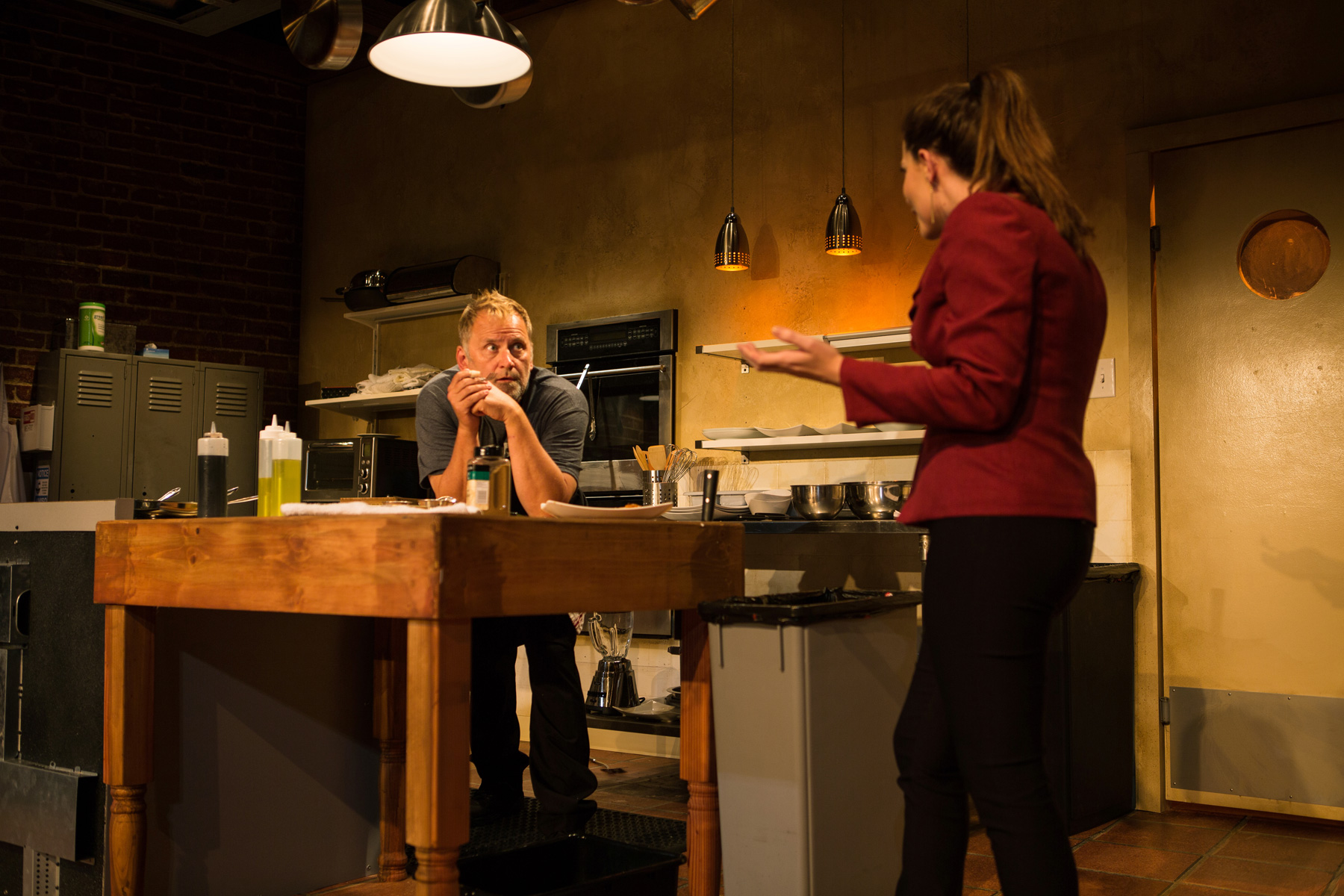
"Seared" at SF Playhouse

SF Playhouse photo by Jessica Palopoli
Food and fighting: what could be more fun? Set in the kitchen of a small restaurant in Brooklyn, "Seared" is the world premiere of a commissioned work by accomplished writer Theresa Rebeck. Add to this that Rebeck has worked quite a bit with both director Margaret Perry and lead actor Brian Dykstra, and you have the ingredients for a satisfying play.

I saw the opening night performance last night, and although there is promising material with solid performances, the result is ultimately not very satisfying.

The Play

Harry (played terrifically by Dykstra) is the chef of this little upstart restaurant, while his partner, Mike, and waiter Rodney wait tables and apparently do everything else. The restaurant is struggling, but seemingly out of the blue they get a great review of one of Harry's dishes in New York Magazine, and suddenly they are on the map. Great, right?

Maybe not. Harry refuses to cook the dish anymore, and Mike is not pleased. They argue. A lot. At length. Repeatedly. Now, seemingly out of the blue appears a consultant, and suddenly we have new equipment, more tables (and permits to use them), and more. And all for free! Naturally, this becomes grounds for more arguments.

The Production

There is a lot to like here. Dykstra is outstanding as Harry, in part (we learn from the program) because the part was actually written for him, and he is also an accomplished cook. And Rebeck writes some pretty good dialogue, some of it quite witty. Larry Powell as Rodney is a good, sympathetic character with a range of expression and emotion that presents well in the small theater. Consultant Emily does a creditable job of instigating and mediating a lot of the conflict. Rod Gnapp's Mike is probably the least developed character, and we get pretty much one emotional note from him (angry), modulated only by volume.

It's a nicely designed set for the kitchen, though somehow it never seems to reflect the changes in busy-ness that an overtasked kitchen should. They make a point early of hanging order tickets, but Harry never seems to look at them, and again, they don't reflect the amount of business going on. Lights and sound are used to good effect.

So we seem to have all the necessary ingredients for a winning production: good actors and good design. Unfortunately, the script isn't ready for prime time, and the direction doesn't manage to elicit much from what there is.

The Weakness

For about twenty or thirty minutes, I felt like the play was building into something promising. We had believable characters and some conflicts arising. And then the argued. And moved on. And argued. And moved on. And added new conflicts. And moved on.

Rebeck sets up some reasonably interesting scenarios, but never resolves them. That's disappointing, because I'd like to see these characters grow a bit and make some point about life or food or business or partnership or loyalty or something. The set-ups are all there, but we never get anywhere with them. It's really frustrating to see these seemingly clever, articulate characters just stuck and unable to deal with the curves thrown at them.

On another level, since the conflicts aren't getting resolved, I try just looking at them deeper, figuring maybe there is something there I'm supposed to get. Unfortunately, most of the situations just don't make much sense under close scrutiny. So I'm just not sure what it is I'm supposed to get out of this.

Bottom Line

I feel disappointed. There seems to be a lot of potential in this play, but it mostly remains unrealized. So if you go, you can appreciate some good stagecraft and some fine acting performances. Just don't expect to get much insight.

Thursday, September 8, 2016

"City of Angels" at SF Playhouse

SF Playhouse photo by Jessica Palopoli 
Back in the saddle for a mid-week Date Night, which obviously means a trip to the theater. I was a little surprised that the house wasn't a bit more full, but it is Wednesday. I am pretty fond of SF Playhouse, and have signed up to subscribe for the upcoming season. "City of Angels" is the final show of the previous season, and runs for about two more weeks. I've had sort of mixed reactions to previous musicals at SF Playhouse. On one hand, I applaud them for working in musicals every season. On another, I find the results to be somewhat mixed.

The Play

It's a musical. I don't expect great literature, but the more I think about it, the less the story line holds up. It's got some very appealing elements: a kind of pulpy detective novel being turned into a "B" grade film noir piece. There is conflict between the writer ("Stine") and the director/producer ("Buddy") who wants to rewrite things. There is some very appealing interplay between Stine and his main character ("Stone"), particularly in the song pictured above, where they take turns telling each other that "you're nothing without me." That's the catchy tune that you're humming on the way out.

The rest of the music is pretty good, kind of jazzy, pre-rock 'n' roll, late 1940s-early 50s stuff. The harmonies are kind of a mixed bag. Stine and Stone blend really well in their duets. Some of the quartets, including the overture just aren't quite there, although the individual voices are pretty good.

Unfortunately, though some of the characters (the three mentioned above, plus "Alaura" and "Oolie"/"Donna") are pretty well developed, others (particularly "Gabby") are just not, and it leaves one wondering why we actually care about some of the action late in the show. If Stine and Gabby don't really have much chemistry, it's difficult to figure out why they might be getting back together.

The Production

Acting-wise, things were fine. As noted, there were a couple of characters who just didn't pop for me, and in a musical you really need to get a feel for them, because there isn't really going to be enough dialog to develop minor characters very well. The sets and costumes were good, as were the projections that gave the show it's noir feel. On the other hand, there were some lighting issues (or maybe Stine just didn't find his spot), and I have ongoing issues with SF Playhouse's insistence on using its turntable for set changes to excess (and noisily). I found a lot of the scene changes quite distracting, especially when there was still action and/or music going on.

Gotta mention a couple of very good scenes where Stine is writing/rewriting the action being portrayed in the film, and it's both cleverly imagined and very tightly choreographed and performed. Just excellently conceived and done. But that level of execution calls into question some of the weaker choreography in, for example, the overture.

Ending Rants

This to me is probably the biggest problem with some of the shows I've seen at SF Playhouse: the execution of the stagecraft tends to lag behind the designs and the performances, which is unfortunate. It detracts from otherwise effective productions, including this one. The actors and designers deserve better. And it's a nice theater with good facilities, and they've obviously got good ideas and the ability to land good scripts and performers. But the other stuff counts, too.

And finally, I just have to say it: they need to tone down the "empathy gym" thing. Artistic Director Bill English gave the welcome speech tonight, and it sounded pretty worn, and almost word-for-word what's written over the door and on the tote bag behind the bar, etc. We get it. Try a little spontaneity.

On the whole, it was a fun evening, but a bit on the light and fluffy end of things.

Saturday, June 4, 2016

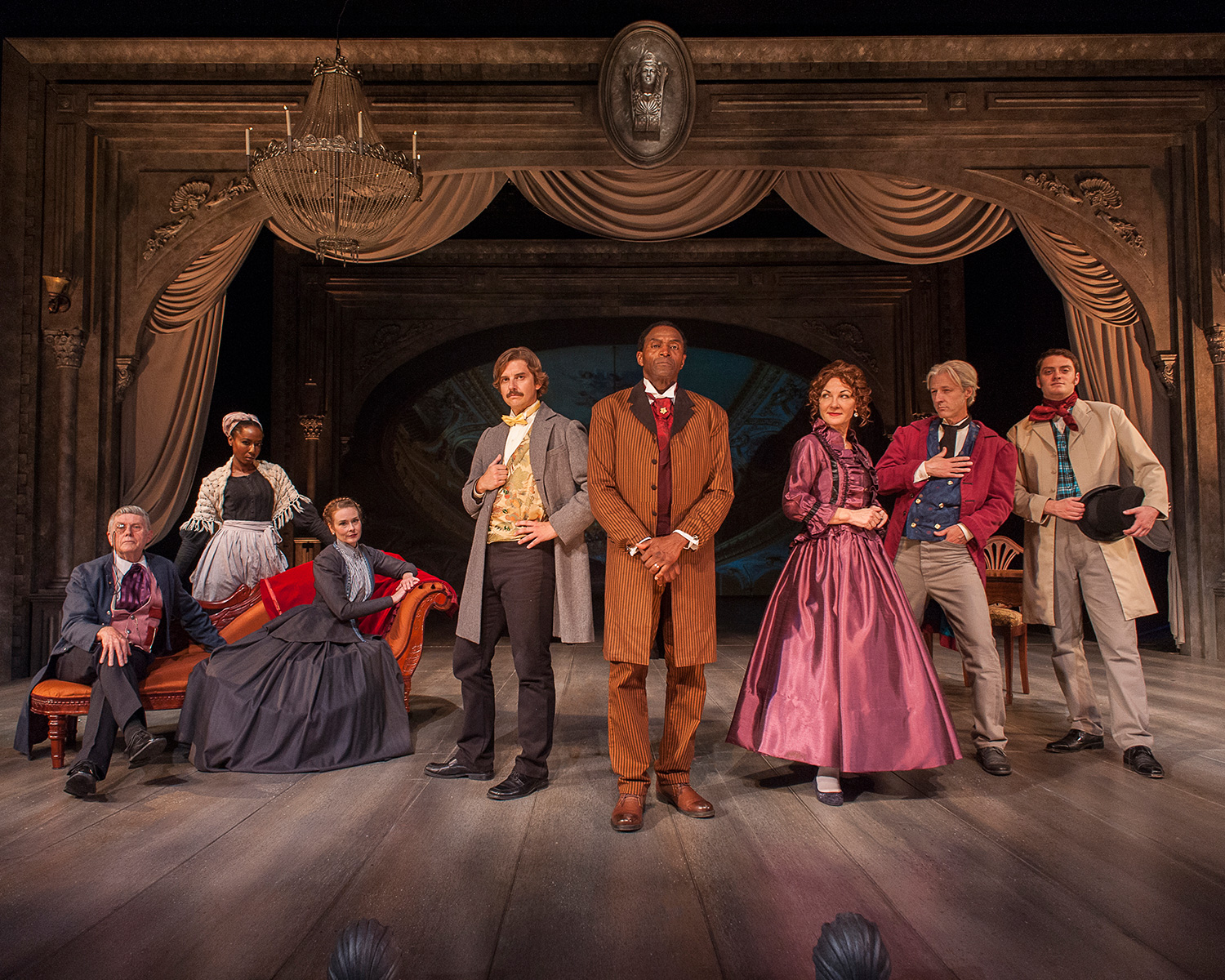
"Red Velvet" at SF Playhouse

Third play in as many nights, all at different theaters. I tell you, when you're aiming for "too much theater," you have to go to extremes sometimes. On the plus side, my wife invited me to a lovely dinner at Boulevard before the show, so I dressed up for the occasion. It's kind of fun walking across town in a suit with a backpack slung across your back. But I digress.


Quick Summary

The famed 19th Century British Shakespearean actor Edmund Kean has fallen ill, and the acting company needs to find a substitute to play the lead in Othello. They turn to an African American named Ira Aldridge. This would make him the first African American to play Othello on the British stage. Needless to say, there is controversy, both within the acting company and without.

It's an interesting portrait of racial and class struggles in Britain in the 1800s, as well as a glimpse at the theater of the time. Did I mention that this is all based on history? It's a pivotal time in the history of race relations, slavery, and the theater, so that seems ripe for a play.

Things I Liked

I should start off by saying I'm a big fan of Carl Lumbly. I tend to think that I'm more about the plays than the particular actors (although I do have my favorites!). But I became aware of Carl Lumbly when he had a recurring, though relatively small, role on "L.A. Law" back in the 80s/90s. His intensity really came through the screen, and when I learned that he was a Bay Area resident and actor in the local scene, I was quite delighted. I think I've seen at least four plays with him in the lead in the last couple of years, and he was terrific in all of them.

So, number one: Carl Lumbly.

Number two: The design. Loved the staging. They did a really nice job of suggesting the large, ornate Covent Garden  theater. Both Gary English's set design and Kurt Landisman's lighting and projections were lovely. Combined with Abra Berman's costumes, it was all quite evocative of the period.

Number three: The set-ups. The first act has a bunch of really good scenes, clearly designed to set up some later drama. From the opening scene that creates a frame we return to at the end, through the "Guess Who's Coming to the Theater?" scene where Aldridge is introduced to the company, we get lots of indications of what is to come.

Number four: The cast. I thought everyone did a good job. Special shout-outs for Britney Frazier, who pulls off a very credible Jamaican servant, and Elena Wright, who gets to juggle three roles with three different accents. (You'll recall from my Treasure Island post the other night that accents are very important to my crowd.)

Little Disappointments

There were a few things that came up a little short for me. I want to preface this with a note that it's been a long and busy week, and I'd just had a large dinner and split a bottle of wine, so maybe not the best set-up for a heavy play. But, here goes (they aren't serious or numerous):


  • Follow-ups. Remember all those cool set-ups in the opening act? Not all of them get followed up. OK, I know the playwright is supposed to surprise me sometimes. I don't insist that the follow-through be the thing I was expecting. But I was expecting something. And in several cases, I just didn't see it. Sometimes we just hear about things that happened offstage, but hey, you've set us up for some confrontations between (for example) Aldridge and Charles Kean (Tim Kniffin), and we don't get to see it.
  • The sacking. The scene where Aldridge is inevitably sacked from the production is not well written. There is a long scene between Aldridge and the company manager (who is rather inexplicably French...maybe I missed that explanation), but it doesn't really settle anything. You're fired. But, but, but... No, you're fired. Repeat a few times. Kind of a let down there.
  • The whole second act, really. I went out at intermission feeling quite good about the play as a whole (for all the reasons listed above), and looking forward to seeing how it all played out. And then, it didn't, really. Aldridge had a good scene with his wife, and then she is gone. There is some chemistry with his leading lady (Susi Damilano), and it's implied that there are allegations of impropriety, but we only hear about them indirectly. They spend the whole first act setting up the dynamite, attaching a fuse, showing us the matches, and then they kind of tell us that it blew up. Over there. It's not my fault.
So that's a little disappointing, but on the whole, it's a good show, well acted, well designed and produced. Mostly the script is a bit disappointing for what it promised to be. Still, a good night at the theater, and worth seeing.