Showing posts with label Berkeley Rep. Show all posts

Friday, July 7, 2023

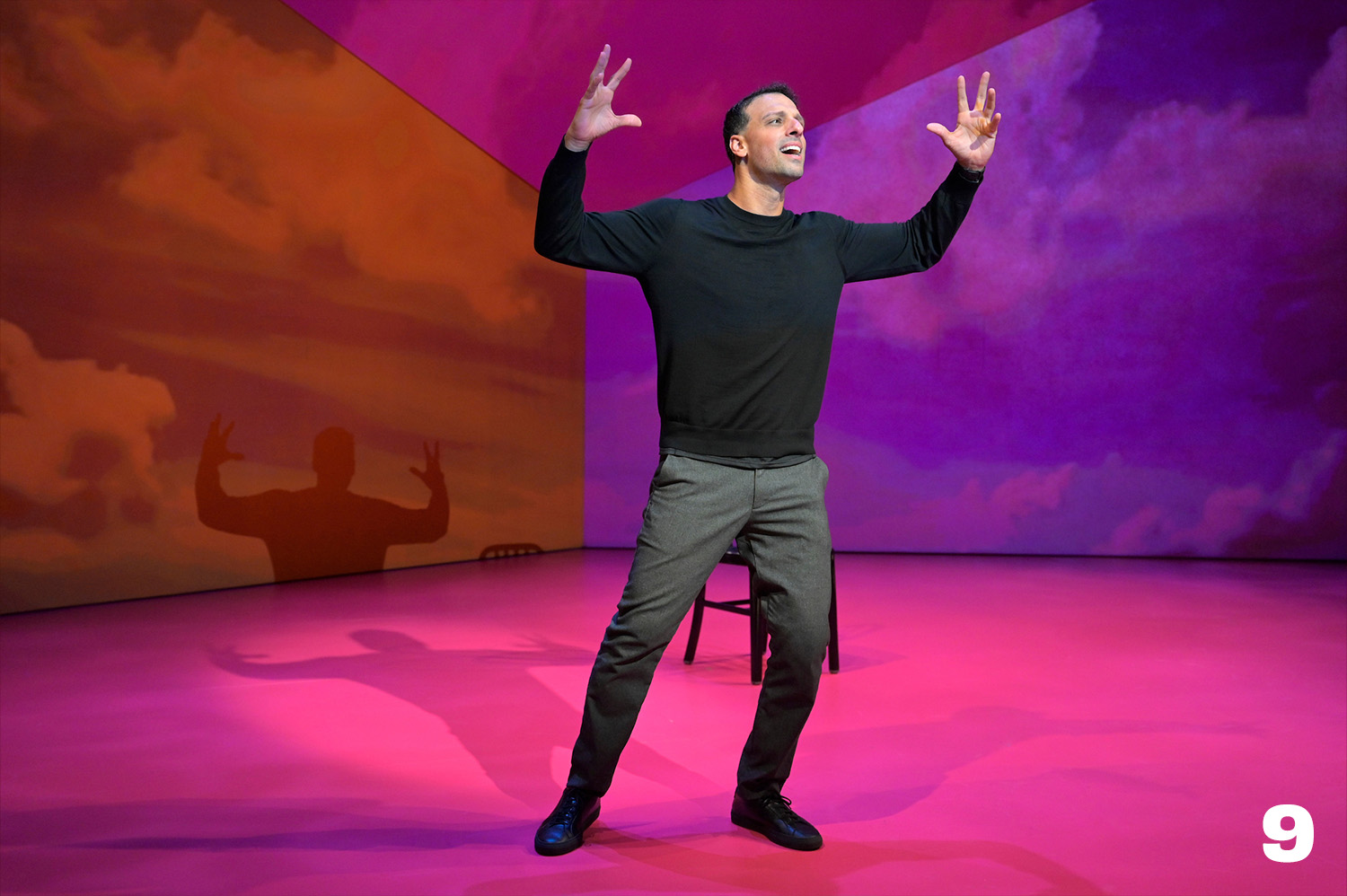
"Out of Character" at Berkeley Rep


Berkeley Rep production photo by Kevin Berne
Solo shows can be interesting, especially when they provide a kind of deep dive into the mind of the writer/performer. Former Berkeley Rep artistic director Tony Taccone has had a strong track record producing successful solo shows, many going on to Broadway. But the ones I've found most satisfying at the ones that really dig into the personal story of a writer/performer, such as those he did with Rita Moreno and Carrie Fischer. That pattern continues with his latest effort, with actor Ari'el Stachel.

The Play

I kind of hesitate to call something like this a "play", but there is a narrative structure to it, and Stachel invokes so many different characters that it feels much like a play at times. But really it's a personal narrative about his lifelong struggle with anxiety. It's a wide-ranging story, from a childhood bouncing among schools, never quite fitting into any of them, morphing his own character in various attempts, always thwarted by perceptions of him or his family (especially his Yemenite father).

The show begins with a recounting of the night Stachel won a Tony Award for his role in The Band's Visit. It appears he spent much of the evening hiding in the bathroom, mopping the profuse sweat from his face. As we learn throughout, sweat is a big feature of his life.

And so is obsessive-compulsive disorder (OCD), which was diagnosed when he was about five years old. He learned to give it a name so he could talk to it. That proves to be a mixed benefit, as the OCD proves to be a persistent foil in his life.

But it's a fascinating story, set largely here in the bay area where Stachel grew up, that sheds a lot of light on both his particular challenges and the way people with mental health challenges have to face the world and themselves.

Another theme running through Stachel's story is that of race. As a Jewish child of Israeli and Yemeni parents, Stachel always found it difficult to find a place where he really fit in, and he discusses numerous aspects of that, particularly surrounding the 9/11 attacks, which he noted were perpetrated by people who looked like him and his family. Even here in the supposedly enlightened bay area, he encountered a lot of issues around that, and more later in his career in New York. There is a lot to unpack here!

The Production

As with any solo show, it comes down to the performer, and Stachel is engaging and talented. His frank exposition of some very difficult incidents and relationships is disarming and captivating. You find yourself rooting for him, while occasionally watching an oncoming emotional train wreck with foreboding.

I also note that Stachel proved resilient in an unanticipated way, as a medical incident in the audience (quite near our seats, in fact) caused an unplanned 10-minute intermission only about 15 minutes into the 80-minute show. But Stachel took it in stride, improvised a recap when the show resumed, and then dropped right back into the script. Of course, he's a pro and should be able to handle such things. On the other hand, he's in the middle of telling us about his lifelong struggle with anxiety, so one could imagine this tripping him up. But it went smoothly.

Also refreshing is his ability to admit both great failures and ongoing shortfalls. He has obviously made great strides in dealing with his OCD and anxiety, but makes sure to express the ways that it continues to impact his life.

The Bottom Line

I thought the show was excellent. It's a real insight into a very talented but often troubled life, and the hometown connection makes it all the more relatable. It's not generally what I go to the theater for, but if I'm going to a solo show, it should be one with real insight and impact, and this has all that and more.

It's a terrific chance to see a very talented performer, up close and very personal, and the show is scheduled to run through July 30th at Berkeley Rep's Peet's Theater. Several of the shows have post-show discussions scheduled on various aspects of race, theater, and mental health, so check the website for those dates if you're interested.


Friday, June 23, 2023

"Let the Right One In" at Berkeley Rep


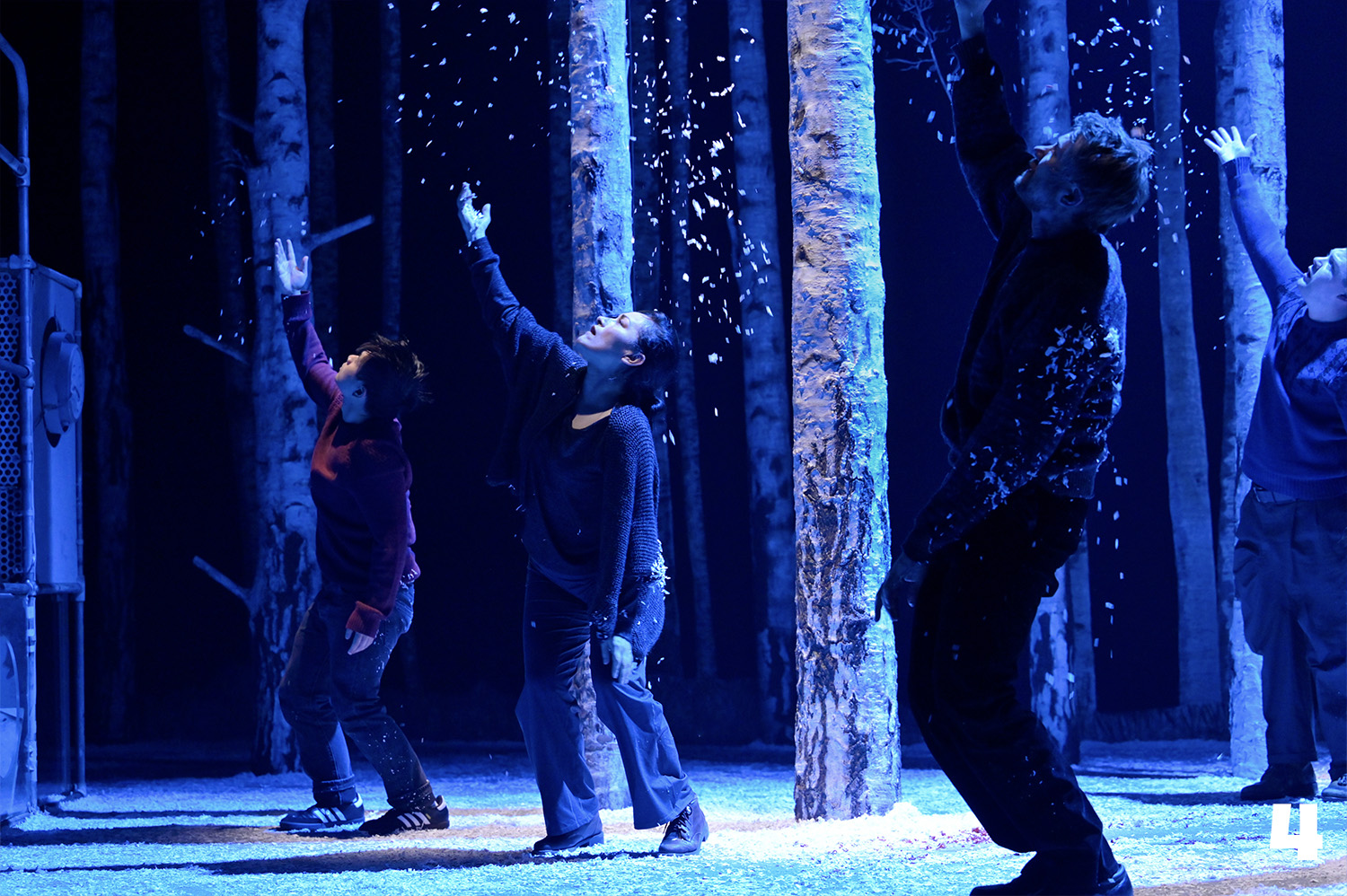
Berkeley Rep production photo by Kevin Berne
As part of our rushing around, trying to catch up on all the local shows in our subscriptions before they close, we scrambled in to see Let the Right One In at Berkeley Rep just before it closed. Clearly, I had not been paying much attention, as I went in knowing essentially nothing about this play, or the movie it was based on. I suppose had I been better prepared, my reaction might have been different, but overall, I think my impression is valid.

The Play

The play is an adaptation by Jack Thorne (yes, the same one who wrote The Motive and the Cue, which we just saw in London!) of the Swedish novel and film by John Ajvide Lindqvist. Though I had never heard of either, apparently the film is kind of a cult classic, but in a genre I don't pay attention to. So I found myself pretty baffled by a lot of what was going on.

It turns out this is a vampire story (though they carefully avoid using that term for some reason). Oskar, a 12-year-old, bullied social outcast meets Eli, who appears to be about the same age, in the playground outside his home. Eli sort of presents as female, but really falls into the non-binary category, and indeed, self-describes as neither a boy nor a girl, but "nothing". Eli lives with Hakan, who it turns out has been harvesting people in the woods to provide blood for Eli, which causes terror among the locals.

When events finally catch up with Hakan, Eli needs someone new to rely on, and coincidentally, Oskar needs someone to protect him from the bullies. A match made in, um, Sweden, I guess.

I've never been a fan of vampire stories or horror movies much, though I realize they have wide appeal. I get the whole vampire as metaphor for queerness thing, which is fine. I just don't enjoy watching all the gore and bullying and such. But that's what we've got. I probably would have opted out of seeing this show had I realized what it was, but since I saw it, you get to read my reactions.

The Production

This is a well-done show. The set by Christine Jones is elegant in its simplicity, though the locals seem to spend a lot of time pondering the trees and snow, considering they live there all the time. Director John Tiffany seems to want to make sure we notice that everyone is aware that there are trees and it's snowing. And groups of actors seem to spontaneously start dancing in unison (with movement choreographed by associate director Stephen Hoggett). As I have doubtless mentioned often, I'm not a big dance fan--I don't really understand it--and it doesn't seem to add much to the show, though many people seemed to enjoy it. Similarly, the weird contortions of Eli (Noah Lamanna) apparently evoke "vampire" in the minds of those in the know. I mean, it's impressive and I guess well done, but I'm sure there are other ways to convey the otherness and the physical cravings of a hungry vampire. But subtlety is not a hallmark of the horror genre.

So anyway, it's hard for me to see the relationship between Eli and Oskar (Diego Lucano) as anything but another instance of someone taking advantage of Oskar's weaknesses. 

The Bottom Line

I feel like this is happening a lot lately, but this seems like yet another show that appeals to a particular audience (which is good), but not to me (which is fine). I wish I'd known that going in, since I might well have foregone this particular experience, knowing that it's something I generally dislike. On the plus side, it was nice to see a lot of people in the theater that are not generally there. And indeed, a friend who ushers at Berkeley Rep confirms that they're pulling in a much younger audience for this show. That's great!

But unlike a show such as last week's Yerma at Shotgun, where I can appreciate the show on some levels, this genre just feels very exclusive. Although I can appreciate that some audience members like seeing this kind of story, and maybe even relate to some of the characters, I struggle to see what anyone else (i.e., me) is supposed to get out of the experience. But this is why I keep going to the theater: new experiences, new questions. It's not always pleasant for me, but it's interesting to see what people are doing and think about why and how.

But I'll pass on the horror/vampire play next time.

Wednesday, May 3, 2023

"English" at Berkeley Rep


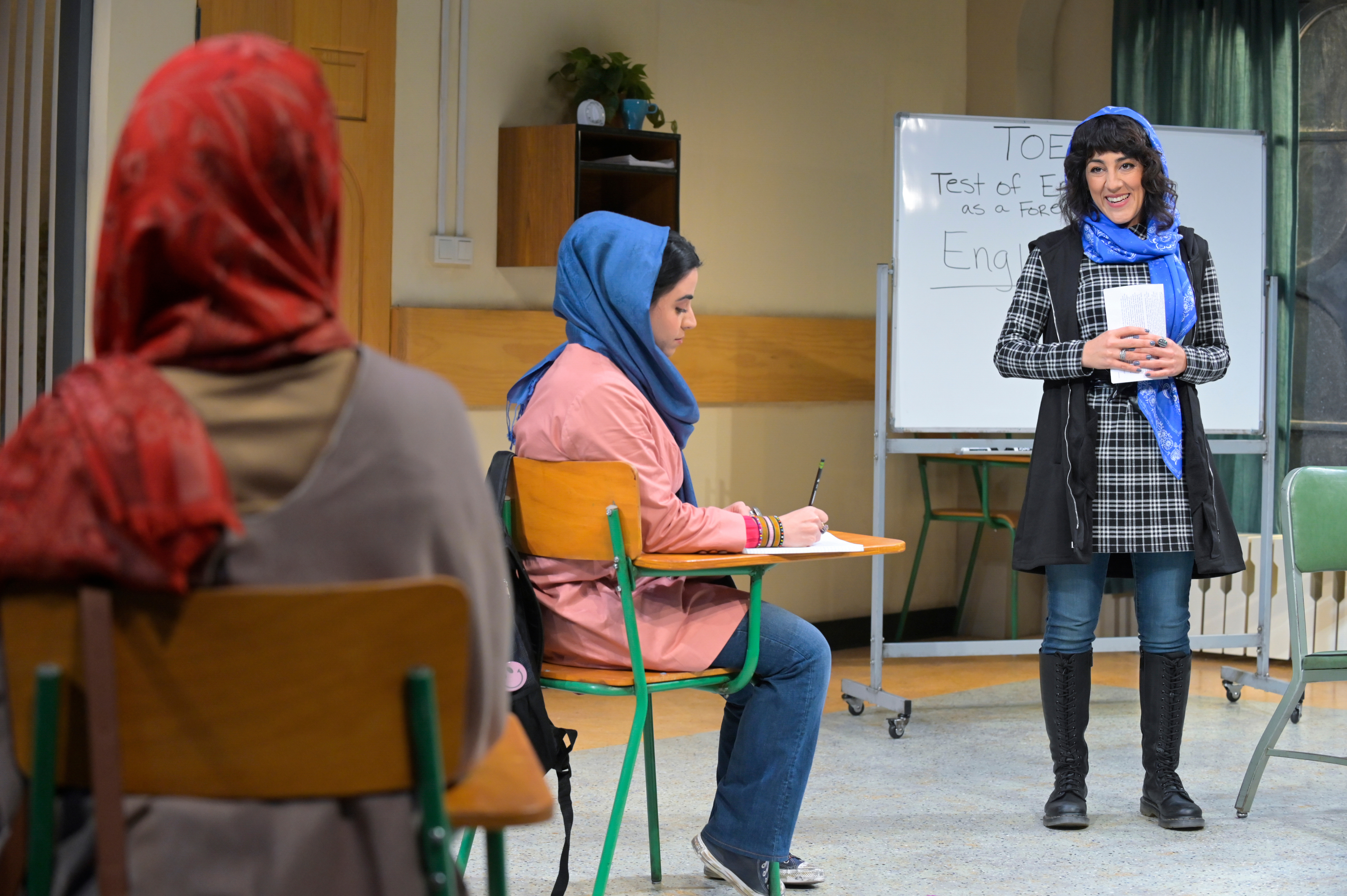
Berkeley Rep production photo by Alessandra Mello

This is a play I've been wanting to see for quite a while. It's very popular, and it seems like every town I go to, I see this show listed. It was playing in DC when we were there a couple of months ago, and we considered going to see it, even knowing we had tickets to see it in Berkeley coming up, but it was sold out. So it's a very popular play! And it seems very thoughtful, from reading the descriptions. So, can it live up to the hype?

The Play

The set-up for English seems very simple: four students and their teacher, studying English in Tehran so they can pass the TOEFL (Test of English as a Foreign Language) to facilitate emigrating to join family members overseas. Three of the students, all women, struggle with the language, while the one male student seems remarkably proficient. The play examines the relationships of people with languages, how languages reflect and create identities, and how non-native speakers relate to others in their learned languages.

There are lots of fascinating topics covered. It's a small play, about a few people and their relationships and their thoughts and feelings around language, country, family, and much more. No big explosions or bombshells (though definitely some surprises!). Just a really solid text.

The Performance

I thought all of the performances were terrific. This play follows the convention that when one is speaking in their native language (Farsi, in this case), they speak unaccented English, and when speaking in their learned language (English, here), they speak it accented to various degrees. I thought all the actors handled that very well. Several characters mention that they feel they are "loud" when speaking in English, though they are not, in fact, speaking loudly. It's just one of the insights about how people feel about speaking in different tongues.

The set (designed by Annie Smart and lighted by Reza Behjat) is simple but effective. It's a very plain classroom with a few desks and a whiteboard, plus a video player that can be rolled out. This keeps the emphasis on the people and their interactions very nicely.

The Bottom Line

I don't have a lot to add about the play, beyond that I really enjoyed it and found it thought-provoking. It's one of the few shows I've come out of lately thinking about the content more than flaws in the presentation. I appreciate that neither the script nor the production tries to do too much: it keeps the focus where it needs to be, on the people and the ideas, rather than on the production. So kudos to director Mina Morita for keeping everyone in line such that the production doesn't get in the way of the play.

The show runs at Berkeley Rep through May 7, and is well worth seeing.

Friday, March 17, 2023

"Cambodian Rock Band" at Berkeley Rep

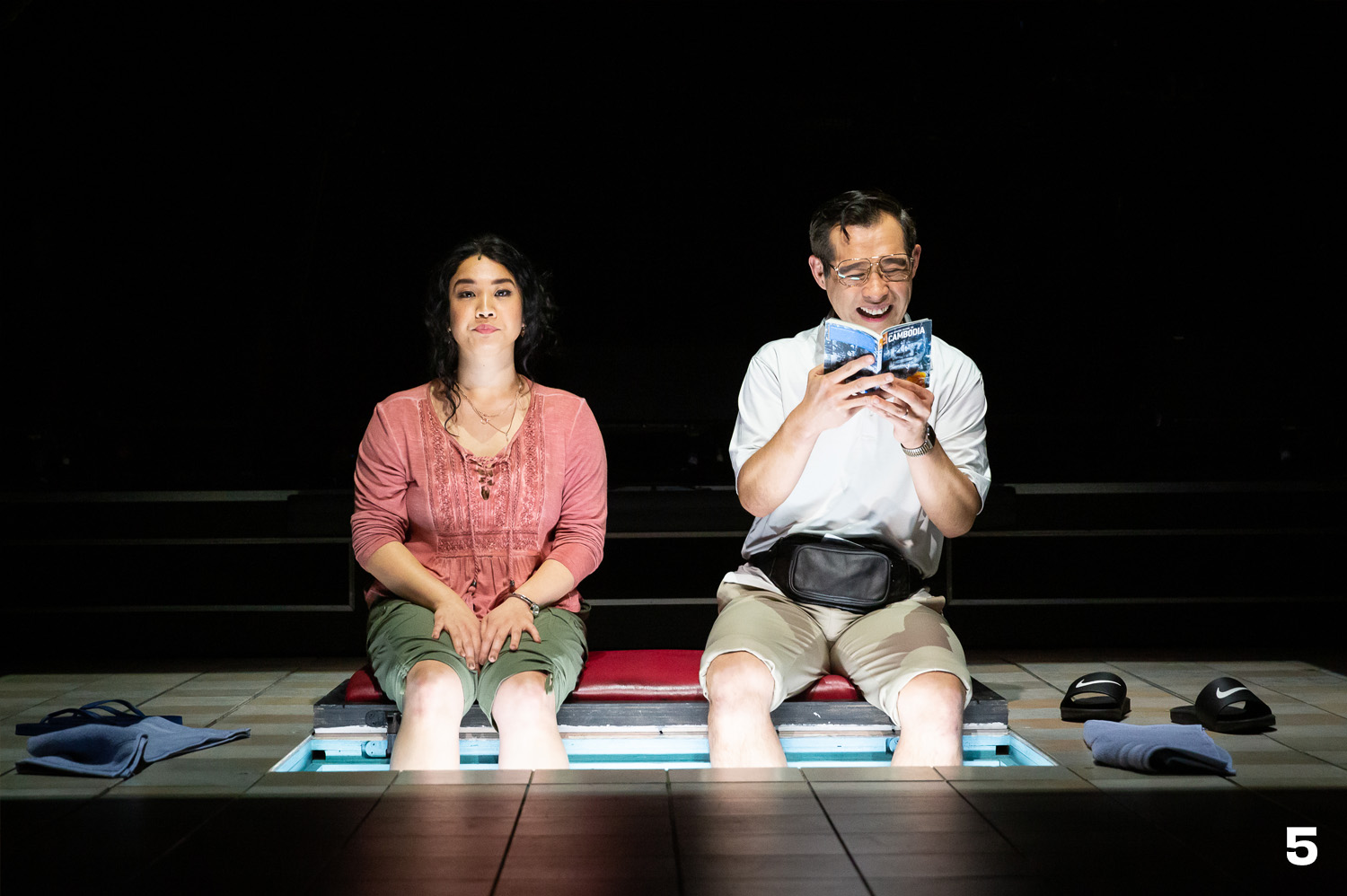
Berkeley Rep production photo by Lynn Lane

 Stop me if you've heard this one before: This is a show we saw in Ashland in 2019 (and really liked), so were looking forward to seeing it again in the Bay Area. Cambodian Rock Band is also by a local playwright, Lauren Yee, whose work we have seen at several theaters recently. So that all seems promising. Berkeley Rep has landed a number of shows from Ashland over the years, and this one was also workshopped at Berkeley Rep's Ground Floor program, so there is a lot of local history here.

The Play

There are sort of two parallel stories going in this play: one is the story of The Cyclos,  a rock band in Cambodia, disrupted by the arrival of the Khmer Rouge in 1975; the other the story of a Cambodian-American lawyer working in 2008 to prosecute one of the most notorious members of the Khmer Rouge for crimes against humanity.

Needless to say, any play that touches on the Khmer Rouge period in Cambodian history is going to be a bit grim, and this play doesn't shy away from that. It's a bit difficult to describe the intersections of the two story lines without a few spoilers. Let's just say artists and musicians didn't fare well under the Khmer Rouge regime, and trying to survive under a repressive regime can lead to extremely painful personal choices.

The Production

Also needless to say, there is a fairly limited number of actors who can also play instruments and sing and speak convincingly in Khmer, the language of Cambodia. So I shouldn't have been surprised when I recognized several actors from the 2019 OSF production. In fact, four of the six cast members were in that production (though we only saw three, as there was an understudy for the fourth).

In fact, the only change that makes a substantive difference in the play is the casting of local actor Francis Jue as Duch. Jue is a terrific actor, but his portrayal of Duch is rather odd, tending into a sort of playful prancing that diminishes the underlying threat he represents. I felt like this choice undercut the effectiveness of that character.

Joe Ngo shines in his portrayal of Chum (a role he originated, and has played in multiple productions). Moses Villarama, though, seems a bit bored with playing Ted/Leng. As much versatility as Ngo displays, Villarama seems to play all his roles as if they are the same. But overall the cast keeps the energy pretty high, the music is good, and the message of the play comes through clearly.

Bottom Line

I'm sort of torn: I think it's mostly a very effective production of a very good, very difficult play. On the other hand, it really feels like basically the same show we saw in Ashland. I kind of expected that there might have been some new development or some new takes from a different cast and director. But it's literally the same director, most of the same designers and musicians, and nearly the same cast.

So if you haven't seen it before, I'd say it's well worth seeing. If you've seen it elsewhere, there isn't really much new here. But the show runs through April 2nd, so you have more chances.

Tuesday, February 21, 2023

"Clyde's" at Berkeley Rep


Berkeley Rep production photo by Kevin Berne or Muriel Steinke
A new play by Lynn Nottage is always an exciting thing. She's won numerous awards (try two Pulitzers and a Macarthur Foundation "Genius" award), and I've really appreciated seeing her plays. In particular, Sweat, which we saw at Ashland in 2015 (before I started theater blogging, unfortunately), has stuck with me. This new show, Clyde's, is getting productions all over the country right now, and it revives one of the more interesting (and problematic) characters from Sweat.

The Play

Our story is set in the kitchen of a sandwich shop frequented by truckers called Clyde's. The eponymous Clyde is the owner, who is a formerly-incarcerated woman who hires other ex-cons to work in the kitchen. Clyde is pretty mercurial, and treats the staff poorly, but they have limited options with their backgrounds. So they work in the kitchen, dreaming about making something more out of it. The oldest of the staff, Montrellous, is kind of the sandwich guru, describing ingredients and techniques that would seem to have no place in a truck stop. The experienced staff include both Letitia, a divorced single mother of a child with severe health issues, and Rafael, the master of the fryer and young, aspiring chef.

All of these characters are people of color, so when Jason and his white-supremacist tattoos arrive, there is a certain amount of tension (to put it mildly). Jason is the carryover character from Sweat, and the assault that put him in prison was part of that play.

As the play progresses, the sandwich cooks bond in their resistance to Clyde's domination, and eventually each spills the story of how they ended up behind bars. It's an interesting if sometimes heavy-handed examination of the lives, choices, and options of formerly incarcerated individuals, along with some rather random investigations of the wonders of the sandwich.

The Production

The cast is strong, and many have local roots and connections. Harold Surratt as Montrellous makes the most of what is a somewhat baffling character at times. Cyndii Johnson as Letitia is a strong presence throughout--she's kind of the moral center of the show, and probably the character that is most fully and convincingly developed. Louis Reyes McWilliams is Jason, a truly difficult role, and he does it well. Nottage has said that crafting that character was the most difficult part of the play for her, and she has clearly given it much thought and nuance. McWilliams is up to the task. Wesley GuimarĂ£es is a charming and fun Rafael. I'm a bit befuddled by April Nixon as Clyde: she does it well, but I just don't understand the character. I think that's on the playwright, or maybe the director (Taylor Reynolds), but I have real difficulty figuring out what I'm supposed to make of Clyde.

And although the props onstage do look pretty much like a sandwich kitchen, the overall effect isn't very convincing. They seem neither very busy nor well-stocked. The kitchen is awfully clean, bright, and spacious for what it's meant to represent.

Bottom Line

There's a lot to like about this show, and that might be part of its problem. For a bunch of ex-cons, this is an awfully likeable group of people, and they get along pretty well. Other than the obvious conflict with newcomer Jason, I don't feel much tension within the group, other than what they direct at Clyde. And we never get an explanation of why Clyde treats everyone the way she does.

So, there's some good writing here, some good characters and scenes. But it doesn't really feel like a full, finished play. If you take out the lengthy riffs on aspirational sandwich ingredients and such, this is probably less than an hour of real material, and that could use some more clarity.

Overall, I guess I'm disappointed because my expectations were so high. I hoped for more. What we got was just OK. The play continues through the coming weekend, closing February 26th. There are better options available.

Monday, September 26, 2022

"Goddess" at Berkeley Rep

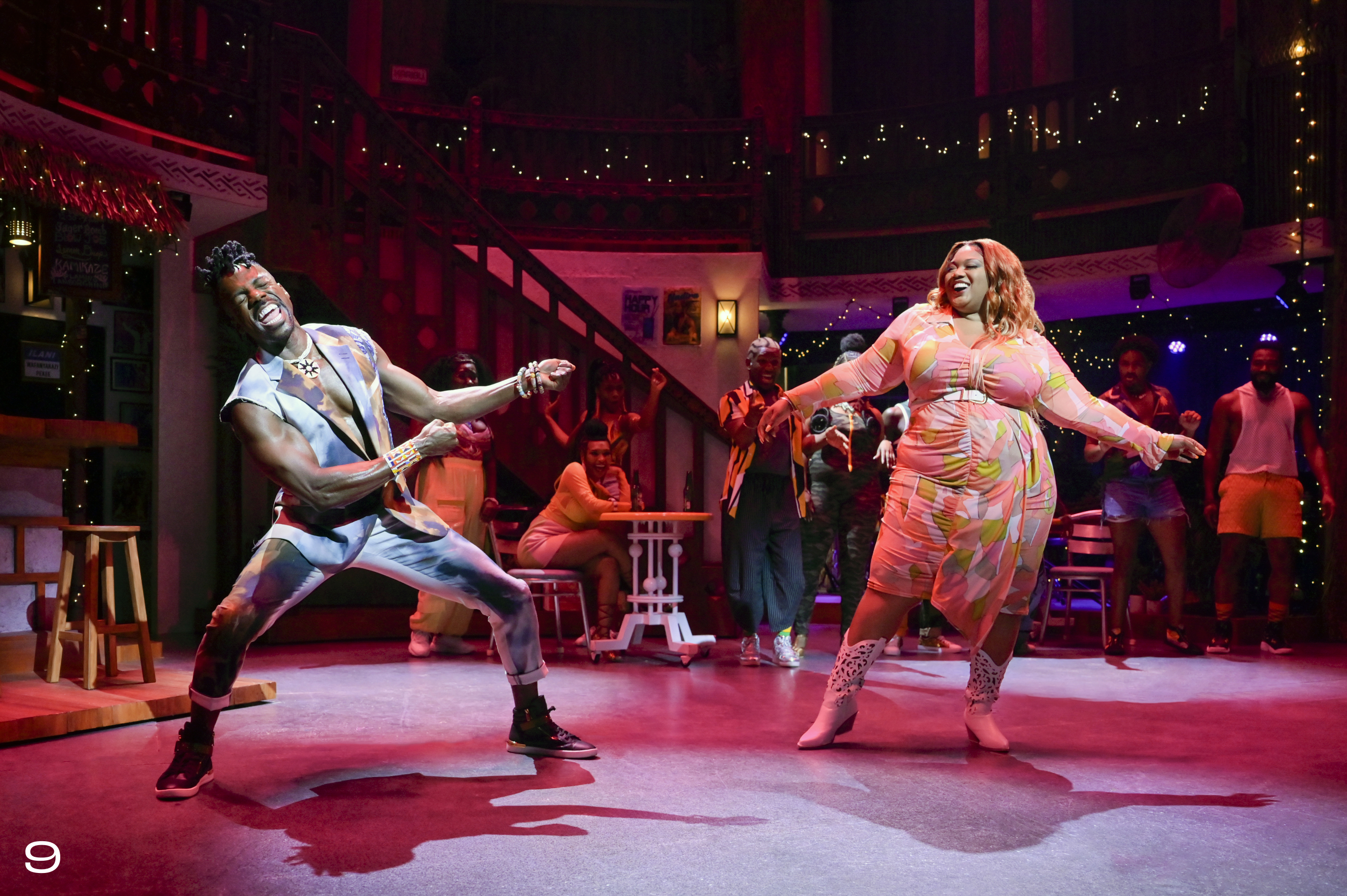
Berkeley Rep photo by Kevin Berne and Alessandro Mello

 Berkeley Rep has become known over the last decade or two as a place where musicals get developed or premiered on their way to Broadway. Starting with Passing Strange and American Idiot and Amelie, then more recently Ain't Too Proud and Paradise Square, Berkeley has become a staging and trial ground for new musicals. The latest iteration is a world premiere of a new musical by a team with a pretty solid track record: it was conceived by Shaheem Ali, composer Michael Thurber wrote the music and lyrics, and the book is by Jocelyn Bioh. I suspect they're already making arrangements to transfer the show to Broadway.

The Play

Set in Mombasa, Kenya, the play is the story of Marimba, the goddess of music and beauty, who has had a falling out with her mother and come to the mortal realm to seek true love. Meanwhile, she gets by in the guise of Nadira, a singer at a trendy club called Mota Mota. There she meets Omari, the scion of the Mombasa political dynasty, just returned home from college in New York. Omari is supposed to succeed his father as mayor of Mombasa, and his fiancée, Cheche, has been making preparations for his campaign while he was away. But Omari just wants to play the saxophone at the club, where he is also falling in love with Nadira.

So the folktale sets up the conflicts between Omari and his parents, Omari and Cheche, Nadira/Marimba and her mother, Nadira and Madongo, the owner of the club who has romantic designs on her. All with a backdrop of the club and its excellent band and crew of colorful, dancing patrons. Lots of singing and dancing, lots of light and color.

The Production

Because this is a show with Broadway aspirations, it's a much bigger, fancier production that we would normally get in a regional theater. The set is large and elaborate. The band is large (and excellent), starting with the Afro jazz music while the audience is getting seated and playing nearly all the way through the show. And the cast is pretty much Broadway caliber: big voices, great dancing skills, etc. The production quality is high throughout. This is a top-notch production.

And it definitely appeals to its audience. This was the first truly packed theater I've been in since the pandemic, and the reception was enthusiastic. I suspect the run will be very successful and the show will go on to New York and do well.

Bottom Line

If you're looking for a Broadway-style and -quality musical show, I would say this is probably as good a bet as any of the touring shows currently playing in San Francisco (though I haven't seen them). The show has been extended through October 2nd, so you still have a chance to see it.

However (you knew this was coming, right?), although I found the show enjoyable, I felt like it was mostly flash and not much substance. Like many folk tales, there isn't a lot of depth or subtlety to the story. Once you get the setup, you pretty much know where everything is going. So it's very predictable, which I realize is what a lot of people want in their Broadway musicals. I also didn't find any of the major characters very engaging. Amber Iman (Nadira) is beautiful and sings incredibly, but her character doesn't have much dimension, and her acting doesn't add much to it. Phillip Johnson Richardson (Omari) has some personal appeal, but his character seems pretty set in his entitled ennui, never really convincing me that there's any conflict involved in choosing his preferred life of music over his family obligations. (And for that matter, it's kind of the same story with Marimba/Nadira--she never seems to show any sense that she has any inclination or reason to go back to being a goddess, preferring instead to pursue the path of personal love. Only when the curse placed on her threatens people she cares about does she get motivated at all to resume her goddess job.)

So the moral of the story seems to be "be true to yourself", almost regardless of the consequences to everyone else. It's kind of a bizarre message to be preaching, but it's done with lots of flair and charisma, so that's something.

On the other hand, a full house and an extended run, and an audience full of more young and BIPOC people than I have seen at almost any other show. So Berkeley Rep has another successful cash cow. The question is, will any of these audiences come back for other shows? And how much of the revenue will go to promoting local artists and shows? A big theater like Berkeley Rep can be a tremendous force in the local theater scene, but only if it invests in that local theater scene. Let's hope.

Tuesday, July 10, 2018

"Angels in America" at Berkeley Rep

Berkeley Rep photo by Kevin Berne
I missed this the first time around. Tony Kushner's Angels in America: A Gay Fantasia on National Themes was one of the defining theatrical events of the late 20th century, and I didn't see it. Didn't really know about it until it was already gone. And in many ways that's apt, because I also managed to miss a lot of the events that are the subject of the plays because I didn't live in the Bay Area (or New York) in the late 1980s and early 1990s. The one brief hiatus I took from living in the Bay Area, and that was it. So I can't relate to a lot of this story of the early days of the AIDS epidemic the way so many of my friends and family do.

All that said, Berkeley Rep's revival of this epic story is incredible, and definitely qualifies as a "must see" event.

The Play(s)

Angels in America is such a big story, it comes in two parts, called Millennium Approaches (Part I) and Perestroika (Part 2). For the most part I will just refer to the whole thing as Angels in America, unless I need to make a specific point about one part or the other.

I'm not going to try to summarize the more than seven-and-a-half hours of drama that make up this show. It is an epic story of the early days of the AIDS crisis, from several key perspectives. The main characters are
  • a gay couple, Prior and Louis
  • a closeted Mormon law clerk, Joe, and his wife, Harper
  • Belize, an African American nurse who is friends with Prior and Louis
  • Roy Cohn, who is Joe's mentor
  • Joe's mother, Hannah
  • The Angel
There are plenty of other supporting parts, played by these same actors, but that's the bulk of the cast.

It's quite a remarkable recreation of the late 1980s, with lots of echoes that connect with issues today.

The Production

It wouldn't be an overstatement to call it spellbinding. Neither of the parts of the play, over three-and-a-half hours each, feels long, and the break between is a refreshing chance to catch one's breath and get ready for more.

Stephen Spinella as Cohn is remarkable, revealing both the charismatic and the horrifying in his portrayal of a real-life character. The fact that Spinella originated the role of Prior in the premiere of Angels long ago is all the more fascinating, suggesting we rethink how we slot our selves and others into categories of good and evil, among other things.

The production itself is largely stripped-down, which makes for smooth transitions between scenes and also keeps the focus on the people more than the setting. The actual angel felt a bit awkward in costuming, but I suspect that was a conscious nod to the original staging (which I didn't see) as well as comporting with the portrayal of the angels in general later on (trying not to spoil things here!).

Suffice it to say that the staging manages to suggest the proper time period without explicitly recreating it, which works fine.

The acting was mostly excellent, though I found both Joe (Danny Binstock) and Harper (Bethany Jillard) a bit flat. Caldwell Tidicue as Belize was terrific, though I gather audience members either farther away or sometimes behind him had some trouble picking up his voice. But the characterization of Belize felt spot-on. And Carmen Roman as Hannah (and many smaller roles) was quite striking.

Much has been written of the reunion of director Tony Taccone with Kushner, since they created the original production at Eureka Theatre. Much has changed over those years, but Taccone clearly still has a clear eye for what this show is supposed to be, and the production reflects that.

Bottom Line

The fact that productions of this show are still selling out in London and New York suggests there is a resonance in the story with current events, but it will always have a special place in the Bay Area, and having a local production makes good sense.

The show runs a bit more, through July 22nd, and it's well worth seeing if you have the opportunity. Sorry it took me so long to finish writing this up--I've been seriously testing the boundaries of "too much theater" as well as trying to live the rest of my life. But Angels in America remains an iconic piece of American theater, and is worth the investment of time to see it.

Friday, March 16, 2018

"Office Hour" at Berkeley Rep

Berkeley Rep photo by Kevin Berne
Julia Cho is a very talented playwright. Her play Aubergine a couple of years ago at Berkeley Rep was a real revelation, and The Language Archive remains a favorite that I could see over and over. So I had pretty high expectations going into the latest effort between Cho and Berkeley Rep, Office Hour.

The show is quite timely, both because of the general theme of young males who feel ostracized by society and respond with violence and threats and because of recent events involving school shootings. And to make it all hit home even more, I have a friend who teaches college in the bay area who has described a student remarkably like the one portrayed in this play. So I really want to see what's up here.

The Play

The play opens with three faculty members talking, somewhere on or near the college campus. Two have already had experiences with Dennis, a particularly difficult student, and the third, Gina, is about to embark on a semester with him. Dennis basically doesn't speak, just sits sullenly in the back of the classroom wearing a hooded coat and sunglasses. He does all the assigned work, but his writing is just foul-mouthed, violent, disturbing screeds. He intimidates his teachers, his classmates, and apparently, the school administration, since they refuse to take any action against him. Meanwhile, other students quit the classes he is in, but the faculty can't get out of it that easily.

Thus forearmed with the experiences of her colleagues and the somewhat inexplicable statement from them that perhaps she will do better with him "because, you know..." (meaning, both teacher and student are Asian Americans), Gina summons Dennis to her office hour under the ruse that it is required of all students.

The remainder of the play is essentially a tug of war between Gina and Dennis, her trying to draw him out and defuse the threat, and him trying to resist and sometimes fighting back.

Dramatically, it takes place in a series of spiraling escalations, all ending badly, only to kick us back a few minutes to learn that's not what really happened, and the actual scene went another way. We're left to decode whether we're just reading the characters' fears and expectations, or perhaps something else. But we see repeated attempts, sometimes making progress, but always somehow going astray.

Late in the play, David, one of the faculty who had warned Gina, and who had tried to take administrative action against Dennis, interrupts the office hour, and we get a rapid-fire view of a whole bunch of different scenarios where things can go wrong.

Parts of the dialogue are absolutely brilliantly written, and some manage to be amazingly funny. But much of the play is just head-scratchingly implausible, starting right from the opening scene. The trio of teachers, meeting somewhere outdoors, apparently, discussing matters that clearly are not appropriate for public consumption, is just weird. Especially when the whole stage is set up as...a teacher's office! And the notion that this student is in his third year in the department and that somehow he hasn't come to the attention of the entire faculty is similarly befuddling. I'm willing to suspend some disbelief, but there are some pretty tough stretches required here.

The Production

As befits a play with such a fluctuating attention to detail, the production is similarly kind of hit-and-miss. When they are really struggling with/against one another, Gina (Jackie Chung) and Dennis (Daniel Chung) are really good. But Gina's body language, in particular, is all over the map. She goes from stolid and persistent to all of a sudden being flustered and wandering all over the office. I guess she and director Lisa Peterson are shooting for some variety, but what they mostly do is break the tension and distract from the flow of the story in ways that make the characters less credible. It just felt sloppy.

I felt kind of sorry for the two "extra" faculty actors (Jeremy Kahn and Kerry Warren). Aside from the fact that they are off stage for nearly the entire show, their characters add almost nothing to the play. At least Kahn's David gets to come back at the end for the violent montage. Warren's Genevieve disappears completely, although Warren herself gets to come back, though in a non-speaking role.

That montage (I won't say too much, as I don't want to spoil anything) is extremely cleverly and intricately staged, and it's super well done. I wish as much attention had been paid to the rest of the production. This kind of play needs to be played very precisely, but Jackie Chung in particular keeps finding ways to undercut her character.

Bottom Line

I can't write this off as a lost cause--there are elements of the play that are, in fact, excellent, both in the writing and in the performance. But I can't help feeling that this is a case where someone wanted to write a play about a really important issue, but without having a coherent message to deliver. Yes, we get the terror and tension and fear. Yes, we get that this is super difficult to deal with. But we all knew that coming in.

By removing all the real dynamics of the situation (the support and assistance of any outside people, for example), Cho precludes any actual investigation of a real solution. Gina decides on her own, apparently without consulting any other faculty, administrators, or mental health professionals, to invite the problem student into her office with no support at all, then starts poking the lion with a stick in various ways. It's no wonder she and the audience are envisioning just about every possible bad outcome. But none of it feels terribly real or meaningful, either.

So that leaves us with a pretty clever piece of drama that doesn't actually do anything to advance the discussion of anomie among youth. There is some element of race injected (as noted above). And at least some of the actual dialogue between Gina and Dennis digs into that, including a hilarious (though I can't help but feel it was somewhat inappropriate as well as out-of-place) fake phone call from Mom that Dennis inexplicably plays along with. I don't pretend to be an expert on racial issues, but it wasn't clear to me that this actually had anything to offer to the bigger discussion.

Ultimately, I thought it was pretty good play, but not nearly as good as I would have expected from Julia Cho. We need to have discussion of these issues--they are near and dear to the hearts of everyone in education, at least. But just dramatizing a situation without offering real insight doesn't really serve the audience.

The show runs through March 25, so you still have time to see for yourself. But if you're looking for a brilliant insight, I don't think it's hiding here.

Monday, January 1, 2018

Best of 2017

I've been told that one of the requirements, now that I do a Theater Blog, is that I must commemorate the end of the year by doing a "Best Of" post to say what was best this year. Since 2017 was my first full year of Theater Blogging (Yep...we started in May of 2016!), this will be the first time I can really look back over a year of posts and opine on what really stuck with me, which is my criterion for "Best Of". Unless I decide it isn't. Stay tuned.

I will preface this with a side note that on the whole, 2017 was not a good year for me at all. Personally and professionally, this year has actually kind of sucked, and even my frequent respite at the ballpark was not its usual pick-me-up. But for the most part, theater--and particularly theater people--has truly kept me going. On the whole, the friends I have made through going to the theater and being involved with theater are some of the most positive, supportive people I have ever known. You know who you are, and thanks for being there for me.

Now then, theater stuff...

Best Plays/Productions

These are the plays that really stuck with me, for one reason or another. I'll list them in the order I saw them. No other ranking is implied unless I say so. I will include links to my original postings for each of them, in case you missed my musings the first time or just want to see if I lost my mind in between or something.

If I can find a theme to my "best" list, it's mostly that they almost all manage to tackle an issue that is pertinent to the day and explore it in a non-obvious way. 

"Hamlet" at Shotgun Players

Fortunately, the repertory portion of Shotgun's 2016-2017 season ended in January, and much of what I saw in January was more Hamlet. I believe I ended up seeing it about 18 times, with only one repeat casting. The shuffling of actors was amazing to watch and very educational. I learned a great deal about Hamlet and about theater from watching these shows, and my only regret is that I didn't manage to go more often. The seven actors plus one understudy deserve medals for performing in this show. And extra medals for the fact they were also performing in at least one additional repertory show each. It was just an extraordinary experience, the likes of which we are not likely to see on a Bay Area stage again any time soon.

"John" at ACT

This was the first show I felt really showed off the value of ACT's new second stage at the Strand Theater. The show was quirky, but it really kept me thinking about it for quite some time, and that's what good theater is about.

"Leni" at Aurora

Once again showing my fondness for the intimacy of small theater spaces, this little show in Aurora's second space really showcased the talents of actors Stacy Ross and Martha Brigham and brought some history to life in a thoughtful and timely way. It was an innovative and thought-provoking show, well directed by Jon Tracy.

"Sisters Matsumoto" at Center Rep

This was a very powerful and beautifully staged performance of a story that really resonated. Particularly having just seen TheaterFIRST's Beneath The Tall Tree, which also dealt with Japanese American internment, it was moving and thought-provoking and made me aware of aspects of that period and its aftermath that I hadn't been aware of.

"The Events" at Shotgun Players

My buddies at Shotgun really kind of went off the rails on some things these past couple of years. Staging The Events requires a different community choir on stage for each performance. As such, it was informative to see the play more than once (and I did). Not only did this help cement for me the value of seeing plays more than once (I also saw Hamilton for the second time around the same point), but it made me appreciate both the difficulty of incorporating different outside groups into a play and what that actually means to this particular show. This is a tough but important and certainly timely play about the resilience of both individuals and communities to sudden, shocking events.

 "As You Like It" at CalShakes

As the only comedy on the list, this seems a little odd (note that I have a separate section for comedies later). But I was moved and surprised by this CalShakes production. I usually don't expect much thought to ensue from a Shakespearean comedy, but Desdemona Chiang's interpretation of this play of mistaken identity broadened the issue to cover personal and gender identity, and did so smoothly in a fine production. This was also the start of a very strong season for CalShakes.

"Grandeur" at The Magic Theater

I went into this play knowing almost nothing about it, and left absolutely stupefied. Carl Lumbly exceeded even the lofty expectations I have of him, and the play was riveting. It's not earth-shakingly important, but it shows just how effective a small play can be. I was extremely fortunate to be sitting in the front row, in the seat closest to the chair where Lumbly sat for much of the play, so I got to watch him up close, and it was amazing.

"Mojada: A Medea in Los Angeles" at Oregon Shakespeare Festival

I would normally expect at least a couple of plays from our summer jaunts to Ashland to land on the "Best Of" list for a year, but this year wasn't overall that impressive up there. But Mojada was a knockout. The adaptation of the well-worn story of Medea is almost obvious in retrospect. The portrayal of undocumented immigrants trying to assimilate (or not) and the consequences for them personally and socially is excruciating, but very effective.

"An Octoroon" at Berkeley Rep

Everybody's trying to push your buttons this year, but this time Berkeley Rep got it right. It's a super complex script, as you might expect from a hotshot playwright who has won just about every award imaginable. What I didn't expect was that Berkeley Rep would find the right director and cast, and that that director would be Eric Ting, who had previously disimpressed me with his direction of Othello at CalShakes. This production was pretty much spot-on. We're still talking about it, almost six months later.

"black odyssey" at CalShakes

I would never have guessed at the start of the year that Eric Ting would direct even one, let alone two, of my favorite productions. But here he was, coming right off the triumph that was An Octoroon, directing local playwright Marcus Gardley's wonderful adaptation of "The Odyssey" into a story of African American life. And it packed the Bruns Amphitheater every show, bringing in rafts of people who do not normally make the trek to Orinda to see a play. This was terrific storytelling.

"The Farm" at TheatreFIRST

Another artist making his second appearance on the list is Jon Tracy. Having directed Leni for Aurora earlier in the year, he also re-adapted his adaptation of Orwell's "Animal Farm" for TheatreFIRST, and the result was delightful and moving. This modest production reminded us that we don't have to be big and fancy to tell an important story. The reboot of TheatreFIRST is having sort of uneven results, but The Farm was definitely a sign of what a dedicated bunch of theater artists can do with limited resources.

Comic Relief

Most of the plays that really stuck with me this year were dramas. Maybe it fit the rhythm of my own life, which had way too much drama in it this year. But there were funny plays that made an impression on me, and they deserve some recognition, even if they weren't overall the "best" things I saw this year.

"Noises Off!" at SF Playhouse

This is one of those kind of classic plays that I had always heard of by never seen. I love the intricacy of the plotting and staging, and felt that for once, the rotating stage at SF Playhouse really was an asset. And the play is just screamingly funny, both because of all the theater in-jokes and because of some real character development. I liked both the play and the production here very well.

"The Play That Goes Wrong " at Lyceum Theatre (NYC)

This play isn't nearly as deep as Noises Off!, but the production we saw in New York this fall was absolutely the funniest thing I've seen on stage in a long, long time. The comedic timing and the convoluted set design were truly impressive. I needed a good laugh, and this provided it.

Spectacles

This is a category I just made up to salute the shows that just make you drop your jaw a bit at the stagecraft. There were some pretty over-the-top productions out there, even if they weren't among the shows that I deemed "best" overall.

"Needles and Opium" at ACT
"Monsoon Wedding" at Berkeley Rep
"A Thousand Splendid Suns" at ACT
"The Black Rider" at Shotgun Players

I won't go into them in detail again. Suffice it to say that in each case I was less than delighted with the play, the message, the storytelling, or something. But in each case the stagecraft, design, music, dancing, lights, and so on were dazzling and worth recognizing.

Musicals

I saw a fair number of musicals this year, but none that really rose to the level of "best"-ness required to make the big list. But I thought I should mention the ones that stood out, because musicals can be special in their own right, and if they are your thing, this is important.

"Good Night, Good Night, Construction Site" at Bay Area Children's Theater
"Hamilton" (touring) at SHN San Francisco
"La Cage Aux Folles" at SF Playhouse

Other

I can't think of a category it really fits into, but Taylor Mac's A 24-Decade History of Popular Music at the Curran was like nothing I have ever seen before. I realize now that I never got around to writing up the portions of the show that I saw (I saw only the first two 6-hour segments, so didn't feel I could really comment on the show as a whole). This mash-up of musical theater, cabaret, drag show, and history lesson amazed me on a bunch of different levels. The subversive way Taylor Mac gets into the heads and under the skins of the audience while knocking out a really impressive array of popular tunes in ways probably never seen or conceived before just boggles the mind.

I truly have no words to describe the whole experience, and in any strict definition, it's not really "theater" per se, but it is, too. And it probably stuck with me more than any other performance I saw this year, so it needed to be included here.

Personal Bests

If you'll allow me to conclude with a moment of self-indulgence, there were two other productions that were particularly meaningful to me personally this year, so I just get to put them in the "Best Of" post as kind of a footnote.

My Professional Stage Debut

Yes, those loons at the Shotgun Players not only allow me to sit on their board, they also offered me a tiny role in their staged reading of Tom Stoppard's Rosencrantz and Guildenstern Are Dead last January. And hey, we sold out and got extended, so I had three glorious nights on stage with a bunch of real, professional actors, and I have the check to prove it.

This makes the list not because I was any great revelation on stage or because it changed my life or anything like that. But there were two important takeaways from  the experience: One, I got to see firsthand, close-up, just how real theater artists work. Rehearsing, dressing, blocking, designing and redesigning--all of it. It was glorious. And it gives me all the more respect for the work these people do, day in and day out, to produce these plays that I enjoy so much. But just as important, two, after seeing me onstage, my daughter said, "Well if Dad can do that, I can do that." And promptly signed up for her first real staged play.

Which obviously leads me to...

"Assassins" at Berkeley Playhouse Teen Stage

About six months after my little dalliance on stage, there was my daughter, singing and dancing and trying (futilely) to shoot Gerald Ford on the stage in the Julia Morgan Theater. It's still not one of my favorite plays ever, but she got out of it exactly what I hoped: she found a wonderful community of like-minded, creative, accepting people who share a love of making theater and support each other while they do it. She's now working on her second show, already signed up for another, and planning one more for the summer.

Which just goes to show, we can always handle more theater, so we obviously haven't reached the mythical "Too Much Theater" yet, and the quest must continue.
Sunday, December 17, 2017

"Watch on the Rhine" at Berkeley Rep

Berkeley Rep photo by Kevin Berne
Timely revivals of older plays are often even better than new plays, because it's often helpful to know that prior generations have stumbled on some of the same rocks we find in our path now, and their insights can help us navigate, or at least understand. One example of such a revival is Berkeley Rep's current offering of Lillian Hellman's Watch on the Rhine, a 1941 play about resisting fascism. It's a play that is fundamentally about getting out of one's comfortable bubble and realizing that fascism can be right in the house, unsuspected.

The Play

Set in a wealthy home outside Washington, DC, in the spring of 1940, we first see members of the Farrelly family anticipating the arrival of a long-absent member. Daughter Sara married a German engineer and has been living abroad with him and their three children. Mother Fanny is quite distracted in anticipation. Her son, David, is rather hard to read, but he misses his sister. So Fanny antagonizes Anise, the live-in French secretary, and Joseph the butler. The long-term house guests, the De Brancovises (whose presence is never fully explained), are minor Romanian nobility, down on their luck (and their finances).

So Sara and her family arrive earlier than expected, looking a bit threadbare and scruffy. It's clear they've not been living high on the hog, and have in fact been missing a lot of meals and staying cheaply as they move around a lot. Soon we learn that Kurt (Sara's husband) is no longer working as an engineer, but working as an antifascist, opposing the rise and spread of fascism all over Europe. As the discussion turns to European politics, we find that De Brancovis has pro-fascist sympathies and many German connections, and a scheme evolves to turn in Kurt to the Germans in exchange for money.

But maybe he could be bought out of that option, with the Farrelly family helping to buy his silence.

So we have the tension of family loyalties, the awakening of the awareness of how world affairs affect all, including the isolated American family, and of course the pro- and antifascist agents. It all blows up at the end, of course. Amidst all the political intrigue, we see some quite tender and difficult bits as it becomes clear that Kurt has brought his family to stay with the Farrellys while he must return to Europe to continue his dangerous fight. Hellman does a terrific job of juxtaposing the personal and the global, as well as bringing out hidden depths in seemingly fairly superficial characters such as Fanny and David.

All in all, the play is a solid piece of writing, and holds up well, although the early pacing is a bit slow. Eventually all the pieces fall into place, and you realize it's a cleverly crafted work.

The Production

Terrific looking set, I have to say. One advantage to a play that all takes place in one room is that the designers can really go to town on the details. So the room looks really good, nicely lighted, etc. I had a few issues with the sound and with audibility of some of the dialogue, even though we were seated pretty close to the stage, though on the side. I've never encountered acoustical issues in the Roda Theater before, so I doubt that's the problem. But mostly it was fine.

The acting was solid, mostly unspectacular. The key standouts were Elijah Alexander as Kurt Muller and Sarah Agnew as Sara Muller. And both stood out for the subtlety of their non-spoken parts. When Sara first enters the home she hasn't visited in 20 years, there is a palpable tension in her nervous movements, between the joy and comfort of being home and the anticipation of the unknown reception they will receive when her family meets her husband and children for the first time.

But the real winner is Alexander's Kurt. Soft-spoken and serious throughout, he evinces a tremendous strength of character and restraint, with a tenderness for his family that belies his hatred of the Nazis and all they represent. I found him utterly convincing throughout the show.

Caitlin O'Connell showed flashes of brilliance as Fanny, though a bit overplayed at times. And James Detmar's Joseph, the butler, showed some good comic touches. All the child actors playing Kurt and Sara's children were exceptional, particularly given how much stage time they all had. I found their portrayals a bit too forthcoming for children who have supposedly been on the run for essentially their whole lives--a bit too naive and trusting for who they really ought to be. I'm not sure whether the fault there lies in the text or in the direction of it, but still the performances are impressive.

Bottom Line

There is nothing flashy about this play. It's meant to convey the conflict and turmoil that underlies the denial in a quiet, normal life in a world about to melt down. And director Lisa Peterson's approach captures that well. Indeed, the tizzy about the arrival of family members is, for most of the play, the biggest disruption of daily life. The incursion of outside conflict is quiet and almost goes without notice until it can't any longer.

All in all, it's a very good production of a truly good play. Berkeley Rep has resisted the temptation to sensationalize the material, making its message all the more powerful.

The play runs through January 14, so there is still plenty of time to catch this one, and it's worth doing so.

Sunday, August 6, 2017

"An Octoroon" at Berkeley Rep

Berkeley Rep photo by Kevin Berne
The last show of the season for Berkeley Rep this year was the west coast premiere of Branden Jacobs-Jenkins' play An Octoroon, which is a really interesting, very different sort of show. Jacobs-Jenkins is a hot property among young (he's only 32) playwrights, having won an Obie award for Best New Play, been a finalist for the Pulitzer Prize in Drama, and winning a Macarthur Foundation "Genius" award. So clearly there are high expectations that accompany any of his plays.

The Play

On one level, An Octoroon is sort of an adaptation of a 19th-century melodrama by Dion Boucicault called The Octoroon, which was itself adapted from a novel by Thomas Mayne Reid called The Quadroon. All of these works are affirmatively anti-slavery pieces, with the titles referring to persons of mixed race, designating the proportion of their ancestry that was black. Melodrama was quite formulaic in its structure and style of performance, so some of this new play is an attempt to recreate that sense of theater.

At the same time, however, the play adds a layer of meta-theatrical analysis, as the characters "BJJ" (Lance Gardner) and "Playwright" (Ray Porter) both step into roles in the melodrama, with BJJ donning whiteface makeup to portray "George" in the story, and Playwright going bright red to portray an Indian. So we see early on that there will be nothing subtle about race in this production (although looks can be deceiving).

The play begins with a prologue in a dressing room, preparing for the melodrama. BJJ and the Playwright both prepare and trade jabs at one another, each both claiming and disclaiming the play we are about to see. It's a pretty interesting, if unsettling, beginning.

Next we launch into a couple of fairly straightforward renditions of the acts of the melodrama as it unfolds. By the fourth act, however, BJJ/George interrupts, quite thoroughly breaking down the fourth wall to make some points about slavery and lynching. After which the play resumes, but with a bit more self-awareness, and some winks and nods to the audience. By the fifth act, we are back in full immersion until we get some surprises.

The stage and casting directions specify that the male roles are to be played by certain races, but then performed in white-, red-, or blackface makeup. The female roles are all cast in accordance with the race of the characters portrayed. So all three slave women are played by black actors (though they behave in some wildly anachronistic ways at times).

In general, I would say the first part of the melodrama goes on a bit too long. The play as a whole ran well over three hours, with an intermission, but we'd gone almost two hours before the break. That could be cut down some without losing much of the play. It's hard to recommend cuts, because ultimately it's all interesting. But clearly some of the audience gets bored or restless in the long first act, and not all the seats were still filled after intermission. It's unfortunate to lose a chunk of the audience simple because the play is overly long.

The Production

With the exception of my earlier comments about the length of the show, I felt nearly everything was excellent. The casting was terrific. I have often enjoyed the work of Lance Gardner in recent years, but this was far and away his strongest overall effort. His is the focal character almost throughout, and he carried the role extremely well. But the supporting cast was strong as well. Porter's playwright and the almost silent Assistant (Amir Talai) really make the prologue sing. Talai really plays up the blackface roles later in the show. And the three slaves (Afi Bijou, Jasmine Bracey, and Afua Busia) had a particularly good chemistry and really aced their parts in the last act--totally convincing.

The set design by Arnulfo Maldonado was outstanding: minimal at times, but intricate and convincing (especially with the lighting from Jiyoun Chang). The "gotchas" of the last act could not have worked nearly as well without the work of the designers and techs.

Really, it all comes together and provides an extremely thought-provoking and yet entertaining show. Just about every time you find yourself getting caught up in the story, Jacobs-Jenkins pulls you back and makes you think about why it's working on you, even when he's told you what he's going to do and why. It's really quite remarkable.

Bottom Line

Sadly, this was yet another case of me seeing the show very late in the run, and then not getting around to blogging about it until after the show had closed. This was definitely the most intriguing and thought-provoking play I've seen in a while, and certainly the best overall production I've seen at Berkeley Rep in several years.

I should give credit to director Eric Ting, who holds together this most difficult assembly. It's easy to see lots of ways this play and production could go off the rails and become didactic or just offensive, and Ting keeps his crew well on the side of interesting and provocative without going for silly or inflammatory. Since I felt that was pretty much the opposite of what he did with last season's Othello at Cal Shakes, it seems only fair to give him credit here.

I quite enjoyed this production. Wished there were a bit less of it, but on the whole, I felt it was extremely well done.

Monday, June 5, 2017

"Monsoon Wedding" at Berkeley Rep

Berkeley Rep photo by Kevin Berne
I'm a sucker for weddings. I love them. They're so fun, so hopeful and forward-looking. I don't think I've ever been to a wedding I didn't enjoy. And I'm also a fan (not a huge or knowledgeable one, but a fan) of Bollywood musicals. The color and energy and spectacle of them is just incredibly fun, even if the story isn't always compelling. So of course I was going to go see Monsoon Wedding at Berkeley Rep. Director Mira Nair spearheaded the conversion of her romantic comedy movie into a stage musical, which is promising.

The Play

There is a lot to like in the story line of the play: You get the arranged-marriage, girl-meets-boy angle, the ex-pat and native angle, the wealthy/middle class/serving class conflict, religious issues, more marigolds than you can imagine, and a great many songs with dancing. It's all there. And there is plot, but I have to say that although there are the outlines of some decent stories here, the motivations of the characters are pretty thin, so you just have to kind of go along for the ride. Suspend your disbelief and wait for the next dance number.

It's a reasonably large cast, with 18 named roles and a couple of swing actors, plus a 7-member band/orchestra. So there's a lot going on. But ultimately it feels like it tries to do too much. When you have to make room for all the big musical numbers, some of the dialogue has to go, but it feels like Nair tried to keep all the plot lines from the movie, and it doesn't feel like it really does any of them justice (other than maybe the secondary romance of Alice and Dubey). Most just feel like you've gotten the Reader's Digest version of the story, which makes it sparse even by musical theater standards.

The Production

It's a big play. I mentioned the size of the cast and the number of musicians. And there are lots of colorful costumes (nice job there by designer Arjun Bhasin) and enjoyable songs by Vishal Bhardwaj and lyricist Susan Birkenhead. But interestingly, I felt particularly at the beginning, the show wasn't big enough to fill the stage. Obviously a stage show like this can't produce the overwhelming effects of the scores of extras in a Bollywood extravaganza, but I couldn't help feeling that different sets and maybe some projections could have made the set feel more full. Later on, with more set pieces on stage, it felt like it worked better.

And the producers make a big deal about having done a worldwide search for authentic Punjabi actors with proper accents and such to make the show just right. And that's great: the cast is quite good. The matched couple, Hemant (Michael Maliakel) and Aditi (Kuhoo Verma) have incredible voices, managing to sing strongly through a yoga class. Namit Das as PK Dubey really nails the comic acting I expect in an Indian comedy (and sings very well, too). There were a few moments where some of the actors fell a bit short of their notes or acted in a way that wasn't quite in sync with the rest of the cast, but for the most part, it was all good.

But it makes me wonder about the future of the play. If it takes a worldwide casting call to land just the right cast, what happens when they have to replace someone, or the show goes on tour, or it eventually gets produced in local theaters? When you're making a movie and doing it once, you write and cast for just the right stuff, and it lasts. But for the stage, you have to be a bit more forgiving, and I'm concerned that without the all-star cast, this show might not hold up quite so well.

Bottom Line

It's a big Punjabi wedding with colors and songs and dancing: What's not to like? It's an enjoyable show, and will likely never be better than in this world premiere production, so head on out to Berkeley. It's not a brilliant story, but it's quite a spectacle.

Wednesday, July 13, 2016

"Latin History for Morons" at Berkeley Rep

In the summer, between their regular subscription seasons, Berkeley Rep often has some kind of special production. Past instances have included shows by monologist Mike Daisey, actress/educator Anna Deveare Smith, and perhaps most notably a pre-NYC run of "No Man's Land" starring Patrick Stewart and Ian McKellan. The shows are different from their regular season's plays, but generally interesting and of high quality.

And then there is this summer, where actor/comedian John Leguizamo presents a one-man show called "Latin History for Morons." To be fair, many in the audience found the show extremely funny. I was not one of them.

Disclaimer

I've never been a big fan of the series of "how-to" books named " For Dummies." I realize that it's meant to be tongue-in-cheek and make seem more approachable to non-experts. But it always seemed condescending, if not insulting, to the audience. In part this is because the term implies not just ignorance or unawareness, but inability to learn: there is a difference between "uninformed" and "dumb."

And the term "moron" is way more loaded to me than "dummy," so this suggests to me that either he really disrespects his audience, or he has a point to make about just how ignorant we are, and perhaps why. So I come into the show hoping that he's got some insight, not only into what I don't know about history, but why that is.

The Show


The show is kind of a rambling stand-up comedy routine, riffing on Latin history since the arrival of Columbus and/or Cortez. There is kind of a thread running through the show that the actor was motivated by trying to help his son, being bullied in middle school, complete an assignment about Heroes, which gives him a reason to try to dredge up Latin heroes from his supposedly limited knowledge of history.

Unfortunately, he shows little respect to any of the historical figures on any side of any encounter, up to and including himself, his family, his teachers, his therapist, etc. Everybody is pretty much just a set-up for a stereotype so he can make a joke. Montezuma is gay, so he has to lisp and prance around a bit. There are bits that verge on creativity and humor, but a lot of it is just riffs, tropes, and recycled jokes.

[Spoiler...I guess.] Ultimately, his son sort of miraculously manages to not only complete his assignment in spite of "help" from his father, but his last-second completion is somehow selected to be the graduation address, where the big reveal is that after searching his background for any sort of hero, unearthing only losers and such, he concludes that he is his own hero.

To me it came off as kind of a TV sitcom meets an "uplifting" after-school special, but less earnest and with more old jokes. Obviously, there is an audience for all those things, and much of the audience seemed quite delighted. Of course, they gave him a huge ovation just for stepping on the stage at the outset, so it was clear that they were primed to enjoy whatever he threw at them.

All I can say is, it didn't appeal to me. Director Tony Taccone and Berkeley Rep are capable of so much more than this, it was quite disappointing to see that this is their idea of what their subscribers want between seasons.

Bottom Line

Whatever hopes I had for insight coming out of this were dashed and/or abandoned. Leguizamo was so busy yukking it up that he seems to have neglected to put a point to all his slurs and insults. And that, perhaps, should have been the director's job, to make sure that was in there somewhere.

In some sense, I think Leguizamo is trying to do too much, trying to make statements about bullying, Latin identity, and (perhaps) history and other education. But at the end we're left with little in the way of answers or even insights, just a few platitudes tacked on to the end.

Reading the interview in the program with Taccone and Leguizamo, it's clear that they like each other and found a lot to laugh about in coming up with this show. Unfortunately, I think that relationship might have blinded them to the shortcomings of the script. And they get a lot of laughs from the audience and they sell a lot of tickets, so maybe that's enough for them.

Your mileage, as they say, may vary. But I'd say you're better off going either to a real play, or if you want laughs, go to a comedy club. There are some terrific, insightful comics out there who actually have a point to their comedy beyond just playing up stereotypes and making you laugh.

Saturday, June 18, 2016

"For Peter Pan on Her 70th Birthday" at Berkeley Rep

I was really looking forward to this season-closer at Berkeley Rep. I'm a big fan of Sarah Ruhl, and have really enjoyed some of her works produced at Berkeley Rep (Eurydice, Dear Elizabeth) and elsewhere (Eurydice, Stage Kiss, The Oldest Boy). Ruhl has a great gift for dialogue, and produces characters I really care about.

And then there was "For Peter Pan...". There's nothing particularly wrong with it, but there's nothing very profound, either. It's pretty much "you grow up, you get old, you die." I kept waiting for some greater insight. Family relationships are, or can be, good. Religion and politics are controversial, but you stick with your family anyway. Some choices let you postpone part of the growing up thing.

Nicely written, with a few very clever moments. Nicely acted, but with nothing outstanding. It feels fairly "real," or at least, realistic, and maybe that's the problem. Real life isn't dramatic. Normal people are pretty boring. I kept waiting for the bit that would justify all this, but it never came.

Odd Choices

I was a little surprised with this play for a couple of reasons. For one, it starts with the family-gathered-for-dying-parent scene. It's not my favorite trope to start with, and I've seen it recently, at this theater, and done better ("Aubergine," which predates me blogging...sorry!). And also in Shotgun's reading of "You Got Older." So I'm struggling a little with Berkeley Rep's choice to put such a similar play on the stage again so soon.

The set design was clever, with reusable pieces that can morph from hospital to home to Neverland. I kind of liked the prologue, where Ann (Kathleen Chalfant) comes out through the curtain to talk with the audience. Unfortunately, during a later scene change, the crew kept bumping the curtain, which was very distracting, and then later scene changes happen without the curtain dropping, so crew are moving sets and pieces while I'm supposed to be watching something else. I kept looking for some meaning in the choices director Les Waters made here, but there didn't seem to be any. Was it meant to be related to Ann playing Peter Pan as a child? I didn't get it.

Family Matters

Individually, I thought all the five siblings in the play were pretty good characters, well acted. But there wasn't a whole lot of bond displayed between them. There was shared experience, which was good. There were a few odd questions that represented attempts to elicit information that aging family members would clearly already know about each other.

And then the deceased father wanders through the room while they're having his wake. It's cleverly staged and choreographed so that he can sit at a seat that was recently vacated, etc. And obviously it serves the purpose of showing that in some way he's still there. But that never really goes anywhere. We just have a symbolic presence, a couple of laughs, and then get upstaged by the dog. To what end? There doesn't seem to be a larger message.

Bottom Line

The play was OK, but I expected much more from playwright, director, and cast. It seemed like no one's heart was really in it, and the reaction from the audience was warm, but not particularly enthusiastic. I don't think this will be particularly memorable.

Thursday, June 2, 2016

"Treasure Island" at Berkeley Rep

This was one of the shows that got me excited for the current season at Berkeley Rep. Treasure Island was one of those books I loved when I was a kid, and enjoyed when I re-read it as an adult. So seeing it on stage, adapted and directed by Mary Zimmerman,  in a production in conjunction with Lookingglass Theatre Company (of whom I've heard great things), seemed like a sure thing. Plus, pirates!

And on the whole, I liked it. There are some issues, but overall, I liked the production. Reactions in my group were mixed, including some who left at intermission.

Summary

Really, what do I need to say? It's Treasure Island, adapted (quite faithfully) from the Robert Louis Stevenson novel. It's Jim Hawkins, Long John Silver, Billy Bones, and a cast of pirates looking for treasure. On an island. X marks the spot. This is kind of the Ur-pirate story, and if you don't know it, nothing I say here is going to help you.

The set is very clever. It's a big wooden swing with ship's rigging that can be stationary to serve as the Admiral Benbow Inn or the stockade on the island, but can also rock and roll when the ship is at sea. I thought that was quite well done. There are roving musicians playing sea chanteys, and overall the nautical elements are quite convincing.

Unexpected Excitement

In the second act, just as Jim is about to make his surprise entrance to the stockade, a fire alarm went off. We were all pretty stunned for a few seconds, and then Captain Smollett (Philip R. Smith) took command and urged us all to evacuate in a calm and organized manner. We did. We all headed out to the street, the Berkeley Fire Department came and apparently concluded that the alarm was in error (or the put out whatever set it off), and we filed back in after about a 15-minute interlude. The cast did a good job of picking up where they'd left off.

I have to say, I can't recall ever being in a theater and having an alarm go off like that. We had a somewhat similar episode during a college basketball game many years ago at the Oakland Coliseum Arena, but no one apparently believed it was real. They just kept playing, and no one left. Kind of surreal, that.

Anyway, it made for kind of a long evening. The program lists the run time as 2:10, plus a 15-minute intermission. So one would expect the 7:00 show to end before 9:30, but we didn't get out until about 10:00, so things ran a bit long even without the interruption.

My Thoughts

It did seem a bit sluggish at times. We deliberated over whether the heavily accented characters were speaking slowly so as to enunciate more clearly. But truthfully, even with that they were a bit hard to understand at times. And both Jim Hawkins (John Babbo) and Long John Silver (Steven Epp) seemed to have some difficulty deciding which accent they were going to use. Where other actors were changing roles at times, both of these were playing only a single role, so a solid accent (whatever it be) would be helpful. At least one, probably two, of our party who left at the intermission said they just couldn't take the wandering accents from those characters.

But we persisted through that, and were mostly pleased that we did. The second act gets a bit more into the psychological drama of negotiating with pirates when your health and safety, at least, are on the line. I'll spare you any spoilers. Suffice it to say that we get to a satisfactory ending.

Maybe my expectations were a bit too high for this show. But I did think the production was top quality (set, light, and sound all very well designed and implemented). The pacing and accent issues struck me as issues that I would have expected director Zimmerman to have ironed out long before this--certainly I have not encountered such in the other productions of hers I've seen at Berkeley Rep and Ashland.

And finally there is Steven Epp. I like the guy--really, I do. He is a very talented clown and actor, but in all the roles I've seen him play, he is definitely Steven Epp. And that contributed somewhat to the slow pace of the play tonight, as he mugged and drew out some of his bits. He does it well, but at a price to the overall production. Those stylings are suited to a broad farce than in an ensemble adventure story.

Bottom Line

It was worth going. There was a lot to like in the show, but even without the fire-alarm interruption, the show was feeling a bit long. A bit tighter direction and a little more discipline with the language would have helped a lot.

But still, pirates! And the second pirate show of the season at Berkeley Rep, following The Hypocrites' Pirates of Penzance. So extra points for extra pirates.