Showing posts with label Custom Made. Show all posts

Tuesday, July 31, 2018

"Good. Better. Best. Bested." at Custom Made Theatre

Custom Made production photo by Jay Yamada
Oh, dear. Getting way behind again. I will perhaps be a bit brief on some of these shows that have already closed.

I was motivated to see Good. Better. Best. Bested. (a co-production of Custom Made Theatre and Just Theater) because it was written by Jonathan Spector, who wrote the excellent Eureka Day that we saw recently at Aurora. So I thought I'd check this out, too. It's kind of a weirdly abstract play, but it does some interesting things very well.

The Play

Set in Las Vegas, GBBB (as I'll call it for brevity) explores the reaction of a potpourri of people to an unspecified, horrific disaster. Everyone in the cast portrays a variety of characters, with none being particularly featured. So it's essentially an ensemble piece with a lot of interwoven storylines. We see a number of different characters, including a bunch of different tourists (of course--it's Vegas), but also a number of locals, including street buskers, an escort, a lounge magician, and so on.

It takes a while to kind of figure out what's going on, as the start seems like a sort of random assortment of vignettes, but eventually we start to see the patterns and interconnections between the characters, and pretty soon everyone is reacting to something awful that has happened, somewhere else. As the news starts to sink in, characters sometimes pull together, but some also lash out and kind of randomly hurt others.

It's ultimately a pretty striking investigation of how trauma reveals character, bringing out both the best and worst in people. I found the use of the non-specific disaster (maybe a terrorist attack, maybe a military strike) to be very effective, both because it allows Spector to explore how people react to the unknown and sudden, and because it doesn't tie that reaction to any particular place or people. That's all kind of magnified by setting the piece in Las Vegas, because there everyone is somewhat detached from home, family, and reality.

There's a lot going on, but ultimately it's a pretty thoughtful and thought-provoking play that stuck with me for a while.

The Production

Like all shows at Custom Made, this one has kind of a low-budget feeling, but that suits my impression of Las Vegas, anyway. The cast all get to show off a bit of versatility. Mick Mize gets to open the show as a sparkly magician, but his predictions don't seem to have tied in to the subsequent action, or maybe I just didn't remember. Jessica Lea Risco gets to be a worldly escort who really gets thrown by the upheaval, bring us into her personal life (much to the chagrin of the tourist who hired her). David Sinaiko really gets shafted, not only being abused by tourists while performing as a human statue, but also having his shoes stolen and encountering broken glass. I think all the male actors eventually end up in the Spiderman suit.

The cast does a good job of pulling a plot out of the assemblage of little bits, without a great deal of support from the design and direction. I suspect that a different crew could refine the message a bit and make something more of it. But here it's largely left to the actors, and they do a credible job.

Bottom Line

So out of the chaos comes some meaning. It's definitely not as polished as, say, Eureka Day, but Spector definitely has something to say here. I'd like to see a company with more resources have a go at this play.

But as often happens, I caught this on one of the final performances of the run, so you'll have to wait for it to show up somewhere else to see what you think.

Monday, March 26, 2018

"Hooded, or Being Black for Dummies" at Custom Made Theatre Company

Custom Made Theatre Company photo
I wasn't entirely sure what to expect from this show. It struck me as one that could be super powerful, or it could go in various either silly or preachy ways and really fall over. On the whole I was impressed that both playwright Tearrance Arvelle Chisholm and director Lisa Marie Rollins  kept things on a pretty middle path.

I was also intrigued by the similarity in title to a book I've heard of, but not read: "How to Be Black," by Baratunde Thurston. That one is a humorous and at least somewhat autobiographical look at the role of a young African American man coming of age in this country.

The Play

Hooded is the story of two fourteen-year-old African American boys: Marquis, who lives with his adopted white family in the suburbs and attends a prestigious prep school where he is essentially the token black, and Tru, from inner-city Baltimore. The two meet in a jail holding cell. Marquis was caught trespassing in a cemetary where he and a couple of his white friends from school were taking pictures to post online. Tru's charges are more nebulous, amounting to loitering and not much more.

The opening scene between them is pretty amusing, as Tru tries to wrap his head around what the naive Marquis was actually doing, and Marquis tries to figure out why Tru thinks it's so bizarre. It eventually becomes clear that Tru is pretty much accustomed to being detained essentially for being black, and Marquis doesn't quite grasp that there is a reason why he, and neither of his white friends, was pursued and detained.

We soon meet Officer Borzoi, himself African American, but quite thoroughly in the service of the white power structure. Tru has a lot of opinions about Borzoi (and a lot of knowledge about his eponymous dog breed). Next into the scene is Marquis's adoptive mother, a rather obvious strawman representing the do-gooder white savior who not only gets her son released, but also springs Tru for pretty much all the wrong assumed reasons.

Next we arrive at school where we meet Marquis's two friends, Hunter and Fielder, and three girls: Meadow, Prairie, and Clementine. It becomes pretty clear that the boys' friendship is rather an odd one, and definitely not reciprocal. The girls are pretty humorously stereotypical teens, always taking selfies and talking about boys, and which ones they like.

As it turns out, there is some mutual attraction between Marquis and Clementine, which leads to some interesting scenes. Meanwhile, Marquis's mom has decided to sponsor Tru into the prep school, too, so he shows up determined to teach Marquis to be black, to the point of writing a book for him, called "Being Black for Dummies." Marquis finds this rather insulting and refuses the book. Hunter picks it up unbeknownst to the other boys, and starts studying up on how to be black.

So where I largely expected this play to be about Tru schooling Marquis (and there is certainly some of that), there is also a good chunk of what happens when a very white white boy decides to follow the lessons and become black.

At this point the dynamics among the kids become pretty interesting, and much more nuanced than I had anticipated or been led to expect from the early scenes. So I'm impressed with Chisholm's writing here.

I'm not going to go into the details of the later interactions, but let's just say things get out of hand in a couple of different directions, and everyone learns some lessons about being black. Oh, and there is some intervention by Apollo and Dionysus, which is a little weird, but why not?

The Production

As usual with Custom Made productions, the staging can't be too intricate, as there just isn't much space on or off stage. But the actors manage to make the most out of what they've got. Costumes are pretty easy, as most of the kids are wearing their prep school uniforms most of the time. The lack of sets and props in general keeps the focus on the actors, and they are the interesting part of the show anyway.

On the acting front, Tre'Vonne Bell as Tru stands out as very smooth and natural. Jesse Franklin Charles Vaughn as Marquis never seems quite comfortable in his skin, and I had a hard time telling whether that was an intentional portrayal of Marquis or just discomfort with the role. Either way, it was pretty effective. Rebecca Hodges as Clementine seemed particularly good among the teen girls.

I have to say on the whole that the girls were much more effective as passing as 14-year-olds than the boys were. They definitely had the mannerisms and speech patterns down. Neither Bell nor Vaughn was able to really convince me that they were fourteen. I might have bought sixteen or seventeen, but they definitely didn't have the raw adolescent feel that the parts really call for.

Even before the first scene starts, BE Rivers comes out as Officer Borzoi and gives a fairly unique curtain speech, instructing us to turn ON our cell phones and to answer them if we get calls. He then drew attention to the two LAUGH lights above the stage, informing us that we were to laugh when they come one, and not laugh when they do not. If you laugh without the lights, you're racist. That part was sort of cute, but the execution of it was poor--the timing of the lights was distracting, and we all eventually ignored them (and I think they just stopped using them, but I don't guarantee that). But it sets the tone for the show: this is going to be uncomfortable, and we don't make the rules. Good lessons about being black.

For the other roles, Peter Alexander impressed with his versatility as the very white Hunter who decides to become black, and then later as the school administrator who dresses down Marquis at the end. I wasn't quite what to make of Max Seijas as Fielder. He seemed more comfortable when he was playing Dionysus. Ari Lagomarsino as Meadow makes an interesting counterpart to Hunter's transition, though that part of her role is pretty short.

Overall, the acting manages to overcome the deficiencies in the staging, and the writing stands up to the devices like the LAUGH signs. We ultimately get a pretty human story with some good laughs along the way, and just enough discomfort to keep one from just laughing it all off.

Bottom Line

I was pleasantly surprised with this play overall. The staging mostly managed not to get in the way of the play and the acting, so we could focus on the people and the issues. There was nothing really earth-shaking here for those who have been paying attention. I was pretty acutely aware of some of my black friends growing up in a relatively white world and the fact that their path, even when near mine, was very different. But it's been a long time since I had to focus on that for an extended period such as this, so 100 minutes of immersion in that world is a good reminder that my life is very different from even those of some people quite close to me.

So I'm pleased to say that Custom Made has a winner with this one. My expectations for them aren't all that high, as I've had kind of mixed results from the plays I've seen there. But this one is good, and worth seeing. The play alone is quite good, and the production is fine.

The good news is they've been extended through April 7th, so you still have two weekends to go see this show, and I recommend that you do so if you can.

Saturday, November 25, 2017

"The Lion in Winter" at Custom Made Theatre Company

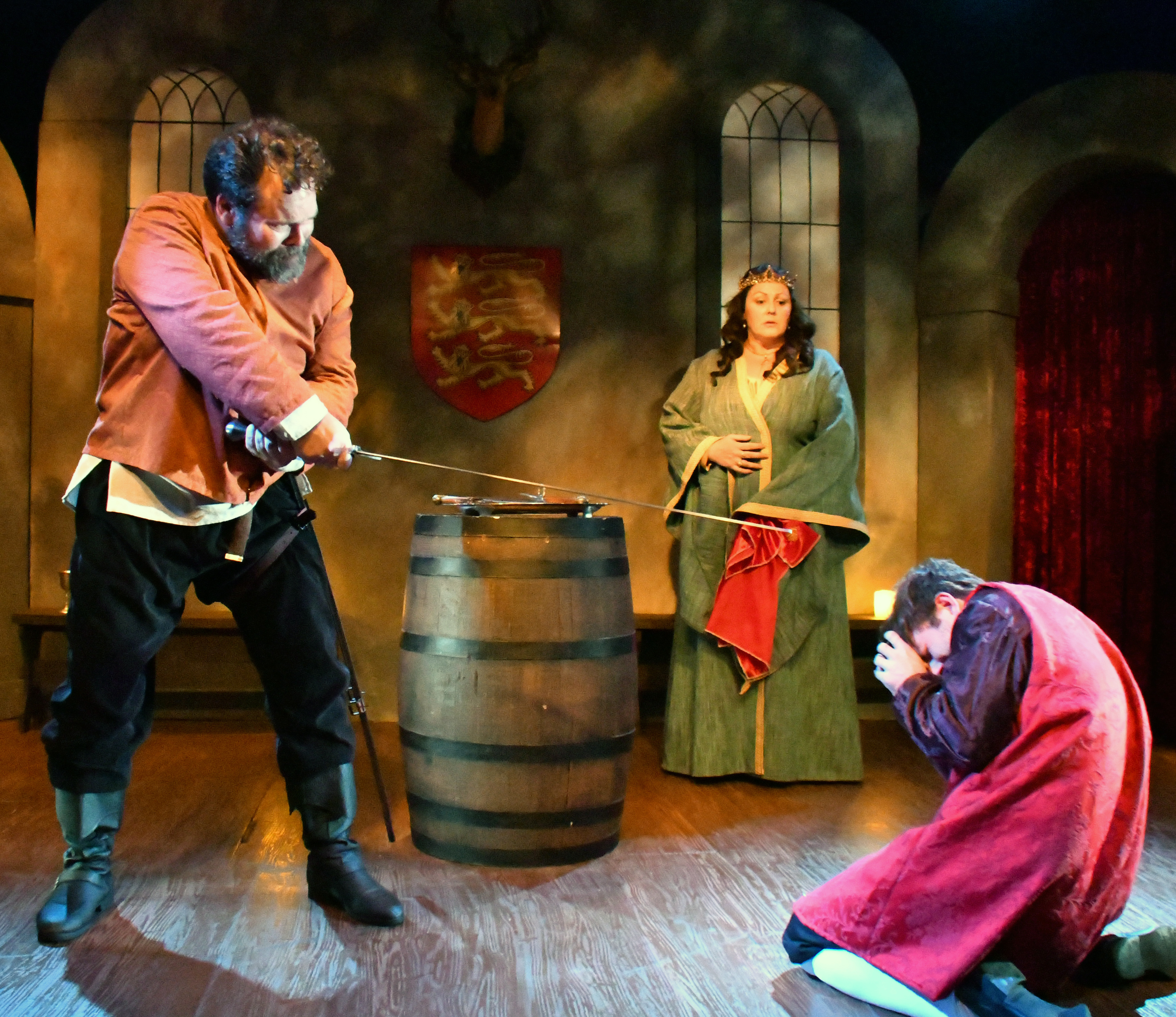
Custom Made Theatre photo by Jay Yamada
I really want to like this play. I truly appreciate the fact that Custom Made Theatre Company has the sense of humor and the guts to schedule The Lion in Winter as their holiday show because it is set at Christmas in the year 1183. And it's billed as “A Medieval Who’s Afraid of Virginia Woolf?“-- that certainly seems like fun for the holidays!

It turned out that the most convenient time to see it was the weekend after Thanksgiving, at a matinee, and tickets were not exactly selling like hotcakes. But we decided to take the plunge and see what we got.

The Play

I think in the right hands, this could be a pretty interesting play. King Henry II has lost his favorite son (also named Henry) very young, and he's not terribly keen on any of his three remaining sons (Richard, Geoffrey, and John). Nor is he particularly fond anymore of his wife and queen, Eleanor of Aquitaine, who has been in prison for the last decade or so. He's quite fond of Alais, a French princess brought to his household by a treaty as a wife for Richard, though that hasn't happened yet. And Phillip, the young king of France, has come at Christmas to discuss that matter.

So Henry needs an heir, but hasn't named one. We get lots of political and family machinations around which of the sons should and will get the throne, along with a lot of verbal sparring between Henry and Eleanor, something they have clearly perfected over the years (and which draws the comparisons to Virginia Woolf).

There are plenty of twists and turns and such to keep one's interest, though the ending isn't all that satisfying (and isn't that what we want from a holiday show?).

The Production

The set is simple, which is good. It's clearly meant to be a medieval castle, or at least as muc of one as can fit on the small stage at Custom Made. But it's fine for the size of cast and amount of action. And the costumes, designed by Brooke Jennings, are excellent: not flashy, but evocative of royalty of the period. The sound, though, wasn't good. After intermission there is a small fire burning at center stage, and I heard pops and crackles coming from a speaker way off to the side, which was very distracting. And unfortunately, much of the sound design was overwhelmed by a buzzing from the lights or something overhead. So the production itself is kind of a mixed bag.

The acting covers quite a range, too. Eleanor (Catherine "Cat" Leudtke) is quite solid, and though he started our performance pretty flat, Henry (Steven Westdahl) managed to stay with her most of the way, though his range is more limited. Alais (Caitlin Evenson) started pretty strong, but kind of disappears later on. And the three competing sons don't seem to know they are in the same play. Richard (Elliot Lieberman) is stoic, yet angry. Geoffrey (Kalon Thibodeaux) is reserved and calculating. John (Luke Brady) is a whining, petulant child. Yet somehow I'm supposed to believe that they are fighting for the throne of the largest and most powerful empire in Europe.

Eleanor's favorite is Richard. Henry's (for inexplicable reasons) is John. There are valid political arguments complicating the case for either, but temperamentally, there is no question who ought to get the crown. (Hint: his nickname is "Lionheart".) In the hands of a different director, this might be an interesting struggle over geopolitics. But as staged by director Stuart Bousel, we see melodramatic arguments over important matters, but ultimately the question seems painfully obvious: Richard is suited to be a king, Geoffrey can be useful, and John is a ninny. Yet somehow we fight over whether to give John the crown, the princess, etc.

Bottom Line

This play ought to be more interesting than it is. Either a different cast or a different direction could probably take the script and turn it into something both fun and interesting. But this effort is only mildly fun or interesting. So I came away disappointed.

This isn't the holiday treat I was hoping for. It was a mildly diverting production marred by some inexplicable casting and directorial choices, plus some really bad tech in the sound department.

Still, there were a fair number of people in attendance today, and the show has been extended a week to December 9. So if you're looking for something a little different for the holidays, you have more chances to see The Lion in Winter. Just don't go in with your hopes too high.

Saturday, March 4, 2017

"Isaac's Eye" at Custom Made Theatre Company

Custom Made Theatre Company photo by Jay Yamada
No surprise: I like plays about science and scientists. So when I saw that Custom Made Theatre Company was producing a play about Isaac Newton and Robert Hooke, I was all in. I was also intrigued because the play is by Lucas Hnath, apparently an up-and-coming playwright who also wrote "The Christians," currently at SF Playhouse.

The Play

I was expecting a play about science, about the rivalries and personal relationships that advance and/or hinder scientific advancement. This was not that play. I mean, it is about the rivalry between Newton and Hooke, although that is a bit one-sided. Established Hooke feels threatened by the coming of young, unknown Newton. So being some kind of evil genius, he decides to destroy the nascent career of his potential rival.

Newton, on the other hand, is a socially-inept savant, probably with Asperger's or something, but also with some kind of quasi-messianic notion that he speaks for God, or God speaks through him, or something. This strikes me as a terrible misreading of Newton's nature. But he's ambitious, and wants to join the Royal Society so he can become famous, which leads him to contact Hooke, at the time the curator of experiments for the Society. The overlap in their areas of inquiry leads to conflict.

There is a sort of narrator who writes facts about Newton and Hooke on the white boards that line the stage. He also speaks a lot of stage directions and occasionally becomes another character. And then there is Catherine, and old friend of Newton's who might or might not be his love interest. But she's an apothecary, which comes in handy later.

The title of the play comes from an experiment that Newton did, historically, perform on himself, inserting a darning needle into his tear duct to deform the shape of his eyeball in an attempt to determine the nature of light (which sort of makes sense, scientifically, other than the whole sticking a needle in one's eye part). Much of the second act focuses on Newton and Hooke and a random, dying stranger and needles and eyes. Prepare to squirm. They do.

The Production

The staging is stark, with a mostly bare stage surrounded by whiteboards, and a sort of desk atop a pair of file cabinets. The lighting is harsh, fluorescent industrial lighting, and all the costuming is pretty much a dull palette of grays and browns. Except Catherine. I guess she's in color to emphasize that she's the only one who isn't really part of the mess. So we have a very modern setting, and modern language and dress, but of course this is all happening in the 1660s.

The text is pretty sloppy about adhering to the historical timeline, so I suppose we can't really expect the production to follow it, either. But the whole thing is quite jarring, from the time the lights come glaringly up on the set initially, and continue through much of the initial dialogue. The portrayal of Newton as brilliant but with socially naive notions of fame and glory just don't seem plausible. And his clueless relationship with Catherine makes little sense from either side.

Ultimately, it becomes clear that Newton's guilelessness has to exist to enable the last twist of the plot in the second act, but by then I was well beyond caring. Neither Hooke nor Newton is a believable character by then, anyway.

I would have to read the script to get a better notion of what Hnath really intends with this play. I can't tell whether he has written something that is clearly off base, or whether this production has interpreted the text in such a way as to distort what the playwright intended. Either way, it seems a pretty flawed text that isn't really improved by this production.

That said, I thought the players mostly did a pretty credible job. Adam Niemann as the narrator/actor was quite good, and Jeunee Simon does a good job with the very limited role she's given to work with as Catherine. Robin Gabrielli and Gabriel A. Ross as Hooke and Newton, respectively, are far too one-dimensional for educated men of their time. Again, I don't know whether that's necessary for this text, or represents a choice by director Oren Stevens. But neither is ultimately credible, and both characters are just kind of obnoxious.

Bottom Line

Don't bother. The play runs through March 11, and I really hoped it was going to be something interesting and cool, but it's not. It's a difficult, awkward, and frankly unenjoyable play. It has interesting bits, but particularly as the second act proceeds, it descends into a kind of mad rivalry that is neither fun to watch nor informative.

It's a disappointing result from what I had hoped would be a really interesting endeavor.

Saturday, October 29, 2016

"Chess" at Custom Made Theatre Company

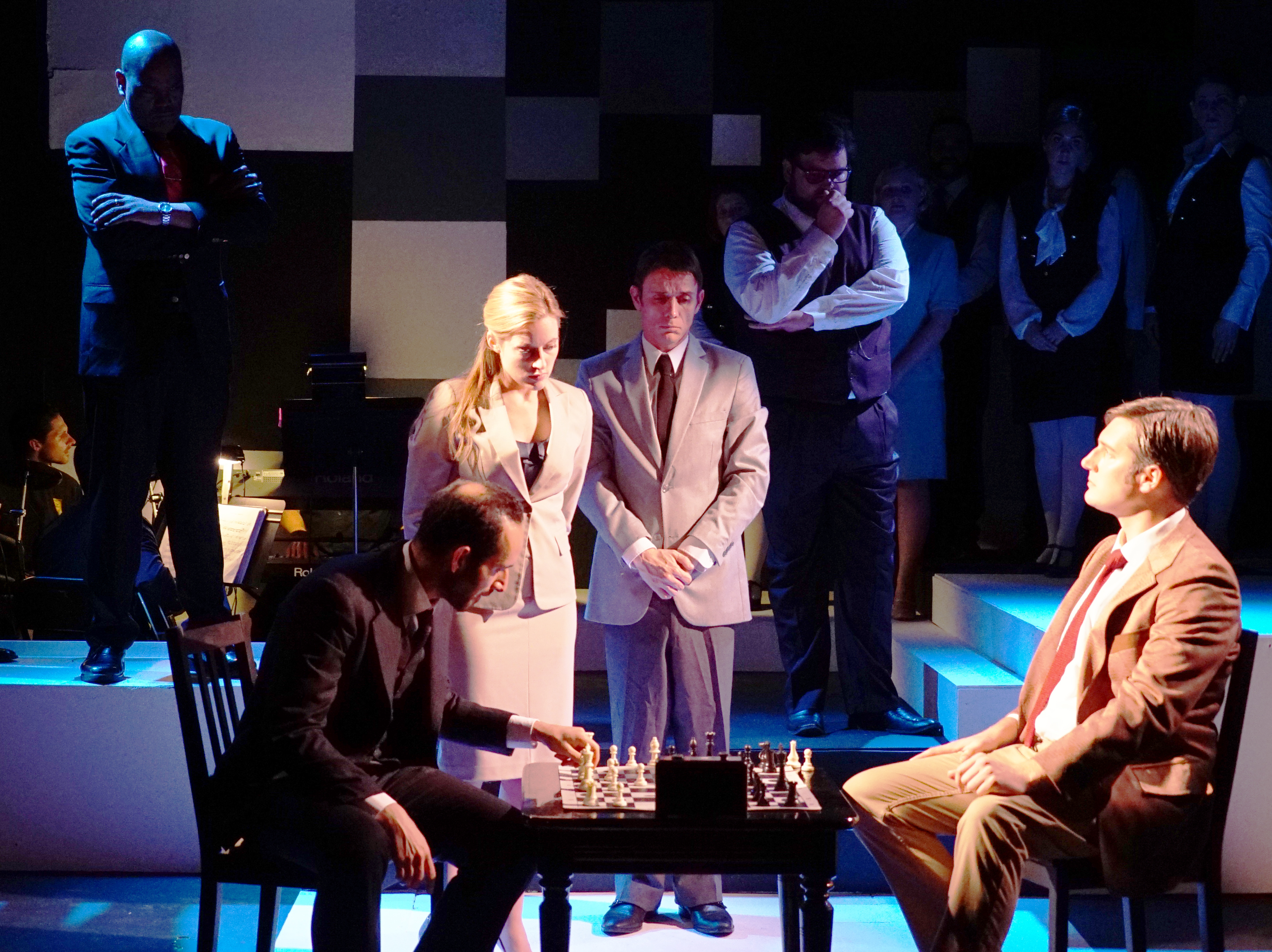
Custom Made Theatre Co. photo by Jay Yamada
The 1980s were a different time, in many ways. And I didn't go to a lot of theater in the 80s, largely because I was either in college and working or just out of college, working, and cash-strapped. So when some of my theater friends got very excited about a local production of "Chess," I didn't really have any points of reference for it.

The key element of the play is a world chess championship, pitting an American master against a Soviet master. Obviously, this derives from the famous 1972 match between American Bobby Fischer and Russion Boris Spassky that caught world attention. The tension of a Cold War era match between the US and USSR through the proxy of a chess competition is a plausible setting for a play. But a musical?

In its day, "Chess" was fairly revolutionary, starting with a musical concept album with lyrics by Tim Rice and music by Benny Andersson and Bjorn Ulvaeus of ABBA fame. The show was then staged in London, where it had a very successful, three-year run. A subsequent mounting on Broadway, considerably reimagined, was a tremendous flop, closing after two months. Where the London production was almost operatic, with almost no spoken words beyond the songs, the New York version added a lot of dialogue, rearranged the music, and was apparently nearly incomprehensible.

This Production

Fast-forward about 25-30 years, and the Custom Made Theatre Company decides to try their hand at a revival. The scale will necessarily be much smaller than the early productions, but Rice's introduction to the libretto give producers permission to cut, rearrange, and generally try out what works. So Artistic Director Brian Katz decided to try to make a production that is closer to the original concept album, and on a scale that fits his small theater.

Small disclaimer here: I apparently had a senior moment, and misremembered the starting time for the play. As a result, I got there late, and missed the start. The staff kindly seated us during the third scene. I admit it took me a bit to get into the flow of the play after that, but I think my comments are still relevant.

Actual world championship matches stretch out over months, but the play wisely chooses to minimize the actual playing of chess onstage. The show is much more about the machinations of the players, countries, and chess officials than it is about the match itself. And of course you have to have a love triangle, because this is after all musical theater.

The Play I Saw

I give Custom Made full credit for even attempting this. I have a warm place in my heart for small theaters that undertake ambitious works. And there was definitely a group in the audience that was wildly enthusiastic for this production, either because of a nostalgic fondness for the original production(s), such as the couple to my left who kept talking about that throughout the performance, or perhaps some attachment to either the show or the company, as evidenced by the hooting crowd to my right. All told, the show was well received.

I have to say I wasn't quite as taken up with things as they were. Maybe that's because I came in a little late. Maybe it's because I wasn't already familiar with the material. Maybe it's because the first thing I saw was a fairly complex number with lots of moving, singing people that didn't quite come off. It got better as it went on, but my initial impression was not great.

Anyway, full marks to the company for even attempting this show. And some of the players (notably Leah Shesky as Florence, Heather Orth as Svetlana, and Chris Uzelac as Anatoly) really have the voices to handle the music. Unfortunately, the music is quite complex and often requires a considerable range that most of the singers didn't possess, so a lot of the singers were straining to hit notes well beyond their range, which takes away a lot of the power and appeal of the songs.

Also, the stage is very small (especially with a portion of it taken up by the band), so there is not much room for the 14-member cast to move around. Thus, the choreography is necessarily constrained and simplified. But still, that was probably the weakest part of the production overall.

Finally, the size of the house constrains the singers considerably. They were making an effort to keep their voices balanced and not overpower each other or the audience. This had two noticeable effects: One, singers pinching off their voices. Ms. Shesky, in particular spent a lot of the show singing through her nose, which is unfortunate, because she has a lovely voice, and when she let it loose (notably in "You and I" late in the show), it comes through quite nicely. Similarly, I found that members of the ensemble would be singing and then their voices would just tail off or disappear. It was quite odd sounding. Two, during several numbers, there are a lot of singers doing different parts simultaneously. Since they aren't amplified and mixed, it's up to the director and the singers to make sure we in the audience hear the important bits, and mostly what I got was a muddle.

Finally, the lighting was pretty ineffective. I couldn't tell if the lights were just inadequate, or if the players were missing their marks, but there were a lot of instances where key players were poorly lit, back-lit, and whatnot. This made it really hard, even from fairly close up, to see facial expressions and smaller interactions.

Bottom Line

I'm sure that those who know and love the play were delighted to see it again, in any form. And there are elements of the play that really appealed. The second act was definitely better than the first. I'm glad I got to see it, and disappointed (in myself) that I didn't get to see all of it, as I think that would have improved my impression of the overall show.

But I give full credit to Custom Made for undertaking such a difficult and complex show. It clearly has an audience, and the loved it.

Unfortunately, I don't think the substance of the show stands up nearly as well as the music. Outside the setting of the Cold War, the intrigues of US vs. USSR and who is-or-isn't a spy and such really don't hold up as plot devices. So it's kind of a weird little slice of a very different time: interesting and sometimes enjoyable, but ultimately not that fulfilling.

I'm glad my friends who are fans got to see the show at last, and I'm glad Custom Made undertook the project, in spite of its flaws and limitations.