Showing posts with label CalShakes. Show all posts

Monday, October 3, 2022

"Lear" at CalShakes

 King Lear and I go way back. It was the first Shakespeare play that I read of my own accord, back in high school, and I wrote one of my essays on the AP English test about the play. And of course, I've seen it performed a number of times. So I was particularly interested when CalShakes announced that they would host the world premiere of a new translation of King Lear, written and adapted by the terrific Marcus Gardley and directed by Eric Ting. This is the same team that brought us the magnificent black odyssey back before the pandemic, so that bodes well.

I'll add a note about the term "translation" here. The play was commissioned by the Play on! Project that began at the Oregon Shakespeare Festival and now exists as a stand-alone non-profit company called Play On Shakespeare. I've always had sort of mixed feelings about the project, which set out to make modern-language versions of all the plays in the Shakespeare canon, presumably without altering the meaning, preferably by restoring the original meaning that might have been lost as the language shifted under the plays.

This play, Lear seems to be a further adaptation of the translation Gardley did several years back as part of that effort. I'm a little unclear as to whether this is the translation itself, or whether that exists as a thing, and then further work went into creating this play for this production.

The Play

I'm not going to try to summarize King Lear here. Suffice it to say the basic, well-known plot of the aging Lear dividing his kingdom among his three daughters based on their professions of how much they love him is still here, along with all the resulting conflicts, madness, eye-gouging, and so on. However (and here is where I have to assume this is the adaptation, not just a modern "translation" of the Shakespearean text), the whole play is set in San Francisco's Fillmore district in 1969, which takes some real imagination to accommodate. The whole cast (but for one member) is black, and the character of Kent is explicitly the countess of Kent, because she needs to be a black woman. This is one of the clear places we have departed the original intent and text. Same when the Black Panthers show up. And eminent domain evictions for urban renewal.

To my ear, most of the language modernizations are fine. Gardley has a good ear and a good writing voice, so his changes there are pretty transparent. I would actually like to see a production of his modern translation of the original King Lear, which is what I thought this was going to be. It wasn't.

A friend of mine summarized the problem rather neatly at intermission, and I'll paraphrase: I would love to see a Marcus Gardley modernizaton of King Lear. I would love to see a Marcus Gardley play that riffs on King Lear to examine the issues of mid-20th-century urban issues. This isn't either one of those, and it doesn't work. Displacement by eminent domain is not the same as a king voluntarily dispersing his lands, or a father favoring his legitimate son over a bastard.

The Production

Here is where I'm struggling to delineate between production matters and matters of the play content. As I just noted, I think the translation of the text is fine, and the acting is generally strong and the technical designs are quite good--simple but not simplistic--things don't have to move around or change much, so the actors are the focus as they ought to be. And I'm pleased that the majority of the actors in the cast are local and quite good. In the current, downsized Bay Area theater scene, any work we can get for these artists is welcome, and it's reassuring to see so many artists I've been missing these past couple of years back on stage.

Any production of King Lear is going to live or die with the actor playing Lear (in this case, James A. Williams). He was generally strong, and has a powerful voice, though I felt he needed to modulate it a bit at times. Lear is a complex character, and a lot of that complexity can come through the variation of volume and tone in his voice. The daughters were generally strong, particularly Goneril (Leontyne Mbele-Mbong) and Cordelia (Sam Jackson). Regan (Emma Van Lare) had a few lapses in her lines, which is hard to take at the penultimate performance in the run. Dane Troy and Jomar Tagatac as half-brothers Edgar and Edmund do a terrific job. Troy particularly works well as "Tom", guiding his blinded father Gloucester (Michael J. Asbery, who has a wonderful, commanding voice). And the always wonderful Cathleen Riddley handles Kent very well, serving as the moral center of the play.

I would be remiss not to mention the excellent, live jazz soundtrack (sometimes augmented by the Black Queen (Velina Brown)) and the overall excellent blocking of the scenes. It's a very effective presentation, with the slight exception of a scene played to the extreme side of the stage, which is utterly invisible to part of the audience in the front rows.

Bottom Line

This feels like a wasted opportunity. With such a good writer and talented artists, this had the chance to be a real landmark production, as we saw with black odyssey. Unfortunately, neither the playwright nor the director seemed to know what they wanted to do, so instead we get a mashup that lurches from King Lear to the Fillmore and back, none of it fitting together. I hope Gardley can go back and find his Bay Area play hiding in the background of Lear. There are certainly enough touchpoints that he could manage it. But trying to incorporate the literal text and plot of King Lear into this completely different scenario is futile, and does a disservice to both.

I'll leave with just a couple of last comments. One of the choices I found inexplicable was the discarding of Lear's fool, who is such a key element of Shakespeare's play. There are lots of ways to interpret the fool, but this play chooses to replace the fool with a stand-up comic (who also sits down in one scene). There's nothing particularly wrong with that, as long as you're not trying to tell the story of Lear. But much of King Lear doesn't make sense without some incarnation of the fool. This strikes me as another case of trying to straddle the translation/adaptation chasm without a clear idea of why or how it will work. It also strikes me that Ting used a similar device (entirely out of whole cloth) in his production of Othello several years back. I didn't think that worked, either.

And finally, the powerful speech that Kent delivers to close the play, which is in some ways the whole justification for making Kent a woman, has the character noting how apt it is that a black woman has to clean up after everyone. That's a great message, but one that is sorely hampered by the fact that the mess in question was largely created by Lear's daughters, who are also black women. Again, a problem that seems to have been created by not knowing what play the writer and director actually want to do.

So I was terribly disappointed in this play. I had very high hopes and expectations, and feel that the artists were not well served by either the writer or the director. Eric Ting, who I deeply mistrusted after he made his CalShakes debut with Othello, had earned my trust with some really good work in subsequent years. Sadly, with this being his final production as he leaves CalShakes, I'm left with a disappointing memory.

I should note that the production closed yesterday, so you'll just have to take my word for it.

Tuesday, September 18, 2018

"The War of the Roses" at Cal Shakes

Cal Shakes photo by Kevin Berne
As I noted recently, there are not very many Shakespeare plays that I have yet to see performed. Among those is the set of history plays collectively depicting the life of Henry VI, which comes in three parts as written. Because of its sheer length and verbosity, the trio of Henry VI plays is rarely produced at all, and is generally condensed considerably. So I've seen bits and adaptations, but never a full version.

I'm in something of a quandary now, after seeing the California Shakespeare Theater production of The War of the Roses, which they describe as adapted "from William Shakespeare's Henry VI trilogy and Richard III". Totaling almost four hours (including an intermission), Roses is roughly half and half of the Henry plays and Richard III. So I still haven't seen a full version of Henry VI, but I have now seen a lot of it.

The Play

As usual, I'm not going to try to summarize the plot of Shakespearean history plays. This basically picks up with the untimely, relatively young death of Henry V, whose son Henry was crowned king as an infant. His uncle Humphrey, Duke of Gloucester, served as Lord Protector until Henry achieved his adulthood and dismissed him. Meanwhile, the French territory won by Henry V was slowly frittered away, and ultimately bargained away by the Earl of Suffolk, who has designs of his own. So there is dissension and unrest in England under Henry, and lots of intrigue and machinations within the extended royal family.

The big split in the ruling Plantagenet family comes between the factions nominally supporting Henry (including Suffolk) called the House of Lancaster, and opposing him, led by the Duke of York and called the House of York. The factions signify themselves with red or white roses, respectively. Hence, the name of the play. Because the conflict does devolve into civil war (more than once) between the factions.

And of course loyalties switch as we go along. Ultimately, this all traces back to the same contested lines of succession that characterize the several generations (and four Shakespeare plays) reaching back to Richard II and his rival, the eventual Henry IV. Rising from the ruins of the House of York as the Henry portion of the play winds down, York's sons, including Richard, who will eventually connive his way to the throne as Richard III.

It's a lot to keep track of over the course of many hours. The program had helpful text and illustrations to help out, but mostly it's just fun to watch all the backstabbing and manipulation.

The Production

Given the plethora of characters in the story, they manage to cover them all with a relatively modest sized cast. Everyone plays multiple roles, but never at the same time. As director Eric Ting noted in his curtain speech, the actors only assume new roles when their previous characters die. As luck would have it, lots of characters die in this play.

There are some really terrific performances in this show. Several veteran local actors provide their usual excellent contributions, including Stacy Ross (Humphrey, Edward IV, and the Dutchess of York), Aldo Billingslea (Warwick, Buckingham), and Catherine Leudtke (Winchester, Elizabeth Grey). Some of the younger local stalwarts put in great performances, too, notably Lance Gardner (Suffolk, Rivers, Tyrrel) and Jomar Tagatec (York, Louis XI, Stanley).

I can't go without commenting on the performance of dependable local actor Danny Scheie as Richard III. As he grows from one of York's vengeful sons to become Duke of Gloucester, his menacing, conspiratorial, and eventually maniacal behavior grows steadily and rather quickly. Unfortunately, by the time he's becoming King Richard III, there's not much room for him to build anymore, so it gets a bit old. Also, his years of comic roles seem to seep into his Richard at somewhat odd moments or in inappropriate ways. Overall I found his Richard III much less compelling than his younger roles, which surprised me because if anything, he's a bit old even for the older role.

Throughout the production, Joshua Pollock provides an effective soundscape with is guitar from the side of the stage, and occasionally supplies lines for minor characters (and eventually takes the stage as Catesby toward the end). The set designed by Nina Ball is relatively unobtrusive most of the time, but they made good use of it, particularly as numerous characters were confined to The Tower (never a good sign). The throne at the center of the stage (nearly the whole time) makes for an effective center to the story. After all, that's the thing all the conflict is about.

Bottom Line

Although Richard III is a reasonably well known piece, the Henry VI trilogy is pretty rarely performed. But as noted above, a lot of Richard's early development comes in the latter parts of the Henry plays. This adaptation (by Ting and Cal Shakes dramaturg Philippa Kelly) trims the politics around Henry almost to the bone, such that if you don't know the story, it might be hard to follow. On the other hand, it move pretty quickly and preserves most of Richard's bits. I gather Ting and Kelly each wanted to do either Henry or Richard, and compromised by doing both. I suppose it works. I doubt a strictly Henry production would have drawn the degree of interest, and Richard is less interesting without the lead-in.

Ultimately it's nice to see Cal Shakes dipping a bit deeper into the canon for material. Under Ting's artistic direction the company has moved to diversify its offerings in general, so it's nice to see them choosing some less common Shakespeare works, too.

Overall I would say the show was worth seeing: I always enjoy an evening in the outdoor theater, and this one was well done and different. Unfortunately I had to reschedule my original date (because of our trip to Stratford), so ended up seeing the show's penultimate performance, so it's already closed by the time you read this.

But I will say that I enjoyed all three shows of the Cal Shakes season this year, and am looking forward to seeing their remount of last season's black odyssey in a couple of weeks. That should be really good.

Tuesday, July 10, 2018

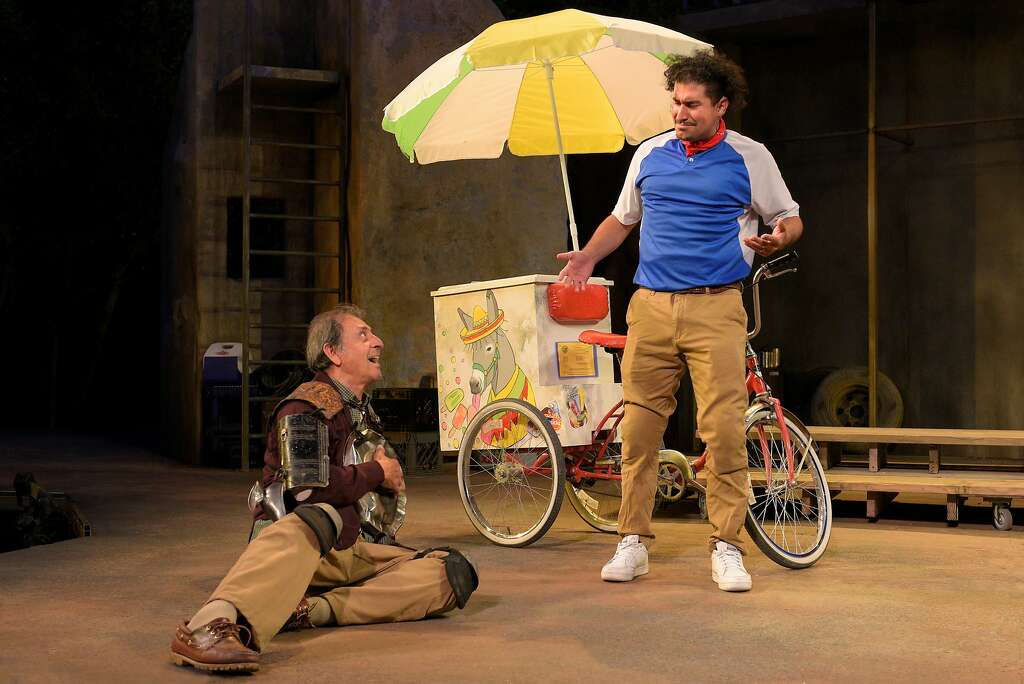
"Quixote Nuevo" at Cal Shakes

Cal Shakes production photo by Kevin Berne
Continuing a month of June that contained so many plays that I'm having to wait until July to write about it all, here comes Cal Shakes with the world premiere of Quixote Nuevo by Octavio Solis. Somewhere in the fine print in the program is an indication that this is related to an earlier take on Don Quixote that premiered at the Oregon Shakespeare Festival in 2009, which I also saw (my first ever show in Ashland!). But I don't remember it very well. I wasn't blogging about theater back then, but I did find some notes on a more general blog. Definitely a different show!

The Play

Unlike the show in Ashland a decade ago, this is not a telling of Cervantes' Don Quixote, but rather a retelling of a similar story set in modern Texas. La Plancha, Texas, to be precise. So our Quixote is an aging, Latino Texan who seems to be losing a lot of his mind. His family is trying to take care of him, despite very limited resources. And lately, as they are about to move him into a home, he's having visions brought to him by a calaca, a skeleton or spirit of the dead. He begins to see himself as the legendary knight Don Quixote, and recruits a local to be his squire, Sancho, as he searches for his lost love across the border, Dulcinea.

It's really quite a sweet story, as we watch our Quixote drift in and out of lucidity, and we sometimes see the world as he's imagining it, sometimes as those around him see it. Moving back and forth over that line is an effective tool, and Solis handles it well.

Particularly touching is the way so many people try to help our errant knight, realizing he's old and not in his right mind, and trying to thwart those who would take advantage of him.

The Production

This show continues a trend of impressive productions at Cal Shakes, though I have to say the amphitheater wasn't full, and not nearly as full as I've been used to seeing. I hope that doesn't reflect a drop in their attendance overall, because I think the quality of their shows has been trending upward the last couple of years under new Artistic Director Eric Ting.

I will admit this show set off one of my alarms, when I saw they'd imported a guest star who is best known for his TV work. Emilio Delgado plays our aging Quixote, but he's best known for a 44-year run as Luis on "Sesame Street". That's not exactly an obvious set-up to a leading stage role. But I was pleasantly surprised. Delgado handled the complex role with aplomb, managing to be charming and vulnerable and dashing and humble and all the characteristics needed for both his real self and his imagined knight.

I thought the acting was quite good throughout, with Juan Amador particularly effective as the supportive Sancho and Hugo Carbajal playing the difficult role of Papa Calacas, leading our Quixote ever farther astray. Sol Castillo as a very worldly Padre Perez, Amy Lizardo as Juana, and Gianna DiGregorio Rivera as Antonia also stood out for me.

The set design by Annie Smart was fine, though nothing particularly spectacular, but I thought the props and costumes (by Ulises Alcala) were particularly effective and often comical.

All in all, I thought it was a touching and smooth production, which suits both the Quixote story and the path of our aging protagonist. Director KJ Sanchez kept things moving and coherent, which is often a challenge with new works.

Bottom Line

Another solid and enjoyable production by Cal Shakes. I appreciate their efforts to tell stories beyond their core set of Shakespeare and American classics, reaching out for good stories from different cultures. I truly hope that was not responsible for the number of empty seats around the theater, because this was a good show that deserves to be seen.

Solis has managed to take the familiar tropes of the Don Quixote story and turn it into something nuevo, touching the modern issues of aging and the contemporary issues of the U.S.-Mexican border with the humor and charm of Cervantes' characters. For me, this was a much more approachable version of Don Quixote than the distantly-remembered version I saw at Ashland almost a decade ago.

Unfortunately, this seemed to be a really short run, and we saw it in its last week, so it's now gone. But you should keep an eye open for this show and for the work of Octavio Solis. Seeing what he's done with the Quixote story over time suggests to me that he's an impressive and talented writer, and I'd like to see more of his work.

Monday, January 1, 2018

Best of 2017

I've been told that one of the requirements, now that I do a Theater Blog, is that I must commemorate the end of the year by doing a "Best Of" post to say what was best this year. Since 2017 was my first full year of Theater Blogging (Yep...we started in May of 2016!), this will be the first time I can really look back over a year of posts and opine on what really stuck with me, which is my criterion for "Best Of". Unless I decide it isn't. Stay tuned.

I will preface this with a side note that on the whole, 2017 was not a good year for me at all. Personally and professionally, this year has actually kind of sucked, and even my frequent respite at the ballpark was not its usual pick-me-up. But for the most part, theater--and particularly theater people--has truly kept me going. On the whole, the friends I have made through going to the theater and being involved with theater are some of the most positive, supportive people I have ever known. You know who you are, and thanks for being there for me.

Now then, theater stuff...

Best Plays/Productions

These are the plays that really stuck with me, for one reason or another. I'll list them in the order I saw them. No other ranking is implied unless I say so. I will include links to my original postings for each of them, in case you missed my musings the first time or just want to see if I lost my mind in between or something.

If I can find a theme to my "best" list, it's mostly that they almost all manage to tackle an issue that is pertinent to the day and explore it in a non-obvious way. 

"Hamlet" at Shotgun Players

Fortunately, the repertory portion of Shotgun's 2016-2017 season ended in January, and much of what I saw in January was more Hamlet. I believe I ended up seeing it about 18 times, with only one repeat casting. The shuffling of actors was amazing to watch and very educational. I learned a great deal about Hamlet and about theater from watching these shows, and my only regret is that I didn't manage to go more often. The seven actors plus one understudy deserve medals for performing in this show. And extra medals for the fact they were also performing in at least one additional repertory show each. It was just an extraordinary experience, the likes of which we are not likely to see on a Bay Area stage again any time soon.

"John" at ACT

This was the first show I felt really showed off the value of ACT's new second stage at the Strand Theater. The show was quirky, but it really kept me thinking about it for quite some time, and that's what good theater is about.

"Leni" at Aurora

Once again showing my fondness for the intimacy of small theater spaces, this little show in Aurora's second space really showcased the talents of actors Stacy Ross and Martha Brigham and brought some history to life in a thoughtful and timely way. It was an innovative and thought-provoking show, well directed by Jon Tracy.

"Sisters Matsumoto" at Center Rep

This was a very powerful and beautifully staged performance of a story that really resonated. Particularly having just seen TheaterFIRST's Beneath The Tall Tree, which also dealt with Japanese American internment, it was moving and thought-provoking and made me aware of aspects of that period and its aftermath that I hadn't been aware of.

"The Events" at Shotgun Players

My buddies at Shotgun really kind of went off the rails on some things these past couple of years. Staging The Events requires a different community choir on stage for each performance. As such, it was informative to see the play more than once (and I did). Not only did this help cement for me the value of seeing plays more than once (I also saw Hamilton for the second time around the same point), but it made me appreciate both the difficulty of incorporating different outside groups into a play and what that actually means to this particular show. This is a tough but important and certainly timely play about the resilience of both individuals and communities to sudden, shocking events.

 "As You Like It" at CalShakes

As the only comedy on the list, this seems a little odd (note that I have a separate section for comedies later). But I was moved and surprised by this CalShakes production. I usually don't expect much thought to ensue from a Shakespearean comedy, but Desdemona Chiang's interpretation of this play of mistaken identity broadened the issue to cover personal and gender identity, and did so smoothly in a fine production. This was also the start of a very strong season for CalShakes.

"Grandeur" at The Magic Theater

I went into this play knowing almost nothing about it, and left absolutely stupefied. Carl Lumbly exceeded even the lofty expectations I have of him, and the play was riveting. It's not earth-shakingly important, but it shows just how effective a small play can be. I was extremely fortunate to be sitting in the front row, in the seat closest to the chair where Lumbly sat for much of the play, so I got to watch him up close, and it was amazing.

"Mojada: A Medea in Los Angeles" at Oregon Shakespeare Festival

I would normally expect at least a couple of plays from our summer jaunts to Ashland to land on the "Best Of" list for a year, but this year wasn't overall that impressive up there. But Mojada was a knockout. The adaptation of the well-worn story of Medea is almost obvious in retrospect. The portrayal of undocumented immigrants trying to assimilate (or not) and the consequences for them personally and socially is excruciating, but very effective.

"An Octoroon" at Berkeley Rep

Everybody's trying to push your buttons this year, but this time Berkeley Rep got it right. It's a super complex script, as you might expect from a hotshot playwright who has won just about every award imaginable. What I didn't expect was that Berkeley Rep would find the right director and cast, and that that director would be Eric Ting, who had previously disimpressed me with his direction of Othello at CalShakes. This production was pretty much spot-on. We're still talking about it, almost six months later.

"black odyssey" at CalShakes

I would never have guessed at the start of the year that Eric Ting would direct even one, let alone two, of my favorite productions. But here he was, coming right off the triumph that was An Octoroon, directing local playwright Marcus Gardley's wonderful adaptation of "The Odyssey" into a story of African American life. And it packed the Bruns Amphitheater every show, bringing in rafts of people who do not normally make the trek to Orinda to see a play. This was terrific storytelling.

"The Farm" at TheatreFIRST

Another artist making his second appearance on the list is Jon Tracy. Having directed Leni for Aurora earlier in the year, he also re-adapted his adaptation of Orwell's "Animal Farm" for TheatreFIRST, and the result was delightful and moving. This modest production reminded us that we don't have to be big and fancy to tell an important story. The reboot of TheatreFIRST is having sort of uneven results, but The Farm was definitely a sign of what a dedicated bunch of theater artists can do with limited resources.

Comic Relief

Most of the plays that really stuck with me this year were dramas. Maybe it fit the rhythm of my own life, which had way too much drama in it this year. But there were funny plays that made an impression on me, and they deserve some recognition, even if they weren't overall the "best" things I saw this year.

"Noises Off!" at SF Playhouse

This is one of those kind of classic plays that I had always heard of by never seen. I love the intricacy of the plotting and staging, and felt that for once, the rotating stage at SF Playhouse really was an asset. And the play is just screamingly funny, both because of all the theater in-jokes and because of some real character development. I liked both the play and the production here very well.

"The Play That Goes Wrong " at Lyceum Theatre (NYC)

This play isn't nearly as deep as Noises Off!, but the production we saw in New York this fall was absolutely the funniest thing I've seen on stage in a long, long time. The comedic timing and the convoluted set design were truly impressive. I needed a good laugh, and this provided it.

Spectacles

This is a category I just made up to salute the shows that just make you drop your jaw a bit at the stagecraft. There were some pretty over-the-top productions out there, even if they weren't among the shows that I deemed "best" overall.

"Needles and Opium" at ACT
"Monsoon Wedding" at Berkeley Rep
"A Thousand Splendid Suns" at ACT
"The Black Rider" at Shotgun Players

I won't go into them in detail again. Suffice it to say that in each case I was less than delighted with the play, the message, the storytelling, or something. But in each case the stagecraft, design, music, dancing, lights, and so on were dazzling and worth recognizing.

Musicals

I saw a fair number of musicals this year, but none that really rose to the level of "best"-ness required to make the big list. But I thought I should mention the ones that stood out, because musicals can be special in their own right, and if they are your thing, this is important.

"Good Night, Good Night, Construction Site" at Bay Area Children's Theater
"Hamilton" (touring) at SHN San Francisco
"La Cage Aux Folles" at SF Playhouse

Other

I can't think of a category it really fits into, but Taylor Mac's A 24-Decade History of Popular Music at the Curran was like nothing I have ever seen before. I realize now that I never got around to writing up the portions of the show that I saw (I saw only the first two 6-hour segments, so didn't feel I could really comment on the show as a whole). This mash-up of musical theater, cabaret, drag show, and history lesson amazed me on a bunch of different levels. The subversive way Taylor Mac gets into the heads and under the skins of the audience while knocking out a really impressive array of popular tunes in ways probably never seen or conceived before just boggles the mind.

I truly have no words to describe the whole experience, and in any strict definition, it's not really "theater" per se, but it is, too. And it probably stuck with me more than any other performance I saw this year, so it needed to be included here.

Personal Bests

If you'll allow me to conclude with a moment of self-indulgence, there were two other productions that were particularly meaningful to me personally this year, so I just get to put them in the "Best Of" post as kind of a footnote.

My Professional Stage Debut

Yes, those loons at the Shotgun Players not only allow me to sit on their board, they also offered me a tiny role in their staged reading of Tom Stoppard's Rosencrantz and Guildenstern Are Dead last January. And hey, we sold out and got extended, so I had three glorious nights on stage with a bunch of real, professional actors, and I have the check to prove it.

This makes the list not because I was any great revelation on stage or because it changed my life or anything like that. But there were two important takeaways from  the experience: One, I got to see firsthand, close-up, just how real theater artists work. Rehearsing, dressing, blocking, designing and redesigning--all of it. It was glorious. And it gives me all the more respect for the work these people do, day in and day out, to produce these plays that I enjoy so much. But just as important, two, after seeing me onstage, my daughter said, "Well if Dad can do that, I can do that." And promptly signed up for her first real staged play.

Which obviously leads me to...

"Assassins" at Berkeley Playhouse Teen Stage

About six months after my little dalliance on stage, there was my daughter, singing and dancing and trying (futilely) to shoot Gerald Ford on the stage in the Julia Morgan Theater. It's still not one of my favorite plays ever, but she got out of it exactly what I hoped: she found a wonderful community of like-minded, creative, accepting people who share a love of making theater and support each other while they do it. She's now working on her second show, already signed up for another, and planning one more for the summer.

Which just goes to show, we can always handle more theater, so we obviously haven't reached the mythical "Too Much Theater" yet, and the quest must continue.

Thursday, October 5, 2017

"Measure for Measure" at California Shakespeare Theatre

California Shakespeare Theatre photo by rr jones
Cal Shakes wraps up its season with a bit of Shakespeare, albeit one of the odder comedies, given that it sort of flaunts a lot of the conventions of the comedic genre: Measure for Measure. But on the heels of such strong productions earlier in the season, my expectations were quite high. I have to say this production was a bit of a let-down from the quality I've come to expect, but it was not without merit.

The Play

I call Measure odd for a comedy in part because it's quite dark, with characters condemned to death and relatively little of the lighthearted banter I associate with Shakespearean comedy. And even the "happy" ending with marriages is not quite the mega-happy outcome one might expect. Director Tyne Rafaelli's states in the program that she sees the play as being "essentially about a political regime change," which really is pushing it. Although the interim duke (Angelo) aspires to wield power, it reminds me more of when Mike Curb was California's Lieutenant Governor under Governor Jerry Brown (the first time around). Every time Brown would leave the state, Curb would issue orders as Acting Governor, which Brown would then countermand as soon as he returned.

This is much like the play, where Angelo rather runs amuck, though the actual Duke is disguised and watching the whole thing play out. Although Angelo is literally playing with matters of life and death, we know the Duke is going to unravel it all, so there is no real regime change here, just aspirations of power. The other themes she cites, though, justice versus mercy and love and (especially) forgiveness, are all quite clearly there, and (to me) much more important to the play.

Although the production makes some attempts to soften the edges of some of the more atavistic aspects of the play such as bartering a woman's chastity for the life of her brother, the choice of setting the action in a distinctly modern setting makes much of the action seem even less plausible than normal. This strikes me as a needless attempt to make a play feel more relevant and approachable to a modern audience. It's really quite clear how all of this pertains to contemporary life without the modern costumes and music and such.

The Production

I've already strayed into some of the aspects of the production, but now let's focus. The set design by Annie Smart is quite nice, though a little busy, requiring a fair amount of running up and down stairs that seemed gratuitous. And Cal Shakes seems to have a thing about sliding doors. It was better here than in some of their previous designs (I'm looking at you, Glass Menagerie), but still rather excessive.

But visually and audibly, the production clashes with its setting. In the absence of the Duke (Rowan Vickers), who wears a rather normal, modern suit, Angelo (David Graham Jones) and Escalus (Tristan Cunningham) and the Provost (Patty Gallagher) go quasi-Nazi drag in outfits that look like Scandinavian Airlines dressed its flight attendants at the Folsom Street Fair or something. It sort of works when we get to the various scenes of police brutality and such, but hardly in line with the strict piety that Angelo supposedly presents. Similarly, Isabella (Lindsay Rico) is dressed appropriately in a white shift, about to take her vows as a nun, but at the same time is searing black boots with clear heels that look most un-nunly, like she's about to hit the disco. And the music...even after reading sound designer Brandon Walcott's statement in the program, I can't fathom how the blasts of music were meant to advance my understanding. The early sounds were so jarring that I just forced myself to tune them out later.

And finally, the language. In this summer's OSF production of Off The Rails, an adaptation based on Measure for Measure, many of the best bits were the parts that were actually Shakespeare's language, the beauty of which was soothing and lovely, in spite of being set in the American west. But in this Cal Shakes rendition of the actual play, the poetry and majesty of the language seem to have been sacrificed to the modernization of the setting. I'm not clear whether it's the intention to deliver the lines this way, or whether the actors just aren't up to the challenge of the text, but most of the language comes across flat, almost stilted. And that's too bad, because one of the redeeming features of this rather troubling play is the beauty of the language behind much of it.

Bottom Line

As you can tell, I was disappointed. The strong, extremely professional productions of the first three plays of the season really set my expectations high, and this just didn't measure up to that. Although I liked the set and the lighting was effective, the rest of the design and direction just weren't of the same caliber, and the acting was OK, but not nearly at the level seen earlier in the year.

So it was definitely a disappointing end to the season. Overall, I thought the quality of the shows at Cal Shakes this year was terrific, much better than in past seasons. I hope the earlier shows are a better indication of what to expect in the upcoming year, because they have committed to some very challenging material. We'll have to wait until next summer to see how it turns out.

Saturday, September 2, 2017

"black odyssey" at California Shakespeare Theatre

Cal Shakes photo by Kevin Berne
I suppose it's pretty rare to see two wildly different productions, both based on the same story, so close together. On the other hand, the classic stories get retold and repurposed, so having seen The Odyssey at Ashland earlier in the summer, it was extra interesting to see Marcus Gardley's black odyssey this week at Cal Shakes.

I've been so impressed with the first two productions of the 2017 season at Cal Shakes, I was really looking forward to this one. And on top of that, I'd been quite disappointed in Eric Ting's direction of Othello last season, so I was intrigued to see what he would do this time.

The Play

Unlike the Ashland production, which was a pretty straight adaptation of the Homeric epic to the stage, Gardley takes a different path, adapting the well-known tale to tell a similar, but different, story of a man lost and found again. This time, Ulysses Lincoln (J. Alphonse Nicholson) is a contemporary U.S. soldier trying to find his way home from the wars in the Middle East, but he has angered the sea god, Paw Sidin (Aldo Billingslea), who is in turn in conflict with both his brother, Deus (Lamont Thompson), and Deus's daughter Aunt Tina (Margo Hall). Tina tries to protect her nephew Ulysses, while Paw Sidin wants to kill him, or at least keep him lost. But Ulysses wants to get home to Oakland, where he left his wife Nella P. (Omoze Idehenre) and unborn son Malachai (Michael Curry). Over the sixteen years it takes Ulysses to come home, Nella will lose some of her faith in him, tempted by a suitor who is really Paw Sidin.

Along the way, Ulysses faces the temptations you would expect, sirens, enchantresses, etc. But there is always another meaning. Because Ulysses is not just a soldier lost in the war, he is a black man who has lost his way, lost his faith in himself. So his odyssey is not just about coming home, but really the struggle to find himself and his place in history.

Adapted a bit for the local staging, the script is full of references to local landmarks and icons. This is very much a show about here. At times the local color seems a bit overdone, trying to be just a bit too cute. But overall it does a good job of grounding the play in the here and now, especially because the content, being an odyssey, is so unmoored from time and place. Gardley handles that part quite masterfully: it is remarkably clear what is happening, and though the connection to the original epic is a helpful reference for those who know it, the story as told stands on its own as well. It's a remarkable and powerful piece of writing.

The Production

In addition to some localization of the story to the east bay, Cal Shakes has provided two composer/directors, Linda Tillery and Molly Holm, who weave African-American spiritual songs into the tapestry of the play, providing a strong undercurrent of culture drawing Ulysses along his path. Along with the interventions of Aunt Tina, who drops her immortality to aid her nephew, Ulysses manages to eventually move along to his proper path, meeting important guides along the way.

I haven't even gotten to mention the rest of the ensemble players, Safiya Fredericks, Michael Gene Sullivan, and Dawn L. Troupe. The whole group is extremely strong, both as character actors and musicians. In fact, the entire cast is one of the most solid, balanced groups of its size I've seen locally in quite a while.

The design of the production is good, though not spectacular. Michael Locher's scenic design seems rather familiar, like I've seen it or things rather similar on this stage before. [Can I say I'm getting a little tired of the framed doors that move on and off stage? It was a useful idea, but is getting a bit overdone.] And the staging doesn't really take full advantage of the expanse of the stage. The action is largely focused in the middle of the stage, which makes the whole thing feel just a bit less, well, epic.

But truly, it's a high-quality production, masterfully acted by all. If I have to call out the truly outstanding performances, I would probably point to Hall, whose physical presence can dominate scenes in multiple ways, and Billingslea, who ranges from comical to threatening with almost no visible transition, really embodying the vagaries of a powerful but rather immature god.

Bottom Line

I liked this show a lot. I wish I'd been able to see it earlier in the run so that I could perhaps direct more people to see it. On the other hand, most of the run has been completely sold out, including the remaining shows this weekend before it closes. And that is well deserved. This is the third straight excellent production in the 2017 season for Cal Shakes. And I am pleased to say I thought Ting's direction of this one was spot-on.

In his role as Artistic Director, Ting has clearly made a commitment to improving the diversity on the Cal Shakes stage. This is the second consecutive show with a full cast of people of color. And this one (though Glass Menagerie, too, in a different way) really shows the power of adapting a classic tale to present the story of a different culture. One might initially think a Greek epic would be an odd vehicle for a story of a modern African-American in search of his personal and racial identity. But Gardley's adaptation of Homer is really strong here. It's clever, often funny, decidedly poignant, musical, and impactful. The crowd seemed almost reluctant to leave, and the discussions I overheard on the way out were varied but almost all focused on aspects of the play. And that's one mark of a successful production.

Good stuff. Good luck getting a ticket to one of the last two shows!

Tuesday, August 1, 2017

"The Glass Menagerie" at Cal Shakes

Cal Shakes photo by Kevin Berne
So the night after seeing the rather disappointing Splendour at Aurora, we headed over the hill to see Cal Shakes' production of the Tennessee Williams classic, The Glass Menagerie. I'm sure I have expressed before how much I enjoy seeing plays outdoors in the Bruns Amphitheatre. It's a lovely spot with nice weather. And unlike the night before, I had expectations about the play, having seen it previously.

The Play

The Glass Menagerie is a family drama about (among other things) respectability and the facades people put up to appear respectable to others. It's also a remarkably prescient piece about children who "fail to launch." Set in Saint Louis, Missouri, in 1943. Framed by narration by Tom (Sean San Jose), we get the story of Tom and his sister Laura (Phoebe Fico) who both live with their mother, Amanda (Karen Aldridge). Tom works a dead-end job to support the family. Painfully shy, "crippled" Laura sits home listening to records and playing with the eponymous collection of animal figurines. Amanda, who had hoped for more from her life, craves the respectability that she believes she had in her youth as a popular social butterfly. Tom takes refuge "at the movies," though he seems to come home very late and very drunk most nights, while Amanda frets that Laura does not receive any "gentleman callers."

Eventually Amanda convinces Tom to invite one of his coworkers (Rafael Jordan) to dinner, hoping that this gentleman caller will be the turning point for Laura and the family.

The Production

The first and most obvious production choice was the casting of all actors of color. The Wingfield family is normally portrayed as white, but other than some early, racially insensitive remarks by Amanda, the story works well with the casting of minorities. Indeed, it serves to remind the audience how universal many of the themes of the play are. Aldridge plays the former debutante to a T, blending the frustrated Southern gentry with the thwarted social climber largely without the histrionics that the role often seems to entail. And San Jose bring a flippant, insouciant air to Tom that masks much of the bitterness that can easily overcome that character. Indeed, all the cast manage to make their characters much more likable than I have previously encountered or envisioned, and that's a pleasant change. The fact that the interpersonal fireworks are kept at such a low level actually makes the story all the more powerful. Instead of shouts and tears we get real intensity and repressed emotion.

Although I ultimately came to feel the set was pretty effective, the start from a basically empty frame that was then filled in with furnishings and decoration was distracting. And then we had to make sure we opened and closed the sliding door/walls, because they were there. It could have been worse, but it felt overdone.

The production also made good use of the amphitheater space, with Tom especially covering a lot of ground as he left for work or the movies, still engaged with the action on stage.

But ultimately it was about the actors and the words, and those were very good. The actors treated the text with respect, letting a natural presentation of the dialogue and interactions focus our attention on the story and the situation, rather than drawing attention to themselves.

Bottom Line

I liked it, much more than I expected to. The cast were all excellent, really bringing Williams's words to life in a way that was both appropriate to the period but also accessible to the modern sensibility. The show was not about people in 1943, but just about people.

Sadly, this show has also run to its end before I could get around to writing about it, but combined with the strong effort of the season-opening As You Like It, this bodes well for the two remaining plays of the season. I'm feeling good about subscribing to Cal Shakes this year!

Saturday, June 10, 2017

"As You Like It" at Cal Shakes

Cal Shakes photo by Kevin Berne
I believe I might have mentioned in a recent post that I'm a sucker for weddings. Well, that makes As You Like It pretty much the ultimate trap for me, since it ends with a full set of four weddings. I had wanted to see this Cal Shakes production when I heard that Desdemona Chiang was directing it, as I really appreciate her insight and creativity. What I hadn't realized until I counted things up tonight: this was the only one of Shakespeare's comedies I hadn't yet seen on stage.

And that's odd, really. I'm unclear how I managed not to see it at least once. My wife remembers seeing it in Ashland in 2012, but for some reason, though I was there, I didn't see it with her. I'm guessing she saw it with our daughter while I saw something else that wasn't age-appropriate for the younger generation. Anyway, the Comedy portion of the Shakespeare canon is now complete for me. Cool!

The Play

Giving a summary of a Shakespearean comedy is pretty pointless. There is confusion of identity, cross-dressing, lost relatives, love triangles (or other shapes), and at least one wedding at the end. This is no different. Plus we get shepherds and a really great motley coat.

But in a bigger sense, this is a play about identity. Part of it deals with the superficial kind of identity, like "who is this person I don't recognize because he is now wearing a hat" that pervades these plays. That's fun and important to the plot, of course. But in a deeper sense, it's more about the self-identification of the characters. For example, a duke is banished by his brother, who usurps his dukedom and sends him off to live in the forest. Rather than sitting around, angrily plotting his revenge and reinstatement, the deposed duke makes peace with his new, rustic life. Similarly, his later-banished daughter escapes to the same forest in disguise and has some interesting explorations of gender identity while disguised as a man and still being wooed by her love interest. A courtier clown falls for a shepherd and the country life.

Much of the play centers around characters coming to grips with who they are, rather than who they thought they were, or who others expect them to be. In the hands of director Chiang a crew of able designers, and some choice music, this becomes a timely vehicle for examining class and gender roles.

The Production

Despite being nearly two-and-a-half hours long (with an intermission), the play feels snappy and engaging. This is in part because there are almost no discernible scene changes. Most are either extremely brief and fluid or just subsumed into the flow of the play. Nina Ball's lovely set transforms quite brilliantly from Duke Frederick's court to the Arden forest, which in this production is actually a dilapidated urban warehouse (really, it works). The transition is handled brilliantly both in the moment and as characters from court later arrive and find themselves in the "forest." Somehow we just accept that there are shepherds and deer here.

The use of some key double casting also facilitates the change of scene. The redoubtable James Carpenter starts the play as the usurper, Duke Frederick, but deftly transitions into his brother, the banished Duke Senior. And Warren David Keith jumps back and forth several times between the servant Adam and Touchstone the clown, to good effect. Jomar Tagatac provides a strong physical presence as both the wrestler, Charles, and Jaques, who slips from foreground to background as easily as he hops onto a platform.

The central characters (to the extent the play has a center, which is debatable) of Rosalind and Orlando are quite strong. Jessika D. Williams resists the temptation to ham up the cross-dressing role as Rosalind dresses as the male "Ganymede," and Patrick Russell, though love-struck, manages to remain remarkably controlled and seems to be understanding the scenario as it develops, rather than simply being smacked by a big reveal at the end. Indeed, the whole production, though humorous, mostly avoids playing for yucks, and instead opts for a more subtle, nuanced playing of the gender roles and relationships.

The ensemble is strong, and the whole production flows so smoothly that intermission feels almost like an interruption (though a necessary one).

Bottom Line

This is a really good rendition of the play, and quite thoughtful and respectful of both the audience and the sensibilities of the community. The courtyard outside the theater holds some materials about the roles of gender and love and such, with input from Oakland's Youth UpRising program. As contemporary society struggles with these matters, it's reassuring to know that a 400-year-old play can help bring out the dialogue. It's interesting to walk out of the theater and hear people speculating on the role of gender and cross-dressing and such in Shakespeare's day.

All in all, I came away impressed with both the stage production and the degree to which Cal Shakes has made the entire endeavor feel extremely relevant to a large swath of the community. This is what theater is about, and it's well worth seeing it.

Thursday, October 6, 2016

"Othello" at CalShakes

CalShakes photo by Alessandra Mello
Oh, my.

I am deeply conflicted about this production. The acting is top-notch. The staging is wonderfully minimal, which should enable the focus to be on the words and the characters. Unfortunately, director Eric Ting apparently doesn't trust us to understand the play, so he interrupts it, frequently, to have actors drop out of character and explain what's happening.

I'm not going to spend any time explaining Othello here. I had never read or seen the play, but I knew more than enough to understand how well it pertains to modern-day life. It's a great choice of plays right now. Race relations, xenophobia, domestic violence, Islamophobia, truth and trust issues--it's all there. Bring it on!

The Good

The acting ensemble is terrific. Particularly outstanding are James Carpenter as Iago, Aldo Billingslea in the title role, and Julie Eccles as Emilia. Liz Sklar is also very good as Desdemona, and Matthew Baldiga as Rodrigo manages to steal a few scenes. For the most part, they all gave consistent, nuanced, and (dare I say) dramatic performances. This is exactly what you want from Othello, an immersion into a world of high emotions and intricate plots.

The staging is quite brilliant. There are ten chairs placed in a rough square in the middle of the 3/4-thrust stage with no other set pieces. For the most part, actors "enter" and "exit" by standing up or sitting down, and it works wonderfully, with the action flowing seamlessly between scenes. The actors are all in plain, modern dress, with only an occasional scarf, hood, or hat to distinguish changes. It's all designed to not distract from the play itself, the words, the interactions, the ruminations of the characters. And in that sense, it works brilliantly.

I particularly liked the way characters were able to address characters who were not in the scene by looking at or walking around the seated, "absent" characters. There is a wonderful fullness to the performance when all the characters can be present or not, as needed. There is a little inconsistency with whether the actors stay in character when seated, but for the most part, it works great.

The Bad

I wish I could just leave it there, with a terrific cast on a simple stage that facilitates their work, bringing a brilliant piece of literature to life. Or perhaps I should say, I wish the director had left it there.

Apparently director Ting doesn't think his audience will understand how a powerful black man being manipulated and brought down by the connivance of his white subordinate applies to current affairs. Or that xenophobic fear and resentment of a Moor needs to be illustrated with the explanation that "Moor" means "Muslim" projected over the stage during intermission, and just in case that isn't clear, he adds some sound clips of Donald Trump denouncing Islamic extremism. Similarly, he seems to think we won't find a man strangling his wife in their bed horrific enough, so he provides narration of a description of the biological effects of strangulation on the body. There's more: I'll spare you.

Ultimately, Ting shows he doesn't respect his audience, his actors, or his script. I kept expecting subtitles to start flashing "AUTHOR'S MESSAGE" or something.

But no, that won't do. Let's interrupt the final, climactic scene to have a 10-minute audience talk-back session, and then finish the play, sucking virtually all of the intensity out of it.

The Talk-Back

I generally like talk-back sessions. The give and take between audience and cast/crew can be really enlightening and add to the understanding of the play, the production, and the context. But that's not what this was. This was a solicitation of audience feedback, slightly guided by questions from the stage (asked by the recently-deceased Desdemona). And a number of people said interesting and moving things. Mostly it gave an opportunity for sanctimony from the stage, and substantive questions were usually bounced back with "what did you think?" and such.

But that session could have been done after the play, and thus avoided deflating the ending. In a setting that seemed designed to let the play be the thing, the director seemed set on making sure we knew that the production was all-important, and that there were some really key points we needed to get.

It appeared to work for a number of people, but ultimately the machinations detracted from what seemed like it should have been the best play I saw in a long time, and instead turned it into a mediocrity. Instead of coming home enraptured by the performance, I find myself pissed off by the director spoiling his actors' work.

Wednesday, August 31, 2016

"You Never Can Tell" at CalShakes

CalShakes photo by Kevin Berne
I think I'm going through theater withdrawal! I believe it's been almost two weeks since I saw a play before tonight. That's what I get for going out of town for a week.

Anyway, right back in the swing of it tonight with a trip out to CalShakes to see their production of George Bernard Shaw's "You Never Can Tell." I knew almost nothing about this play going in, which is often fun. I specifically went to see my friend Michael Torres (in the impressive top hat, above), but I do generally enjoy the productions at CalShakes, and the atmosphere at the Bruns Amphitheater can't be beat on a summer evening.

The Play

I've been a fan of Shaw's work ever since reading "Major Barbara" in high school (though I had not seen it staged until ACT did it a couple of years ago!). This play isn't particularly deep, though it is, as Shaw classified it, "pleasant." It's amusing and light, though I have to say the feminism of its 1896 setting seems a bit dated in the Bay Area.

On the plus side, director Lisa Peterson has set the play in a California coastal resort that pleasantly reminds me of Santa Cruz, and the open amphitheater suits the beach setting well. I tend to find plays of this period set in Victorian parlors kind of claustrophobic, and this setting really opened up the environment and let the characters, rather than their setting, carry the play.

Perhaps because I grew up immersed in Greater Berkeley, surrounded by ardent feminists (indeed, my grandmother who was born right around the time this play was written would have felt right at home with the Clandon clan), that aspect of the play doesn't really resonate. It feels to me much more about the clash of parenting styles between the estranged parents. Still interesting, but probably not with the layers of social complexity it would have had a hundred or more years ago. Still, fun language, funny lines--hey, it's Shaw!

The Production

I thought the play was very well presented. The set is decorated enough to give you the period feel, and the costumes are excellent. But the props and walls and such are sparse enough to suggest, rather than present, the setting. As a result, you know where this is without it being an imposition, and you can focus on the characters and what they are doing. Plus, there is lots of physical space for them to move around in, and they take advantage of it very well.

Khalia Davis and Lance Gardner are quite delightful as the younger Clandon children. Bay Area stalwarts Anthony Fusco and Danny Scheie are exactly who you expect them to be. And Michael Torres is quite unlike the real person I know, which means he must be a good actor!

Although I felt all the roles were well played, I have to admit there were a couple of bits and relationships that didn't quite work for me, such as Scheie with Liam Vincent's Bohun. Individually, they were compelling, but I didn't feel the chemistry that I thought should have underlain their relationship.

But this is a pleasant play, not one to think about too deeply. I laughed, I chuckled, I held hands with my wife on a beautiful summer evening. What's not to like?

Sunday, July 31, 2016

"Fences" at CalShakes

If it seems like forever since I saw a play, that's only an illusion. I did see "Hamlet" again this week at Shotgun, but decided I've probably blogged about it enough for now. Maybe later in the year when it's running in repertory with everything else we'll revisit it.

Meanwhile, we'd been wanting to see "Fences" at CalShakes, and suddenly realized that it was closing today. So we went to the closing performance this afternoon at 4:00. I'm pretty sure this is the first time I've been to the Bruns Amphitheater when the show was not at night. It was still light out when we left at the end.

Of course, buying tickets at the last minute pretty much guarantees sitting in the back corner, or splitting the group into random single seats. We chose the back corner, which was nice because it was in the shade from the start. I love outdoor theater, and it felt pretty good for this play, since much of it takes place outside the house. On the other hand, I have a feeling some of the production design gets lost in the daylight.

I'll also note that this was my first time out to CalShakes since their new artistic director, Eric Ting, took over. I didn't notice any major changes, but I have my eyes open. I suspect I will go to at least one of the two remaining shows this season, too.

The Play

First off, this is an August Wilson play, and I really like his writing, so I was bound to like the play. And the central character is a former Negro League baseball player, so it hits on another of my favorite things.

As part of Wilson's set of plays set in Pittsburgh in each decade of the 20th century, "Fences" hits a really great spot: the late 1950s, into the early 60s. The character Troy Maxson was a talented baseball player, but too old to reach the Major Leagues once the color barrier gets broken. Perhaps his criminal record plays a part as well. In any case, as an illiterate black man in a changing world, he find steady work where he can: collecting garbage. His own fight against the color barrier in the trash-collector union is a factor in the play, but mostly it's about his relationships with his wife and his sons, including his struggle to deal with their attempts to succeed beyond what he could achieve.

It's a strong, tightly-written play, well structured and presented, and a terrific platform for the actors to really dig into the heart of the relationships. Aldo Billingslea and Margo Hall as Troy and his wife, Rose, are very good. Their chemistry works well as a couple married 18 years who encounter and deal with a number of crises. They both give a lot of depth to their characters.

Minor Gripes

On the whole, I thought it was a terrific production, and I rather wish I could have seen it at night with the full lighting design and such. I was a little puzzled by some of the set design, particularly the interior walls that are absent in the opening scenes, then inexplicably rise and remain for the rest of the show. I realize it's because there were things to see in the rear of the house early on, but truly, they weren't that critical; they could have left the walls out entirely and it would have improved my sight lines, for sure.

And finally, I have to mention the microphones. As I have noted previously, I am not a fan of mikes on actors in plays. I realize that the crowd at CalShakes is older, and that an outdoor stage with no back makes it difficult to project into the audience. But there is wind, and it was really distracting a number of times in this production. Wind on microphones is a known issue, and there are solutions, but we got a lot of it today. Also, I don't know whether it was issues with the mikes or some other aspect of the sound system, but there were times when characters' voices just about disappeared for a while. And that's not supposed to happen.

All in All

That's really it, though. Good performances up and down the cast. Nice set design and costumes that made it feel like the right period. And of course, a terrific August Wilson play, with the wonderful language and structure that I'm accustomed to, well-delivered by the cast.

I wish I could recommend that you go see it, but as noted at the outset, this was the closing performance. But good stuff from CalShakes.