Showing posts with label ACT. Show all posts

Sunday, June 25, 2023

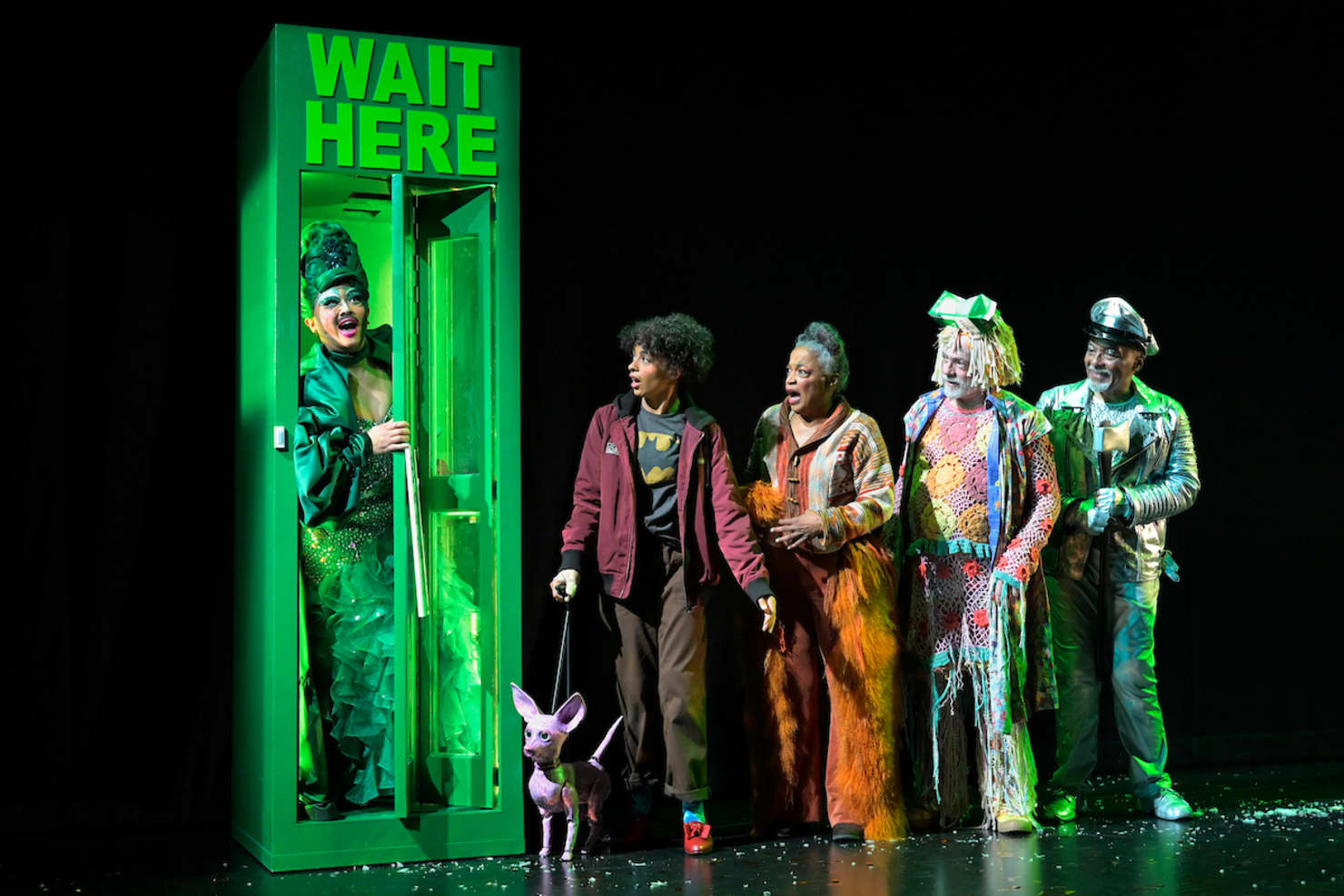
"The Wizard of Oz" at ACT


ACT production photo by Kevin Berne
Normally I wouldn't go far out of my way to see a production of The Wizard of Oz. It's a well-worn story that has become almost a parody of itself, so one must tread carefully. But this production featured a bunch of my friends in the cast, as well as a number of other well-known and respected local actors, so it seemed like it ought to be fun.

The Play

Really? Am I going to summarize L. Frank Baum's classic story (adapted by John Kane for the Royal Shakespeare Company) here? If you don't know the story in some form, you probably have no business reading this. Dorothy and her little dog, Toto, run away from home in Kansas just as a tornado hits, transporting them to the land of Oz, where Dorothy makes friends and enemies on her way to solicit assistance from the eponymous wizard in order to return home.

The Production

As you can deduce from the production photo, it's a very colorful production. The designers and crew obviously had a field day with this one, and I'm sure it's not a coincidence that the performance schedule fell right in the middle of Pride month in San Francisco. It's campy and a bit raucous, clearly influenced by artists such as Taylor Mac, but not in a way that would prevent it being a kid-friendly show. And indeed, there were plenty of families with children in the audience, along with a goodly contingent from Pride activities. In short, a cross-section of San Francisco and Bay Area life.

Dorothy (Chanel Tilghman) has an incredible voice, but I don't think she quite pulls off the childlike quality needed for the character. We need to feel like this is a child in trouble, who needs to get back home, but mostly she comes off like kind of a petulant teenager. Toto is a puppet. Dorothy's companions in Oz (Danny Scheie as the Scarecrow, Darryl V. Jones as the Tin Man, and Cathleen Riddley as the Lion) are all very strong and sympathetic in their portrayals, with Scheie getting to be quite snarky at times. 

I guess my main qualm about the show is its self-awareness that creates a bit of distance. Director/choreographer Sam Pinkelton lets the cast get playful, which is fun, but as a result the show lacks a certain earnestness that would help sell the story to the audience. By continually breaking the fourth wall (e.g., Courtney Walsh as the Wicked Witch keeps encouraging us to boo her), we're taken out of the story line, which probably contributes to the overall lack of cohesion. The cast is obviously having a ball, but by endlessly reminding us that they're putting on a big, fun show for us, we never get to enjoy the show itself, the story they are ultimately trying to tell.

The Bottom Line

It was great fun to watch, and clearly a lot of fun to put on. But I can't help feeling that they missed an opportunity to do something more. By assuming that we all know the story, so they can just play and camp it up, they miss the chance to actually let us learn something from the story itself. Because the whole reason the Wizard of Oz is a timeless classic is that there is an underlying story there, and I think that got lost in the effort to throw a big, campy party.

So I really enjoyed watching my friends putting on a show. I just wish the director and company had shown a little more respect for the story they were telling, instead of just leaning into the costumes and props and effects. There really is something useful to be conveyed by the script if they'd remembered to give it that level of care.

Fun. Glad I went. Wish it could have been a bit more substantial under all that color and glitter.


Friday, April 21, 2023

"Poor Yella Rednecks at ACT


ACT production photo by Kevin Berne

Here's a play that we were supposed to see in Ashland a few years ago, but it was canceled by COVID. Having enjoyed its predecessor, Vietgone, both in Ashland and at ACT, we were looking forward to seeing this, eventually. The original play was really powerful, and as I noted at the end of my Ashland post on it,

It made me think about things I thought I understood in a different way, from a different perspective, and that's what theater is for.

Pretty heady stuff, and a pretty high bar. So let's see what comes next!

The Play

Following our characters from the previous play, now seven years later, somewhat settled in Arkansas, this play has a more narrow focus that the original. This is the story of a family trying to come to grips with what it means to be Vietnamese in America, when the Vietnam they came from really doesn't exist, and how do we pass along a story like that when maybe we're not so proud of it all.

So this is a much smaller show in scope than its precursor. This is playwright Qui Nguyen trying to get to the heart of the story of his parents (and grandmother) after the fact, uncovering details he was unaware of as a child. Interestingly, his childhood avatar, "Little Man", is represented by a puppet. Taken at face value, I guess that tells us a lot of what Nguyen thinks of his role in the family, but I suppose it's also a way to keep from having an actual child in the cast, when the rest of the characters are pretty foul-mouthed and amorous.

The other sort of interesting feature is the way various characters just burst out into rap. I'm not quite sure what to make of that. Rap was not a terribly common feature of Arkansas, circa 1981, so I'm still not quite sure what I'm supposed to take away from this.

The Performance

On the whole I thought the production was well done. The acting is a bit uneven, but nothing terrible. The set design is pretty simple, with a raised box representing the family's apartment and a rotating portion that serves numerous functions. The turntable is a bit of a distraction, but otherwise Tanya Orellana's set works well.

Jomar Tagatac (Playwright, many other roles) is seemingly omnipresent in Bay Area theater these days. He's good and versatile, and that stands him in good stead here, as he has to switch between numerous small roles, as well as being the playwright's adult avatar. The other actor who particularly stands out is Will Dao, in part because he manages to bring the wooden puppet of Little Man to a remarkable degree of life. I'm not a fan of puppets in plays, but Dao manages to infuse the jointed puppet with nuanced gestures and apparent feelings, backed up by nice vocal work. Since I'm told he actually has no real training in puppetry, this is a notable achievement!

I will note that although I didn't find much meaning in the rap numbers that kept appearing in the show, they did seem to rev up a portion of the audience, who reacted quite favorably, hooting and cheering to some of them. So maybe it's just me.

I'll add one other note, which is that for a newly-renovated theater, the Strand is really quite awkward to navigate, and the seats are not comfortable. I used to really look forward to going to this stage, as it was convenient to my work and shiny and new. But the narrow corridor, hard seats, and strangely-located restrooms make the whole experience rather less pleasant that it ought to be. That's disappointing.

The Bottom Line

Given that I'd had several years to look forward to this show, I had built up fairly high expectations. Overall, I don't think the play itself is nearly as strong (or as much fun) as the original Vietgone, though that was a pretty high bar. I read in the program that there is a third installment of this saga in the works, so maybe this is just the traditional let-down in the second volume of a trilogy. I hope that's the case. Nguyen has a clever voice, and I hope he'll find a strong ending to this series.

I can't say I'd go out of my way to see it again, but on the whole I guess it was worthwhile. The show runs through May 7 at ACT's Strand Theater, so there are still chances to catch it.

Saturday, March 4, 2023

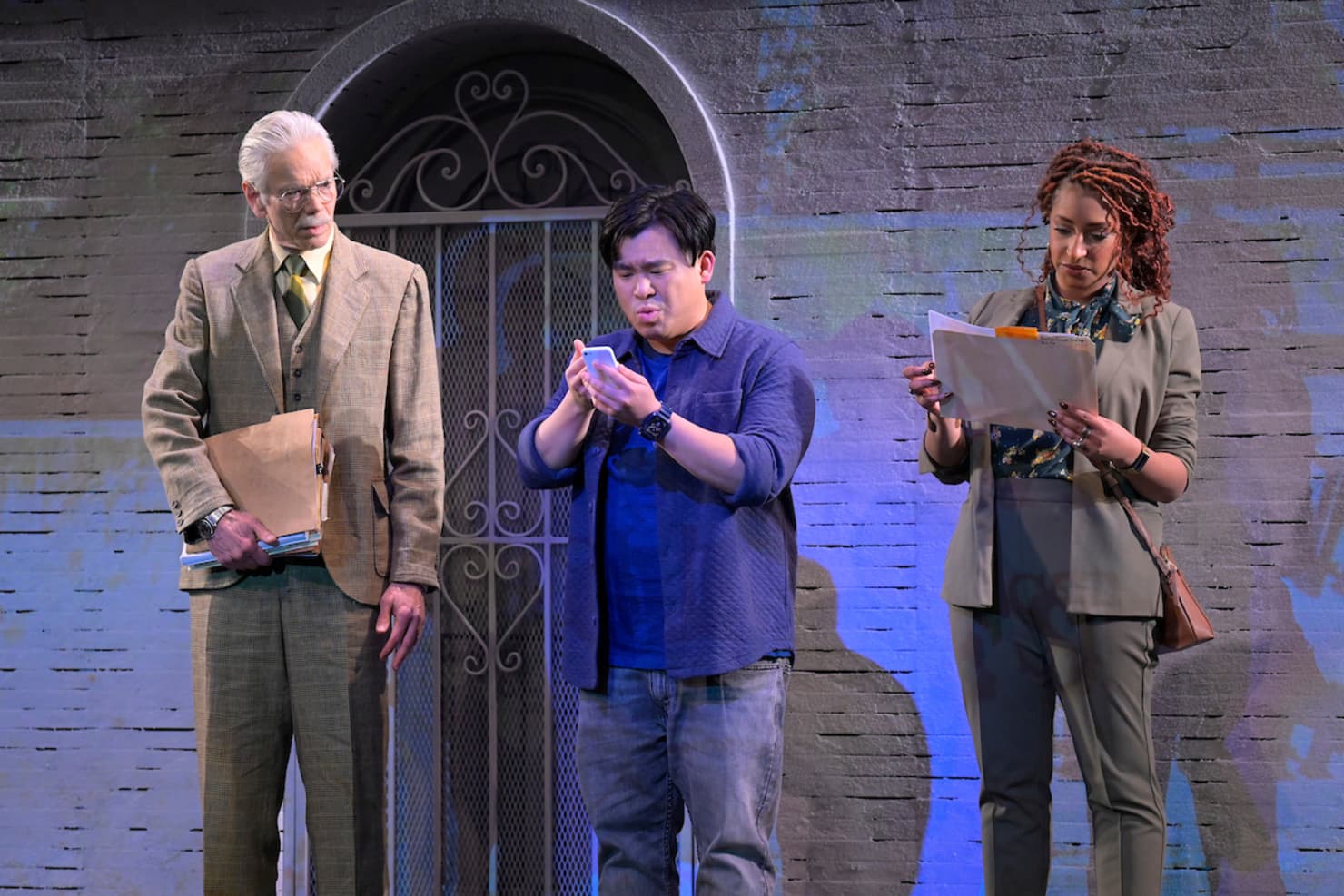
"The Headlands" at ACT


ACT production photo by Kevin Berne
I always look forward to new work from Christopher Chen, a local playwright (and graduate of UC Berkeley--Go Bears!) who always writes complex works that misdirect and play with audience expectations. I was especially keen to see his new play, The Headlands, because it is set in San Francisco, which is always a treat.

The Play

The Headlands starts out breaking the fourth wall, with the central character, Henry, addressing the audience directly and telling us about his hobby, investigating unsolved crimes. His current obsession is the unsolved death (murder?) of his own father, George, an immigrant from China who married Leena, a third-generation Chinese American whose family is very successful and assimilated. He often involves his girlfriend, Jess, in the investigation.

As the investigation turns up new information, Henry constantly pivots his view of the mystery, and also of his family's story. The twists are less abrupt than those in some of Chen's earlier works, such as Caught or You Mean to Do Me Harm, but the overall effect of constantly-shifting directions is typical of Chen's work.

The story comes to a head with the introduction of the mysterious character Tom, remembered from Henry's youth as an unknown and strange presence, who turns out to play a key role in the mystery.

Ultimately the story is less successful as a noir whodunit than it is as an exploration of the vagaries of memory and the stories families tell about themselves, but it's an interesting and engrossing yarn.

The Production

First off, solid local cast. Phil Wong as Henry is excellent. I've enjoyed his work for several years, but mostly in supporting roles. It's nice to see him in a central role. Sam Jackson as Jess is outstanding as always. Erin Mei-Ling Stuart is strong as Leena (as is Keiko Shimosato Carreiro as the older Leena and also her best friend, Pat). And Johnny M. Wu as the stoic George is terrific throughout. Tom (normally played by Jomar Tagatac, but understudied in our performance by Alex Hsu) was the only kind of miss, as the actor seemed too old for the role and not terribly comfortable in it. Charles Shaw Robinson does a wonderful, humorous turn as an aging SF detective.

The set design by Alexander V. Nichols seems simple at times, but like the plot of the play it has some very intricate aspects. I'm not generally a huge fan of revolving set pieces, but I will admit that this set mostly uses it effectively. Director Pan MacKinnon keeps the action moving nicely; I think this is the best work I've seen from her since she joined ACT.

Bottom Line

I enjoyed the play. I wouldn't say it's Chen's best work, but it does represent an advance for him, in that the plot replies less on just changing circumstances and revelations for its interest, and more on the development of characters and investigation of their thoughts and feelings.

I'm pleased to see ACT producing and supporting local work with local actors. For too long they have relied on bringing in material and performers from out of the area, which has really hurt both the theater and the local theater scene. I hope this represents a return to a more local focus.

Overall, it's an encouraging part of this season. I look forward to seeing what comes next. The Headlands runs through tomorrow (March 5th) at ACT's Toni Rembe Theatre (formerly the Geary).

Saturday, September 24, 2022

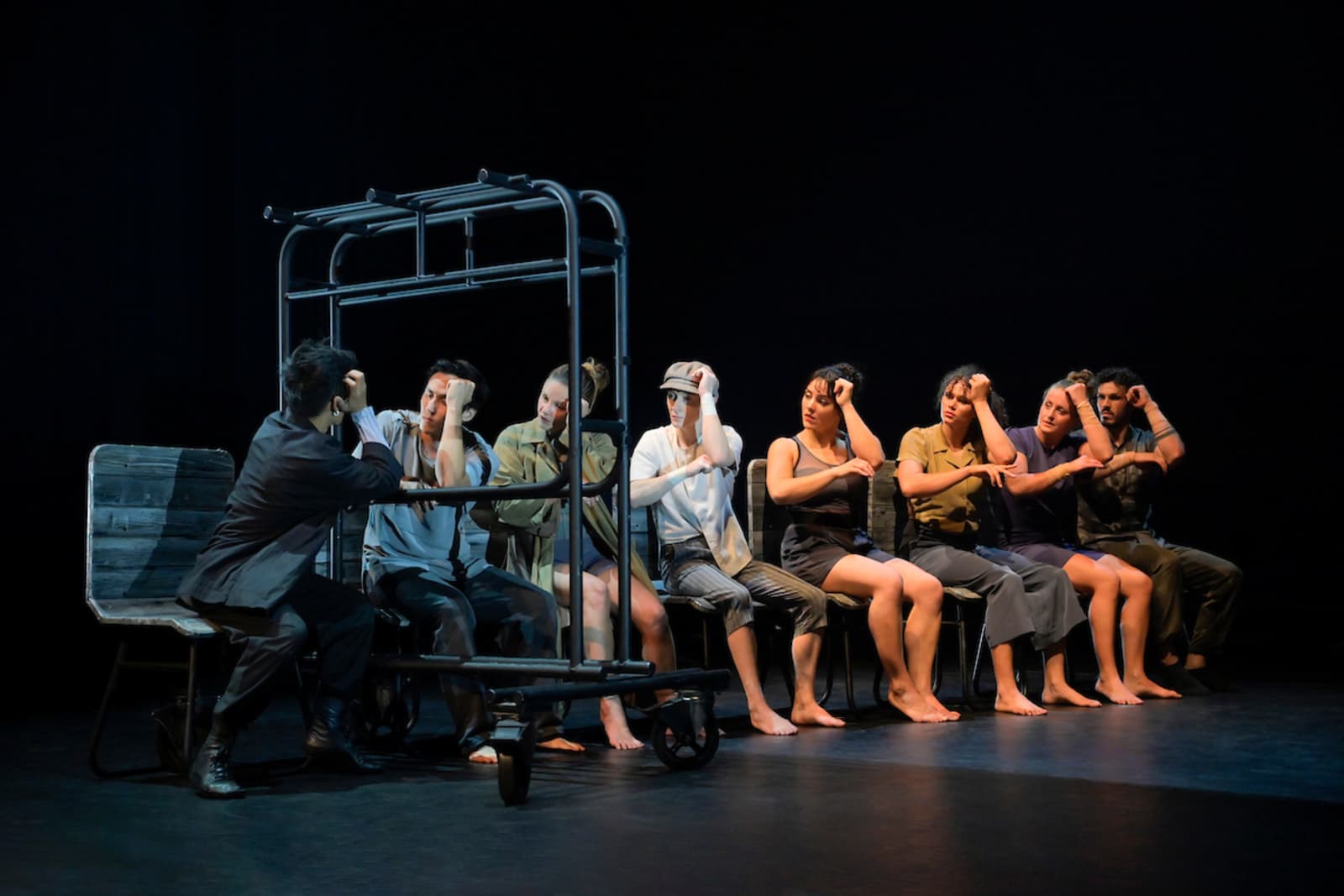
"Passengers" at ACT

ACT photo by Kevin Berne

 Several things struck me as odd last night when we walked into the theater to see Passengers at ACT. The first was that it was the first theater I've attended that really seems to believe we are in a post-COVID time: no vaccination check, masks optional (a fact reinforced during the recorded pre-show announcement), and the bar is open downstairs.

The second was that they've obviously done some tinkering with the ticketing system. When I bought my tickets a couple of weeks ago, I scored the last two available seats in the center orchestra section. But walking in, I saw that the section was nearly half empty. There seemed to be a pair of empty seats between each pair of patrons (except in the front rows, which appeared full), so, some kind of social distancing? But we were the only patrons in Row H, and the row behind us was entirely empty. On one hand, better sight lines, or at least the ability to shift a seat or two to avoid sitting behind someone. On the other hand, a huge number of empty seats. I guess this is how they justify keeping their ticket prices so high.

And the third thing was a note inserted in the program explaining that they've renamed the Geary Theater to the Toni Rembe Theater, after a huge, anonymous gift to the company. I guess if I'd been paying attention, there were also banners outside that had the new name. Anyway, nice to see an arts organization getting a big infusion of cash (much of which they are going to put into an endowment). The Chronicle had more information about it today.

The Show

I can't call it a play. It's not a play. It's a multi-disciplinary art performance, combining dance, music, gymnastics, and a lot of circus performances, all written, directed, and choreographed by Shana Carroll. I guess the closest thing I could compare it to might be a Cirque du Soleil show, but on a smaller scale and without the clowns to provide even a modicum of a story line. There is a theme, however. As the name suggests, Passengers is about people on trains, mostly. Among the small amount of verbiage in the show is some talk about how we're all going somewhere, or leaving somewhere. Which I guess is true, but most of us do so without the gymnastics.

The Production

It's really well done. The stars of the show are the circus acts, which are all excellent, as are the gymnastic tumbling bits. The dance is good, but not as polished as the rest. And the sung portions are probably the least-inspired portion, feeling more like a rest period or an excuse to do something else. All the while there are lighting and projection effects that are often distracting, and don't seem to add much to the performance. Ultimately I found that I needed to just focus on the current circus act at any given moment, because the dancing and tumbling and video off to the sides just seemed to be a distraction, and nothing I saw there was as interesting as the current act in the spotlight.

I guess that would be my only complaint, that the show was so busy, it detracted somewhat from the central acts. The choreography and coordination of all these moving parts is impressive, but ultimately not something I can appreciate as much as whatever impossible feat is currently happening on the trapeze, for instance.

Bottom Line

It's a good show, but sort of an odd choice for a theater trying to draw back its audience after the pandemic. It's cool and different and a spectacle, and will likely draw a different audience than your average play. But at the same time, while local theater artists are struggling to get back to work, it would be nice to see the area's largest theater hiring some of them, rather than pulling in a group from outside the area. On the other hand, if this is what puts people in the seats, more power to them.

But this is a theater blog, and I don't feel qualified to really comment on circus, gymnastics, and dance. So I'll just say it's a fun time, worth seeing. It runs through October 9th at the newly-rechristened Toni Rembe Theater.

Monday, June 25, 2018

"A Walk on the Moon" at ACT

ACT photo by Alessandra Mello
ACT has a rather mixed record with musicals. I would definitely not call it one of their strengths. Nonetheless, they persist in producing new musical works, so as a subscriber, I get to see them. And I rather like a good musical. A Walk on the Moon was not a good musical, and I did not like it.

To be fair, we all departed at the intermission. It was a unanimous decision. We discussed whether there was any reason to stay, and concluded there was not. So, I suppose in fairness I should say that it's possible the second act is so good that it makes it worth sitting through the dismal first act, but I sincerely doubt it.

The Play

Apparently this is an adaptation of a movie. I did not see the movie, so I can't comment on the adaptation. All I can talk about is the play. It's set at a Jewish summer camp in July, 1969. A group of families have made their annual trek to the camp from Brooklyn to the Catskills, with the working husbands commuting on weekends and the rest of the families staying in bungalows. There are certainly aspects of this I can relate to, so there's a setting for a play.

And then, very little happens. Which, I can attest, seems very likely in a resort setting. That's kind of the point of it all. In Act I the campers do a little dancing and singing about arriving at summer camp. Kids meet new friends. Teens express frustration with, well, everything. Some even sing about it. The blouse man arrives to sell (yes) blouses.

Playwright Pamela Gray adapted this script from her first screenplay that eventually got produced as a movie, all based on her childhood memories. I hope the original is more lively than the musical.

We get a little bit of subdued teen angst and some nascent middle-age feminism from a bored housewife. The voices are pretty good,  but Paul Scott Goodman's songs just aren't compelling. They're pretty cliched and repetitive. Nothing you're going to leave humming.

We are supposed to get a little sparkle of excitement from a little flirtation between housewife Pearl and the blouse man, Walker. They later have a little fling during the moon landing, while everyone else is watching television (and Pearl's husband has been conveniently detained at home by his TV repair job). But there is never a sense of actual excitement or risk, or really even of attraction.

The Production

I suppose the fact that the program has an inserted page with updated song listings suggests that this world premiere is still very much a work in progress, so perhaps I should be more forgiving. But I didn't pay to see a workshop. This is billed as a full production, but it doesn't feel like it.

First, it's terribly static. Bungalows don't move, and frankly the people don't move much, either. There is not much action in watching a group of women play mahjong. So the director has the table rotate sometimes, which is just weird, and seems only to emphasize how dull and motionless the scene really is. It might be a fine scene in a novel, propelled by sparkling banter, but the lifeless song is not revived by the turning of the table.

Similarly, when rebellious teen Allison (Brigid O'Brien) (and you know she's rebellious because she scowls all the time, except when she's swooning over guitar-player Ross (Nick Sacks)) sings about how she's frustrated and wants to go do things, her vehemence is demonstrated by her standing up. And raising her arms. So clearly, she's going places.

Forgive the snark, but really, director Sheryl Kaller and choreographer Josh Prince need to get some actual motion into the characters. Two kids sitting on a picnic table rapping about how bored they are and how they'd really like to go to Woodstock (or at least the movies) is realistic, but it's not theatrical, and it's not interesting to watch.

And for all the effort they seem to have put into building a fancy set, some of it seems terribly amateurish. For example, a character opens the door and walks into a bungalow--and then we see them walking offstage behind the facade. Really?

Bottom Line

I could go on, but you get the point. The best I can hope for is that the show really isn't done, and this is the best they could slap together in time for the opening. There are some obviously talented actors and singers, but there isn't much for them to do. I really don't think there's enough meat on the bones of this beast to make a satisfying snack, much less a professional-quality musical production.

One of our party summed it up that the whole thing was really deficient in every area: script, music, stagecraft, choreography, direction, acting....

It's hard for me to say this about any play, but this is just not worth seeing. It would be pretty disappointing as a community theater production, but from a major regional theater company, it's just inexcusable. One can only hope the new management at ACT will spare us such a showing in the future.

Both thumbs down on this one. I wish there were something I could recommend about it, but really, there is nothing. Save your money and go see two or three plays at smaller theaters. You'll have a much better time. All four shows I saw in the week after seeing this were much better.

Thursday, May 17, 2018

"Father Comes Home From the Wars" at ACT

ACT photo my Joan Marcus
Suzan-Lori Parks is perhaps the modern playwright I have been most curious about. I hear raves about her work, but until now I had not seen any of them performed. So I've been looking forward to the current offering at ACT since I saw the season announcement last year.

The Play

Father Comes Home from the Wars is a really ambitious project. Sort of like Star Wars, it is a nine-part saga that apparently consists of three related trilogies. Unlike those movies, though, Parks has decided to start at the beginning, so we currently see Parts I, II, and III. My understanding is that the subsequent parts are not yet written.

Anyway, the three "parts" serve as essentially three acts in a long afternoon or evening of theater. The whole presentation is about three hours long, with each of the parts taking up approximately an hour. ACT puts an intermission between parts II and III, although part III is the shortest of the three. I will just refer to these three parts as "the play" for purposes of this article, since together they are the play we saw.

The play is quite loosely based on The Odyssey by Homer. The central character, Hero, is a slave whose owner is going off to join the American Civil War as an officer. He gives Hero the choice of whether to accompany him. Part I consists of a group of slaves (and later, Hero himself) debating whether and why Hero should go. It's actually a pretty interesting discussion and dilemma. On the one hand, it's hard work in the service of an army dedicated to preserving the institution of slavery, so an obvious conflict for Hero. On the other hand, the master has promised Hero his freedom if he goes with him, which is terribly, terribly tempting. Complicating matters is the revelation that the master has promised freedom once before, and reneged.

This part is really well written and realized. The slaves act as kind of a Greek chorus behind Hero and his not-quite-wife, Penny. A character called the Oldest Old Man serves as both a surrogate father to hero and a source of wisdom for the group. On the whole I found this first act quite compelling and interesting.

In Part II we are off to the war, where we see the master (now known as The Colonel) and Hero (spoiler...he ends up going to war) in a rough camp with an injured Union prisoner named Smith. Here the issues and temptations are different, and the nature of the play changes, too. We get longer, more drawn-out, and thoughtful discussions of issues and ethical questions. How to treat this officer, captured from leading a regiment of free Negro soldiers? Is he actually their white officer, or a Negro soldier passing for white? The relations of both The Colonel and Hero to Smith get pretty interesting. Presented with the temptation of escape, perhaps to join the Union army, how will Hero choose?

And finally in Part III, we have Penny and another slave, Homer, back home awaiting Hero's return from the war, in the temporary company of a group of runaway slaves. We get more of the backstory of Homer, Penny, and Hero, as well as a look at how Penny and Homer have been keeping busy in Hero's absence. And then when Hero arrives, there are more choices and a number of secrets that have to be dealt with. And Hero's dog (missing, in a running gag in Part I) arrives home ahead of Hero and narrates much of what has happened. Yes, a talking dog.

I thought Part III was probably the weakest writing of the whole (and not just because of the talking dog, but really). But it does wrap up a lot of the story lines, and leaves enough dangling that we have the promise of some interesting developments for Parts IV and onward to follow succeeding generations.

The play is long (epic, one might say), but it holds interest in part because it is well crafted and coherent. There are enough twists and turns to maintain some suspense and foil any predictions one might have made. It's just good writing, with some quite interesting characters.

The Production

ACT is presenting Father Comes Home in association with Yale Repertory Theatre, and the play actually opened first at Yale Rep, so even though I saw this fairly early in the San Francisco run, the show was quite polished and smooth. All the staging and lighting and such have come from Yale, though expanded a bit for the Geary Theater's larger stage.

Also, the cast is intact, as far as I can tell, and that really helps. One big highlight in the cast for me was Steven Anthony Jones as the Oldest Old Man. I'm a long-time fan of Jones, but was rather disappointed by his work in ACT's Hamlet earlier this season. But here he was reminiscent of his best work, which was a delight to see. Local fixture Dan Hiatt was quite good as The Colonel, as well.

Some younger local actors had good turns in the show, too. Rotimi Agbabiaka, last seen in Shotgun's Black Rider, and Safiya Fredericks, recently in ACT's The Hard Problem and the Magic's Grandeur (among other shows) stand out in the ensemble of slaves. I was also impressed with Tom Pecinka as Smith and Eboni Flowers as Penny. James Udom does a fine turn as Hero, which is quite a demanding role. Longtime ACT company member Gregory Wallace seems a bit out of place until he surfaces as the talking dog, which is a role he seems destined for.

All in all, it's a fine production, well designed. It probably doesn't need to be three hours long. I suspect some judicious editing could trim some of Parks' text that gets a little repetitive, but on the whole, it's fine. The nature of the subject matter kind of requires that it be a bit drawn out, so it's hard to complain on that score.

Bottom Line

This is well worth seeing. The material is strong, and the production is polished and coherent. I'm glad I finally got to see one of Parks' plays, and I look forward to more. (I just picked up a copy of the script to Topdog/Underdog so I can read it, and I see that Ubuntu Theater Company is about to stage that show.)

The show runs through May 20th, so you still have many chances to see it.

Sunday, April 1, 2018

"Heisenberg" at ACT

ACT rehearsal photo by Beryl Baker
As longtime readers will recall, I'm a sucker for a play about science. So when I saw the ACT was doing a show called Heisenberg, that got me going. Werner Heisenberg is, of course, an important character in Michael Frayn's Copenhagen, of course, and his role in the development of nuclear physics is well known.

Simon Stephens' play, however, has nothing at all to do with the scientist or science. The popular perception of Heisenberg's work boils down to a single concept, known as the uncertainty principle, which is loosely understood to mean that an outside observer cannot simultaneously know the position and momentum of a quantum particle with any precision. This is (as with most of quantum physics) both extremely counterintuitive and wholly inapplicable to life on the human scale. This has to do with the way an observer affects objects being observed, but again, this applies only to observations of quantum effects, not humans or human-scale objects.

That doesn't mean it can't serve as something of a metaphor, which is roughly what Stephens attempts here. More or less, this play says if you know where you are, you can't know where you're going, and vice versa.

The Play

But enough of theory, let's talk about the play. Alex is a 75-year-old butcher who likes to sit in train stations, even though he doesn't like to go places. He loves being in London, though. One day as he sits on a bench in the station, the loud, flighty American Georgie approaches him and immediately starts telling rather bizarre, incoherent, and untruthful stories. Although bemused and somewhat annoyed, Alex finds himself somewhat engaged by the whole encounter.

Next we find Alex working in his butcher shop, when who should walk in but Georgie? She has tracked him down using her super Google powers, so now we think she's a psychotic stalker. But it turns out she only wants to con him out of enough money to go find her son in New Jersey. Maybe. Meanwhile, Alex is rather stoic and lonely, seems to know he's getting toward the end of his life (which appears to have no other people in it, at all, except one girlfriend of his youth), so what has he got to lose by talking with his stalker?

So they date. Alex gives a really exceptional speech about listening to all kinds of music, though it ends with a facile appropriation of the notion that the music isn't in the notes, but the spaces between them. They go to bed. Because, you know, why not?

For reasons good or ill, they end up going to New Jersey together, despite his stated aversion to travel and her inability to keep a story straight. It seems to be a fairly quirky but workable relationship. End of play.

So it's a character study, which is not generally my cup of tea, and it rates as fairly implausible, even if you try to apply some pop-culture version of the Heisenberg principle to human interactions. We never know where the relationship is going, or why. Just deal with it.

The Production

The acting carries the day here. Bay area stalwart James Carpenter is outstanding in his portrayal of Alex. The staid, soft-spoken butcher has an incredibly expressive face and subtle body language. Sarah Grace Wilson can't possibly be as annoying as her portrayal of Georgie, so I give her credit as an actor. Together they manage to have a degree of chemistry (or physics--see? I can make facile science jokes, too!) that seems unwarranted by anything in the script, but manages to make the bizarre relationship tenable.

The first couple of scenes are truly irritating, with Georgie creating a situation that any but the ever-patient Alex would have extricated themselves from. But once we pass peak irritation, it just becomes a strange and quirky (if still somewhat predatory and exploitative) relationship, fitting the tropes of many a romantic comedy. It really is only because the acting is so exceptional that one can really stand to see it through.

The set design is clever, with an octagonal wooden platform that can raise sections to serve as a bench, a butcher's counter, a bed, a restaurant table, etc. But on the big Geary Theater stage, the two people feel truly isolated (which is apt, because there are no other characters in this story except mentions of Alex's long-ago fiance and Georgie's gone-to-Jersey son). Maybe that isolation is meant to mean more than the characters' lack of social connections, and somehow ties into the faux-physics notions, but mostly it just seems like an awful lot of stage space for what is essentially a very small play.

Bottom Line

As is often the case with the genre of modern romantic comedies, one has to completely suspend disbelief and just go with the fact that for some reason these characters find some attraction in one another, despite the efforts of one or both to demonstrate that any such attraction is at best masked behind cynical attempts to defraud or at least mislead. At least the quality actors in this production make at least a plausible attempt at showing some changes in the characters that can justify why they eventually pair up.

As a character study, I guess it's OK. As a vehicle for two really good actors, it's excellent, and worth seeing just for that. But I wish they had a more plausible vehicle that actually justifies the time and effort of the artists. because of them it's pretty good, but feels like it really ought to be better.

The show runs for another week, through April 8, at ACT's Geary Theater.

Sunday, March 18, 2018

"Vietgone" at ACT

ACT photo by Kevin Berne
This is a show I really liked in the 2016 season when it played at the Oregon Shakespeare Festival. So I've been looking forward to seeing it again at ACT this year. The Strand Theater presents some interesting options and challenges for staging the show, though.

The Play

I just went back and read my description from Ashland, and I think it covers it pretty well. The play itself seems pretty much the same, but there are definite differences in the staging and directorial approach.

The Production

The relatively small stage at the Strand presents a challenge for staging this play, primarily because there have to be frequent changes of scene. Ashland handled this by staging the show in their black-box theater and just designating different floor spaces to represent different scenes. But the Strand has a traditional proscenium stage, so they used two adaptations: a rotating turntable that enabled relatively quick switches of scene and a minimal second story that bridged over the stage below, letting some transient scenes take place in a neutral space.

I thought that was pretty clever, but with some reservations about the implementation. From our perspective in the third row of seats, it was a bit of an effort to crane our necks up to watch the scenes above. And the frequency of scene changes necessitated a lot of rotation of the turntable, which I found distracting. But overall, I thought it was probably the best one could do in this space.

The acting was mostly strong. James Seol as Quang and Jenelle Chu as Tong are both solid, though Chu didn't seem very comfortable with the rapping portions of her role. All three of the other actors have to cover a fairly wide range of characters, particularly Jomar Tagatac, who excels in a particularly challenging swath. Stephen Hu does a nice job in the second-banana roles, and Cindy Im is mostly good, but I found her unconvincing (and too young-seeming) when portraying Tong's mother.

Differences

For those who saw the production in Ashland, there are several stylistic differences in this production. Perhaps most noticeable is that the comic-bookish, superhero style is missing. That was a conscious choice in the Oregon premiere, and I didn't really miss it. In Ashland the rap interludes seemed to come out of nowhere, but here they seem to integrate more smoothly into the flow of the play. I definitely felt like the motorcycle road trip, though using very similar bike props, suffered from the lack of space on the stage.

Overall

I still like the play a lot. In the current social climate, a play about the experience of refugees trying to adjust to a new country while missing their old home and family is particularly pertinent. One of my big takeaways from the play both times has been the expression of how differently the South Vietnamese and Americans viewed (and still view) the war in Vietnam. The poignancy of the final scene between Quang and his son, playwright Qui Nguyen, is wonderful.

The play runs through April 22, so there are still plenty of opportunities to catch it. It's far from a perfect production, but still very enjoyable.

Thursday, January 25, 2018

"The Birthday Party" at ACT

ACT photo by Kevin Berne
I have this strange sense of deja vu after seeing Harold Pinter's The Birthday Party at ACT last night. The last Pinter play I saw was No Man's Land at Berkeley Rep a few summers ago, when they brought in Patrick Stewart and Ian McKellen to play the two roles in the show, and they were absolutely incredible. McKellen gave perhaps the most impressive performance I've ever seen on stage. And yet I remember almost nothing about the play itself. Amazing, well-played characters, and no actual plot to get in the way.

You probably see where this is going.

ACT Artistic Director Carey Perloff is stepping down after 25 years on the job, and her final directorial endeavor with the company (at least under her artistic direction) is this Pinter piece she directed elsewhere before coming to ACT. I guess she's something of a Pinter specialist. I am not. Be forewarned.

The Play

Set in a small beachside boarding house in England, run by an aging couple (Meg and Petey), we initially find that they have one and only one boarder, Stanley. They have a rather odd relationship with him, but everything is exceedingly routine. Stanley is a bit of a shut-in, but apparently he pays his rent, so all is well, though we can tell from the moment he comes downstairs that he is upset, depressed, or...something.

Then two men show up out of the blue for a brief seaside vacation. Goldberg is a sharp-dressed, smooth-talking charmer. McCann is a rather large, surly Irishman. They are something of an odd couple, to be sure, though Goldberg is clearly the one in charge. The only other character we meet is Lulu, a young woman in the town who drops by now and again.

Stanley is not pleased that two men are suddenly showing up, and he tries to avoid them, which is tough in a tiny boarding house. When they do meet up, it's clear that he either knows them or knows who they are, and feels threatened by them for unstated reasons. When Meg and Petey are away, Goldberg and McCann interrogate and threaten Stanley.

Meanwhile, Meg has decided that it's Stanley's birthday (though he insists it is not), and throws the eponymous birthday party, inviting the newly-arrived guests and Lulu. Goldberg supplies the liquor (roughly a bottle per person--yikes!).

The party is odd--uncomfortable, but then, so is pretty much every interaction in the show. By the end, all in attendance are well and truly drunk, and Stanley seems to have snapped.

Next thing we see, it's morning. We see the aftermath of the party. People go away. Nothing is actually resolved. Pinter play.

The Performance

The acting is really very good. Meg (Judith Ivey) is convincingly senile. Petey (Dan Hiatt) is rather bizarrely unconcerned with any of the odd behavior going on. He and Meg obviously have a well-established routine (tea, corn flakes, friend bread, newspaper) that works for them. Stanley (Firdous Bamji) seems nearly catatonic, though apparently when he arrived he was quite the piano player. It's unclear why he stopped playing and now just holes up in the boarding house. He is clearly not happy being there, and Meg's dotty ministrations obviously annoy him. It's all very mysterious.

Goldberg (Scott Wentworth) is terrific, just a smooth, convincing con man, which offsets MaCann (Marco Barricelli), who is pretty much his mirror opposite: a looming presence, more likely to grunt than speak. The two of them are most effective. And Lulu (Julie Adamo) is sort of a harmless bystander, sucked into the vortex of whatever it is that's happening at the boarding house.

All the portrayals are quite effective, and the characterizations are pretty interesting, but since the script doesn't actually go anywhere, we are sort of stuck in this purgatory with all the characters: clearly uncomfortable, struggling to hold power over each other, with no way out. Pinter play.

Nina Ball's set is very effective: a tiny, claustrophobic house (of which we really only see one room) on the big Geary Theater stage, with sand dunes and beach chairs surrounding, providing a buffer zone from the rest of the world. It's almost like there is nowhere else to go.

The Bottom Line

I don't really know what else to say about the show. It's well done, but doesn't go anywhere. So it seems to be a high-quality rendition of the play, but the play is basically just Pinter's message that the characters are just stuck in some kind of Sisyphean power struggle with each other. Everybody is either ordering people around or adamantly refusing to submit. It's very tiring. I'm sure that's the point.

So I'm afraid I don't have a great appreciation for this Pinter thing. Others obviously like it a lot, but it doesn't do much for me. So, good stagecraft, excellent acting, but for me, that was it. Your mileage may vary, obviously.

The show runs for a couple more weeks, through February 4th. If it's your kind of play, you should like it.

Monday, January 1, 2018

Best of 2017

I've been told that one of the requirements, now that I do a Theater Blog, is that I must commemorate the end of the year by doing a "Best Of" post to say what was best this year. Since 2017 was my first full year of Theater Blogging (Yep...we started in May of 2016!), this will be the first time I can really look back over a year of posts and opine on what really stuck with me, which is my criterion for "Best Of". Unless I decide it isn't. Stay tuned.

I will preface this with a side note that on the whole, 2017 was not a good year for me at all. Personally and professionally, this year has actually kind of sucked, and even my frequent respite at the ballpark was not its usual pick-me-up. But for the most part, theater--and particularly theater people--has truly kept me going. On the whole, the friends I have made through going to the theater and being involved with theater are some of the most positive, supportive people I have ever known. You know who you are, and thanks for being there for me.

Now then, theater stuff...

Best Plays/Productions

These are the plays that really stuck with me, for one reason or another. I'll list them in the order I saw them. No other ranking is implied unless I say so. I will include links to my original postings for each of them, in case you missed my musings the first time or just want to see if I lost my mind in between or something.

If I can find a theme to my "best" list, it's mostly that they almost all manage to tackle an issue that is pertinent to the day and explore it in a non-obvious way. 

"Hamlet" at Shotgun Players

Fortunately, the repertory portion of Shotgun's 2016-2017 season ended in January, and much of what I saw in January was more Hamlet. I believe I ended up seeing it about 18 times, with only one repeat casting. The shuffling of actors was amazing to watch and very educational. I learned a great deal about Hamlet and about theater from watching these shows, and my only regret is that I didn't manage to go more often. The seven actors plus one understudy deserve medals for performing in this show. And extra medals for the fact they were also performing in at least one additional repertory show each. It was just an extraordinary experience, the likes of which we are not likely to see on a Bay Area stage again any time soon.

"John" at ACT

This was the first show I felt really showed off the value of ACT's new second stage at the Strand Theater. The show was quirky, but it really kept me thinking about it for quite some time, and that's what good theater is about.

"Leni" at Aurora

Once again showing my fondness for the intimacy of small theater spaces, this little show in Aurora's second space really showcased the talents of actors Stacy Ross and Martha Brigham and brought some history to life in a thoughtful and timely way. It was an innovative and thought-provoking show, well directed by Jon Tracy.

"Sisters Matsumoto" at Center Rep

This was a very powerful and beautifully staged performance of a story that really resonated. Particularly having just seen TheaterFIRST's Beneath The Tall Tree, which also dealt with Japanese American internment, it was moving and thought-provoking and made me aware of aspects of that period and its aftermath that I hadn't been aware of.

"The Events" at Shotgun Players

My buddies at Shotgun really kind of went off the rails on some things these past couple of years. Staging The Events requires a different community choir on stage for each performance. As such, it was informative to see the play more than once (and I did). Not only did this help cement for me the value of seeing plays more than once (I also saw Hamilton for the second time around the same point), but it made me appreciate both the difficulty of incorporating different outside groups into a play and what that actually means to this particular show. This is a tough but important and certainly timely play about the resilience of both individuals and communities to sudden, shocking events.

 "As You Like It" at CalShakes

As the only comedy on the list, this seems a little odd (note that I have a separate section for comedies later). But I was moved and surprised by this CalShakes production. I usually don't expect much thought to ensue from a Shakespearean comedy, but Desdemona Chiang's interpretation of this play of mistaken identity broadened the issue to cover personal and gender identity, and did so smoothly in a fine production. This was also the start of a very strong season for CalShakes.

"Grandeur" at The Magic Theater

I went into this play knowing almost nothing about it, and left absolutely stupefied. Carl Lumbly exceeded even the lofty expectations I have of him, and the play was riveting. It's not earth-shakingly important, but it shows just how effective a small play can be. I was extremely fortunate to be sitting in the front row, in the seat closest to the chair where Lumbly sat for much of the play, so I got to watch him up close, and it was amazing.

"Mojada: A Medea in Los Angeles" at Oregon Shakespeare Festival

I would normally expect at least a couple of plays from our summer jaunts to Ashland to land on the "Best Of" list for a year, but this year wasn't overall that impressive up there. But Mojada was a knockout. The adaptation of the well-worn story of Medea is almost obvious in retrospect. The portrayal of undocumented immigrants trying to assimilate (or not) and the consequences for them personally and socially is excruciating, but very effective.

"An Octoroon" at Berkeley Rep

Everybody's trying to push your buttons this year, but this time Berkeley Rep got it right. It's a super complex script, as you might expect from a hotshot playwright who has won just about every award imaginable. What I didn't expect was that Berkeley Rep would find the right director and cast, and that that director would be Eric Ting, who had previously disimpressed me with his direction of Othello at CalShakes. This production was pretty much spot-on. We're still talking about it, almost six months later.

"black odyssey" at CalShakes

I would never have guessed at the start of the year that Eric Ting would direct even one, let alone two, of my favorite productions. But here he was, coming right off the triumph that was An Octoroon, directing local playwright Marcus Gardley's wonderful adaptation of "The Odyssey" into a story of African American life. And it packed the Bruns Amphitheater every show, bringing in rafts of people who do not normally make the trek to Orinda to see a play. This was terrific storytelling.

"The Farm" at TheatreFIRST

Another artist making his second appearance on the list is Jon Tracy. Having directed Leni for Aurora earlier in the year, he also re-adapted his adaptation of Orwell's "Animal Farm" for TheatreFIRST, and the result was delightful and moving. This modest production reminded us that we don't have to be big and fancy to tell an important story. The reboot of TheatreFIRST is having sort of uneven results, but The Farm was definitely a sign of what a dedicated bunch of theater artists can do with limited resources.

Comic Relief

Most of the plays that really stuck with me this year were dramas. Maybe it fit the rhythm of my own life, which had way too much drama in it this year. But there were funny plays that made an impression on me, and they deserve some recognition, even if they weren't overall the "best" things I saw this year.

"Noises Off!" at SF Playhouse

This is one of those kind of classic plays that I had always heard of by never seen. I love the intricacy of the plotting and staging, and felt that for once, the rotating stage at SF Playhouse really was an asset. And the play is just screamingly funny, both because of all the theater in-jokes and because of some real character development. I liked both the play and the production here very well.

"The Play That Goes Wrong " at Lyceum Theatre (NYC)

This play isn't nearly as deep as Noises Off!, but the production we saw in New York this fall was absolutely the funniest thing I've seen on stage in a long, long time. The comedic timing and the convoluted set design were truly impressive. I needed a good laugh, and this provided it.

Spectacles

This is a category I just made up to salute the shows that just make you drop your jaw a bit at the stagecraft. There were some pretty over-the-top productions out there, even if they weren't among the shows that I deemed "best" overall.

"Needles and Opium" at ACT
"Monsoon Wedding" at Berkeley Rep
"A Thousand Splendid Suns" at ACT
"The Black Rider" at Shotgun Players

I won't go into them in detail again. Suffice it to say that in each case I was less than delighted with the play, the message, the storytelling, or something. But in each case the stagecraft, design, music, dancing, lights, and so on were dazzling and worth recognizing.

Musicals

I saw a fair number of musicals this year, but none that really rose to the level of "best"-ness required to make the big list. But I thought I should mention the ones that stood out, because musicals can be special in their own right, and if they are your thing, this is important.

"Good Night, Good Night, Construction Site" at Bay Area Children's Theater
"Hamilton" (touring) at SHN San Francisco
"La Cage Aux Folles" at SF Playhouse

Other

I can't think of a category it really fits into, but Taylor Mac's A 24-Decade History of Popular Music at the Curran was like nothing I have ever seen before. I realize now that I never got around to writing up the portions of the show that I saw (I saw only the first two 6-hour segments, so didn't feel I could really comment on the show as a whole). This mash-up of musical theater, cabaret, drag show, and history lesson amazed me on a bunch of different levels. The subversive way Taylor Mac gets into the heads and under the skins of the audience while knocking out a really impressive array of popular tunes in ways probably never seen or conceived before just boggles the mind.

I truly have no words to describe the whole experience, and in any strict definition, it's not really "theater" per se, but it is, too. And it probably stuck with me more than any other performance I saw this year, so it needed to be included here.

Personal Bests

If you'll allow me to conclude with a moment of self-indulgence, there were two other productions that were particularly meaningful to me personally this year, so I just get to put them in the "Best Of" post as kind of a footnote.

My Professional Stage Debut

Yes, those loons at the Shotgun Players not only allow me to sit on their board, they also offered me a tiny role in their staged reading of Tom Stoppard's Rosencrantz and Guildenstern Are Dead last January. And hey, we sold out and got extended, so I had three glorious nights on stage with a bunch of real, professional actors, and I have the check to prove it.

This makes the list not because I was any great revelation on stage or because it changed my life or anything like that. But there were two important takeaways from  the experience: One, I got to see firsthand, close-up, just how real theater artists work. Rehearsing, dressing, blocking, designing and redesigning--all of it. It was glorious. And it gives me all the more respect for the work these people do, day in and day out, to produce these plays that I enjoy so much. But just as important, two, after seeing me onstage, my daughter said, "Well if Dad can do that, I can do that." And promptly signed up for her first real staged play.

Which obviously leads me to...

"Assassins" at Berkeley Playhouse Teen Stage

About six months after my little dalliance on stage, there was my daughter, singing and dancing and trying (futilely) to shoot Gerald Ford on the stage in the Julia Morgan Theater. It's still not one of my favorite plays ever, but she got out of it exactly what I hoped: she found a wonderful community of like-minded, creative, accepting people who share a love of making theater and support each other while they do it. She's now working on her second show, already signed up for another, and planning one more for the summer.

Which just goes to show, we can always handle more theater, so we obviously haven't reached the mythical "Too Much Theater" yet, and the quest must continue.
Saturday, November 25, 2017

"Small Mouth Sounds" at ACT

ACT photo by T Charles Erickson
ACT likes to use their newly-renovated Strand Theatre for smaller, more innovative productions that probably wouldn't work on the big stage in the cavernous Geary Theatre. Such is the case with Small Mouth Sounds, by Bess Wohl. As advertised (people meeting and interacting at a silent retreat), it doesn't sound like much of a play. But in fact, during much of the play there is the voice on an unseen teacher, so there is something of a narrative structure and words for the (mostly) silent characters to react to.

The Play

There's not a lot to say about the play itself beyond what I already said. A group of six people arrive at a silent retreat. Four are strangers, and two others are a couple, and we know really nothing about them except what we see. The unseen Teacher welcomes the guests and sets down some rules, at which point we really start to see various characters' personalities come out in their silent reactions. A key scene has everyone settling into their sleeping spaces, rolling out mats, undressing to one degree or another, etc. All along, little snippets of character come out.

And this goes on for five days. We get a few little interludes where people speak a bit, but that's about it. One character is permitted to ask a question, which is predictably lengthy and actually one of the most uncomfortable scenes in the play.

Ultimately, we don't learn all that much about any of the characters (though some more than others). We have essentially a character study with pretty strict limits on what the characters can reveal, and little or no plot for them to interact with. So in 100 minutes of uninterrupted performance, we get what we might get out of 15-20 minutes in a spoken play.

The difference being that you have to guess a lot more, and you end up filling in your own back stories and such. That's kind of interesting, but none of the reveals in the play are really enough to validate or invalidate much of one's speculations, so you're left with that. And I guess that's OK, but it's not really a play.

The Performance

The actors are all good, and expressive (as you might expect). Ned (Ben Beckley) ends up talking more than others (in part because of the aforementioned question scene), so we have a clearer picture of some of his issues and background. Joan (Socorro Santiago) and Judy (Cherene Snow) are the couple, so their interactions have more context, and we can interpret some of their back stories as well. Jan (Connor Barrett) has lost a child and is a magnet for mosquitoes.

Unfortunately, most of the characters are pretty one-dimensional. Rodney (Edward Chin-Lyn) is rather a show-off about his yoga and meditation practices,  but pretty self-absorbed. Alicia (Brenna Palughi) is a hot mess all around for no reason we ever discern. And the effort to insert a little personality into the unseen Teacher (Orville Mendoza) feel more like an effort to extend a scant "plot line" in the play, rather than a realistic effort to create a meaningful character of him or provide realistic prompts for the rest to react to.

In short, everyone does a good job with the material they are given. I thought Barrett and Snow and Chin-Lyn were particularly good and consistent with their portrayals. But really, there's not a lot of substance here. The "fill in your own story" aspect is kind of fun, but limited, and the one-dimensionality of the characters doesn't allow for very fulfilling stories at all.

Since it's kind of inevitable to make comparisons with other shows I've seen recently, it occurs to me that with a very similar-sized cast, Central Works' Strange Ladies managed to portray many more aspects of each character's life and personality. Admittedly, they used language, but that's kind of my point. If you're going to limit your characters to non-verbal communication, you (as writer or as director) had better provide them with more opportunities and tools for communicating. Otherwise you get flat, silent characters.

Bottom Line

It's an interesting exercise, but not a terribly fulfilling one. The actors are competent, and some manage to convey some really good, subtle emotions. I just wish there had been more to it. I'm not sure whether playwright Wohl and director Rachel Chavkin are concerned that audiences will be confused if the silent characters are more complex, or perhaps they just don't know how to do it. But for me, the main thing the show cried out (silently) for was more dimensions to the characters.

So I can't recommend it highly, but neither would I say to avoid it. The show runs through December 10 at the Strand Theatre, but there are probably better holiday shows out there.


Monday, October 9, 2017

"Hamlet" at ACT

ACT photo by Kevin Berne
I believe this is the fourth time I have blogged on the play Hamlet in just the last couple of years. The fact that I saw it well over a dozen times last year at Shotgun Players suggests that I like the play. It's a classic for a reason, and watching different stagings and castings and interpretations is always educational.

The Play

No, really, I'm not going to summarize the play. If you don't know, go read it. Or go see it. Or (better yet) both.

What I will say here, since there are many ways to cut or otherwise alter the play, that ACT largely kept the full text in place, meaning it was a 3-hour production. Since the vast majority of my recent viewings were of Shotgun's reduced version, I was looking forward to seeing the full show again. Truthfully, the wrapper story with Norway doesn't really add much to the play (except in the sort of academic sense that it gives us a third iteration of sons avenging slain fathers). I marveled at the fact that Jomar Tagatac as young Fortinbras really does only appear for about the last two minutes of the play, with no other roles, until I realized he is also the understudy for Hamlet, which is plenty to keep him busy.

That said, it's really nice to hear some of the less-famous speeches in all their Shakespearean fullness. Much of the joy of Hamlet is the beauty of the poetry, so although it doesn't necessarily enlarge on the story per se, it does increase the enjoyment of the telling.

The Production

As with most productions of Hamlet, the discussion starts with the casting of the title role. It's a huge role (in terms of the number of lines and time spent on stage). ACT went with a very experienced Shakespearean actor, John Douglas Thompson, last seen at ACT in Satchmo at the Waldorf. He's a bit old for "young Hamlet," but that's not an insurmountable obstacle. Indeed, by casting mature actors for the older generation [Gertrude (Domenique Lozano), Claudius/Ghost (Steven Anthony Jones), and Polonius (Dan Hiatt)], director Carey Perloff makes it at least plausible that Hamlet the son is at least pushing middle age, and his friend Horatio (Anthony Fusco) is of similar age.

Somewhat less plausible, however, are the castings of Hamlet's love interest, Ophelia (Rivka Borek), and his friends Rosencrantz and Guildenstern (Teddy Spencer and Vincent J. Randazzo, respectively). They all do terrific jobs, but there is no covering for the fact that their characters all seem much too young for the relationships they have with an older Hamlet. The friends aren't too worrisome, but the scenes between Hamlet and Ophelia just have a certain...uncomfortable aspect.

A few other notes on casting and performances. Hiatt as Polonius does a fine job. He's a really solid, reliable character actor who manages to make his character here credible without veering over into farce. All of the actors who are members of the ACT MFA program (Borek, Peter Fanone, Adrianna Mitchell, and Randazzo) blend extremely well into the cast, unlike some of their predecessors. I usually worry when I see MFA students in the cast, but this time I was very pleased with the results. On the downside, I had been looking forward to Jones' portrayal of Claudius, as he is one of the long-time stalwarts of the ACT company and I have many memories of him carrying shows over the years. Unfortunately, here he seemed a bit out of place, struggling for lines at times, and generally displaying little energy or fire in a role that really requires it. As a result, some of the energy that should exist between Hamlet and his uncle/stepfather is just missing, and though the words are there, it falls a little flat.

As for design, scenic designer David Israel Reynoso seems to have taken rather literally the lines about Denmark being a prison. It feels a bit like being in a really large, dreary Alcatraz prison. Within that setting, some of the choices seem a bit odd, such as the heavy plastic curtain behind which the ghost appears, or the various curtains and arrases the slide noisily in and out between scenes. One of the few fittings in the structure, a brass showerhead, seems oddly placed when we're in the throne room, though less so when the setting is one of the characters' bedrooms. It just seems an odd choice in such a sparse staging to have one very obvious object that is not itself important.

And my resident clothing historian tells me that the costumes (also by Reynoso) place the characters clearly in the late 1950s to early 1960s, which is fine for the setting, I guess, but there doesn't seem to be any actual reason to set the play then. Perhaps there is some large message to this timing that eludes me, but I get nothing from it.

Finally, there are the weapons. At times there are wooden "daggers" that seem like harmless sparring practice tools, and that's OK, I guess. But then later they pull out some "swords" that look like some weird cross between a metal pipe and a screwdriver. This seems rather inexplicable, as it doesn't seem in keeping with the period of the setting at all, unless I'm supposed to see them as improvised weapons like shivs that prisoners might construct. Otherwise, I don't quite get it.

The Bottom Line

All in all, it's a decent rendition of Hamlet. I expected a bit more from the experienced members of the cast. The chemistry between the characters is just not really there. Besides the aforementioned lack of fire between Claudius and Hamlet, I also don't see the friendship between Hamlet and Horatio. Both are so reserved around each other, they seem more like long-time coworkers than best friends. And similarly, I have trouble understanding the relationship between Hamlet and Laertes (Teagle F. Bougere), perhaps because they don't seem to understand it, either. Laertes' ire seems to ebb and flow very quickly, but it's hard to see him as being particularly incensed at Hamlet, versus just angry.

Producing such a well-known play sort of demands that you have a reason for doing it, a message that you're trying to get across. It's not really enough to just put on the play, say the words, and check it off on your bucket list. And that's what I feel like I'm seeing: an actor who always wanted to play Hamlet, and director who wanted to direct it, and yet neither seems to have a compelling message to put across with this production.

It's not bad, and parts are good. But I can't help feeling that it should have been much more.

The play runs for another week, through October 15th.

Sunday, May 7, 2017

"Battlefield" at ACT

ACT photo
Right on the heels of seeing Needles and Opium and its spectacular staging just a couple of weeks ago, we returned to the Geary Theatre yesterday afternoon for a very different sort of show, Battlefield. Adapted from a portion of the famous poem "The Mahabharata," the play covers the aftermath of a devastating bloodbath. As the photo above suggests, the staging is quite sparse, basically a bare stage with a few sticks and boxes and a few cloth drapes. "Minimal" kind of understates how simple the staging is.

The Play


Coming as it does out of the middle of an extremely long story, the play leaves one to find and tie together some of the threads that are missing. We know we join the story after a mutual massacre: both armies have been slaughtered, almost to a man. The descriptions are quite poetic, delivered with a stoicism that seems to indicate shock. The "victorious" leader is to be crowned king of the defeated side, currently ruled by his uncle. [This is one of the points where we realize there is much, much more to this story, but we have to just go with it.] He decides he won't take the job, but the uncle insists, and sends him off to talk to his father, the victor's grandfather.

There ensues a lot of storytelling, focused on duty and destiny. There is a sort of reconciliation, but then the uncle and his wife head off into the woods. There is a lot of magical, mystical stuff going on out there. Some other stuff happens.

The Production

So this all goes on for about an hour and a quarter. The acting is pretty good, but always muted and unemotional. Obviously the situation is loaded with emotion, but the actors barely express any of it, either physically or verbally. This is all intentional. Director and co-adapter Peter Brook is apparently known for this style, so it's very innovative. Unfortunately, I don't find it very effective. Perhaps if I knew the story coming in, I would find some importance in the way the material is presented. But coming in cold, it just leaves me cold. I understand stripping away the artifice of scenery and props. But removing the human emotions makes no sense to me. Understated is one thing; unstated quite another.

It doesn't help that the play ultimately doesn't go anywhere. [Spoiler, I guess...] At the end, when the characters are supposed to find out The Meaning Of It All, we get a (very nice) drum solo by Toshi Tsuchitori, and then...nothing. The lights come up. Eventually people clap. We're done.

Bottom Line

Ho hum. The very sparing style of the production comes across not as a humble attempt to let the humanity come through in the absence of artifice, despite the stated intentions of the director, as noted in an interview in the program. Really, the emperor has no play, despite the praise heaped on him and it by his fawning fans. It just seems pretentious and, dare I say, lazy.

There are some nice elements in the staging, but ultimately, it's a pretty empty shell. Asking me to fill it in for myself begs the question of why I paid for a ticket to this play instead of reading the poem for myself.

OK, enough. I thought this was a pretty wasted effort. If the director can't be bothered to have a point of view and express it, I can't be bothered to go see his work.

Thursday, April 27, 2017

"Needles and Opium" at ACT

ACT photo by Tristram Kenton
For some reason, our regular subscription tickets to see Needles and Opium at ACT's Geary Theater were for the Saturday afternoon of closing weekend, so I didn't get to see it in time to make meaningful (or at least, useful) recommendations to others. So I will just give my impressions, because the show has now closed.

ACT offered this show in collaboration with a number of Canadian artists, most critically, writer and director Robert LePage, with the staging produced by Ex Machina. And that, too, is important, because the staging is one of the stars of the show. Just about every review I saw of this production talked more about the stagecraft than about the play and acting, which is usually not a good sign at all. Luckily, in this case, the play itself is strong enough to at least hold its own with the flashy staging.

The Play

Here I would normally give a quick synopsis of the plot and characters and such, but truly, that's not very meaningful here. Needles and Opium isn't a narrative as much as a kind of dreamlike, stream of (sort of) consciousness depiction of some impressions of actual events. In short, it's hard to describe. The jazz artist Miles Davis (portrayed by Wellesley Robertson III) plays a large role, as do the French writer Jean Cocteau and other characters who may or may not be based on LePage (all played by Olivier Normand). But all the action, scenes, impressions, and so on, play out not on the stage per se, but rather in and on a cube suspended above the stage, full of trap doors and other openings, lighted with projections and sometimes populated with props. So it's all an elaborate performance, not quite a play, not quite dance, but all quite striking, visually and emotionally.

This brightly-lighted, ever-changing cube captures our focus and imagination, but now and then one can't help but realize it's just a small zone in the middle of an otherwise dark stage. The surreal and phantasmagorical scenes that play out in the cube are all the more potent in contrast to the void around them.

Summary

I'm not even going to try to convey my impressions of the action. I had favorite moments, such as one where a hotel room in Paris rotates and transforms itself into ... another, different view of the same room. It's just magical. And watching Miles Davis slowly descending into drugs and depression, literally sliding down the slope of the cube, one totally gets that he's on Skid Row in every sense. There are plenty of other terrific uses of the cube, the music, the lighting, and so on. But I don't think I can convey any real sense of what the show was.

Suffice it to say that it was one of the more striking and effective uses of stagecraft I've ever seen, in a way that will probably color my notions of what is possible to accomplish on stage going forward. And that's always worthwhile.

Sorry I didn't get to see it in time to recommend it to others; It was really quite good. But like all theater (and perhaps more than most), it was ephemeral. I'm sure it will be produced elsewhere, so keep your eyes open.

Sunday, March 12, 2017

"John" at ACT

ACT photo by Kevin Berne
I've probably mentioned a few times now how much I have been looking forward to the current season at ACT, ever since they announced it. It being their 50th anniversary season, they pulled out a lot of stops, and reading the descriptions of the plays last year got me pretty excited. One that piqued my interest was the one we saw Friday night at the Strand Theater, "John," by Annie Baker.

Baker is a pretty hot property these days, having won a Pulitzer Prize for drama a couple of years back. And the blurb teasing the content of the show sounded intriguing. So I've been looking forward to seeing it.

The Play

First off, the play is long. The current production is three hours, including two intermissions. I didn't feel it really needed two breaks, but there are definitely two logical places to put them, neither of which would really work as the only break (too early or too late), so OK, two intermissions. When one person behind me saw in the program that the show would be three hours, he said loudly that that is "fcking long." I spoke with him during the second break, and he commented that he would never have come had he known it was so long. On the other hand, he was rather enjoying it. Go figure.

Anyway, the play: A young-ish couple arrives to spend a few days at a B&B in Gettysburg, PA, on their way back to Brooklyn from visiting family in Ohio. Elias was a Civil War buff in his youth, so had always wanted to visit Gettysburg. Jenny is going along, despite having no apparent interest in the visit. The B&B is chockablock with tchotchkes, and the proprietor, Mertis (but you can call her "Kitty") is a bit unusual, too. The whole setting is a bit surreal from the get-go, and the more we learn about Mertis and her life and the house, the weirder it gets. What's also clear from the outset is that Jenny and Elias have issues in their relationship, having nearly broken up recently. So there are things to work through. In a strange old house, surrounded by lots of strange stuff.

And eventually we get to meet Mertis's friend, Genevieve, who is both eccentric and blind, which adds to the offbeat environment.

All that said, it's kind of a funny setup, and there are some funny lines, but it's not a comedy. And though there are dramatic situations, it's not really a drama, either. It's a quirky play about some odd people in a very strange situation.

The Production

This is exactly the kind of play that makes one glad ACT has a second, smaller theater, because this show really works well in the fairly intimate setting of the Strand. It would be quite lost in the large space of the Geary. There is just one set: the main room of the B&B, and the audience both needs to be physically close to the stage and also sense the close quarters of the setting to make the emotions work.

Elias (Joe Paulik) and Jenny (Stacey Yen) make it pretty clear throughout that the characters are really not comfortable together. Indeed, they are so convincing at it that it's rather hard to imagine what brought them together in the first place, or how they've stayed together for three years. There really isn't much in the script that helps in this regard, either, so we're left with some questions there. Georgia Engel is quite marvelous as Mertis. You spend a lot of the time trying to decide whether she's just kind of odd and dotty, or whether there is something more malign going on. Ultimately I concluded that she's really much more on the ball than it seemed early on, but there are some decidedly loose ends in the script that are never resolved, and I can't decide whether that matters. It probably doesn't change the outcome of the play one way or the other, but it does leave one wondering why introduce the questions at all.

The fourth member of the ensemble, Ann McDonough as Genevieve, is quite marvelous, and manages to steal several scenes (and even part of an intermission). And I strongly felt the best scenes in the play were the ones where Mertis and Genevieve just sit with either Jenny or Elias and talk. The facade of normality in the heart of the bizarre is quite effective.

All in all, very strong acting, and a really nice set that conveys the discomfort of finding oneself in a place that is trying way too hard to be comfortable and has tilted well over into kitsch. Every time one starts to feel comfortable, either a character or the set will tick just a little off kilter and keep one guessing. Strange bedroom arrangements, heating quirks, background music, and a player piano all add to the environment of disquiet.

Bottom Line

The play is very well done and mostly quite enjoyable. I have to say that though it is well done, even a day later I not sure what it has done. Ultimately I enjoyed the quirks and twists, even while being annoyed by the visiting couple most of the time. But I remain unsure just what I am supposed to get out of it. Yes, it's about relationships that are crumbling, probably past the point where they should have ended. But that story could have been told much more simply, so I remain wondering what else I might have missed in all the oddities. Is there a reason we have a bunch of story lines introduced that never go anywhere?

All in all, I had a good time, and really appreciated the quality of the production. I enjoyed a lot of things about the writing as well, but I'm still left wondering what it is I missed, because I don't think Baker is really that sloppy of a writer.

On the other hand, a good friend of mine says the way to gauge whether a play is good has to do with whether one is still thinking and talking about it days or weeks later, and this one still has me pondering. I'm interested to know what others think. But I do feel the play is well worth seeing.

Sunday, February 12, 2017

"A Thousand Splendid Suns" at ACT

ACT photo by Kevin Berne
Adapting a novel into a play is tricky business, because a novel contains so much more than can fit into a play of a length people will actually sit through. I have not read the novel "A Thousand Splendid Suns," but I gather it contains much more story and more characters than does the play currently running at ACT's Geary Theatre, adapted for the stage by Ursula Rani Sarma on commission by ACT.

I will say that it works as a play, although I found some of it a bit abrupt, as if the playwright had lifted scenes out of a larger structure that didn't quite fit together. But ultimately it works reasonably well.

The Play

The story focuses on the lives of two women forced together by circumstances beyond their control in the chaos that is modern Afghanistan. Starting with the civil war that followed the withdrawal of Soviet forces in 1989, Kabul begins a descent from an enlightened, modern city into a war zone and a zone of strict religious patriarchy under the Taliban. It is through that arc that we follow young Laila (Nadine Malouf) and the older Mariam (Kate Rigg), both of whom end up married to the difficult Rasheed (Haysam Kadri).

Initially, Mariam resents and rejects the addition of Laila to the family, but she has no choice in the matter. This is truly a man's world. And teenaged Laila, newly orphaned by the war, rescued by Rasheed, has no options either. So the women are forced together, and eventually find themselves united in their efforts to survive life ruled by both their tempestuous husband and the ever-stricter rules of the ruling Taliban.

The narrative is intense, and frankly, unpleasant (as it's meant to be). My guess is that the narrative fullness of a novel would make this a more rounded story. Even at two-and-a-half hours, the play feels like it's been condensed, that there is too much story crammed into the available time, so it all feels kind of inevitable. There's really no room for a pleasant digression or a character who brings some relief for more than a moment. I'm sure life in Kabul is pretty unrelenting, especially for women in such a situation. But that doesn't mean the play has to be, too.

The Production

Once again, ACT shows what a lovely show you can put on with a big budget. The play is beautiful, visually stunning (just look at the production photos for a sample), and the music and soundscape produced by David Coulter is amazing and immersive. The costumes and the minimal set pieces allow the backdrop of Afghanistan to shine through. In that sense, the production is striking and effective in almost every way.

Unfortunately, particularly early on, the acting isn't quite so smooth. Some of the dialogue comes across as stilted and unnatural, particularly from Laila. I'd have to see it again to tell whether my issue was with the writing or the acting (or possibly some of each). But I just found it hard to get into the characters for at least the first half hour or so. Later I just kind of settled in and let it flow over me. Either the sense of awkwardness passed, or perhaps the mix of characters changed, but I definitely felt whole opening scene felt wrong.

There is some really terrific acting, however. Watching the women, in particular, aging and becoming more oppressed and downtrodden is quite impressive. A number of the supporting characters, particularly those played by Barzin Akhavan, are quite effective, but they are really small roles.

Bottom Line

I'm sort of torn about this play. As an example of stagecraft, it's stunning. The acting is good and sometimes terrific. As a piece of writing, it's just OK, and probably could use some more work. As a story that personalizes the larger issues of war and religion and patriarchy, it seems a bit blunt, perhaps because in San Francisco it feels like preaching to the choir. But it's not often we get to see such a lush, immersive production, so I have to say it's worth seeing the show. I wish I could give it a more ringing endorsement than that, but I just find the story doesn't live up to the standard of the production.

Saturday, October 29, 2016

"The Hard Problem" at ACT

[I wanted to include a production photo, but at this date, ACT has none on their website. Go figure. Too bad: It's a nice looking production.]

Let's get this out of the way right up front: Tom Stoppard is probably my favorite playwright. Full stop. My wife and I are known to go to fairly extraordinary lengths to see his plays, including trips to London and New York City. And it was our love of Stoppard that got us involved with the Shotgun Players when they undertook to produce his trilogy, "The Coast of Utopia."

Stoppard's most recent play, "The Hard Problem," was in fact the reason for our trip to London last year, although I have to admit it ended up not being the highlight of the trip. This play is not, despite the press quote on the ACT website, "Stoppard at his best." It has many of the things I love and admire in a Stoppard play, including deep ideas, playful debate, clever word play, and a respect for both sides in an argument. His plays will make you think, about important matters, while laughing at the wit and humor. His best plays will also leave you with a memorable character or scene or line (or many, of course). But truthfully, that's not this play.

This Play

The eponymous "hard problem" in this play is consciousness: how does the physical mechanism of the brain produce the conscious phenomenon of the mind? Hilary is an undergraduate in Psychology, interested in the concept of altruism and where it comes from. Her tutor, "Spike," poo-poos such notions, claiming that everything can be explained by science and especially evolutionary biology, with arguments that draw heavily from works such as Richard Dawkins's "The Selfish Gene" and its ilk.

Hilary goes on to apply for a job at a neuroscience research lab funded by a hedge-fund billionaire. Here we get to see Hilary's humanistic research in contrast with both the "hard science" research at the rest of the lab, in addition to some potential conflicts of interest with the hedge fund company, which wants research as a means toward making more money (and needless to say, altruism has no place there). Egoism versus altruism is the theme throughout.

Ultimately, things come to a head when Hilary and her assistant, Bo, come up with some unexpectedly exciting research results that might save their department.

This Production

First impression: I quite like the set design. They manage to make the stage into a deceptively large, modern building, but by sliding in smaller rooms and projecting different backgrounds, they create smaller, more intimate spaces. This breaks down a little in one of the late, climactic scenes, but there are other problems there, too. Scenery and lights are just very good, and the music and sound is fine.

The acting is mostly pretty good. Vandit Bhatt as Amal the fast-talking quant is quite good, except at times he gets a bit hard to understand, which is too bad. And Anthony Fusco's Leo seems just a little too low-key most of the time to be the leader of a renegade department in a high-powered research institute. The dynamics between Stacy Ross as Ursula and Safiya Fredericks as Julia are quite enjoyable.

The kind of inexplicable casting choice is MFA student Narea Kang as Bo. Without giving too much away, let's just say that Bo's relationship with Hilary is extremely important to the meaning of the end of the play, and when the big reveal comes in the  aforementioned climactic scene, it comes completely out of the blue: we haven't seen any of the relationship between the two that would explain the scene. It's not in the script per se, but in the acting between the lines. It was done brilliantly in London, and here it's just not there at all. So either the actor can't handle the nuance of the role, or (unlikely) the director has made a conscious choice not to include it.

In any case, the emotional impact of the end of the play is severely dampened by that particular choice. There's supposed to be this emotional payoff after all the intellectual banter earlier, and it's just not there, which is unfortunate.

Bottom Line

It's not the best Stoppard play there is, but even so, it's a far more interesting play than you're likely to see most anywhere else. And by and large, this is an excellent production, but there are some real weaknesses that seem to be self-inflicted by ACT. So it's a tribute to the material that the play is as impactful as it is. But it could be much more.