Showing posts with label Mike Daisey. Show all posts

Thursday, February 23, 2017

"This is Not Normal" at Shotgun Players

Here in California, we're just getting over a drought. I mean that both in the sense that after at least five years of below-average rainfall and water shortages, this winter we are getting a lot of rain (and snow in the mountains), and in the sense that people are having to adjust to living with normal or even above-normal precipitation.

I'm writing this a couple of weeks after seeing the show because after a kind of slow period for me, theater-wise, I have suddenly been going to a lot of shows, and I'm having to learn to keep up with my writing afterward.

And also, this is a really tough subject to write about.

The show in question is Mike Daisey's other new show, a part of Shotgun's Blast Festival. I wrote about Daisey's previous show, "The End of Journalism," when we saw it a week before. I also discussed the Blast Festival, so we'll skip that here, too. In many ways, although it continues some of the themes of "The End of Journalism," and said decline in journalism certain contributes to the not-normal matters in this show, it is really very much a follow-on to the show Daisey performed much of last year, "The Trump Card."

What's Not Normal?

Because indeed, the subject hanging over much of this latest effort is not just the recent American presidential election, but also the kind of behavior the outcome represents. Roy Cohn makes a return appearance in this new show, largely because he was such a huge influence on Donald Trump.

Daisey finds himself in something of a pickle with this effort. On the one hand, it's tempting to tell us "I told you so," because he did. He told us what Trump represented and where it all came from, and the country elected him anyway. But on a deep, fundamental level, he is also trying to tell us that the autocracy Trump represents is not normal, and can't be allowed to be seen as normal.

Some of the material kind of fills in holes in Daisey's life story. I've been following him since seeing "21 Dog Years" many years back at Berkeley Rep, so it was fun to hear some more stories of his early theater years in Seattle. His portrayal of a Czech director (and Czechs in general) is amusing, as is his description of auditioning for and performing in a play called "Fernando Krapp Wrote Me This Letter," which sounds just awful, yet bizarrely amusing. And honeymooning in Rome with his now ex-wife. So there is definitely material in here that has promise: these things are not normal.

The Problem(s)

There are several difficulties with this show, however. One is that it's brand new, and after seeing two brand new monologues in a row, I have to say that I like them better when they've got a little more mileage on them. Daisey always speaks somewhat extemporaneously, just working from a few pages of hand-written notes. So there is always a bit of spontaneity to the show, which is good. On the other hand, spontaneity works better as part of a familiar act, and these new shows don't have that comfort level for him yet.

What's particularly missing from this show is a story arc. It's episodic, but doesn't have the same sense of flow that I consider the hallmark of a Mike Daisey monologue. It's probably just a matter of him not having found the right connection, and that will come. But in the meantime, it just feels a little awkward.

And frankly, I think there's a reason underlying the discomfort, beyond unfamiliarity with the particular show: I don't think Mike is comfortable with the message. He's fundamentally telling the audience about things they already know, things they are not comfortable with, and things they are already trying to come to grips with. So on some level it feels like therapy for the group, but instead of the patients coming to an understanding of what is wrong and what they need to do about it, it sort of feels like the therapist is kind of apologetically writing and rewriting the prescription as we tear them up and throw them away. In a room full of people who are already outraged, it's hard to incent them to act or change.

The Bottom Line

The show has some good bits and some promise. I wish I'd written it up when it was fresher in my mind so I could point to more specifics. But really, I came away thinking I hadn't really gotten that much out of it. I got a few phrases (and truly, I keep seeing and hearing "this is not normal" in way too many contexts lately). Maybe it's just because I've now heard Mike sounding the alarm three different times in the last six months, and I'm a bit numb.

But ultimately he is right: we can't let this absurd and awful situation become normalized. We have to resist that every bit as much as we resist specific actions and attitudes that offend us. So in a weird way, the phrase "this is not normal" is going to have to be a normal thing for a while. And that's not a comfortable place to be.

So it's definitely not my favorite Mike Daisey piece, by a long shot. I suppose it might ultimately be the most important one, but like many medicines and prescriptions, what's good for us isn't always something we like.

It's been interesting to see a couple of early-stage works from Mike Daisey this year, but on the whole, I think I'll let other people attend the early workshops and try to see more polished presentations.

Saturday, February 18, 2017

"The End of Journalism" at Shotgun Players

Mike Daisey is back in town. I last saw him last fall, doing a monologue about Donald Trump and what a piece of work he is. And I've written about some of the other times I've seen him and the controversy around him, too. So I'll spare you the recap.

Apparently Mike enjoyed his appearance at Shotgun's Ashby Stage last September, so he's back with two brand new monologues as part of Shotgun's Blast Festival between seasons of their regular productions. Thursday night I caught the second night of his presentation of his first new work, "The End of Journalism." Next week he'll be doing a separate new work called "This is Not Normal."

Unlike Daisey's works I've seen in the past, these new shows are quite early in their development, and as such less polished and less complete than what I'm accustomed to. So in addition to enjoying the performance, I'm getting a view into a part of his development process I've not had before.

I will also note that reading other reviews of, for example, the opening night of the show made it clear to me just how different Daisey's shows are from one performance to the next, and probably even more so in the very early stages of development. So it's entirely possible that my comments are not applicable to shows that came before or after.

This Show

Journalism is in trouble. You don't have to be paying very close attention to know that. Newspapers are either shrinking or disappearing entirely as what remains of the industry consolidates into a relatively few hands. Relieved of their public-interest obligations, broadcasters have largely abandoned any pretense of doing more than sensationalism and ambulance chasing. Local and independent journalism is nearly non-existent. So how did we get here?

Daisey takes us through a cursory history of journalism from the invention of movable type through the heyday of 20th century journalism and mass media, through to today's shriveling landscape, examining some themes that contribute to the ongoing decline.

Primary among those is the notion of objectivity, that a journalist can somehow stand outside of events and evaluate what is true and what is not, and report on that. Daisey makes the fairly convincing case that true objectivity doesn't really exist, and that maintaining the pretense and appearance of objectivity is one of the key factors undermining the enterprise of journalism. With the rise of media who do not feel constrained by the pretense of objectivity, traditional journalism finds itself at a considerable disadvantage today. Daisey makes a good case that attempting to treat "objectively" that which in fact has no connection to any objective reality is inherently self-defeating. The only outcome is essentially validating that which it should be discounting.

The Frame Story

As anyone who has seen Daisey's previous works knows, his talks are generally structured with several layers of meaning, some explicit, and some only implied. The weaving of stories and exposition make for both entertainment and plenty of room for interpretation. In this case, the show starts and ends with Daisey sitting vigil in a hospital with an ailing friend who seems to be dying, though he doesn't say that explicitly. This leads to some interesting digressions on the health care system that never quite relate back to the main event, but they are fun and interesting.

Unlike most of the frame stories I'm accustomed to with his monologues, however, this one seems to be ambiguous as to its nature. We had considerable debate on the way home whether it was purely metaphorical, or whether there was an actual friend at death's door. Ultimately, that's probably not that important, but I think the ambiguity distracts from some of the more important items one should be thinking about at the end of the show.

A Couple of Other Notes

One aspect of journalism that gets hammered a bit in the course of the show is theatrical reviews (for reasons that should be obvious). The decline in journalism has resulted in few journalistic resources being devoted to the arts and theater, and Daisey talks about his own relationship to reviews and reviewers. Among other things, he insists that he reads all the reviews (Hi, Mike!), looking for "pull quotes," among other things.

As a local theater aficionado, I can see first-hand what an outsized impact the few professional reviewers with large circulations have on the success and failure of individual productions. On the one hand, because those reviewers cannot see every show, their selection of what to review must necessarily help to shape the local market. And then the impact of either a favorable or unfavorable review can have a make-or-break impact on a show. In a market with more reviewers and more outlets for their reviews, consumers might be able to make better-informed choices of what they want to see.

And of course, the same goes for other parts of the news as well. Fewer reporters covering fewer events or relying on remote sources and stringers for content means fewer viewpoints in general, and many issues left uncovered. The result is a poverty of real information and discussion, even in the flood of information that seems to engulf us.

Nitpicks: In the course of the monologue, I thought there would be some discussion of the definition of "journalism." I wasn't sure whether he intentionally avoided that to enable himself to be a little slippery on the subject, or whether it was just an oversight in the current incarnation of the show. The history portion of the talk seems a little scattered without having that definition to hold it up. The distinction between "journalism" and "news" seems key here, but it's not really discussed directly. For example, many people get their "news" from Facebook these days, but that "news" may not be based on anything I would recognize as "journalism" at all. The issue was sort of mentioned, but again not defined clearly.

Bottom Line

I always enjoy Mike Daisey's shows. They never fail to both entertain and make me think. This is no exception, and I look forward to picking up another new one next week.

Thursday, September 29, 2016

"The Trump Card" at Shotgun Players

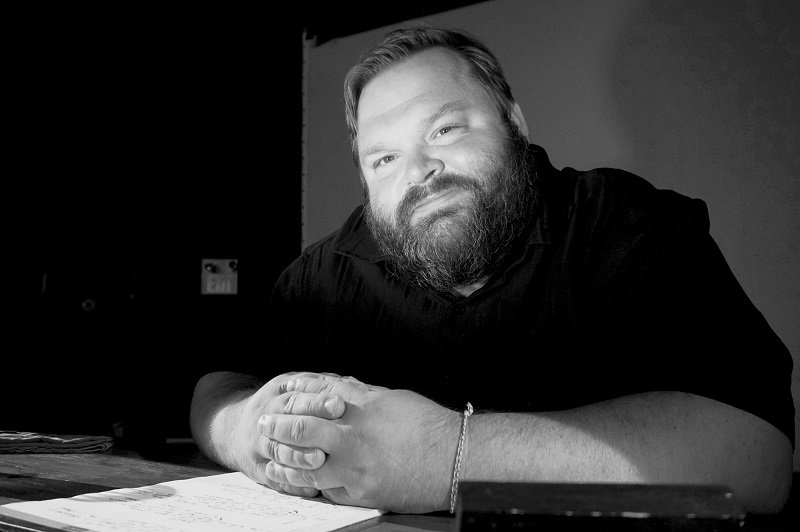
Photo of Mike Daisey from mikedaisey.com
I suppose it was inevitable, really. Monologist Mike Daisey has performed monologues about some of the greatest megalomaniacs in history (his series "Great Men of Genius" played at Berkeley Rep several years ago). And he's also been pilloried for stretching the truth (as story tellers are wont to do). So as he notes in "The Trump Card," it's kind of a miracle that he hasn't already done a monologue about Donald Trump.

But here he was, Tuesday night, at the Ashby Stage in Berkeley, at the confluence of a bunch of events. The Shotgun Players are in the middle of a run of Christopher Chen's play "Caught," which was inspired at least in part by the kerfuffle with Daisey on NPR when his piece about Steve Jobs and Apple was adapted for "This American Life." And apparently Mr. Trump is running for president. And Daisey is doing a tour of his Trump monologue, so it's only fitting that he'd sweep into town for two quick shows.

Background

I should note that I blogged several times about Daisey and the fuss with NPR back when it happened in early 2012. I think the most interesting piece is this one, because it both discusses the outcome of the show and links to several other commentaries. I won't go into detail here, since I've already written about it.

But Trump and Daisey is kind of an irresistible combination. Big, loud, guys from New York who don't just march to their own drummers, they are their own drummers.

I first became aware of Mike Daisey and his work when he came to Berkeley with his monologue (which was also published in book form), "21 Dog Years," about working in customer service for Amazon.com during the dot-com boom. We've since seen a number of his other pieces, including the controversial one about Apple. I like the fact that Daisey is always entertaining and thought-provoking, and because he has a very theatrical take on the ancient art of story telling.

The Art of the Story

Indeed, rereading my pieces from several years ago about the NPR controversy, what strikes me is that my favorite parts dealt with the role of story telling in general. Stories are the basis of culture, but also the basis of communication. We perhaps like to think we communicate with facts and ideas, but it is in fact stories that tie those together and enable human minds to absorb them.

Which (finally) brings me back to "The Trump Card." Daisey makes clear from the get-go that he is a story teller, a monologist, and a theater person, so he is, by his own admission, a professional liar. Now maybe that's just a clever disclaimer to ward off the hounds at NPR, but it also establishes his bona fides, because if it takes one to know one, he certainly recognized the professional liar and performer in Donald Trump.

He walks us through the history of the Trump family, most of which is probably familiar to anyone who has been paying attention for the last year or two. We get the stories of Trump's father, Fred, the slum lord and racist who was known for never paying people what they were owed. It becomes quite clear that the fruit didn't fall far from the tree. But always, Trump is telling his story, his version of "reality."

The Game

Among my favorite bits in the monologue is the description of Daisey hosting a big party, serving (fake) Trump Steaks to his friends while they play "Trump: The Game," which is, he says, like Monopoly for dogs. It sounds like a mind-numbingly awful game, but it also speaks volumes about the eponymous brand.

The Characters

In addition to the Trumps, of course, we also get to hear about Trump's longtime lawyer and advisor, Roy Cohn. That's pretty chilling stuff, but again, not so new.

I thought my favorite insight was when Daisey mentioned that as a monologist, he has spent much of his career developing and honing the character he plays on stage every night, "Mike Daisey." Because he says that's just what Trump has spent basically his entire career doing, too, at least since his businesses all pretty much tanked in the 1990s. It's all one long "reality" show, where Donald Trump plays the role of "Donald Trump."

And this might be the most useful insight: the fact that, no matter how much we think we know about Donald Trump, we really only know "Donald Trump." How much that distinction matters is left as an exercise for the reader, but Daisey makes it clear from the outset that we are all in deep trouble. And he also makes clear that even if "Donald Trump" is vanquished (or at least, defeated at the polls), we will eventually encounter someone who plays the role even better, and there the real trouble sets in.

The Script

I should note that if you can't get to see Daisey do the monologue, you can at least read it. You can download the whole thing here. In fact, you can read it out loud, if you like: It's open sourced. You, too, can play the role of "Mike Daisey" if you like. He has also released the script for "The Agony and Ecstasy of Steve Jobs" the same way.

If you're interested, a lot of his work is also recorded and available as a podcast, "All Stories are Fiction". It's all explained on his website.

The Evaluation

Obviously, this is a very timely work, which is why Daisey is on a whirlwind tour between now and the election. And it's clearly a work he cares a lot about. At over two hours, it's a bit long, and somewhat repetitive. It strikes me that this might be the first show I've seen since Daisey split with his wife, who used to direct and co-create a lot of his work. That might account for some of the difference. It's good, but not really his best work.

I'll drop a link here to a review of some earlier workshop performances of the piece in Washington, DC, last summer. It probably gives a better flavor of the actual content of the show.