Showing posts with label Central Works. Show all posts

Monday, April 24, 2023

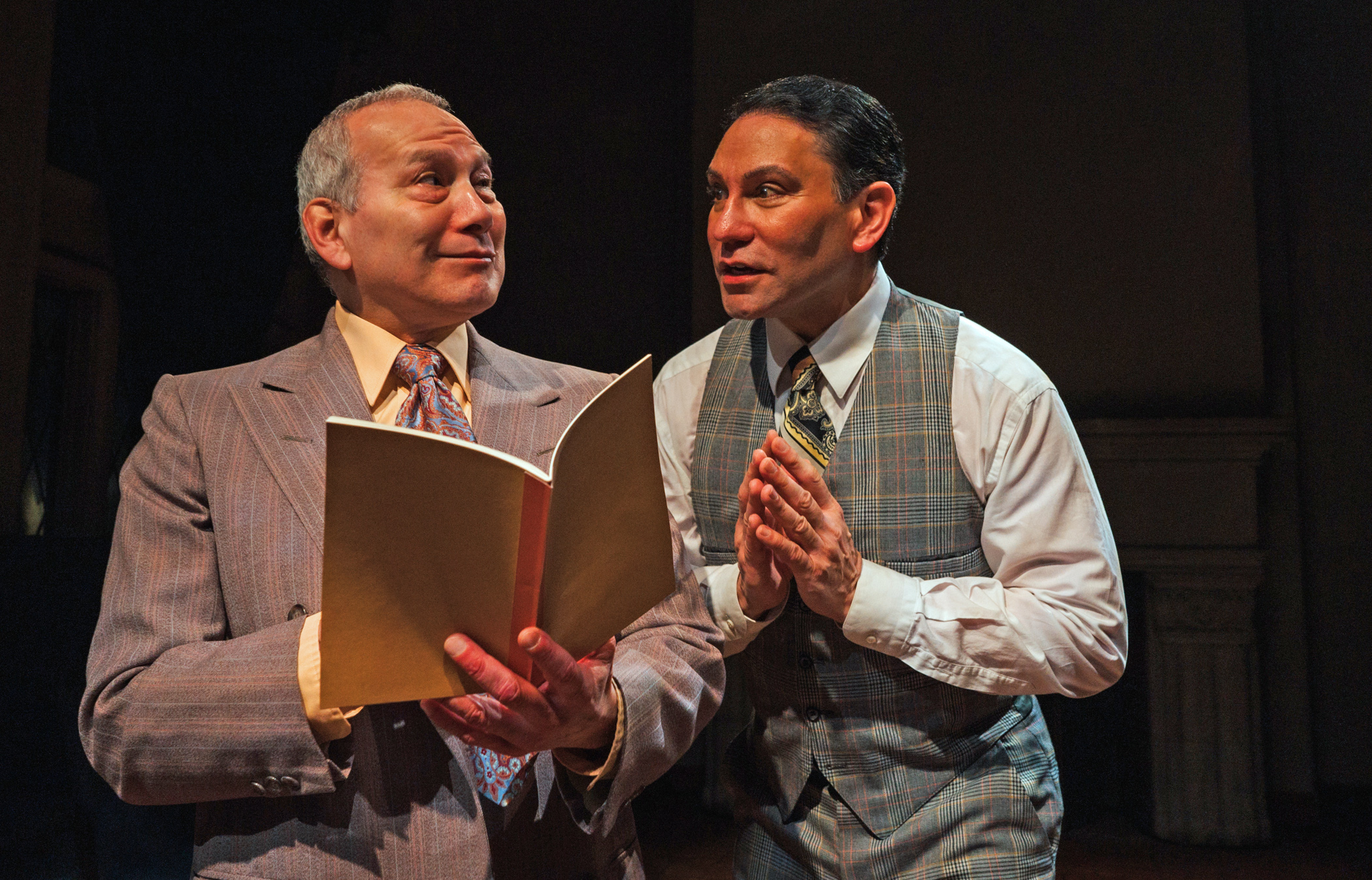
"Mondragola" at Central Works


Central Works production photo by Robbie Sweeny

Plays at Central Works are always kind of hit-and-miss. For over thirty years, they have been producing only world-premiere plays, Mondragola being their 70th, written by founder and company co-director Gary Graves and directed by fellow founder and co-director Jan Zvaifler. I'm going to say up front that this is not the best work by the company, by a long shot.

The Play

At a scant 65 minutes, the play seems pretty minimal, considering all it's trying to accomplish. In 1522, playwright Niccolo Machiavelli (yes, that guy) is in Florence, delivering a play to be performed before Cardinal Medici. The play is a silly farce called "La Mondragola", which means "the mandrake root", a supposed aphrodisiac. Although they spend a fair amount of the start of the show explaining this little play, neither the play nor its subject matter ends up being important to the plot of Graves' play, which seems odd.

Mostly what we get is a lot of fussing over the fact that the hired actors have run off with their fees, so there is no one to perform, so Battista, the guy who hired them, Luigi, the loopy guy who seems to have no actual job, and Zenobia, whose presence never makes any sense, will somehow learn and perform the play in one day.

All of this is merely a front for political machinations (hey, it's Machiavelli, after all) by Battista and Zenobia. Given some more time and attention to the writing, I think this premise could perhaps have turned into a decent play, but this isn't it. It definitely feels like it wasn't thought through, and then wasn't very thoroughly written.

The Performance

Given that they don't have much to work with in the script, the actors try to pull something together, but there is really no depth here, and they mostly end up kind of flailing. I wish there were some ray of hope I could glean from this, but really, just no.

The Bottom Line

I'm not sure what they were thinking here. I've seen much better work from all the people involved here: Graves, Zveifler, and some of the actors. I have to believe that something went wrong in the process, and they were committed to putting this on stage. But really, it wasn't ready, and wasn't up to the standards I expect from Central Works.

The production has finished its run, so this mostly serves to remind me what I saw here. Overall, a forgettable effort, and I hope it's just a one-time glitch in the Central Works story.

Saturday, March 17, 2018

"Bamboozled" at Central Works

Central Works photo by Jim Norrena
It's always something of a treat to go to Central Works plays. For one thing, their theater is a rather small room on the first floor of the Berkeley City Club, which is both a beautiful landmark building designed by Julia Morgan and also the place where my grandmother used to go swimming when I was a kid. So it's just a cool place. And on top of that, Central Works produces four plays a year, all of them world premiers, mostly by local playwrights. And they get lots of terrific local actors, and you get to see them in a really intimate space. What's not to like?

Anyway, the current offering, Bamboozled by resident playwright Patricia Milton, is precisely the sort of play Central Works does well. It's a small cast tackling a meaningful issue on both the substantive/policy level and the personal level as well.

The Play

Abby is a young antiques appraiser who specializes in American Civil War artifacts. Valuing Confederate artifacts is a little dicey for her because she is African American. She is also interested in researching her family history. As we meet her in the opening scene, these two aspects of her life both come into play. She is trying to convince Savannah, who works at a research center for just such  matters, to open her resources to help her find her twice-great grandmother, for whom Abby was named. It turns out Savannah is also working in the law office of the lawyers who are going to defend Abby in a civil lawsuit, in a case brought by some locals who believe Abby cheated them out of the value of their family Civil War mementos.

Basically, Abby was brought it to value these artifacts at the request of a boyfriend, whose family had heirlooms. Abby valued them for a rather low number, but they subsequently sold to a state museum for a cool million dollars, and the family wants the money, believing Abby has it. The boyfriend is a co-defendant, but they cases are being tried separately.

So we find ourselves in a law office in Shelby County, Tennessee. The lead partner in the firm is...indisposed, so Abby will be working with Rochelle, the hard-charging, attention-seeking lesbian lawyer who seems to have a track record of advancing her own career at the expense of some of her clients. This is a bone of contention with Savannah, in part because Savannah is a lawyer whose license got suspended as a result of Rochelle's hijinks, meaning she is currently reduced to clerical work in the office. Oh, and by the way the KKK is currently rallying outside the building to protest the impending removal of a Civil War memorial statue. There's a lot going on.

Things are already going a bit poorly when Opal Anne, the aunt of Abby's boyfriend, and the plaintiff in the case, suddenly appears and announces that she is representing herself. Opal Anne represents the Old South, the dedication to the Lost Cause, and so on.

I won't try to unravel all the fun that ensues. Suffice it to say that the plot is fairly intricate, with multiple characters in conflict with each other, even when they also need to pull together. And the script is also genuinely funny, with twists and turns that ratchet up both the drama and the humor in the script. Ultimately all four characters prove to be pretty interesting, which is a rare treat.

The Production

The time and space available for the show necessarily limit what the team can do, but within those constraints, they've come up with a pretty compelling set-up. We're in a conference room in the law office, with various people being sent out at times, often for prolonged periods, and often to their chagrin. Abby (Jeunée Simon) manages to remain remarkably calm in light of the lawsuit hanging over her head. Much is made of the racist temperament of the town, and Rochelle (Stacy Ross) hopes to create a situation that will produce a change of venue to someplace more sympathetic to Abby and her case.

One might expect Savannah (Chelsea Bearce) to be more of an ally to Abby, as she is also African American, but she has issues both with the Californian Abby and her treatment by Rochelle. Bearce manages to keep us guessing much of the time with sly, nuanced body language and facial expressions. She is, in many ways, the star of the show. And the unfashionable, atavistic Opal Anne (Susan Jackson) brings a whole new dynamic, as she gets to personally represent all the Civil War re-enactors and pretty much every racist, Southern stereotype you might want to throw out there. But she handles the load with aplomb.

Indeed, the casting is terrific all around. Watching Ross close up like this is a real treat. She was terrific in the big-stage production of Shakespeare in Love last year at Marin, but this is more like watching her in Aurora's Leni last year, as her personality can really fill up the small theater space. And yet, despite playing the character who seeks the limelight, she manages not to upstage the rest of the cast. Indeed, they all hold their own quite well--it's a very strong ensemble.

Technically, there's not much to the show. The lights and sound are pretty much limited by the setting in a single office space, with the occasional sound to remind us of the Klan rally outside. But this is definitely a show that lives and dies with the actors, and they come through.

Bottom Line

This is a really good play. It manages to be clever without being too full of itself, poignant at times without being cloying, and balances humor and drama pretty seamlessly. It's a treat to see the strong acting up close, though the configuration of the room necessarily makes it hard to see some bits if you sit toward the middle. But even with that, it's terrific.

The show we saw last Sunday was not just sold out, but oversold, so they added folding chairs and got everyone in. That enabled some of us to be even closer to the action than anticipated, but again, it's great.

The show has been extended a week, through March 25, so there are still opportunities to see it, and if it's still sold out, you can probably convince them to give you a folding chair. You won't be sorry.
Friday, November 17, 2017

"Strange Ladies" at Central Works

Central Works photo by J. Norrena
I hadn't been to Central Works for a while, so I was quite looking forward to seeing what this latest world premiere was all about. All I knew from reading blurbs on their website and in the paper was that Strange Ladies by Susan Sobeloff was about the American women who fought for women's suffrage, and that's a subject of great interest to me.

As always with these Central Works productions, they are world premieres, generally written by local playwrights, and they are often in somewhat raw form. In addition, the theater at the Berkeley City Club is really just a room with some seats around three sides, so the staging can't be too elaborate. On the other hand, they generally tackle issues of real interest, so even if the result isn't necessarily stellar, there is something worthwhile there.

And that's definitely the case here.

The Play

The play doesn't have a plot line per se, but rather follows a series of vignettes or episodes involving a group of six women joined together to fight for the right to vote. Some of the dialogue is a bit polemical, sounding more like they're giving each other their stump speeches than actually discussing issues or trying to persuade each other of tactics. But it's also a sort of shorthand that compresses our introductions to the characters and the issues.

So we first see the individuals, then send them off to recruit more, and then regroup together to plot a picket of the White House and President Wilson in the lead-up to the Great War. We get to see some splintering of the group over the war and how to advance (or not) their cause during it. And eventually we get to see some of the women arrested, imprisoned, and abused for demanding their rights.

Most effective in the script is the way it takes the six characters (although there are a few extras where someone fills a momentary role) with diverse backgrounds and priorities and manages to make them stand for the national coalition of women who came together over this particularly pressing matter.

Overall I thought the presentation was effective, and would probably be more so in a somewhat fancier theater with a bit fancier stage and light facilities. But on the whole, for a new work, it's quite effective.

The Production

Here again we have kind of a mixed bag. Of the six actors in the cast, three really stood out: Gwen Loeb as Rose, the New York union organizing veteran , Nicol Foster as Mary, the African American with a lot extra at stake, and Renee Rogoff as Alice, the organizer of the group. Each character has strong moments, but those actors really put something extra out there.

The costumes by Tammy Berlin are quite effective: Evocative of the era without being distractingly so. And the minimal props (by Debbie Shelley) and lights (by Gary Graves) manage to make the most out of the limited space. A "Votes for Women" banner held up represents the White House picket. A grid of dim light establishes that we are in prison. As a result, the production is pretty tight at just over an hour.

I should also call out the music, under the direction of Milissa Carey. The women frequently break into song, whether to break the monotony of picketing or to maintain their spirits in prison. It's one of the ways they bond, but also a way for the characters to establish themselves.

Again, they make the most of their limited space. The actors fairly frequently sat on the steps in the audience, making the setting all the more intimate.

Bottom Line

Strange Ladies is not, and need not, be a big play. Indeed, the small size of the cast and the stage effectively draws the audience into the already tight spaces and relationships of the characters. And we see in fair detail the efforts and the costs of the work these women undertook, the conflicts, the moments of doubt, and so on. It all seems very familiar to those who have worked on contemporary issues of social justice.

I appreciated getting some insight into the lives of the real women in the movement, although these particular women were fictionalized composites drawn from historical research. The result is quite moving as well as informative.

The play has been extended a week, and has three more performances this weekend. I'd say it's well worth going if you're in the area.

Sunday, October 23, 2016

"Into the Beautiful North" at Central Works

Central Works photo by J. Norrena
It's always interesting to see what Central Works offers. It's an ambitious undertaking, producing four world-premiere plays per year, and having to commit to those plays before they really exist. So you never know quite what you're going to get.

"Into the Beautiful North" is a bit different from the usual fare, in that it's not a local playwright or company member creating the script, but rather a local production of a "rolling world premiere" through the National New Play Network.

The Play

The core of the play is kind of a riff on the movies "The Seven Samurai" and "The Magnificent Seven." The small Mexican town of Tres Camarones is being besieged by "narcos," corrupt police officers selling drugs and generally terrorizing the citizenry. Nayeli, a plucky teenager, decides to steal off to the U.S. to recruit seven magnificent men to come back to Tres Camarones and save the town. She takes with her her best friend, Vampi, and her employer, Tacho, who runs the only Internet cafe in town, El Mano Caido.

The structure of the play is pretty familiar, with characters narrating among fairly quick scene changes. If you've seen some of the story plays by the likes of Campo Santo or Culture Clash, it will seem similar.

Nayeli, played by Samanta Yunuen Cubias, and Tacho (Rudy Guerrero) maintain their characters throughout, with the other six players in the ensemble playing about 40 other roles. For the most part it works well, though some of the scene changes are a bit clunky.

The Production

Realizing that this is a world premiere, a work in progress, and still relatively early in the current run (the play runs through November 13), one expects a few hiccups. There are some hesitations and fumbled lines, and a number of the (quite frequent) scene changes are distractingly slow. Some of the latter is due to the constraints of the little theater space in the Berkeley City Club. The plays I've seen there that work the best are those where either there are few scene changes at all, or where the play works with little or no scenery.

Somewhat surprisingly, the second act of the play comes out much smoother than the first. I'm not sure whether the ensemble just hit their stride after intermission or whether they have just honed the latter part of the play more completely. In any case, in the first half I was concerned that a lot of the dialog came out rather stilted, and some of the characters just didn't gel. But the show was better in virtually all aspects in the second half, which gives me hope that they will eventually get rid of some of the other wrinkles.

The writing is clever, with some quite witty dialogue, featuring fun puns and topical references. Clearly, the presence of "nasty women" and "bad hombres" was added just this week, as those references come directly from a presidential campaign debate just a few days before. In context, they work fine. Not all of the jokes flow quite as organically, but some bits work really well. The scenes with Rudy Guerrero and Ben Ortega in a bar in Tijuana and crossing the border are very funny and very well done. And Caleb Cabrera's "Atomiko" is consistently good.

Conclusion

I think the script has a lot of promise, and there are good bits to be found throughout. I was a bit disappointed with the cohesion of the cast, particularly in the first act. Some of the acting just felt rather amateurish, and not up to the standard I expect from Central Works. But it got much better in the second act, so I can hope that some of the bumps can be attributed to changes being made to the script and staging as the play is developed.

Overall, I thought it was a fun evening and certainly worth seeing. I really like what Central Works does, and fully expect that not every play they do will live up to expectations. But more power to them for promoting new works and opening doors to actors who might not have the resume to land a role this large in one of the bigger theaters in the area.

Friday, August 5, 2016

"Hearts of Palm" at Central Works

Photo Credit: ACT OUT Photography by Jim Norrena
You never quite know what you're going to get at Central Works. It's all new plays, all world premieres, and tonight I found myself sitting right behind playwright Patricia Milton at a performance of her current play, "Hearts of Palm." The newness definitely shows: there are some really uneven bits, but they are balanced by some very clever material and earnest performances.

Quick Summary

Representatives from Empire Holdings (OK, some of this is a little heavy-handed) are in the small island nation of Marititu to negotiate a land deal so they can grow more palm trees to produce palm oil for consumer products. We get lectured a bit about conflict palm oil and the power of Girl Scouts writing letters and such, but once we get into the meat of the play, there is some promising material about negotiations, hidden agendas, loyalty, and treachery.

This being Berkeley, I would have liked to see a bit more subtlety about the theme of "corporate colonialism." It's no secret to anyone in the theater that corporations have done unspeakably horrible things to lots of "third world" countries in the name of profit, so we don't need quite so much spoon-feeding of it. In short, I wish Milton would leave a bit more room for us to read between the lines.

She does a better job with the interpersonal relationships. There is a bit too much exposition in the opening scene between Vi and Brittany, but otherwise, it's well done. And the clownish character Strap is kind unbelievably and unevenly clueless on a negotiating team. Again, I would have liked to see him afforded some of the subtlety that Vi and Brittany display. Both Strap and Helen provide comic relief, but could use a bit of smoothing to make them less farcical. The native negotiator, Ni-Bethu, played with evenhanded smoothness by Michelle Talgarow, is the one character who manages to surprise with her little twists at the end.

Stuff to Like

Overhearing some of the other audience members who had seen the play earlier in the run, I get the impression that the smoothness and cohesion has improved over the course of the run. A play with the level of complexity and quick dialogue that this one has is likely to have a rough launch, especially if there is still work happening on the script.

But again, that's one of the attractions of Central Works. If you're looking for the comfort of an old classic, you'll find it somewhere else. This theater is all about promoting and producing new works, and that necessarily entails some bumps and jolts. But the rewards come, too. Between the blunt agenda and some slips in the lines, there are some clever ideas and good thoughts. My wife summed it up well as we left, that this play shows a lot of promise.

Extended

We went to the show tonight because it was literally the only performance we could schedule on the original run. As it turns out, they have extended the run an additional week, so it now closes on August 21 instead of the original date of August 14. Since they perform Thursday-Sunday, that's four additional shows you can now attend!

And it's worth it if you are willing to accept that it's not going to have the same level of polish you might expect in other theater companies. Tonight's audience definitely enjoyed the show in the spirit of the Central Works company.

Now I'm off with the family for the second half of our Ashland summer, so lots more play postings coming soon!

Friday, June 10, 2016

"Jekyll and Hyde" at Central Works

Central Works is a really small theater company that performs new plays (original works, world premieres) in a 50-seat theater inside the beautiful Berkeley City Club. I've seen several of their plays over the last couple of years, and have been impressed enough to subscribe. On one hand, it's pretty inexpensive, something like $30 per show. On the other hand, it's kind of a "pig in a poke" situation: You don't know what the plays will be like when you subscribe, since they aren't done yet.

I'll take those chances.

And just to reiterate the truism I frequently cite, that theater is a very small town, the production sponsor for this play, Ted McClellan, was a year ahead of me at the same high school, and now  serves on the board of Central Works.

Quick Summary

Tonight's offering was "Jekyll and Hyde," a play by Gary Graves inspired by a story told about Robert Louis Stevenson and the writing of "The Strange Case of Dr. Jekyll and Mr. Hyde." It's a pretty interesting mashup, featuring Brian Herndon as Louis (Stevenson) and Danielle Levin as his wife, Fanny.

Louis is trying to write. He hasn't produced much lately, so there are financial pressures, but he's too proud to ask his father for money, despite Fanny's urging. His last several attempts at stories have  gone up in smoke, unfinished.

The bulk of the play involves an ailing Louis trying to explain to Fanny this new story he's writing, about Dr. Jekyll and Mr. Hyde, all the while slipping in and out of the characters, while Fanny recognizes aspects of Louis' real life and character in the story. So it's pretty intricately woven.

The whole show takes place in one room, in one act, in about an hour and a half.

More Detail

Since it's been a theme for me this week, I should say that I found Herndon's accents quite credible. His Louis has a recognizable and consistent Scottish brogue, but it's fully intelligible. Jekyll speaks proper British English, while Hyde has a lower-class accent. All well delineated and consistent. To complete the set, Fanny is American.

The play does a nice job of weaving the frame story of Louis and Fanny in with the conception and telling of the Jekyll and Hyde story, with Fanny serving as our agent to interpret story elements against details of Louis' own character, relationship with his father, etc. I'd say that holds up about 75-80 percent of the way through.

Unfortunately, about the time we come to the realization that Louis doesn't have an end for his story yet, it also starts to unravel the play as well. The play meanders a bit trying to come in for a satisfying end, and frankly, I was a little confused by the way it concluded. But it held my interest and kept me thinking.

More Chances

Central Works has announced a one-week extension of the play, so it closes on June 19 (fun for Father's Day!). I'd say it's well worth spending an evening.