Showing posts with label Shotgun Players. Show all posts

Sunday, June 18, 2023

"Yerma" at Shotgun Players


Shotgun Players production photo by Ben Krantz
OK, back from our vacation jaunts, with plenty of local theater to catch up on. Lots of things closing in the next couple of weeks, so we'll sneak them in when we can!

First up in Yerma at Shotgun Players. I thought we were going to miss this entirely, but they added a Wednesday evening show that we could squeeze in between a couple of little trips, so we literally made the one performance we could before they closed.

The Play

I actually had a chance to read the script while it was under consideration for the Shotgun season, and frankly, I was not that impressed. It's an adaptation and translation by Melinda Lopez of a play by Spanish poet Federico Garcia Lorca about a young woman, Yerma, who desperately wants to have a child with her husband, Juan. But she never conceives. The play is about her efforts to have a child, and what she will and won't do to achieve that.

For whatever reason, the story doesn't appeal to me. Perhaps I've never been in a position of wanting something terribly that I could not have. But whatever it is, the play just doesn't do it for me. But clearly it has a strong appeal for many others, so I was hoping to find something in the performance that eluded me when reading. 

The Production

The play is indeed better in the flesh than it was on paper, but I still don't think it's all that. In the hands of director Katja Rivera (a long-time member of the Shotgun artistic company, making her mainstage directorial debut) and a good crew of designers (Nina Ball designed the set, lighted by Sara Saavedra, with costumes by Valera Coble), the story comes to life. But there still isn't that much story. I find myself siding with the majority of the characters who can't fathom why Yerma seems unwilling to take any of the alternative options presented to her (e.g., sleep with someone who looks like your husband, or adopt one of your many nieces and nephews) when endlessly repeating the same scheme continues to produce no results.

Regina Morones as Yerma, Caleb Cabrera as Juan, and Samuel Prince as Victor all give fine performances, but the material they have to work with just doesn't give them much room to shine. And some of Yerma's friends and relations (such as they are--she's pretty distant from everyone) manage to give more life to the characters than I detected in the script. Notably, Linda Maria Giron as Marta and Linda Amayo-Hassan as Incarnacion manage to make me care about them.

The Bottom Line

This just seems to be one of those plays that has great appeal to some audience, but not to me, personally. (Another example would be last season's Man of God at Shotgun.) Well done, but with a script that doesn't do much for me. But that's fine. Theater isn't just for me, and I can appreciate that there is value in hearing other voices and seeing other faces on stage.

So I applaud theaters for taking steps to highlight other stories, especially when they do it well. Expanding the scope of the works and the audience are both important goals. With so many theaters struggling to draw audiences after the pandemic, it's good to see so many of them at least trying to reach out to broader swaths of the community.

Wednesday, April 19, 2023

Reading: "Thirty-Six" at Shotgun Players

 I've been a big fan (and sponsor) of Shotgun's Champagne Staged Reading Series for many years now, and while a few of the readings have disappointed for one reason or another, they generally pull off something pretty special.

In this case, I had a chance to read the script for Leah Nanako Winkler's Thirty-Six a few weeks ago when I had some time on my hands. It's a rather amazing piece, but I have to say that I had doubts about how it would work as a staged reading. I mean, there would be challenges with staging it fully as a play, but in a staged, script-in-hand reading, it seemed almost impossible.

I've seen a couple of Winkler's plays before, and enjoyed them. Ferocious Lotus did a production of Two Mile Hollow a few years ago, and somewhere I saw a version of Hot Asian Doctor Husband, but I don't have blog posts to document either one; alas. In any case, this play steps out of the Asian-American milieu that I associate with Winkler's earlier plays, and into some very interesting territory.

The Play

The name of the play derives from a list of 36 questions published by the New York Times several years ago, ostensibly designed to improve intimacy and even lead to love between couples. In this play, Winkler has one of the characters, David, reading off the questions from his phone to Jenny, his Tinder date who has no interest in the questions (or intimacy, beyond the immediate hook-up). As David persists, we eventually get a lot of insights into both of the characters and the world they inhabit.

Part of the staging difficulty revolves around the whole Tinder hook-up thing, because the script contains a lot of rather graphic stage directions around the couple having sex. And while modern theater certainly wouldn't shy away from something like that, I found it difficult to imagine how one would stage that for a reading.

But the script manages to steer around the trite dialog opportunities, or at least faces them head-on and self-consciously. The characters realize the situation they are in, and acknowledge when they are and aren't following the expected path.

The Reading

I should not have doubted. Director Michelle Talgarow staged the reading very cleverly, with the two characters seated at tables on opposite sides of the stage. They interact, but they never actually approach each other physically. And upstage center sits a third character, called "The Mechanic" who reads the extensive stage directions to great humorous effect, as well as reciting the thirty-six questions when those come into play. It was a very effective way of defusing what could have been very tricky logistical issues with staging the scenes as a "straight" reading.

I should add that the audience for this reading was very lively and interactive: they were into the show from the start, and clearly that made the endeavor more fun for everyone. I can't imagine how the reading would have played out if the audience had sat there passively, instead of laughing, cheering, hooting, etc. 

The actors were terrific, of course. Lauren Garcia (Jenny) and Soren Santos (David) really nailed the roles and managed to interact with each other from across the stage in ways that were quite wonderful. Nic Feliciano as the Mechanic was delightful, with wonderful timing and expression for the stage directions. That definitely made the whole thing work.

And I would be remiss not to acknowledge the Intimacy Director, Natalie Greene. One might think that in a reading where the actors don't even come near one another, intimacy direction would be pointless, but in fact, I think it was the opposite. The actors managed to create or simulate intimacy in a very effective way that was safe and respectful (and funny!), and I suspect the attention of an experienced intimacy director contributed to that.

And lastly I will add that it was not lost on me that this was all happening on the set of Shotgun's current mainstage production, The Triumph of Love, designed by Malcolm Rodgers. Having the characters deployed across a simulated, Classical-style, 18th-Century garden added a rather ironic romanticism to what is not a traditionally romantic play. That was a nice touch.

The Bottom Line

I like this play. I have no idea how it would play out in a full staging, but I think it would be fun to see. Meanwhile, the staged reading seems to have been a huge success, at least judging by the audience reaction on opening night! Sadly, as is always the case with these things, there were only two nights, and they are past now. So you'll probably need to wait to see whether Shotgun or someone else locally stages the play. I will certainly go see it when that happens!

Tuesday, April 18, 2023

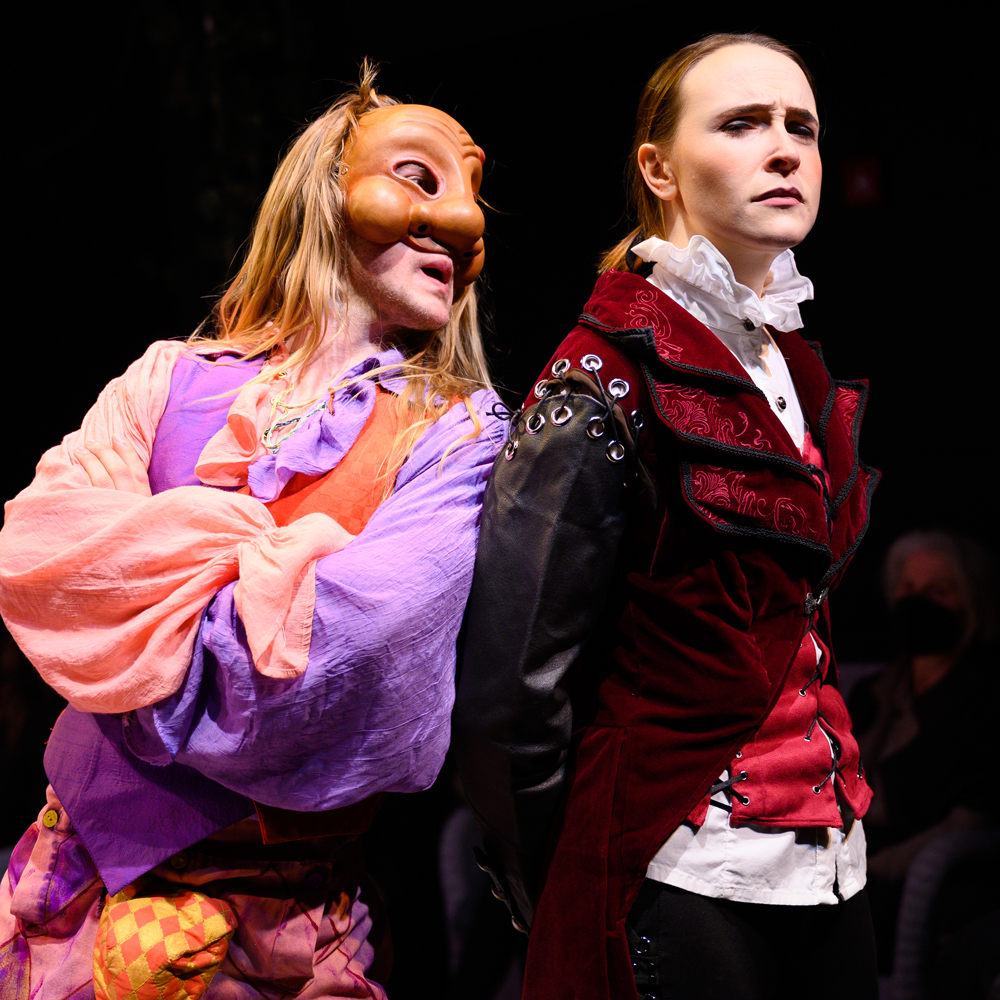
"The Triumph of Love" at Shotgun Players

Shotgun Players production photo by Ben Krantz

 I wasn't sure what to think about this play going in. On one hand, Shotgun Artistic Director Patrick Dooley is very excited to be directing it, a friend tells me it's his favorite 18th-Century play, and when I read it, I was impressed with a lot of the word play, which is impressive for a translated work. On the other hand, I didn't feel like the play itself had a lot of substance. But it seemed like it ought to be fun, at least.

The Play

Pierre de Marivaux's script, translated by Stephen Wadsworth, is nothing if not complex. One might even call it convoluted. Princess Leonide, whose grandfather usurped the throne, has located the rightful heir to the throne, Agis, who is being raised and educated secretly by a reclusive philosopher, Hermocrate, and his equally reclusive sister, Leontine. Leonide decides to disguise herself (and her maid, Corine) as a man to gain access to Hermocrate's estate and get close to Agis. Things get complicated when Leonide falls in love with Agis from a distance, then decides to seduce both Hermocrate and Leontine to be allowed to stay. Add in Hermocrate's comical servants, Harlequin and Dimas, and there is much deception and co-option going on.

As love stories go, this one isn't terribly convincing--the whole thing takes place over a period of less than two days. But if you jut kind of go with the flow and enjoy the twists and turns and puns and malapropisms, it's a pretty fun ride.

The Production

As usual, Shotgun puts together a solid cast. Veronica Renner as Leonide has to carry a lot of the show, as that character (in one guise or another) is in nearly every scene, fast-talking and manipulating virtually everyone with layer upon layer of deception and misdirection. She handles it well, but at times she seems to lose her way, as she's so busy manipulating others that we kind of lose sight of the point of the story and who she really is.

The supporting cast is good. David Boyll and Mary Ann Rodgers, as Hermocrate and Leontine respectively, make good, stoic foils for Leonide's inventions. The servants are quite good, notably Jamin Jollo as the masked, acrobatic Harlequin and Wayne Wong as the tongue-twisting Dimas. The whole play takes place in Hermocrate's garden, designed beautifully by Malcolm Rodgers, with on-stage seats that let the actors interact a bit with the audience to good comic effect. All in all, it's a pleasing and fun performance.

The Bottom Line

I liked it. I don't love it, but I appreciate that it's a complex and difficult piece that sort of hints at having more depth to the story than is obvious at first glance. But ultimately it kind of reminds me of how my mother described her least-favorite Shakespearean comedy, which she noted was extremely aptly named: Much Ado About Nothing. Here, too, there is a great deal of convoluted plotting, and that's fun to watch and unravel, but ultimately that's in service of a fairly minor plot goal.

Still, it's a fun play and the performances are good. It's worth seeing, and it has been extended to run through April 30th.


Tuesday, November 15, 2022

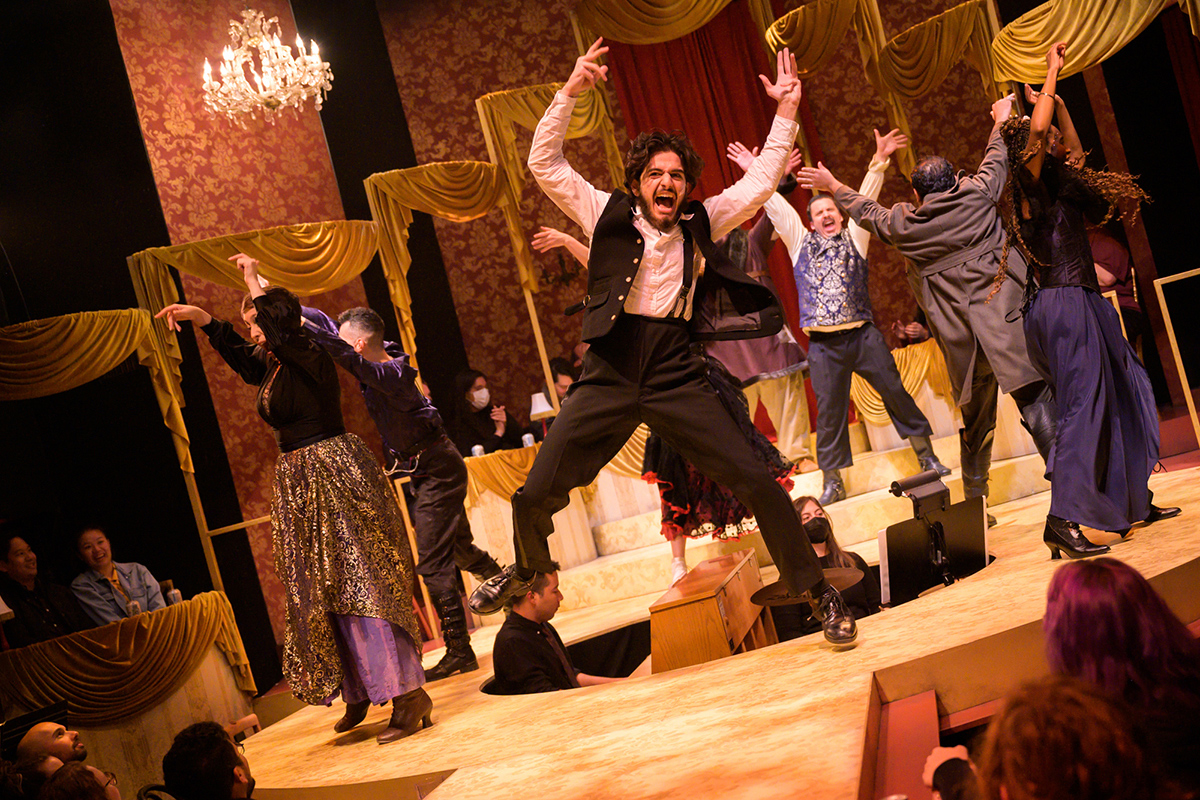
"Natasha, Pierre, and the Great Comet of 1812" at Shotgun Players


Shotgun Players production ensemble photo by Ben Krantz
I always find it a little difficult to write about shows at Shotgun, because they really are my favorite local theater. And I try to be at least reasonably objective, even though I'm a supporter/donor and board member. That's going to be tough here, because I really like this show.

I saw Natasha, Pierre, and the Great Comet of 1812 on Broadway some years back. I have to admit that I wasn't really prepared, and I didn't think the venue was all that conducive to really appreciating the show. It was a big open floor with cabaret tables where folks could drink, and lots of different entrances, so the show itself was a bit difficult to follow. So I've been looking forward to this production in the more intimate setting of the Ashby Stage, though I couldn't really imagine a cabaret setting in there.

The Play

The play itself is a most unlikely thing. Playwright Dave Malloy just doesn't do "normal" musical theater. This blog was still on hiatus last spring, or you would have seen a glowing review of Berkeley Rep's production of Malloy's Octet. And there is a long, meandering story about how Comet came about because of Malloy's production with Shotgun over a decade ago of Beowulf--a Thousand Years of Baggage. But let's just say the script is derived from a small slice in the middle of Leo Tolstoy's epic novel War and Peace. And as the first song, "Prologue", makes clear, it's a complicated Russian novel, and everyone's got nine different names, etc. But it also gives you some mnemonic devices for remembering who is who and how they relate, which is helpful (and Shotgun's program helpfully reproduces much of that).

As the title of the show suggests, Natasha and Pierre are the central characters: she young and naïve, loving her betrothed Andrey, who is off in the war, and he older, awkward, and disenchanted with life (and particularly his life, notably his loveless marriage to Helene. So we follow as Natasha careens through Russian society, wishing for Andrey to return and marry her, distracted by the appearance of the seductive Anatole. While Pierre sits, reads, studies, and drinks, all the time thinking he used to be better, and that he wants to wake up into his life.

The music is catchy, the story is actually remarkably easy to follow, and Malloy does a great job of simplifying things without losing the essence of Tolstoy's characters.

The Production

This is the west-coast premiere of the show, which has run in New York (both off and on Broadway) and a few other places in the east. But as far as I know, it's the first time it's been staged in such a small venue. And scenic designer Nina Ball outdoes herself (which is a very high bar) in reimagining the Ashby Stage as a cross between a cabaret nightclub and an opera house. The audience surrounds the stage, but with room for the actors to move around and interact with the house, and the band is spread around so it feels integral to the room. I love the way the cast sneaks into the room to do choral backup behind one or two singers on stage, adding musical depth without distracting visually. The co-directors, Patrick Dooley (Shotgun's artistic director) and Erin Mei-Ling Stuart (who also choreographed), have done a remarkable job of taking the transformed stage and making it both large enough for the whole ensemble and small enough for intimate solo and duet numbers. The lighting design by Weili Shi contributes a lot to the illusions.

Somehow this space also accommodates a remarkably big band: musical director Daniel Alley and his upright piano is in a pit in the center of the stage, along with drummer Brietta Greger and her whole kit. On one side of the house there are strings (both a cello and double bass), while on the other are woodwinds (clarinet and oboe) and a very versatile accordion/keyboard/glockenspiel player. So it's a very rich musical ensemble, but it suits the space.

The cast is very strong, starting from the title characters. Jacqueline Dennis brings both a powerful voice and a very believable sense of youth and innocence to Natasha, which Albert Hodge brings a brooding, yet explosive, mood to Pierre. There are several other particularly strong singers in the cast, most especially Danielle Cheiken (Mary and others) and Veronica Renner (Sonya). Several others bring both vocal prowess and some serious acting chops to their supporting roles, notably Angel Adedokun (Helene) and Michelle Ianiro (Marya). But even the "minor" characters have their moments in the sun, with James Mayagoitia (Old Prince Bolkonsky) doddering humorously, Roeen Nooran filling numerous servant and ensemble roles, and Weston Scott taking advantage of every second as Balaga, just for fun.

Bottom Line

For some crazy reason, I decided to read War and Peace this summer as sort of self-assigned homework leading into this play. As a result, I appreciate both how difficult it had to be for Malloy to carve a meaningful little slice out of the middle of a ponderous tome, and also how interesting it is to contemplate the characters within this slice, knowing that there is so much more to their stories, both before and after. It really is remarkable that Malloy created such a compelling, moving, and fun piece out of that source material.

And as you have already gleaned from my words above, I believe this is one of the finest pieces of theater to hit the local stages in some time. It's not the same kind of intellectual work that wowed me in This Much I Know this summer at Aurora. But to take this remarkable piece of both literature and music and create an intimate, immersive, interactive stage experience unlike anything I've encountered anywhere recently--that's an achievement. Producing a show of this scope with the quality of this production is pretty expensive, which generally means you have to stage it in a larger house. But Shotgun has managed to fit the show into its friendly confines, and the intimacy of the show really adds to the experience.

Really--go see it. It's not just me--the "little man" in the SF Chronicle's review is leaping out of his chair. You will be, too.

Comet has already been extended through January 15th at the Ashby Stage in Berkeley.

Sunday, September 25, 2022

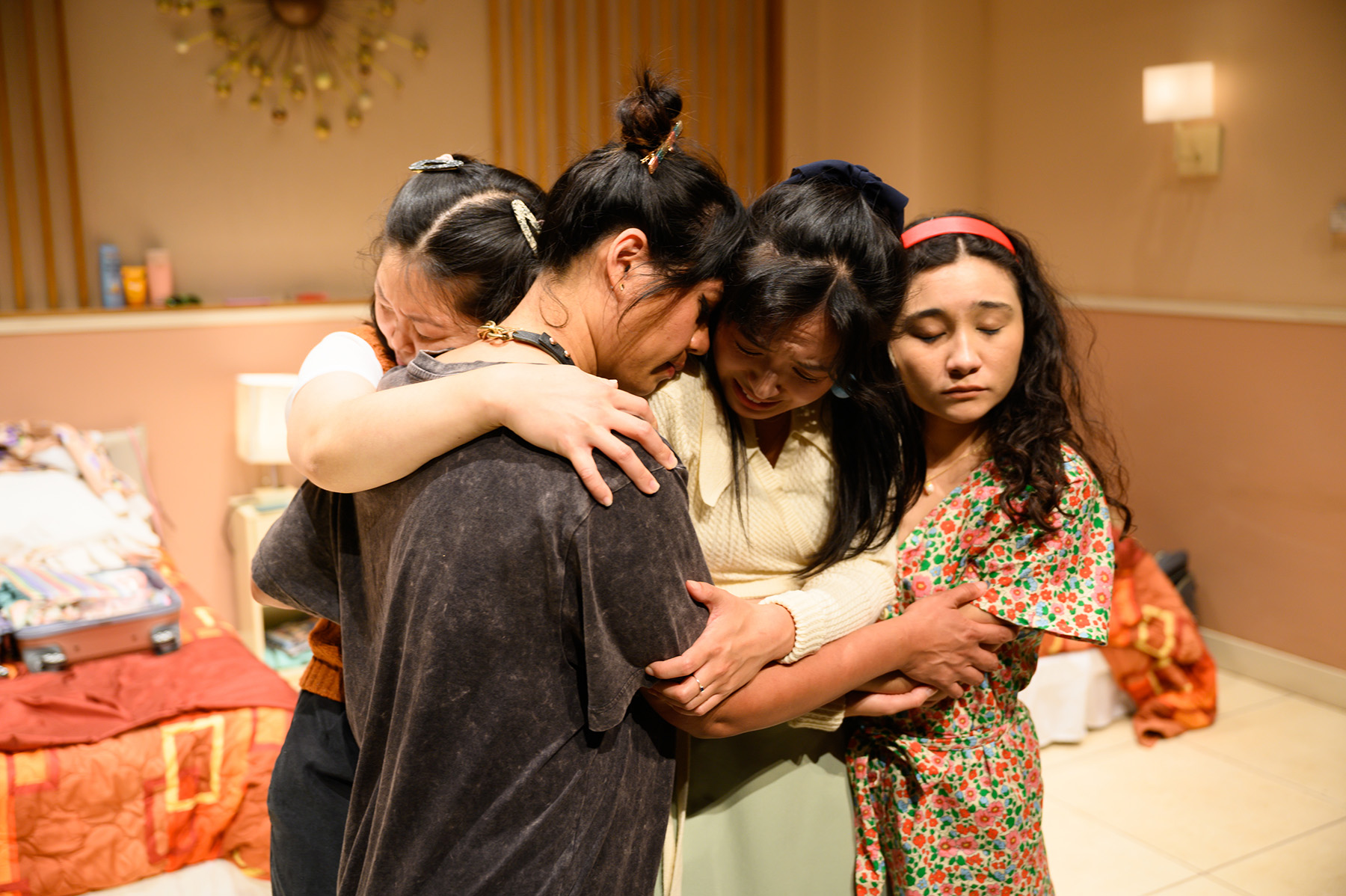
"Man of God" at Shotgun Players

Shotgun Players photo by Ben Krantz

 During the pandemic shutdown, as theaters were experimenting with various flavors of online presentation of plays, my usual reaction was to think that it was better than nothing, but in just about every case I thought the show would be much more effective live on stage. Last night I got my first chance to test that theory, as we went to Shotgun to see Man of God, which had been planned for 2020 and was presented as a Zoom play during the shutdown.

Unsurprisingly, the show is much more effective as a fully-staged production.

The Play

Four teenaged, Asian American girls from a church youth group are on a mission trip to Thailand. When one of the girls finds a camera hidden in the bathroom of their hotel room, the four face a lot of growing up, very quickly. First they turn on each other, but as the realization comes that the camera was placed by the pastor who is also their only chaperone, they quickly have to come to grips with their limited options. As denial gives way to anger, the play dramatizes the cinematic-inspired revenge fantasies they concoct. In the end, they have to confront the pastor in person, and reality has to take the place of the fantasies.

Written by Anna Ouyang Moench, the play explores both the reality of how young women learn to live in a world where they are constantly the subject of the male gaze (or worse), and how neither the reality nor the fantasies of how to deal with ongoing problems like this are satisfying in the end.

The Production

[My usual disclaimer here: I'm a member of the board at Shotgun, and my wife and I are season sponsors. I am friends with members of the cast and crew. Opinions here are solely my own.]

This play is so much richer as a fully-staged production than it could be online. For one thing, the interactions of the characters, both verbal and physical, are much clearer and more meaningful in person. It's one thing to tell something from one Zoom window to another, and quite another to physically move toward someone, raising your voice. Also, as the production photo above illustrates, there is much meaning in the contact of these characters, who are constantly ping-ponging between jousting amongst themselves and realizing that they are also their only support system.

Director Michelle Talgarow (with ample assistance from the lighting design of Gabe Rodriguez and Dave Ragaza) manages to move the girls between their reality and their revenge fantasies deftly and with humor, despite the seriousness of the scenario. This is one of the clear ways the live production is able to do things the online version could not possibly touch. And while none of the four actors playing the girls is an actual teenager, they do generally manage to capture enough of the behaviors and interactions of teen girls to enable one to suspend disbelief.

Another thing that is much clearer when seeing the show in person is that the pastor (Chuck Lacson) is not physically present through most of the action--only appearing onstage during the revenge fantasies and then finally at the end. That makes a big difference in the understanding of the play.

Bottom Line

The play works well, and it clearly speaks loudly to a segment of the audience. There is definitely a sense that young girls, and particularly Asian girls, don't feel seen or heard in society, and that their stories aren't told on stage. This production definitely addresses that, both in its content and in its staging. So that's a big step.

I definitely felt after seeing the show on Zoom that the script was a bit too blunt and the message not as universally appealing as I'd generally want to see in a play. Now having seen it in something more like its intended form, I can see that there is much more subtlety to the story-telling than I was able to get online, and the message is much more clearly directed at a broader audience. This is definitely not just a niche play that panders to those who can relate to the primary characters.

So I feel like the play is well worth seeing. It runs through October 2 at the Ashby Stage.

P.S.

The San Francisco Chronicle's Sunday Datebook (a.k.a., "the pink section") has an article by Bay Area journalist Joy Diamond (who is Chinese) about this play. I found her insight informative, as her viewpoint is notably different from my own. One small excerpt:

As much as I love theater, it’s a space in which I feel especially like an outsider, where my race feels particularly noticeable in contrast to the average theatergoer. It’s no secret that both artists and audiences of American theater are overwhelmingly white, and it’s not enough to retroactively fit people of color into the existing canon — we need to introduce new works that reflect and prioritize the diverse perspectives of our population.

“Man of God” does exactly that.

I thought the whole piece was well worth reading. 

Monday, September 12, 2022

Revisiting an Old Friend

 I know.

I don't do this anymore. I got tired of the effort it took to produce even a modest-length "review" of the plays I saw, when very few people were even reading the results. I felt bad because I knew a few people, at least, had come to expect my posts, and in truth, I missed writing them.

And then came The Plague, and the Master of the Revels closed all the theaters. In fairness, I had stopped blogging about theater well before COVID-19 was even a twinkle in some Chinese bat's eye. But it soon became clear that not only was my attempt at "Too Much Theater" impossible, but we would all get to experience "Not Nearly Enough Theater" for far too long.

And now things are opening up again, and we're seeing shows in person (the less said about the lessons we learned with online performances, the better, though maybe I'll blog about that someday). But that's not what brought me back here. It was rereading a play.

Searching for a Reading

Last summer, when it appeared theaters were going to get to reopen for real, and we were all vaccinated and excited about life again, my wife and I got to be guinea pigs. A few years earlier at the Shotgun Players' annual gala we had bought the rights to host a private, staged reading, and the reading itself was scheduled for late April of 2020. Obviously, that didn't happen. We had planned to use the beautiful set that Nina Ball had designed for Shotgun's production of Henry V that was supposed to open right as COVID shutdowns hit--they were in tech rehearsals, and never got to open. It was terribly sad for the artists, of course, but I also took it personally as I'd been allowed to sit in on quite a number of their rehearsals, and really felt like a small part of the gang. Plus I really wanted to use that set!

My thinking had been that we ought to do a reading that would take advantage of Nina's brilliant little interpretation of Shakespeare's Globe Theater inside the Ashby Stage, and the play that came to mind was Bill Cain's Equivocation. We'd seen its world premiere at Ashland in 2009 and also when it played at Marin Theatre Company the following year. Terrific play, partly taking place in the Globe: Perfect!

But as the pandemic wore on, that play felt less pertinent in the moment, and we ultimately settled on a reading of Lauren Gunderson's wonderful play, The Book of Will. We had seen it twice in Ashland in 2018, and had been looking forward to it playing at TheatreWorks Silicon Valley in the summer of 2020 before it got canceled. So it was both a chance to give that play a deserved shot in the Bay Area, and also a celebration of the role theater plays in our hearts during difficult times. It was kind of the ideal show to use to reopen the theater after more than a year away, and it, too, is largely set on the stage of the Globe.

So that's all good, but also not the reason I'm writing this.

Old Play, New Context

When we were planning the reading of Equivocation for 2020, I read through the script for the first time in several years. (I have two copies: the OSF script used for the premiere and also the published version--I really like this play!) The play revolves around the premise that in 1605, while Shakespeare was working on his new play about King Lear, the government tries to hire him to write a new "history" play, but this time about current history, specifically the Gunpowder Plot.

This leaves our playwright in a quandary. The king is, after all, the patron of his theater company, and with theaters having been closed by outbreaks of the plague for several years, a commissioned work would be welcome revenue. But the company is divided over whether to accept the task. The play will have to delicately balance the official government line with portrayals of the conspirators and their views. The playwright struggles both with his company and with the government, all while the story of the Plot is still coming to light. Art, truth, and expediency all seem to conflict. Can he write a play that is true and still get it approved? Are we being manipulated? Is he being manipulated?

A Little History Lesson: A House Divided

The years 1605-6 were busy ones in England, but really, for several centuries the whole country had been in nearly constant upheaval. Must of that period is familiar to theater-goers through Shakespeare's "history plays" that cover the period from the early 1300s to the mid-1500s. Throughout those years, England was wracked by questions of succession, usurpation, and the legitimacy of its kings. Even when the Tudor era put an end to the Wars of the Roses, religion came to the fore, and for several generations the country ping-ponged between Catholicism and the Church of England.

Despite a fair degree of adherence to actual history, Shakespeare's history plays both bend history to fit dramatic needs, and also carefully select themes that will pass the approval of his contemporary censors. Not only does Shakespeare have to craft his plays so his audience will enjoy them, but he also needs to make sure the current monarchs will permit the plays to go on.

With the death of Elizabeth I in 1603 and the succession of James I (brokered by Sir Robert Cecil, the Secretary of State), Protestantism seemed well established in England, though there remained devoted, mostly closeted, Catholics (and indeed, Shakespeare may have been one). Jesuit priests were officially banned from the country, for example. And the Protestant King James was not universally loved, both because he was Scottish and because he was deemed a bit of a lightweight in the ruling department, perhaps more interested in the trappings of the office than the job itself. So in November of 1605, a group of English Catholics conspired to blow up the House of Lords (and the king) during the opening of Parliament, an event known as the Gunpowder Plot. Though the plot failed, the event was used to justify further restrictions on Catholics, and to this day the anniversary is commemorated as Bonfire Night.

So, then: a deeply divided nation, tenuous leadership, and a scandalous attempt to overthrow the government. And even in the aftermath, conspiracy theories that agents of the crown might have aided the plot, knowing they could exploit the event for political gain.

The Play, Then and Now

Cain originally wrote Equivocation in the aftermath of 9/11 and the ongoing Iraq War, and the themes of government coercion and propaganda, lies, torture, and conspiracy theories all resonated strongly. Exploiting a national tragedy to unite divisive factions, even if the story doesn't quite ring true, was a big theme of the play.

The parallels with 9/11 were quite clear at the time, with a big, violent event used to pull the nation and the world together, with threats of further terror used to justify curtailing travel, increasing surveillance, and eventually, invading foreign countries. One can easily equate the incidents and the responses to them--that was certainly palpable when I saw the play in 2009-10.

So in late 2019 I re-read the play to make sure it would still feel timely a decade later. And boy, was I surprised to find that it resonated in whole new ways! The play hadn't changed, but the social context for the audience was very different.

In pre-pandemic America, the notion that the government might be trying to rewrite (or even, pre-write) history was all too credible in the land of "alternative facts" and "fake news". An unqualified new head of state, pulling the levers of the Deep State, manipulating stories and perhaps even staging them--all terribly familiar in the Time of Trump. Cain's exploration of the role of Truth is even more fascinating that it had been a decade earlier, and honestly, the ambivalence of the answers are even more poignant in the current environment.

It was truly eye-opening to see how a play that had been so rich and timely when it first came out was in many ways even more on-point in a dramatically different world ten years down the road.

And that was all before January 6, 2021. I mean, how much more pertinent can we get? An actual insurrection attempting to overturn the results of a presidential election is right up there with putting gunpowder in a tunnel under the Parliament. And the spin doctors casting doubt on everything and everyone--motives, actions, words--everything is up for grabs.

All I can say is that I continue to be amazed at how prescient Cain was in his writing. But really what that means is that he wrote something really good: a piece of work so deep and complex and real that it provides a framework for gaining insights into future conditions that change over time.

Nerdy Shakespeare Notes

Aside from the deep issues addressed in Equivocation, there is a whole layer of "inside baseball" material for the Shakespeare enthusiast. On top of his background as a Jesuit, playwright Cain has strong credentials from his work with Shakespeare's plays: founder and artistic director of the Boston Shakespeare Company, he has also directed Shakespeare plays from coast to coast. So this play is full of playful nuggets that appeal to Shakespeare nerds.

In addition to the delightful digs about Shakespeare's acting ability and his penchant for killing off his characters (and particularly, kings), Cain intertwines history with his own story in at least three different ways. One obvious one is the character of his daughter, Judith. There is no evidence of them having anything like the relationship depicted here. A second is the family rivalry with the Cecils. Although scholars have long linked Robert Cecil's father, William, to the character Polonius in Hamlet, I believe Cain's linkage of the younger Cecil to the Scottish Play is entirely novel. In any case, the snarky digs and clever creations make Equivocation a treasure trove for a Shakespeare nerd.

Why Do We Do This?

I will admit that a few bits of the play seem less timely, or at least less urgent, than they did before. The debate over torture and its use and abuse as a tool of investigation is no longer front-page news, for example. But the bigger dynamics at play--government versus private interests, art as a tool for finding (or obscuring) truth, artistic integrity, fathers and daughters, entrenched dynasties--all still work delightfully.

And ultimately, this is what all literature, all stories, all art should be about--holding up a mirror to our current selves so that we can investigate who we are and what we think, feel, and believe. And that's not a one-time offer. Revisiting a book or a play or an artwork isn't just a way to reinforce something already known or have the same experience again. To paraphrase Heraclitus, you can't step into the same story twice. It's reopening the learning. It might reinforce, but it might replace or adjust or augment what came before. There is always value in revisiting stories.

My first viewing of Equivocation was a milestone for me--both the play and the production were eye-opening, and it's been a touchstone subsequently as I think about plays and the theater. Reading it, and hopefully seeing it again lets me both re-evaluate what I recall I got from it the first time and experience new reactions as well. Even if it's the same story, I'm not the same person, and this is not the same world, and there will be new thoughts to think.

Of course, not every piece of art deserves all this much attention. Part of the ongoing reimagining of theater today deals with pruning some works from the canon and introducing new and different ones. I'm all for new works and new voices, but it's important to remember why some of the classics are genuinely classic, and why some modern works are better than others. Some repay ongoing study with rich rewards, and I'm pleased to find that Equivocation seems to fall in that category.

Wednesday, July 24, 2019

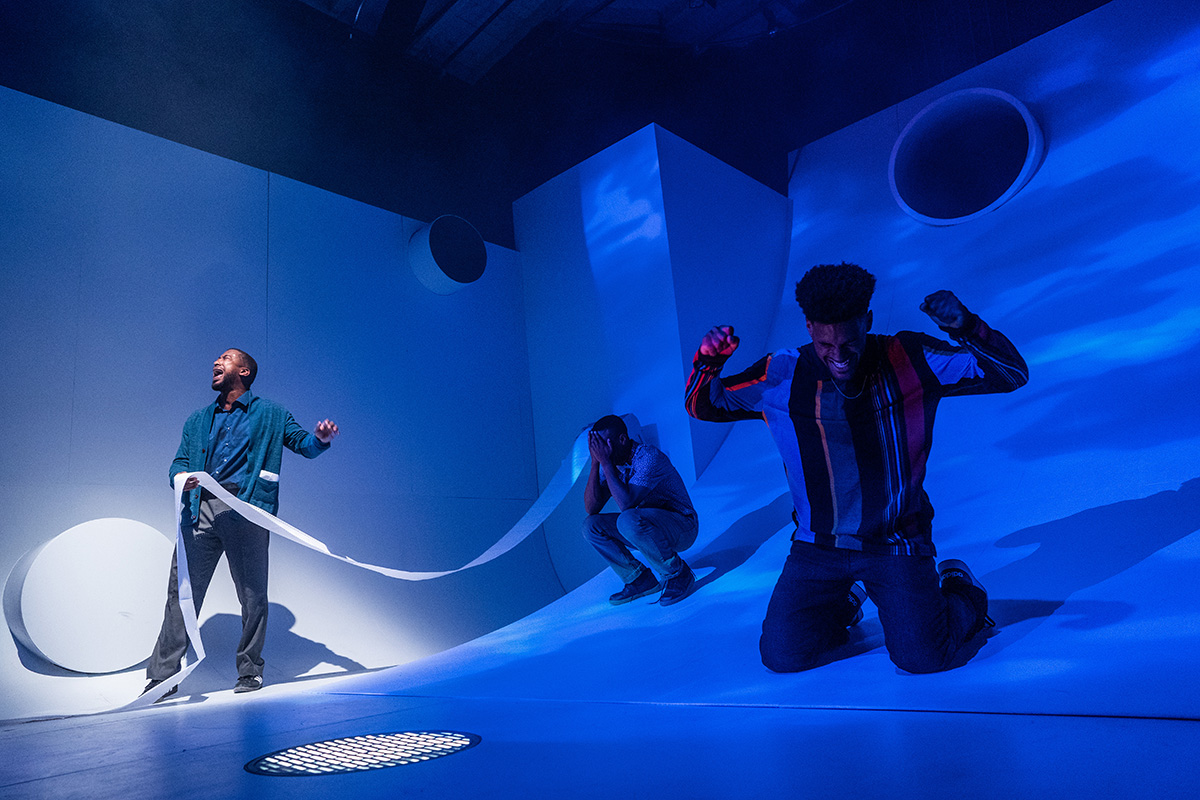
"Kill Move Paradise" at Shotgun Players

Shotgun Players production photo by Robbie Sweeny
One of the things I have missed about blogging is getting to write about my "home" theater, the Shotgun Players, where I am still a member of the board. And I've been looking forward to Shotgun's current production of James Ijames's Kill Move Paradise ever since last season, when they produced Ijames's play White and did Kill Move Paradise as a companion staged reading.

Unfortunately, that was right around the time my blog and I fell off the edge of the universe, so we don't have a way to reflect my feelings then versus now. Oops! Suffice it to say that White was a spectacular, if somewhat flawed, investigation of privilege and cultural appropriation as manifested in race and gender and all sorts of other dimensions of society. I'm glad Shotgun decided to bring this fully-staged production to life this year, as it does much more justice to the material than the reading could.

The Play

We start with a very plain, empty room that looks like a catch basin for all the sewers of the universe, but very clean, almost sterile. Then one by one a series of young African American men arrive and have to come to grips with how they got there and why. It's not too much of a spoiler to say this place is a kind of limbo, and each of the men has arrived because of being killed for no good reason.

As each one begins to fathom his fate, he also begins to note the fourth wall, behind which is an audience, and we all become part of the production, to one degree or another. At some level each member of the audience gets to decide how much to interact, which is an interesting part of the play.

So the play explores both the rash of premature, violent deaths of young black men and the relationship of those men to the rest of society: those of us who observe, but might not act. There is also quite a wonderful element of the play that explores how these men assist each new arrival, as each goes through various stages of awareness ad grieving.

And in the background is an old computer printer that occasionally burps out a few more entries to an ever-growing list: a roster of these men that the first character, Isa, reads aloud to great effect.

All in all it's a rather simple story, but profound and moving.

The Production

The first thing I thought of when I saw a picture of the set for this play was how completely it had transformed the Ashby Stage's performance space. It's almost entirely unrecognizable: starkly white, smoothly curved, and almost unornamented. So, big kudos to set designer Celeste Martore for capturing the necessary aspect of the inescapable sump of the universe! Stephanie Johnson's lighting makes a lot of mood changes possible within the simple space, along with Theodore J.H. Hulsker's video effects and Elton Bradman's sound design (assisted by Dani Chaparro). This plain, white space contains much more than it initially seems.

And as each actor enters the space in turn, we get treated to four different iterations of a young man having to adjust to the realization of where he is and why, with the emotional upheavals that accompany that. And each in turn must also deal with the fact of being observed, causing the audience to think about how they are affecting the actors, the play, and the characters. It's quite fascinating, often subtle, and both disturbing and delightful to watch.

In their turns, Isa (Edward Ewell), Grif (Lenard Jackson), Daz (Tre'Vonne Bell), and Tiny (Dwayne Clay) captivate us in different ways. Each brings something unique to his experience and ours. I can't go into it much without ruining it, so I'll just say that it is remarkably moving and thought-provoking to watch what all of them, individually and collectively, go through in the course of a relatively short show. Director Darryl V. Jones does a terrific job of making sure we see all four of the characters as fully-differentiated individual, yet inextricably bound together by something they cannot change.

Bottom Line

This is not a show that's going to leave you jumping for joy. But it is deeply affecting. I found it has stuck with me now for days (despite my lack of writing about it!). The performances are difficult yet wonderful, and the show overall is well worth seeing. Bring your friends and talk it over, either in the post-show discussion (after every performance) or after you leave. But you will have things to discuss.

The show has been extended to August 11th, so you still have three weekends to see it. And you should. Bring friends. You won't regret it.

Monday, September 17, 2018

"Kiss" at Shotgun Players

Shotgun Players photo by Ben Krantz Studio
I thought this was going to be a really simple write-up, because I'd seen the show as a reading last year. But apparently I neglected to blog about it at the time, so I won't be able to just refer back to that text. Alas!

The current offering at Shotgun is a really interesting play. Thematically and spiritually, it's as if someone decided to mash up Shotgun's 2016 production of Christopher Chen's play Caught with last season's rendering of Sarah Kane's Blasted to produce a consciously self-negating and unnervingly experiential exploration of cultural miscommunication and the horrors of war, all rolled into one.

The Play

As with any play that intentionally undercuts itself, I find it hard to write much about the plot or structure of the play without giving a lot away. Suffice it to say that much like Chen's Caught, each of the four scenes in the play serves to subvert in some manner the audience's understanding of what has gone before. In this case, we start with a pretty straightforward, rather melodramatic rendering of a group of friends gathering in war-torn Damascus to watch their favorite soap opera. We eventually come to understand that this is a play within the play, that a group of actors found a script on the Internet and decided to perform it. When they finish, they treat their audience to a live-via-Internet video chat with the playwright, who is in a refugee camp.

As the discussion with the playwright continues, it becomes clear that the actors have severely misunderstood the script they read, and have a lot of trouble getting clear just what they do and don't understand about the situation in modern Syria. Based on their new understanding, the revisit the script in ways that genuinely amazed me. The artful performance of essentially the same words with an entirely different context is probably the single most impressive aspect of the show. It continues even beyond that, but more I shall not say, for fear of revealing too much.

Suffice it to say that what starts as a pretty simple-seeming little soap opera scene turns out to me much, much deeper when read in the right light.

Chilean playwright Guillermo Calderón wanted to write a play about the situation in Syria, but since he knew almost nothing directly about the conflict, he also decided to write about that: the difficulty of learning and understanding what truly happens in another place, another culture, without first-hand experience. In that sense, the play is quite successful. By depicting artists earnestly trying to convey a message about a situation that they do not themselves comprehend, Calderón suggests the limitations of his own art and abilities, and causes the audience to question what they think they know about such situations, and how they might have learned that.

All in all, it's a very clever piece of writing. I wasn't entirely clear on what Calderón intended from the last scene, but even so, I came away impressed.

The Production

As noted up top, I saw this play in a staged reading at Shotgun last year, so had a pretty good notion of what the play was about. But a full staging made for a much more effective and viscerally satisfying version of the story. Just as one example, having the playwright and her interpreter actually appearing projected on the wall, rather than just sitting on the other side of the stage, is quite satisfying. Similarly, setting the play in a purpose-built living room, rather than adapting the set from some other play, really helps to convey what the actors are going through.

I have to single out actors Rasha Mohamed and Jessica Lea Risco, as the playwright and her interpreter, for managing to act literally behind the scenes and still manage to convey coherent characters when projected on the wall. The fact that they also function in both English and Arabic is impressive, and adds to the general feeling of cultural awkwardness.

The four American actors, played by Roneet Aliza Rahamim, Elissa Beth Stebbins, Wiley Naman Strasser, and Phil Wong, all bring distinct degrees and types of their own biases and misunderstandings to their roles. They manage to represent the earnestness of their endeavor as well as the splintered, inconsistent levels of misinterpretation they all carry. Director Evren Odcikin coordinates all of this chaos quite masterfully. I can see where it would be easy to let this play devolve into a terrible, confusing mess, but Odcikin manages to keep the audience off balance without completely coming untethered.

There's a bit of uncomfortable messing around as we move from the initial presentation to the online session, but that ultimately feeds into the awkwardness of learning that what seemed to be a well-intentioned attempt to convey a political message was in fact not even understood by the messengers. There was definitely a sense of disquiet between the scenes as audience members had to decide for themselves what was really going on.

Bottom Line

I would say this is a good, not great play, but it does some things very well that are difficult and probably necessary right now. Making people question what they think they understand and why, especially across cultural boundaries (that need not be ocean-spanning) is valuable. Perhaps if people start to analyze the kabuki aspects of the way facts and their alternatives filter around our own country, they might feel less certain of their stances in a polarized society that is part of a fragmented world.

In short, the play's not perfect, but it's doing something important, and is really well worth seeing. And as luck would have it, the run as been extended through September 30th, so you still have two weeks to catch the show. It's definitely worth your time.

Monday, June 25, 2018

Reading: "Botticelli in the Fire" at Shotgun Players

Busy times since we got back from New York City a couple of weeks ago. It took me most of that time to catch up on blogging all the shows we'd seen there, but meanwhile I was seeing a bunch more stuff at home, which I now need to catch up on quickly because we're headed off to our annual trip to the Oregon Shakespeare Festival tomorrow, and there will be lots, lots more.

So, let's see if we can't get some of the backlog trimmed, starting with the second of Shotgun's Champagne Staged Reading Series for the year, Botticelli in the Fire by Jordan Tannahill. This show is apparently having (or just had) a very successful run at DC's Woolly Mammoth Theatre. Shotgun snagged the rights to do a staged reading, and I caught the second of two performances. As usual, it's four days of rehearsal with a little technical support in the way of lights, sounds, etc.

The Play

I have to start by saying that this show was interesting, but didn't totally grab me. We have the story of Sandro Botticelli, artist, courtier, and man-about-town. He's currently working on a radical masterpiece, a portrait of his patron's wife in the form of Venus rising, naked on a huge shell. It gets a little complicated, because he's also carrying on a rather torrid affair with the wife while she "poses" for him. This is particularly problematic because a) his patron is the notoriously ill-tempered Lorenzo de Medici, b) his libertine lifestyle provides lots of leverage for an angry patron to use against him, and c) he is particularly fond of his young protege/boyfriend, Leonardo. The atmosphere is ripe, too, because of the religious purges led by Friar Savonarola, the bonfires of the vanities.

So Botticelli finds himself literally caught between his desires and the fires. The volatile Medici certainly has echoes of some current cultural figures, not least of which is a certain wealthy reality-TV-star-turned-politician. I suspect that a more developed production of the play might manage to highlight some of the larger themes, where the reading was dominated by the personal relationships.

The Production

In addition to my usual awe at seeing what these artists can produce in so little time, I was delighted to see the return of local favorite Patrick Kelly Jones to the stage after a hiatus of a couple of years, and also an appearance by Marilet Martinez, who I thought had relocated out of town. So that was extra fun for me.

The production itself was somewhat hampered by having to work on the set of the current mainstage play, Dry Land. Although the lockers in the locker room were shrouded, it was definitely not the right setting for a renaissance artist's workshop. The play is written as contemporary, however, so it can't really be authentic renaissance, but it still shouldn't be a locker room.

And for whatever reason, the whole production seemed less polished than some of the other recent readings at Shotgun.

Bottom Line

There is a lot of interesting material here, but I didn't feel like the reading gave us a clear picture of all this play could be. That said, the conflict of classes, of patron and artist, and of the artist against some of his base desires, should be ripe for exploration on stage. The language seemed interesting and some of the peripheral characters probably have more to offer than we could get from the reading.

All in all, I'd be interested in seeing more of this play, though I can't say with full clarity that I see all it ought to be. I'll be intrigued to see whether this shows up as a full staged production somewhere nearby.

Thursday, June 14, 2018

"Dry Land" at Shotgun Players

Shotgun Players photo by Ben Krantz Studio
My friends at Shotgun Players (obligatory disclaimer: I'm a board member there) never shy away from difficult material. Last year we got the horrors of war onstage in "Blasted," and this year we get the horror of being an American teenager. That's a bit of an exaggeration, but not by a whole lot.

The Play

At the age of twenty-one, playwright Ruby Rae Spiegel set out to write an honest play about teenage girls: their lives and relationships. The result was Dry Land, the story of two Florida high school swim teammates who aren't exactly friends, but maybe they are, eventually. Amy is the brash, cocksure, popular girl who also swims. Esther is a senior transfer to the school, a serious competitive swimmer with a somewhat murky past and dreams of swimming in college. All but one scene takes place in the school locker room.

The play opens with Amy demanding that Esther punch her in the stomach. As things unfurl, we deduce that Amy is pregnant (unintentionally) and is trying to induce a miscarriage without having parents or doctors involved. Esther is trying to ingratiate herself with Amy, so goes along with the punching (and more things later) that she's not really comfortable with. Meanwhile, Amy's theoretical best friend, Reba, is clueless and uninvolved.

The dynamics of the relationships and power hierarchy among the girls is one key aspect of the play. So too is the obvious need to reach out and relate, but tempered by the masks each girl has constructed to protect herself from emotional vulnerability. Amy's bravado, Esther's drive, and Reba's airheadedness all turn out to be constructs built up to keep others at arm's length, despite the fact that all of them desperately need and want close friendships.

I can't spell out too much of what actually transpires without spoiling things, so I won't really. Suffice it to say that the girls alternately pull and push each other, trying to get what they want without sacrificing the emotional safety distance they perceive they need. Introverted college sophomore Victor fills in a few information gaps when Esther goes to try out at college, and the school janitor makes a couple of memorable entrances at inconvenient moments.

The Production

For what is essentially a small, personal play, Dry Land is extraordinarily difficult, particularly for the two lead swimmers. Amy (Martha Brigham) and Esther (Grace Ng) have to express their emotions pretty subtly, while sometime quite literally physically assaulting one another. It's a delicate balancing act, but both are up to the challenge. And each role represents quite a distinct change from the last role I saw each actor play: Brigham as the young Leni Riefenstahl in Aurora's Leni a year ago and Ng as the clownish Wilhelm in last season's The Black Rider at Shotgun. Both exhibit entirely different, but still very strong, aspects of their performing talent in this show, and their chemistry works well.

The other players are also good, albeit in much smaller roles. Amy Nowak as Reba, Adam Magill as Victor, and Don Wood as the janitor all blend in well, and a group of eight mostly anonymous swim-team members mostly appear behind a frosted glass wall, though they come into the locker room toward the end. I should mention that the set, designed by Angrette McCloskey, is a most convincing high school locker room, from the dismal gray-green pain to the drab rows of lockers. All that's missing is the musty disinfectant smell.

And I would be remiss not to mention the great job done by Fight Director Dave Maier, because the punches and other physical tussles are extremely convincingly done. It's a bit hard to watch at times because it's so realistic.

And finally, there is blood. Lots of blood. And other bodily excretions. Amy eventually does miscarry, right there in the locker room. It's super unpleasant to watch, but an important part of the play. This show is about the real lives of teens, and well, things get real. Not for the squeamish.

Bottom Line

The show is extremely well done, and director Ariel Craft keeps a lid on the action: it feels like genuine interactions between teens most of the time, not like acting or stagecraft. That's also credit to the writing, but it would definitely be possible to overdo the action, to the detriment of the overall effect.

It is almost impossible to talk about this show without at least a passing comparison to the recent Marin Theatre Company production of The Wolves. Where that play is about a team of teen soccer players, this show focuses mostly on the two girls. In The Wolves, the girls are distinct but kind of anonymous, calling each other by their uniform numbers rather than names, where Dry Land is very much about how the very personal lives interact with the team activity. Both are very effective, but Dry Land is ultimately more gripping because of the personal depth.

There is great power in watching young people struggling to find themselves and get some degree of control in their difficult, confusing world (or as Craft calls it, "the mess and melancholy of youth"). Like real life, it's not always pleasant, but once you commit to it and follow it through to the end, you find things you never expected, aspects of characters you could not have suspected.

I could nitpick some aspects of the script (and particularly the one scene outside the locker room), but I don't really want to. The play works. The production is super effective. And it's been extended for another week, so it runs through June 23. It's well worth seeing, though I would be careful about bringing actual teens to the show--it's pretty intense.

Sunday, May 6, 2018

Reading: "Hurricane Diane" at Shotgun Players

Readers of this blog will recall that I am quite a fan of the playwright Madeleine George. Last year I was a production sponsor for Shotgun's production of her wonderful play, The (Curious Case of the) Watson Intelligence, which the year before had been part of Shotgun's Champagne Staged Reading Series. And my introduction to George's writing was Shotgun's earlier production of her play Precious Little. One thing all of these Shotgun/George collaborations had in common was director (and sometimes, actor, Nancy Carlin).

So it comes as no surprise that Shotgun got the first chance to do a public reading of George's latest play, Hurricane Diane, and that they would once again tap Carlin to direct it. As one would expect from this writer, it is not a simple play, but it is both funny and moving, and has a lot to say on a lot of topics.

And as with all of Shotgun's staged readings, this is a remarkable achievement, as they take a group of actors and a director, give them only a few days to rehearse, and then put on two nights of rather elaborately staged readings, script-in-hand.

The Play

Madeleine George does not think small. This new play is loosely based on Euripides' classic tragedy The Bacchae. So those are pretty big shoes to fill. In this play, Dionysus (or as she calls herself these days, "Diane") comes to earth after a bit of a hiatus, only to find that modern humans have lost their connection with the planet they live on, and are therefor close to destroying it. So she sets out to recruit her four bacchae who will help her recover her following and the planet. And of course she sets out to do this in suburban New Jersey.

Appearing in the guise of a landscape designer, Diane sets out to reconnect four women who live in a suburban cul-de-sac with the blessings of the natural world. Pam, Carol, Renee, and Beth are all neighbors more concerned with how they measure up against HGTV Magazine and maximizing resale value of their homes than with any connection to the natural world.

So Diane comes to each and tries in various ways to reconnect them with the glory of nature, rather than the draw of the manufactured world. She has varying levels of success with each. The process inevitably involves the women connecting with themselves, as they struggle with their social conditioning against the forces of Diane and nature.

The Performance

As usual, it's hard to assess acting in a staged reading. This reading featured three actors I know quite well: Sarah Mitchell (Carol), Cathleen Riddley (Renee) and Megan Trout (Beth). The other two actors were less familiar to me: Maria Affinito (Pam) and Amy Lizardo in the central role of Diane. I did overhear one audience member say she had been smitten with Affinito (or her character; it was a little hard to tell from context). In general everyone was fine, and I thought the use of a single table to represent the generic suburban home of each of the women was clever.

All told I thought it was a little hard to judge this play (unlike, for example, Watson, where I walked out of the reading knowing I needed to see it fully staged). There is a lot going on, and some very clever dialogue. I'm not sure I'm familiar enough with The Bacchae to really grasp all the nuances of this riff on it, so I need to do that homework one of these days.

Bottom Line

It's good. I'd like to read it again and do some more detailed thinking about it, but I know there is something more to this that I'm not yet appreciating, and I need to figure out whether that's just me or the play needs fuller staging or what.

Meanwhile, as usual, I saw this on closing night, so regardless of what I say, you can't see it now. I will keep my eyes on this play, though, and I suspect we may see it produced somewhere about.

"Iron Shoes" at Shotgun Players

Shotgun Players photo by Ben Krantz Studio
I didn't feel any urgency about blogging about this show because it was completely sold out for the entire run, so no pressure to urge people to go (or avoid). Of course, that also meant I didn't have a lot of incentive to write it up at all, so here we are, on the day the show closes, and I'm finally writing.

And it's not that I'm reluctant to write about the show as such, but I will admit that it's been hard thinking about what I was going to say. This is a most unorthodox production of a brand new show, so I find it a bit hard to describe. But I'll do my best.

The Play

I'm almost reluctant to call this a play, but I don't really have any other word that describes it any better. It is kind of a multimedia performance art piece, featuring singing, dancing, and a narration (or multiple narrations) that end up being part of the action. It's really very complex.

The show is a collaboration and joint production between Berkeley's Shotgun Players and the Oakland-based Kitka Women's Vocal Ensemble. Kitka is known for a capella  versions of Eastern European-style music. Iron Shoes is a rendering of three traditional Eastern European folk tales that all involve young girls getting tricked and/or taken advantage of, and all having to redeem themselves by walking to wear out a pair of iron shoes.

We start with our narrator and her apprentice describing the story and the ensemble acting it out, with the ensemble singing the music as well. It's all sort of like opera, but with a narrator (or two) instead of supertitles. But as we get into the tales, the narrator loses some of her objectivity and detachment, and eventually starts interacting directly with some of the characters. So in addition to the three folk tales, we also have the narrator's journey, as it were.

Truthfully, the tales themselves aren't all that intricate or interesting. But the method of telling the stories is quite engaging, and the show definitely holds one's interest. The third girl's story kind of gets short shrift, feeling almost like an afterthought. It's definitely the toughest of the stories (as the narrator makes abundantly clear), but it lacks the theatricality of the previous stories with their magical animals and such. It all works, and part of the magic of the show is that it takes three fairly simple folk tales and weaves them into something much more interesting.

The Production

There are times when the whole production feels like it could be just a skit in school, but for the fact that there is this amazing and complex vocal harmony backing it all the time. And eventually, the story line becomes decidedly more involved that any of the simple, original stories. So there is a solid and building soundscape that underpins what seems to be a simple, even simplistic staging of simple stories, but nevertheless it is spellbinding.

Some of that spell comes from the increasing discomfort that the narrator (Beth Wilmurt) begins to express. We start to question how much agency the characters have in their own stories, and by extension, how much we have in our own. By the time the narrator has been co-opted into the story itself, we start to see an answer emerging.

Truthfully, I didn't know what to expect of this show, and even some way into it, I wasn't sure what to make of it. But the blending of clever writing with the exquisite Kitka music and movement and dance choreographed by director Erika Chong Shuch forms a truly spectacular whole that is still quite hard to describe.

Bottom Line

I don't know whether this show has a future beyond this initial joint production, but there is really some remarkable artistry on display, and it was well worth seeing. Sadly, as noted earlier, it closes its run today after literally selling out every seat for the entire run. So clearly there is a market for this kind of show!

I will be interested to see whether this results either in further productions of this show, or perhaps more collaborations down the road. But it's definitely fascinating to see what happens when all these artists get outside the bounds of the usual conceptions of art, vocal music, dance, and theater. Cool stuff happens!

Wednesday, January 10, 2018

Reading: "Collective Rage: A Play in Five Betties" at Shotgun Players

This is one of the stranger theater pieces I've seen in a while. As usual, Shotgun puts up a remarkable production of a staged reading in extremely short time (four days of rehearsals, then two readings). We caught the second of the two (sold out!) nights last night.

The Play

Written by Jen Silverman (who wrote The Roommate, which we saw last season at SF Playhouse), this is yet another exploration of queer gender roles, though this one is set in the somewhat likelier locale of New York City, rather than Iowa. And the level of familiarity and comfort that Silverman shows with the setting and the characters makes for a much livelier and more credible show. Where The Roommate struggled at the outset to seem plausible, Collective Rage grabs you from the opening lines and never lets go. All five Betties (yes, the five characters in the story are all named Betty).

In various groupings (and occasionally alone), the Betties explore their lives, their orientations, and their various insecurities. Although they are self-consciously caricatures of the archetypes they represent, all five Betties are well-developed and represent recognizable attributes.

It's really quite fun and funny, and in the course of the reading I heard consistent laughter from all over the audience. Not always at the same scenes or at the same lines, but there was something that tickled just about everyone, regardless of gender or orientation, etc.

I will just add that they play should perhaps carry a trigger warning for men named "Richard." Betty 1 is pretty harsh every time she mentions her husband by name, which is early and often.

One element of the story that really worked was the play-within-a-play inspired by Betty 3 going on a date to the "thea-tuh"  and seeing "Summer's Midnight Dream" and being inspired to become an actor, director, producer, etc. The little riffs on the cobbling together of a rough "Pyramus and Thisbe" is both hilarious and very effectively done.

The Production

Insert the usual disclaimer here that anything that is not pure disaster is quite a triumph for one of these readings, given the limited time and resources allotted to each. Still, this production exceeding whatever limited expectations I had by a huge margin. Aside from the slight distraction of the actors carrying scripts and a few minor blocking and prop-positioning issues, this felt like a production ready to roll. Director Brady Brophy-Hilton (assisted by Quinci Waller) deserves credit for pulling the cast together and making sure a few really key aspects of each character and some shared affectations of the whole crew came through, which is really tough for a reading such as this.

The cast was uniformly terrific. In addition to the fact that all five actors were clearly excellent choices for their particular Betties, each had a terrific persona and stage presence that evolved over the course of the reading and played well off the others. I think it's pleasantly telling that I don't feel the need to single out any of the actors--all were good, and each had at least a few really good moments where their particular characterization shone through. Again, really unexpected in a reading like this.

I guess I will call out the actors, because they all brought something to their roles. Elissa Beth Stebbins (Betty 1, and the only one of the cast I recall seeing at Shotgun before) managed to be remarkably sharp and consistent with her rage toward the aforementioned "Richard." I have to admit, hers was the only Betty from whom I felt real rage. Ayelet Firstenberg (Betty 2) managed to be both kind of ditzy and schizophrenic (complete with pantomimed hand puppet). Livia Gomes Demarchi (Betty 3) undergoes probably the most dramatic (pun slightly intended) change, though perhaps the one that makes the least sense. Rinabeth Apostol (Betty 4) achieves kind of a tough goofiness, which is a difficult combination, and still gets to be vulnerable. Lea Robinson (Betty 5) has a wonderfully understated presence, combining the self-assurance of a martial arts instructor with the shyness of a gender-queer person of color trying to get along in a complex world.

Probably the highest praise you can give for a staged reading is a great ovation at the end. I can't recall the last time I saw an audience keep up their applause so long and loud that the actors for a reading had to come back out for another bow, but our group demanded it. It was well deserved.

Bottom Line

Everyone I talked to after the show expressed delight at having seen it, and many mentioned that they would like to see it again. High praise, indeed, for a reading. Although several people mentioned that it would be fun to see it again as a full production, the more we talked about it, the more we thought it might in some ways work better as a less polished, rougher reading.

I suspect that a fully-developed production would be able to tease out even more ideas and laughs from the script, and the interactions of the characters might develop more depth. This is definitely a complex and rich script, and it would probably benefit from a fairly minimalist production. Somewhere between the staged reading with three chairs as props and a full-on staging, there might be a sweet spot for this.

It's a pretty rare combination to find a truly funny play that also has real, interesting messages worked through it. The combination of clever theatrical riffs and genuine insight into a group of characters should be a real winner.

I look forward to seeing this play produced somewhere before too long.

Monday, January 1, 2018

Best of 2017

I've been told that one of the requirements, now that I do a Theater Blog, is that I must commemorate the end of the year by doing a "Best Of" post to say what was best this year. Since 2017 was my first full year of Theater Blogging (Yep...we started in May of 2016!), this will be the first time I can really look back over a year of posts and opine on what really stuck with me, which is my criterion for "Best Of". Unless I decide it isn't. Stay tuned.

I will preface this with a side note that on the whole, 2017 was not a good year for me at all. Personally and professionally, this year has actually kind of sucked, and even my frequent respite at the ballpark was not its usual pick-me-up. But for the most part, theater--and particularly theater people--has truly kept me going. On the whole, the friends I have made through going to the theater and being involved with theater are some of the most positive, supportive people I have ever known. You know who you are, and thanks for being there for me.

Now then, theater stuff...

Best Plays/Productions

These are the plays that really stuck with me, for one reason or another. I'll list them in the order I saw them. No other ranking is implied unless I say so. I will include links to my original postings for each of them, in case you missed my musings the first time or just want to see if I lost my mind in between or something.

If I can find a theme to my "best" list, it's mostly that they almost all manage to tackle an issue that is pertinent to the day and explore it in a non-obvious way. 

"Hamlet" at Shotgun Players

Fortunately, the repertory portion of Shotgun's 2016-2017 season ended in January, and much of what I saw in January was more Hamlet. I believe I ended up seeing it about 18 times, with only one repeat casting. The shuffling of actors was amazing to watch and very educational. I learned a great deal about Hamlet and about theater from watching these shows, and my only regret is that I didn't manage to go more often. The seven actors plus one understudy deserve medals for performing in this show. And extra medals for the fact they were also performing in at least one additional repertory show each. It was just an extraordinary experience, the likes of which we are not likely to see on a Bay Area stage again any time soon.

"John" at ACT

This was the first show I felt really showed off the value of ACT's new second stage at the Strand Theater. The show was quirky, but it really kept me thinking about it for quite some time, and that's what good theater is about.

"Leni" at Aurora

Once again showing my fondness for the intimacy of small theater spaces, this little show in Aurora's second space really showcased the talents of actors Stacy Ross and Martha Brigham and brought some history to life in a thoughtful and timely way. It was an innovative and thought-provoking show, well directed by Jon Tracy.

"Sisters Matsumoto" at Center Rep

This was a very powerful and beautifully staged performance of a story that really resonated. Particularly having just seen TheaterFIRST's Beneath The Tall Tree, which also dealt with Japanese American internment, it was moving and thought-provoking and made me aware of aspects of that period and its aftermath that I hadn't been aware of.

"The Events" at Shotgun Players

My buddies at Shotgun really kind of went off the rails on some things these past couple of years. Staging The Events requires a different community choir on stage for each performance. As such, it was informative to see the play more than once (and I did). Not only did this help cement for me the value of seeing plays more than once (I also saw Hamilton for the second time around the same point), but it made me appreciate both the difficulty of incorporating different outside groups into a play and what that actually means to this particular show. This is a tough but important and certainly timely play about the resilience of both individuals and communities to sudden, shocking events.

 "As You Like It" at CalShakes

As the only comedy on the list, this seems a little odd (note that I have a separate section for comedies later). But I was moved and surprised by this CalShakes production. I usually don't expect much thought to ensue from a Shakespearean comedy, but Desdemona Chiang's interpretation of this play of mistaken identity broadened the issue to cover personal and gender identity, and did so smoothly in a fine production. This was also the start of a very strong season for CalShakes.

"Grandeur" at The Magic Theater

I went into this play knowing almost nothing about it, and left absolutely stupefied. Carl Lumbly exceeded even the lofty expectations I have of him, and the play was riveting. It's not earth-shakingly important, but it shows just how effective a small play can be. I was extremely fortunate to be sitting in the front row, in the seat closest to the chair where Lumbly sat for much of the play, so I got to watch him up close, and it was amazing.

"Mojada: A Medea in Los Angeles" at Oregon Shakespeare Festival

I would normally expect at least a couple of plays from our summer jaunts to Ashland to land on the "Best Of" list for a year, but this year wasn't overall that impressive up there. But Mojada was a knockout. The adaptation of the well-worn story of Medea is almost obvious in retrospect. The portrayal of undocumented immigrants trying to assimilate (or not) and the consequences for them personally and socially is excruciating, but very effective.

"An Octoroon" at Berkeley Rep

Everybody's trying to push your buttons this year, but this time Berkeley Rep got it right. It's a super complex script, as you might expect from a hotshot playwright who has won just about every award imaginable. What I didn't expect was that Berkeley Rep would find the right director and cast, and that that director would be Eric Ting, who had previously disimpressed me with his direction of Othello at CalShakes. This production was pretty much spot-on. We're still talking about it, almost six months later.

"black odyssey" at CalShakes

I would never have guessed at the start of the year that Eric Ting would direct even one, let alone two, of my favorite productions. But here he was, coming right off the triumph that was An Octoroon, directing local playwright Marcus Gardley's wonderful adaptation of "The Odyssey" into a story of African American life. And it packed the Bruns Amphitheater every show, bringing in rafts of people who do not normally make the trek to Orinda to see a play. This was terrific storytelling.

"The Farm" at TheatreFIRST

Another artist making his second appearance on the list is Jon Tracy. Having directed Leni for Aurora earlier in the year, he also re-adapted his adaptation of Orwell's "Animal Farm" for TheatreFIRST, and the result was delightful and moving. This modest production reminded us that we don't have to be big and fancy to tell an important story. The reboot of TheatreFIRST is having sort of uneven results, but The Farm was definitely a sign of what a dedicated bunch of theater artists can do with limited resources.

Comic Relief

Most of the plays that really stuck with me this year were dramas. Maybe it fit the rhythm of my own life, which had way too much drama in it this year. But there were funny plays that made an impression on me, and they deserve some recognition, even if they weren't overall the "best" things I saw this year.

"Noises Off!" at SF Playhouse

This is one of those kind of classic plays that I had always heard of by never seen. I love the intricacy of the plotting and staging, and felt that for once, the rotating stage at SF Playhouse really was an asset. And the play is just screamingly funny, both because of all the theater in-jokes and because of some real character development. I liked both the play and the production here very well.

"The Play That Goes Wrong " at Lyceum Theatre (NYC)

This play isn't nearly as deep as Noises Off!, but the production we saw in New York this fall was absolutely the funniest thing I've seen on stage in a long, long time. The comedic timing and the convoluted set design were truly impressive. I needed a good laugh, and this provided it.

Spectacles

This is a category I just made up to salute the shows that just make you drop your jaw a bit at the stagecraft. There were some pretty over-the-top productions out there, even if they weren't among the shows that I deemed "best" overall.

"Needles and Opium" at ACT
"Monsoon Wedding" at Berkeley Rep
"A Thousand Splendid Suns" at ACT
"The Black Rider" at Shotgun Players

I won't go into them in detail again. Suffice it to say that in each case I was less than delighted with the play, the message, the storytelling, or something. But in each case the stagecraft, design, music, dancing, lights, and so on were dazzling and worth recognizing.

Musicals

I saw a fair number of musicals this year, but none that really rose to the level of "best"-ness required to make the big list. But I thought I should mention the ones that stood out, because musicals can be special in their own right, and if they are your thing, this is important.

"Good Night, Good Night, Construction Site" at Bay Area Children's Theater
"Hamilton" (touring) at SHN San Francisco
"La Cage Aux Folles" at SF Playhouse

Other

I can't think of a category it really fits into, but Taylor Mac's A 24-Decade History of Popular Music at the Curran was like nothing I have ever seen before. I realize now that I never got around to writing up the portions of the show that I saw (I saw only the first two 6-hour segments, so didn't feel I could really comment on the show as a whole). This mash-up of musical theater, cabaret, drag show, and history lesson amazed me on a bunch of different levels. The subversive way Taylor Mac gets into the heads and under the skins of the audience while knocking out a really impressive array of popular tunes in ways probably never seen or conceived before just boggles the mind.

I truly have no words to describe the whole experience, and in any strict definition, it's not really "theater" per se, but it is, too. And it probably stuck with me more than any other performance I saw this year, so it needed to be included here.

Personal Bests

If you'll allow me to conclude with a moment of self-indulgence, there were two other productions that were particularly meaningful to me personally this year, so I just get to put them in the "Best Of" post as kind of a footnote.

My Professional Stage Debut

Yes, those loons at the Shotgun Players not only allow me to sit on their board, they also offered me a tiny role in their staged reading of Tom Stoppard's Rosencrantz and Guildenstern Are Dead last January. And hey, we sold out and got extended, so I had three glorious nights on stage with a bunch of real, professional actors, and I have the check to prove it.

This makes the list not because I was any great revelation on stage or because it changed my life or anything like that. But there were two important takeaways from  the experience: One, I got to see firsthand, close-up, just how real theater artists work. Rehearsing, dressing, blocking, designing and redesigning--all of it. It was glorious. And it gives me all the more respect for the work these people do, day in and day out, to produce these plays that I enjoy so much. But just as important, two, after seeing me onstage, my daughter said, "Well if Dad can do that, I can do that." And promptly signed up for her first real staged play.

Which obviously leads me to...

"Assassins" at Berkeley Playhouse Teen Stage

About six months after my little dalliance on stage, there was my daughter, singing and dancing and trying (futilely) to shoot Gerald Ford on the stage in the Julia Morgan Theater. It's still not one of my favorite plays ever, but she got out of it exactly what I hoped: she found a wonderful community of like-minded, creative, accepting people who share a love of making theater and support each other while they do it. She's now working on her second show, already signed up for another, and planning one more for the summer.

Which just goes to show, we can always handle more theater, so we obviously haven't reached the mythical "Too Much Theater" yet, and the quest must continue.
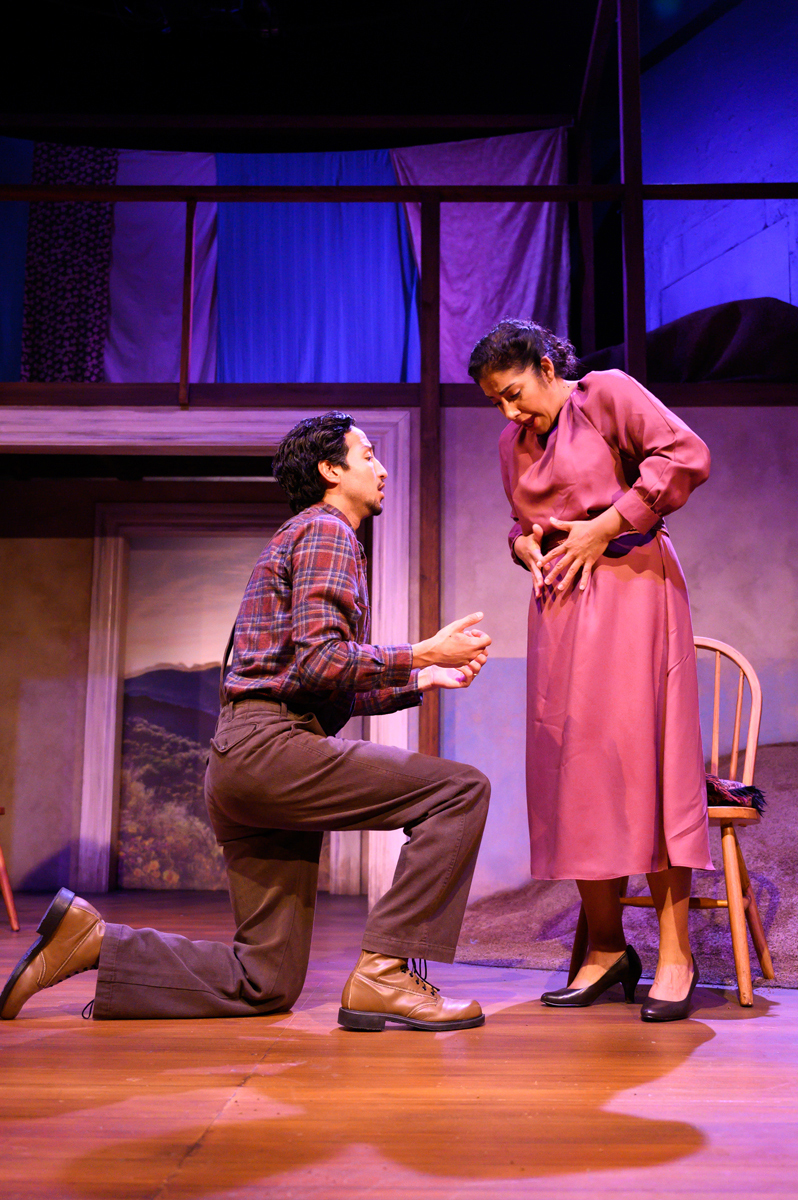
Thursday, December 28, 2017

"The Black Rider" at Shotgun Players

Shotgun Players photo by Cheshire Isaacs
Somewhere at the intersection of patriarchy and gun culture ("at the crossroads," you might even say), there is an old German story about a star-crossed couple of young lovers, the need to shoot a gun (and the inability to do so), and the choice to make a deal with the devil to solve this problem. The Black Rider is a modern derivative of that story, filtered through some very interesting minds.

The Play

The play itself has a history that's actually more intriguing to me than the story itself. Avant-garde theater and opera director Robert Wilson approached musician Tom Waits about creating the piece, and somehow they both got the notion to ask Beat writer William S. Burroughs to write the book for the show, and for some reason, he agreed.

The story involves Wilhelm (Grace Ng), a young file clerk who has fallen in love with Kätchen (Noelle Viñas), the daughter of the legendary hunter Bertram (Steven Hess), who forbids the marriage because Wilhelm cannot shoot or hunt. He prefers her to marry Robert (El Beh), a manly man like him. As Wilhelm despairs, hope appears in the form of magic bullets, proffered by Pegleg (the spectacular Rotimi Agbabiaka). The bullets will always hit their target, though Pegleg reserves one of the bullets for his choice. Wilhelm accepts, becomes a successful hunter, wins the hand of his beloved, and all goes well until....

At the risk of the obvious spoiler, Pegleg's bullet doesn't hit the target, it kills Kätchen instead. Wilhelm goes mad and joins cosmic freak show that Pegleg oversees.

One of the punch lines is that William S. Burroughs accidentally shot and killed his second wife while apparently trying to shoot an apple off her head. Presumably, alcohol and/or other substances were involved. But it does seem odd that he would later agree to write a play about such a similar event. Or not. It's Burroughs, after all.

I have now seen two versions of this play, one at ACT many years ago, and now this Shotgun production (plus a mini version put on by RADIX Troupe a few years back). I still can't say that the play itself speaks to me, particularly. I get that we're responsible for our choices and we shouldn't make deals with the devil and all that. But really, I don't see the appeal of the story.

The Production

It's really quite spectacular. The sideshow/freak show motif mixed in with the dismal, barren woods is quite striking in a set designed by Sean Riley. The colors and the art by R. Black (who does all the Shotgun posters and murals) are really great. The sound design by Matt Stines and live direction by Anton Hedman are exceptional and the live band under the direction of David Möschler all combine to make a complete soundscape, intricately synchronized with the lights (by Allen Willner) and the actions devised by Director Mark Jackson. Wrap this all in the outrageous costumes by Christine Crook, and the whole thing is a sensory masterpiece. It's all really stunning, except the story.

Special attention should go to Grace Ng, whose wonderful physical skills combine clownish miming and acrobatic gymnastics to create a wonderfully bumbling, befuddled Wilhelm. And El Beh proves to be marvelously masculine as Wilhelm's rival, Robert, and thrills with her singing voice as well. Casting women in both of those roles is really quite brilliant, since Wilhelm is supposed to be the least manly man imaginable to this village, one who can't shoot. And Robert is clearly insecure in his manhood as well.

And I should add a mention of Kevin Clarke (Old Uncle), whose role as sideshow barker/narrator/chorus hands him a megaphone to go with his outrageous hair. Elizabeth Carter is the final cast member, playing Anne, Bertram's wife. As befits a patriarchal fairy tale, her role is probably the least memorable. She's fine, but Anne is just not very important to the story.

Anyway, it's all a rather overwhelming feast for the senses, but I walked away feeling pretty unsatisfied, dazzled but not convinced.

Bottom Line

This is a spectacular theater piece. And it obviously speaks to some people, because it's selling like crazy and has been extended multiple times. It's certainly worth seeing (and it runs through January 21) if you're inclined, or if you just want to see the freak show. I wouldn't go looking for enlightenment, but you never know. We all walk into the sideshow knowing we're not going to get what we're promised, but we go anyway. It's our choice.

On some level, I guess you can see it as a commentary on gun culture, and how toxic that is, but really, that's not it. And some people see it as Burroughs trying to talk about the dangers of addiction, but I don't really see that. Pressure, conformity, toxic masculinity, gun worship, hero worship, avoidance of responsibility...yeah, they're all in there. But really, if I have to work this hard to sift out the meaning in the play, it seems like something's amiss. The cast and crew and designers put all this work into making something spectacular, so I feel like I should be clearer on why.

But it is really spectacular.