Showing posts with label Off Broadway. Show all posts

Wednesday, May 24, 2023

"Primary Trust" at Roundabout


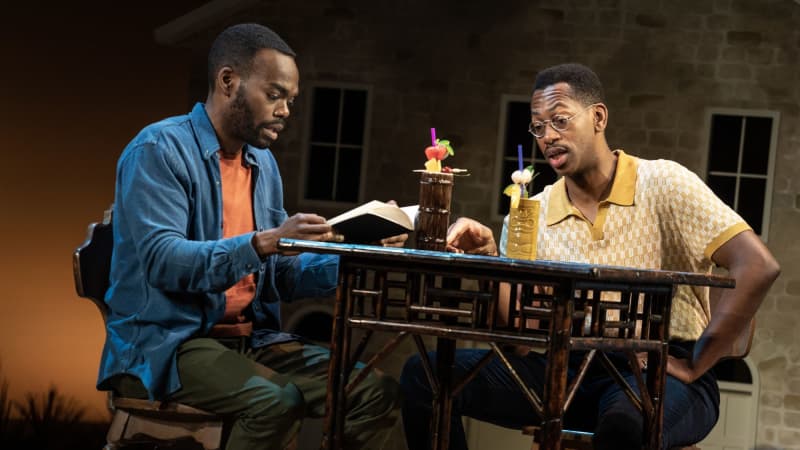
Roundabout production photo by Joan Marcus

Roundabout has long been one of our favorite NYC theater companies, in part because they generally do interesting shows, and also because they are one of the few non-profit theater companies that straddles the Broadway/Off-Broadway divide. I really appreciate their ability to bring less commercial products to the Broadway audience.

Primary Trust is at one of their off-Broadway facilities, the Laura Pels Theatre, which is definitely one of their smaller houses. But it allows them to do some things that just wouldn't work in a big Broadway barn. This show, for example, has a cast of only five actors, and would just disappear on a huge Broadway stage.

The Play

This is one of those plays where I came in knowing basically nothing, and was well into it before I resigned myself to that feeling. Primary Trust by Eboni Booth is a very unusual play. It's almost like it doesn't have the proverbial fourth wall--the main character, Kenneth, addresses the audience from the moment he steps onstage. But at the same time, he's a very unreliable narrator of his own life, despite coming clean with us right off about his only friend, Bert, being imaginary.

So this is a peek into the mind and life of a quite offbeat person, orphaned young in a small town in upstate New York, he's spent his entire life since age 10 either in an orphanage or working in a used bookstore for a guy who doesn't care whether Kenneth talks to his imaginary friend. But now the store is closing, and Kenneth has to face life

Up to now, his only coping mechanisms are talking with Bert and going to happy hour at Wally's, the local tiki bar, drinking mai tais in great quantity. All of this has to change now. And change it does, as Kenneth lands a job working in a bank (called Primary Trust, hence the name of the play) after a tip from one of the wait staff at Wally's.

The ensuing action is odd and disconcerting in many ways, even when it's encouraging and uplifting. I've really not experienced anything like it, and it was truly interesting.

The Production

Nice and simple. The set is a small version of Cranberry, NY, Kenneth's hometown, and the occasional table, desk or chairs show up to represent various venues, and eventually Kenneth's teller window at the bank. But that's about it. William Jackson Harper does a remarkable job as Kenneth, both as the slow, damaged individual we come to know, but also showing flashes of the Kenneth who demonstrates himself to be something of a retail banking savant, flipping back and forth almost instantaneously. Equally impressive is April Matthis as a whole parade of Kenneth's servers at Wally's, jumping in an instant among genders, ages, races, and so on. It's really quite remarkable.

Bert (Eric Berryman) is a constant presence, at least for a while, and dovetails nicely into Kenneth's life during interviews and other events. And Jay O. Sanders fills in as various of Kenneth's employers and a few other niche roles quite effectively.  All of this is backed by a musician, Luke Wygodny, who also serve as something of a stage manager for Kenneth's life.

Director Knud Adams keeps this moving reasonably well, though the pace drags a bit in a few places. But even in slower-paced scenes, the actors keep things interesting--there are some truly pregnant pauses throughout.

Bottom Line

I thought this was a really good and interesting play, and the production was really effective. It's not earth-shaking, brilliant literature, but it's a unique take on the sort of person who doesn't really attract the attention of playwrights or audiences for the most part. In that sense, it's quite unlike nearly every play you can see.

So as long as you're looking for something small and interesting, this is a good option. The show runs through July 2 at the Roundabout's Laura Pels Theatre in the heart of the theater district. Well worth the time if you're in the area.

Monday, May 22, 2023

"The Habit of Art" at 59E59


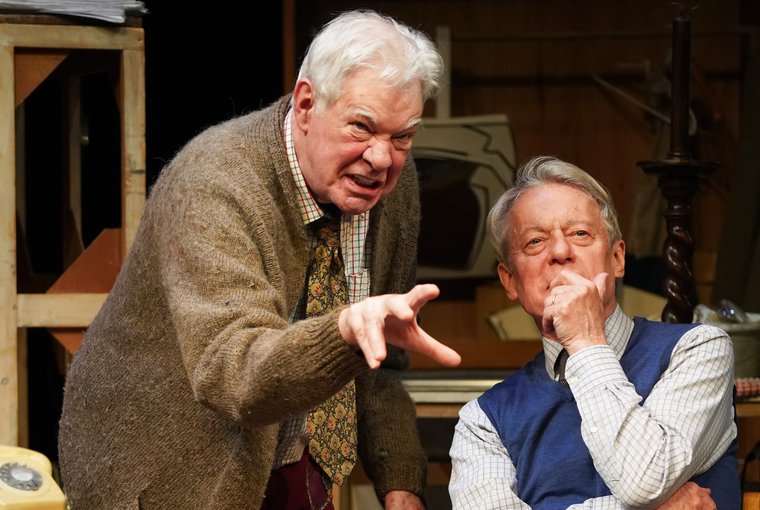
Original Theatre production photo by Carol Rosegg

This sounded like an interesting play. A friend had seen Britain's National Theatre production online and liked the play, and the subject matter seemed intriguing, so we took a chance on it. The production suits the setting at 59E59 Theaters, which is kind of a bare-bones theater space (though a good hall with excellent sight lines). So we headed in for a Sunday matinee.

The Play

This is the New York premiere of a play by a well-known British playwright, Alan Bennett. The Habit of Art is kind of a play-within-a-play, except it's really a rehearsal-of-a-play within a play, and the play being rehearsed involves a writer doing research that will turn into biographies of two of the principle characters in the play, the poet W.H. Auden and composer Benjamin Britten. The two men had been longtime friends and collaborators, then had a bit of a falling out and didn't speak for thirty years.

The play is set in a rehearsal room for the internal play, with the actors, stage managers, and playwright present (but not the director). The action of the wrapping play is a rough run-through of the internal play (called Caliban's Day) with a lot of dialog among the various characters about what they are doing (or sometimes think they should be doing).

Along the way we get to unravel the layers of the play, with each sort of serving as a meta-version of the one(s) within. So for example we have a biographer, Humphrey Carpenter, interviewing Auden, with some discussion of the ethics of biography, when that is exactly what the playwright is doing with Auden and Britten (and Carpenter, for all that), and at another level, it's what Bennett is doing with his play as well. Deep and complicated.

And also quite funny. Bennett has solid comedy chops going way back, and there is much amusement here. But within that is also a lot of difficult stuff about aging, old friends, betrayals, and much more. And discussion of the role of the overlooked, non-starring characters (e.g., Caliban) such as the rent boy Auden has ordered up, or Carpenter). There's a lot, and it's interesting and good.

The Production

This is a British production by Original Theatre, brought over as part of 59E59's annual series Brits Off Broadway. The acting is very good, with particular nods to Matthew Kelly as Fitz, the actor portraying Auden, and Veronica Roberts as Kay, the stage  manager. Kelly has a really tough role, as both Fitz and Auden are complicated, feisty characters, and he moves between them gracefully (with a lot of lines for each). Director Philip Franks seems to have decided that the characters of George, the assistant stage manager (Jessica Dennis) and Neil, the playwright (Robert Mountford) are solely needed for comic relief, as both have been rendered as clownish buffoons, which seems both unkind and unnecessary.

But on the whole the production is quite solid, with difficult material presented in a way that is accessible and fun, but it leaves one thinking through its layers and vagaries for quite some time. That's my favorite kind of play, and this one is very well done indeed.

Bottom Line

We came in with few expectations, and happily, we got a really good performance of a very good play. It made me want to learn more about Auden and Britten and their collaborations, as well as wanting to know more about Bennett's work in theater.

All in all, a fine effort. The show runs one more week, through May 28th, at 59E59 in midtown Manhattan. Check it out if you can!

Friday, May 19, 2023

"Shadow/land" at The Public Theater


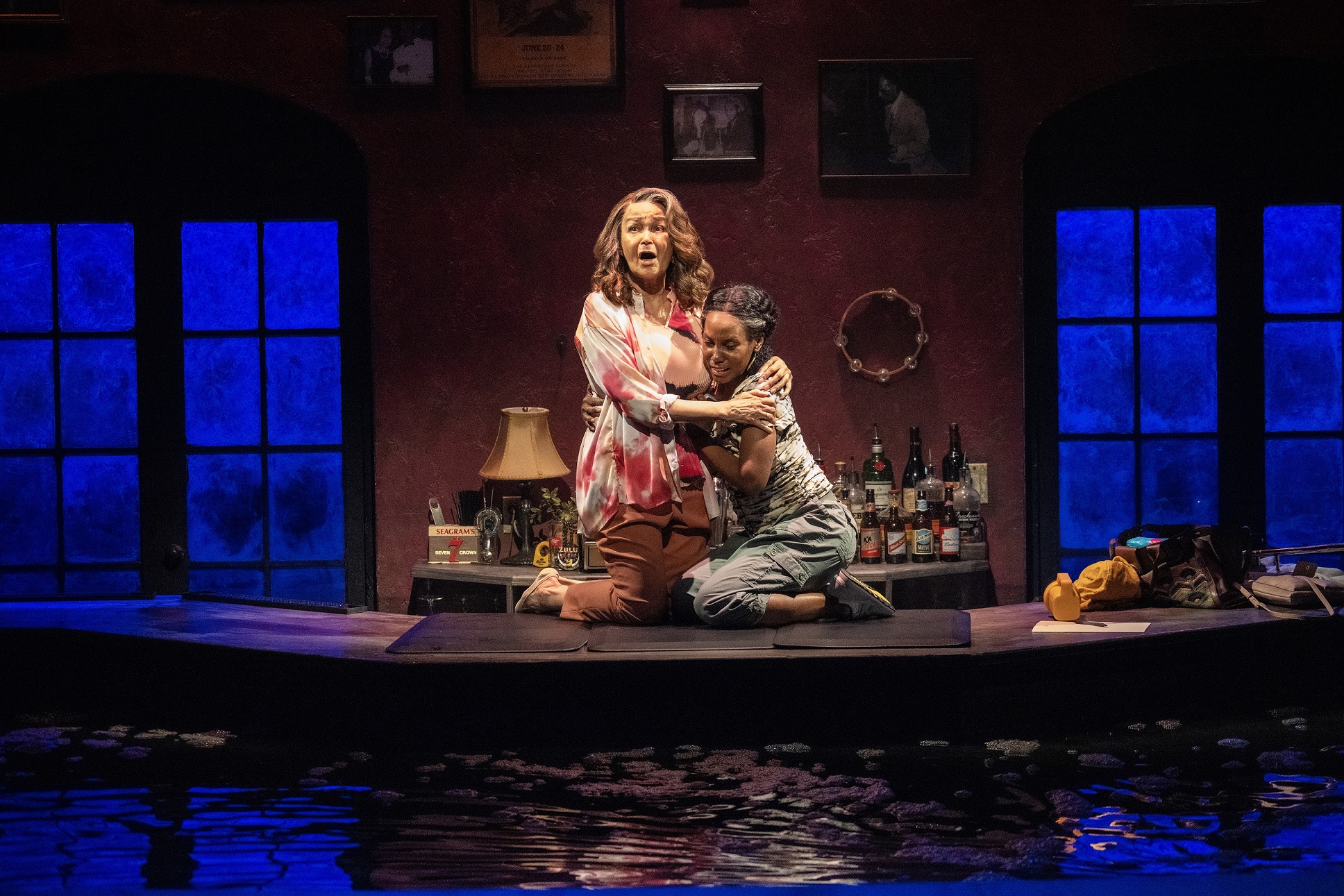
Public Theater production photo by Joan Marcus

The Public Theater always seems to find interesting plays to produce. Past triumphs include Passing Strange and Hamilton, just as examples. But as we saw on our last visit, not every new thing they try is a triumph. This world premiere, Shadow/land by Erika Dickerson-Despenza, has high aspirations: it's the first of a ten-part cycle of plays about the New Orleans diaspora brought about by Hurricane Katrina. We decided to take a flyer on this one since it's our first night in town.

The Play

Ruth and her mother, Magalee, are both trying to protect their family's legacy (the bar/nightclub called Shadow/land) as Hurricane Katrina makes landfall and threatens to flood much of New Orleans. The bar itself represents the family legacy, not only because Ruth's father used to play there, but it also has ties all the way back to an ancestor who worked to buy her own freedom from slavery. As such, preserving the business is as much a symbol of continuing the family legacy as it is a means for Ruth to (perhaps) by her own freedom.

There's not a lot of mystery as to what's going to happen here. Katrina is a historical event, after all. But much of the play is interesting, even as the available stage space shrinks down to the middle of the actual bar. And on the periphery, we see the Grand Marshal dancing, beckoning to the aging, moderately demented Magalee to join the procession of ancestors.

The Production

I'm a sucker for special effects, and any time you can flood the stage convincingly, I'm all in. But the dwindling space available for Ruth (Joniece Abbott-Pratt) and Magalee (Lizan Mitchell) to operate might be a little too symbolically linked to their shrinking options in life. (Also unclear is why an operating bar business only has two bottles of water available, but that's the script.) Although the set is visually impressive, I found some of the language hard to follow, partly because it's in Creole dialect at times, but mostly because it was just hard to distinguish. Sometimes I was just missing some nuance of the dialogue, but sometimes a line would land and I would miss it, and now I don't know whether I've missed some important detail. So that was a bit frustrating, and I overheard several audience members saying the same as they left.

Also visually impressive was the performance of Christine Shepard as the Grand Marshal--great costume and makeup, but also wonderful dance and mime work. It's not a huge part of the overall show, but it's very important to the atmosphere and the mythos of the play.

Bottom Line

Ultimately, I don't have a lot to say about the show. The script didn't tell me a lot I didn't already know, but it did it in a pretty dramatic way, though rather predictably. I give the show high marks for atmosphere, but only middling grades for dramatic interest.

I'm unclear whether the remainder of the play cycle is planned to follow this particular family, or whether we'll see other characters and story lines develop. I'm mildly interested to see what comes next, but also not eager to be first in line when the next one comes out.

This premiere run goes through Sunday, May 28th at the Public Theater in lower Manhattan.

Sunday, October 9, 2022

"Remember This: The Lesson of Jan Karski" at Theatre for a New Audience

Not satisfied with having sat through Tom Stoppard's Holocaust-centered play Leopoldstadt two nights ago, we boldly set out to Brooklyn this afternoon to catch David Strathairn in a solo show at the Theatre for a New Audience's Polonsky Shakespeare Center. This promised to be very heavy.

The Play

 It's not exactly a monologue. The single actor portrays mostly Jan Karski, but also occasionally slips into someone Karski interacts with. It starts as a simple story about him and his background, but ends up focusing on his life in the Polish Underground during World War II, after Germany invades Poland. Karski, who has a photographic memory, becomes a witness and messenger, carrying messages in his mind to leaders of the exiled government.

At one point Karski (who is Catholic) is recruited to observe conditions in the Warsaw ghetto and one of the Nazi death camps, then report what he has learned, first to the Jewish leadership in exile in London, then to the British foreign secretary and then to officials in the U.S., up to and including President Roosevelt. His messages are ignored, and officials later claimed they had no knowledge of the actual situation.

Throughout, Karski reflects on his own life (including his later four decades on the faculty of Georgetown University), his marriage, and many other subjects. But ultimately, his message is about the capacity in every human for good or for evil, and the reluctance to believe horrors, even when irrefutable.

The script is powerful. Apparently it was originally written to have at least one other actor besides Karski, but in the hands of a terrific actor, at least, the solo performance is quite moving.

The Production

The script has been in development for several years, and David Strathairn has been involved throughout, along with a lab at Georgetown that meshes performance with politics (which sounds pretty cool!). After several smaller runs, this five-or-six week Off-Broadway run at the Theater for a New Audience is their biggest yet, and apparently will later turn into at least a limited national tour.

Strathairn is the single actor in the show, although there is a bit of film of the real Jan Karski as well. For a man in his early 70s, Strathairn still displays a lot of energy, and fills the 90 minutes without much of a break to catch his breath, changing his outfit as he goes to subtly reflect changes in Karski's circumstances.

The Karski narrative is a remarkable story, and the play depicts it without much commentary, save for tiny monologues at the start and end. Karski's story is allowed to speak for itself, with an implicit notion that we, unlike his contemporaries, need to heed his warnings.

Bottom Line

This was a tremendous piece of theater, both in the sense that it's an impressive piece of writing and a daunting challenge for the actor, all of which rolls into a simple but compelling message about our responsibility as humans to respond to reports of inhumanity in our time. Although the production does not explicitly mention the situation in Ukraine, there is clearly concern for that.

The show has been extended in Brooklyn for a week, through October 16th. The show we saw on the 9th was supposed to be the closing (and it was sold out). So this would be a good week to see it in Brooklyn. And I'm told that it will be traveling, including to the Bay Area, so watch for it--this is a piece of theater that really needs to be seen.

I would be remiss if I didn't note the conversation going on in my head between this show and Tom Stoppard's Leopoldstadt, which we saw two nights earlier. Stoppard's play talks about the denial among even those who explicitly knew the Nazi threat, and also shows the dangers of reacting too late. It is a different, but also very personal, reminder of the consequences of looking away when people threaten other people.

"Baldwin & Buckley at Cambridge" at The Public Theater

 I have seen TV clips of the debate between James Baldwin and William F. Buckley at the Cambridge Union in 1965, so I thought it would be pretty cool to see that dramatized on stage. So off we went last night to the Public Theater to see their presentation of just that: Baldwin & Buckley at Cambridge. Conceived and developed by the innovative group Elevator Repair Service (whose show Ganz, a dramatization of The Great Gatsby, was so good at Berkeley Rep a few years back (but apparently at a time when I was not blogging).

The Play

In some sense I'm hesitant to call this a play, since it's really more of a declamation of the speeches actually delivered back in 1965. But there is some staging and a bit of acting around it, so we'll just go ahead and treat it as a play, and see where that leads.

The script for the play is, with only slight modifications, a transcript of the actual Cambridge Union debate on February 18, 1965. There were four speeches that night in this "debate" on the question "Is the American Dream at the expense of the American Negro?" Cambridge students delivered the brief opening arguments to introduce the question, and then in turn, the writer James Baldwin and editor/commentator William F. Buckley took up the question in longer form.

I have to put away my expectations from my years as a debater and coach, since this form of debate is more a matter of dueling speeches than actual clash or addressing and rebutting of the statements of the other side. Essentially, Baldwin and Buckley offered separate orations on either side of the question.

At the end of the debate, there is a brief scene between Baldwin and Lorraine Hansberry, compiled from letters, interviews, and writings of the two.

On the whole, I think the debate itself is interesting, but not particularly compelling on its own. The last scene attempts to add a bit of context and interpretation, but not nearly enough to justify its inclusion in the piece. Since the whole thing comes in at about one hour, it feels somewhat minimal. I would definitely have preferred to see more material, perhaps culled from subsequent writings or interviews with Baldwin and Buckley discussing the debate and the aftermath.

The Production

The Public did a pretty good job with this. I quite liked the use of the intimate Anspacher Theater and the minimal set (two tables with lecterns, and a chair for each). Unfortunately, while Baldwin (Grieg Sargeant) spoke, all I could see was the back of the seated Buckley (Ben Jalosa Williams), so I'm not sure how much he was reacting, emoting, etc. I suspect the aloof Buckley would have reacted very little. And when Buckley spoke, I could see Baldwin reacting a bit, but only a little, seeming annoyed (with justification).

Since there is little direct clash in the debate itself (e.g., Buckley mostly addresses Baldwin's published writings, not his words or arguments in the debate), the audience is left to weigh the arguments themselves. Admittedly, that's what the audience at the actual event did, but for dramatic purposes, that's asking a lot of an audience many decades removed from the actual events and people.

And then the final scene with Baldwin having a smoke while Hansberry (Daphne Gaines) does some ironing with the radio playing quietly seems pretty inconsequential until they both break the fourth wall and address the modern audience directly, which feels a bit jarring in what has otherwise been a straight recreation. That whole little postscript feels inadequate and unfinished.

The truly odd choice, to me, however, is the way Sargeant does a genuinely high-quality impression of Baldwin's vocal and physical mannerisms, but Williams mostly does not do that with Buckley. About three times he slips into Buckley's languid, condescending cadence and upper-class accent, but then reverts again to his own voice and style. I have no idea why. It didn't seem to be done for any particular dramatic purpose. I can only suppose that a prolonged use of that style would have bored and irritated the modern audience, but then why use it at all?

Bottom line

Truly, this all felt like kind of a good idea, but not thought through very thoroughly. It's not very satisfying as a purely historical recreation, nor is it at all satisfying as a dramatic presentation based on the historical event. I can think of lots of ways this could be more interesting, and there are probably many others I haven't imagined. But there has to be something better that can be done with this material than what the Public presents here.

I walked away disappointed in both the effort and the outcome. Baldwin and Buckley both deserve better than this, and the collaboration of the Public Theater and Elevator Repair Service leads the audience to expect that there will be something more and better. But there isn't.

In short, don't bother. Maybe someone will turn this into something good, but as it is, your hour could be better spent elsewhere.


Friday, June 15, 2018

"In & Of Itself" at Daryl Roth Theatre

Photo linked from show's website
This one's a little weird to write about. It's not really a play, but it's definitely a play-like performance, with magic or sleight-of-hand or illusions or however you want to describe it. I guess the shorthand would be that it's a magic show.

I like magic shows. A couple of my favorite evenings ever were spent watching Penn and Teller both do and then explain how they did some truly amazing stuff. And I'm never sure which is more impressive, pondering how something is done, or knowing how it's done, but still being fooled, amazed, and so on.

In & Of Itself is a one-man show (or at least there is only one person on stage; there are definitely crew running lights, cameras, projections, and other things) starring Derek DelGaudio. I had never heard of him before, but he is a very talented performer. The show has quite a pedigree, however, including director Frank Oz and producer Neil Patrick Harris. I stumbled across this show tangentially from reading something about Oz, and the reviews were extremely positive, so I decided to go see it. Besides, the rest of the family was going off that night to see Dear Evan Hansen, which I decided to pass on.

Overall, I have to say there's not a lot I can describe about the show without spoiling things. Also, it's really hard to pin down what the show is about, anyway. It's definitely not just a string of illusions or tricks; there is a narrative that runs through it. DelGaudio is a good, low-key, story teller, but of course, this is a magic show, so by definition we know we should take anything at face value. Maybe some of the stories (or some aspects of some of the stories) are true.

Pre-Show

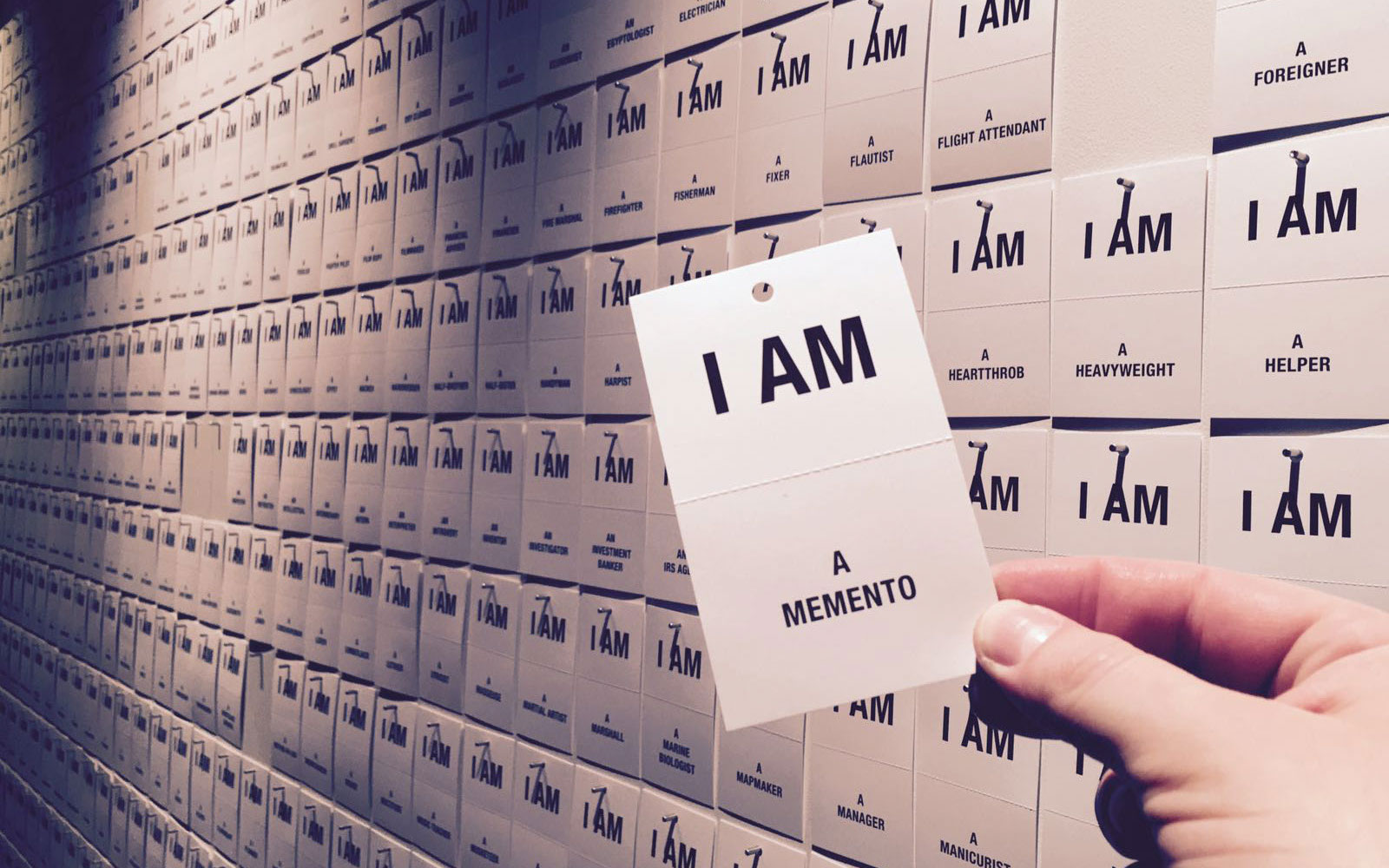
Outside the theater (which appears to have been built in the basement of a former bank--cool!) and also in the lounge below the theater there are posters covered with little cards that read "I AM" followed by the name of some identity. Some are occupations, some are descriptions of attributes (e.g., introvert, healer, optimist), and some are kind of whimsical. It's interesting to look at, but there is no explanation.

Then as we enter the theater, we walk by a wall with cards that can be removed, and we're told to pick one before we go inside. There is still no explanation.

Again, I can't say too much about what happens with the cards or why, but suffice it to say that much of the show is a riff on the question of identity.

The Show

There are six sections to the main part of the show, each with its own story, but all falling into the larger narrative. And each section goes along with a different sort of illusion. It's all quite interesting and engaging, as you would expect from a magic show.

I'm not sure I can say much that's meaningful about any of the sections or illusions, other than some very general comments. For example, DelGaudio may be the slickest card-handler I've ever seen. His narration seems to be an exploration of himself, his life, his role...indeed, his identity. But again, with a magician, you can never accept anything as what it seems to be. The narration seems to also be guiding us to think about our own identities, and the cards viewed and selected before the show play into that, though in ways I can't really go into without spoiling things.

As a side note, this is one of the most difficult shows I've ever tried to write about. Between the desire to not include any spoilers and the intrinsic nebulousity of the material, I'm finding it hard to say much of anything at all.

Bottom Line

I was quite taken with the show overall. Not life-changing, blown-away, must tell everyone, but it's a really good show, thought-provoking as well as entertaining. I should also mention that the pre-show environment seems to induce conversations among attendees to a degree I've rarely seen in a theater. I got drawn into chats with several people in the lounge as we all looked at and interpreted the poster on the wall, and I also chatted with people on both sides of me in the seats as we talked about what we were thinking about what was going on. That was some of the best stuff in the show.

You can probably enjoy this show on a number of levels. At its most basic, it's just a good magic show, and you could leave it at that. You can also dig a little deeper and try to figure out some things about the performer, and that's pretty interesting, too. And finally, you can turn some of that same analysis into introspection, and mull over your own identity. All seem valid and worthwhile.

After running for a couple of years, first in Los Angeles and most recently in New York City, DelGaudio is ready to move on. The final extension for this show runs through August 26th, and then it's done forever. If you're in New York, it's worth checking out.