Sunday, October 23, 2016

"Into the Beautiful North" at Central Works

Central Works photo by J. Norrena
It's always interesting to see what Central Works offers. It's an ambitious undertaking, producing four world-premiere plays per year, and having to commit to those plays before they really exist. So you never know quite what you're going to get.

"Into the Beautiful North" is a bit different from the usual fare, in that it's not a local playwright or company member creating the script, but rather a local production of a "rolling world premiere" through the National New Play Network.

The Play

The core of the play is kind of a riff on the movies "The Seven Samurai" and "The Magnificent Seven." The small Mexican town of Tres Camarones is being besieged by "narcos," corrupt police officers selling drugs and generally terrorizing the citizenry. Nayeli, a plucky teenager, decides to steal off to the U.S. to recruit seven magnificent men to come back to Tres Camarones and save the town. She takes with her her best friend, Vampi, and her employer, Tacho, who runs the only Internet cafe in town, El Mano Caido.

The structure of the play is pretty familiar, with characters narrating among fairly quick scene changes. If you've seen some of the story plays by the likes of Campo Santo or Culture Clash, it will seem similar.

Nayeli, played by Samanta Yunuen Cubias, and Tacho (Rudy Guerrero) maintain their characters throughout, with the other six players in the ensemble playing about 40 other roles. For the most part it works well, though some of the scene changes are a bit clunky.

The Production

Realizing that this is a world premiere, a work in progress, and still relatively early in the current run (the play runs through November 13), one expects a few hiccups. There are some hesitations and fumbled lines, and a number of the (quite frequent) scene changes are distractingly slow. Some of the latter is due to the constraints of the little theater space in the Berkeley City Club. The plays I've seen there that work the best are those where either there are few scene changes at all, or where the play works with little or no scenery.

Somewhat surprisingly, the second act of the play comes out much smoother than the first. I'm not sure whether the ensemble just hit their stride after intermission or whether they have just honed the latter part of the play more completely. In any case, in the first half I was concerned that a lot of the dialog came out rather stilted, and some of the characters just didn't gel. But the show was better in virtually all aspects in the second half, which gives me hope that they will eventually get rid of some of the other wrinkles.

The writing is clever, with some quite witty dialogue, featuring fun puns and topical references. Clearly, the presence of "nasty women" and "bad hombres" was added just this week, as those references come directly from a presidential campaign debate just a few days before. In context, they work fine. Not all of the jokes flow quite as organically, but some bits work really well. The scenes with Rudy Guerrero and Ben Ortega in a bar in Tijuana and crossing the border are very funny and very well done. And Caleb Cabrera's "Atomiko" is consistently good.

Conclusion

I think the script has a lot of promise, and there are good bits to be found throughout. I was a bit disappointed with the cohesion of the cast, particularly in the first act. Some of the acting just felt rather amateurish, and not up to the standard I expect from Central Works. But it got much better in the second act, so I can hope that some of the bumps can be attributed to changes being made to the script and staging as the play is developed.

Overall, I thought it was a fun evening and certainly worth seeing. I really like what Central Works does, and fully expect that not every play they do will live up to expectations. But more power to them for promoting new works and opening doors to actors who might not have the resume to land a role this large in one of the bigger theaters in the area.

Friday, October 21, 2016

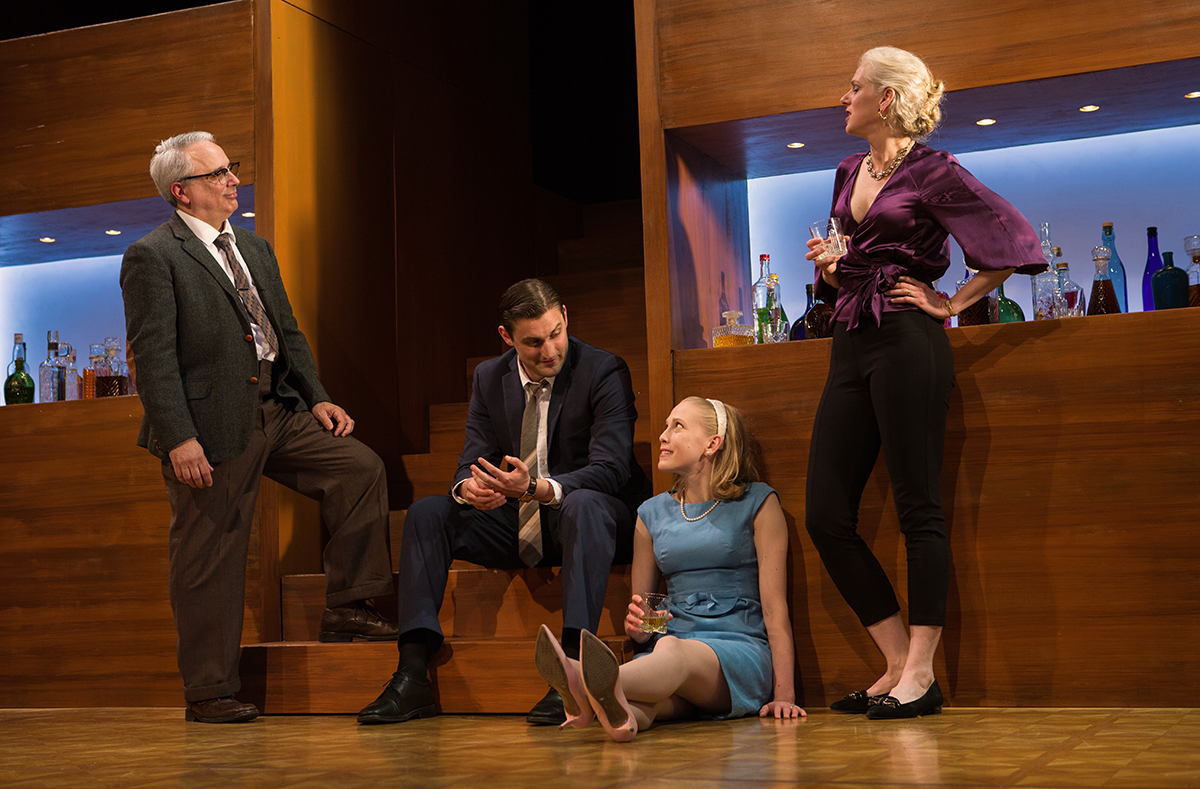
"Who's Afraid of Virginia Woolf?" at Shotgun Players

Shotgun Players photo by Pak Han
Edward Albee is dead. Long live Edward Albee. Or at least, his plays. I haven't seen that many of them (yet), but the ones I have seen are (at the risk of a little redundancy) bitingly incisive. He had a knack for digging into the dark recesses of modern life and then exposing them, with some unkind twists thrown in. He could be cruelly humorous, laying bare the hypocrisies and little white lies that are so necessary to daily life.

This Play

This is the fifth of the five plays in Shotgun's season. For once, I'm reviewing one of their plays close to the opening, when you still have plenty of time to see it ("Woolf" runs through November 13, and then will join the other four plays from the season in repertory through January. So you have lots of chances to see it. And (spoiler!) you should.

The four characters in the play are two married couples: one middle-aged, the other younger. In each case the husband is a professor at the small New England college in town. After a faculty party, the couples meet up to continue the evening at the older couple's home. There is much drinking and games of various kinds are played. They are not fun games. It's more like extreme, do-it-yourself couples' therapy, while drunk.

It's long (3 hours; 2 intermissions), but so engaging it doesn't feel that long. It's intense, but often quite funny. It's dark, and not happy, but not tragic, either. Moral and emotional ambiguity and ambivalence abound. The themes are very adult, even if some of the behavior is quite childish. This is definitely a play for grown-ups.

The Performances

As with all the Shotgun plays this season, the staging is simple: a single room in the home of George and Martha. There is no furniture, just a bar. The actors sit either on the floor or on the edge of the stage, giving the audience a real feeling of being right on top of or inside the action (which is not a comfortable place to be!). The costumes and music give a good sense of the period (early 1960s), and indeed the soundtrack contributes to the sense of being trapped that permeates much of the play.

As the senior couple, George and Martha, David Sinaiko and Beth Wilmurt are wonderfully nasty to one another, sniping and snarking from the moment they enter. Nick and Honey, the younger couple, are quite nicely played by Josh Schell and Megan Trout. Megan in particular brings both comedy and real depth to Honey, who is probably the least intrinsically interesting of the characters as written. All of the actors manage to pull off the descent into drunkenness pretty effectively, though I think Martha could be a little more convincing at it.

But all of the characters come vividly to life: You know all of these people, somewhere, somehow. You've met them or worked with them. Or if you're very unlucky, you live with them. The little digs at the start of the evening are all too easy and familiar, and as the night wears on and the booze flows, the inhibitions and the facades fall away, unmasking some real, deep issues in all of the characters and their relationships. It's not a bad idea to freshen your drink at each intermission.

Overall

The play works really well for me on at least two levels. One, it's obviously a masterpiece of writing, and the minimalist staging doesn't put anything in the way of that. The terrific acting brings out the subtlety that underlies the plain language. This is a production that is only going to get better as it goes on and the actors get more comfortable in their characters and in the story. I look forward to seeing it again in a few weeks to see how it has matured.

Two, it is a wonderful follow-on to a couple of the earlier plays in the season, particularly "The Village Bike," which deals (in very different ways) with the relationships of married couples and how they deal with expectations, roles, and disappointments, and "Caught" which is largely about truth and honesty and how you define them, hide them, and find them. I think it will be very interesting to see how these plays work off each other as they move through the repertory season to come.

There's going to be a lot to think and talk about for the next few months at the Ashby Stage. Pull up a drink and let's have at it!

Wednesday, October 12, 2016

"The Brothers Size" at Theatre Rhinoceros

Theatre Rhinoceros photo by Steven Ho
Let me start out by saying that I really like this play. It's the middle portion of a trilogy called the Brother/Sister Plays by Tarell Alvin McCraney. [Apparently the writer prefers the term "triptych" instead of "trilogy." Whatever.] About six years ago, three local theaters (Marin Theatre Company, The Magic Theater, and ACT) coordinated a presentation of all three plays. The production of "The Brothers Size" at the Magic was just brilliant--very sparse and clean. So when I saw that it was playing again locally, I just had to go see it.

The Play

It's way too complicated to explain how the whole trilogy works. Luckily, each part stands alone quite well. This one concerns the eponymous brothers, Ogun and Oshoosi Size, along with Elegba, a friend Oshoosi met in prison. Now out of prison, Oshoosi is living with Ogun and working in his auto shop. It's a fairly simple play about adjusting to life "outside," being brothers, friends who might or might not be good for one, and much more.

Infused with bits of African Yoruba culture and mythos, the play takes some kind of mystical twists, and the characters, all named after Yoruba Orisha, or deities. Knowing a little about each of the deities adds a lot to the understanding of the characters in the plays, though it's not strictly necessary. The layers of complexity in the writing are impressive, though.

The Production

The set is pretty simple (not as stark at the one at the Magic, but simple), standing in for both Ogun's home and the auto shop, a car, and so on. A few simple tools and buckets and tires, along with a bench, a doorway, and a circle of chain on the floor fill in the rest.

 The incorporation of chanting, singing, and stomping is a mixed bag. Sometimes it's quite brilliant (as in the scene illustrated above, where two buckets serve as both instruments and props in an elaborate dance), but other parts seem forced and rather awkward (including, unfortunately, the opening dance). When integrated into the flow of the show, however, they really add to the mystical elements.

For the most part the cast of three have a fairly easy chemistry; particularly Oshoosi (Gabriel Christian)  and Elegba (Julian Green). LaKeidrick S. Wimberly as Ogun seems a bit less comfortable in his role. Though he's often focused and engaged, his gaze tends to wander off the other characters at inexplicable times, taking the viewer with him out of the moment. This gets better later in the show, however. There were several points where various characters had some issues with enunciating and diction, but not enough to cause me to lose the flow of the play, just a few words here and there.

The other kind of annoying element to me is the decision by director Darryl V. Jones to have the characters speak the stage directions. It's quite unnecessary, and takes away from the flow of the scenes. It's not necessary for a character to announce that he is leaving for work, when both the dialogue and the actions make that entirely clear. Perhaps a somewhat smoother cast could have pulled this off more effectively, but it seemed just weird for these very convincingly blue-collar guys to suddenly break character and speak with the playwright's voice in that way.

Overall

It was an enjoyable evening. The Eureka Theatre isn't very large, and it wasn't nearly full on a Wednesday night. Although the play isn't brilliantly performed, it's quite competent, and the material is well worth seeing and hearing. As long as you don't go in expecting a lot of polish, you'll appreciate the authentic blue collar production.

Sunday, October 9, 2016

"Hedwig and the Angry Inch" at SHN

Here is something a bit out of the usual path for me. The family has a subscription to the SHN series of touring musicals (mostly), and lately I've been sending other family members in my stead. I was sort of curious about this show, since I really knew nothing about it, so we caught the afternoon matinee today.

The Show

Fundamentally, we are seeing a sort of rock concert performance by the fictitious group, Hedwig and the Angry Inch. Hedwig is the transgender lead singer, and the Angry Inch is the backup band. Musically, they're pretty good. I've seen this all categorized as "glam rock," which I guess covers it. It's a sort of moderately-hard rock with some punkish influences and lots of bright, flashing lights and a lead singer who wears large, outrageous wigs.

Some of the early songs are pretty good, notably "The Origin of Love" and "Sugar Daddy," but mostly it's a lot of show without too much substance.

The Reaction

Discussing the show afterward, neither my wife nor I felt like it had "grabbed" us. We both like rock musicals pretty well. We both love Stew's shows, particularly "Passing Strange," and she really liked "American Idiot." So it's not the genre per se that bothered us. Truthfully, from early on it kind of reminded me more of the Berkeley Rep show a couple of seasons back, "An Audience with Meow Meow." The conceit being that there is a rather egotistical performing star who kind of breaks the show in the middle and tells something of their life story, with more music. "Hedwig" reminded me of that a lot, although in Meow Meow's case, it was sort of up in the air whether we were watching a drag show, at least for a while.

The other parallel I would draw is with the excellent show "Boy" we saw in New York earlier this year. That also dealt with a transgender main character and a botched sex-change operation, but without the histrionics of trying to turn the character into some kind of rock star.

But back to the point: I didn't find Hedwig's story particularly interesting, or realistic, or more broadly applicable. The transgender story in "Boy" is much more interesting, both in terms of the motivations of the people involved and the reactions to the sex change. Hedwig just starts with a fairly bizarre premise and runs in weird directions with it. And adds a lot of music.

The Conclusion

Ultimately we concluded that the show isn't really much of a show in that sense. It seems mostly to be a highlight vehicle for the lead performer. In today's case, that meant Darren Criss, who achieved his fame on the TV series "Glee," so it was pretty clear that a lot of people had come to see him. Similarly, in its Broadway run, the role was generally filled by actors already well known for other work. So I suspect it's popularity is largely a matter of showcasing actors that have an audience.

So, it's a chance to go see Darren Criss, if that appeals to you. It's not the sort of musical that will have you leave the theater tapping your toes and humming tunes, feeling like you had a fun time. Kind of diverting, but you'd probably be better off watching reruns of "Glee."

Thursday, October 6, 2016

"Othello" at CalShakes

CalShakes photo by Alessandra Mello
Oh, my.

I am deeply conflicted about this production. The acting is top-notch. The staging is wonderfully minimal, which should enable the focus to be on the words and the characters. Unfortunately, director Eric Ting apparently doesn't trust us to understand the play, so he interrupts it, frequently, to have actors drop out of character and explain what's happening.

I'm not going to spend any time explaining Othello here. I had never read or seen the play, but I knew more than enough to understand how well it pertains to modern-day life. It's a great choice of plays right now. Race relations, xenophobia, domestic violence, Islamophobia, truth and trust issues--it's all there. Bring it on!

The Good

The acting ensemble is terrific. Particularly outstanding are James Carpenter as Iago, Aldo Billingslea in the title role, and Julie Eccles as Emilia. Liz Sklar is also very good as Desdemona, and Matthew Baldiga as Rodrigo manages to steal a few scenes. For the most part, they all gave consistent, nuanced, and (dare I say) dramatic performances. This is exactly what you want from Othello, an immersion into a world of high emotions and intricate plots.

The staging is quite brilliant. There are ten chairs placed in a rough square in the middle of the 3/4-thrust stage with no other set pieces. For the most part, actors "enter" and "exit" by standing up or sitting down, and it works wonderfully, with the action flowing seamlessly between scenes. The actors are all in plain, modern dress, with only an occasional scarf, hood, or hat to distinguish changes. It's all designed to not distract from the play itself, the words, the interactions, the ruminations of the characters. And in that sense, it works brilliantly.

I particularly liked the way characters were able to address characters who were not in the scene by looking at or walking around the seated, "absent" characters. There is a wonderful fullness to the performance when all the characters can be present or not, as needed. There is a little inconsistency with whether the actors stay in character when seated, but for the most part, it works great.

The Bad

I wish I could just leave it there, with a terrific cast on a simple stage that facilitates their work, bringing a brilliant piece of literature to life. Or perhaps I should say, I wish the director had left it there.

Apparently director Ting doesn't think his audience will understand how a powerful black man being manipulated and brought down by the connivance of his white subordinate applies to current affairs. Or that xenophobic fear and resentment of a Moor needs to be illustrated with the explanation that "Moor" means "Muslim" projected over the stage during intermission, and just in case that isn't clear, he adds some sound clips of Donald Trump denouncing Islamic extremism. Similarly, he seems to think we won't find a man strangling his wife in their bed horrific enough, so he provides narration of a description of the biological effects of strangulation on the body. There's more: I'll spare you.

Ultimately, Ting shows he doesn't respect his audience, his actors, or his script. I kept expecting subtitles to start flashing "AUTHOR'S MESSAGE" or something.

But no, that won't do. Let's interrupt the final, climactic scene to have a 10-minute audience talk-back session, and then finish the play, sucking virtually all of the intensity out of it.

The Talk-Back

I generally like talk-back sessions. The give and take between audience and cast/crew can be really enlightening and add to the understanding of the play, the production, and the context. But that's not what this was. This was a solicitation of audience feedback, slightly guided by questions from the stage (asked by the recently-deceased Desdemona). And a number of people said interesting and moving things. Mostly it gave an opportunity for sanctimony from the stage, and substantive questions were usually bounced back with "what did you think?" and such.

But that session could have been done after the play, and thus avoided deflating the ending. In a setting that seemed designed to let the play be the thing, the director seemed set on making sure we knew that the production was all-important, and that there were some really key points we needed to get.

It appeared to work for a number of people, but ultimately the machinations detracted from what seemed like it should have been the best play I saw in a long time, and instead turned it into a mediocrity. Instead of coming home enraptured by the performance, I find myself pissed off by the director spoiling his actors' work.

Sunday, October 2, 2016

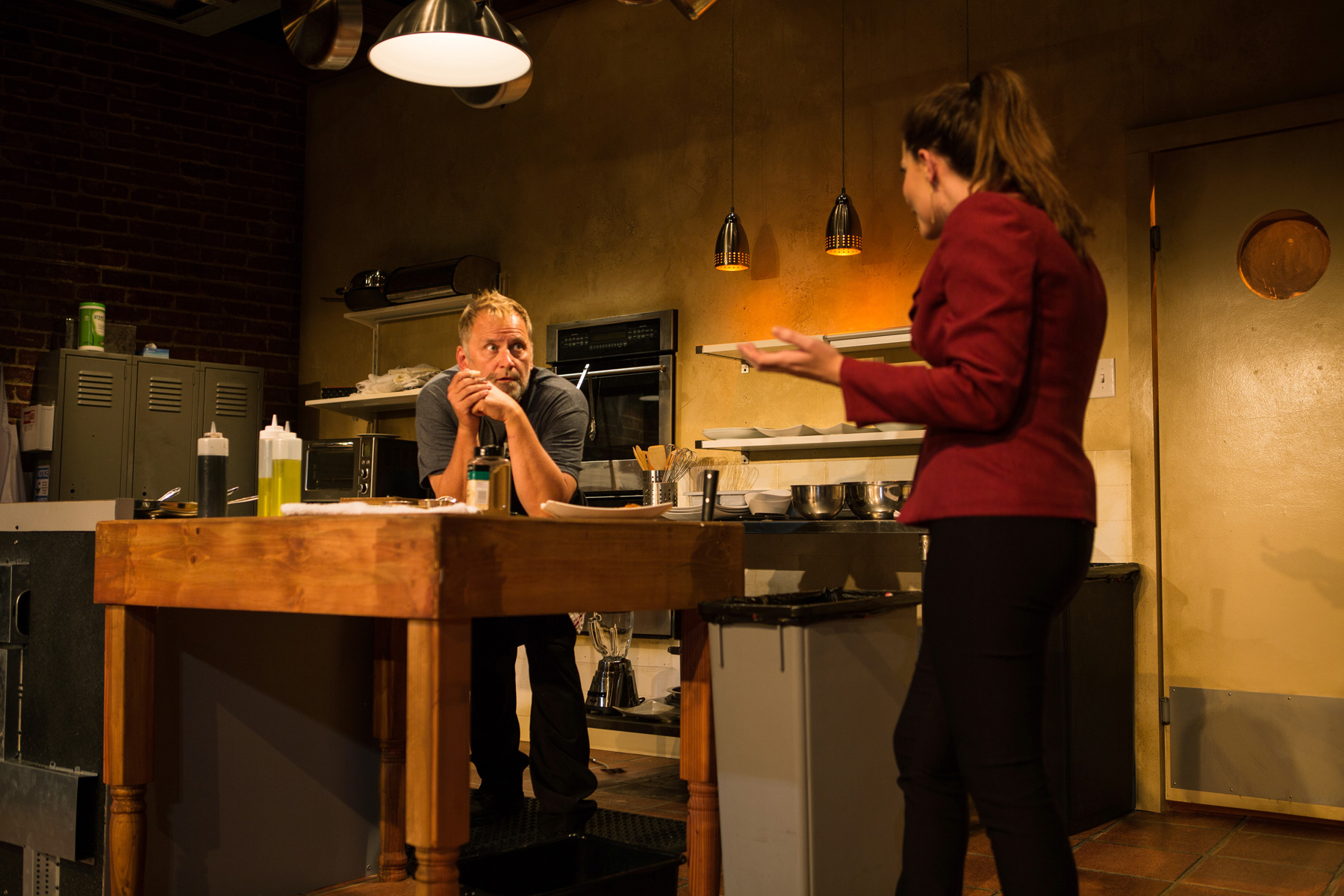
"Seared" at SF Playhouse

SF Playhouse photo by Jessica Palopoli
Food and fighting: what could be more fun? Set in the kitchen of a small restaurant in Brooklyn, "Seared" is the world premiere of a commissioned work by accomplished writer Theresa Rebeck. Add to this that Rebeck has worked quite a bit with both director Margaret Perry and lead actor Brian Dykstra, and you have the ingredients for a satisfying play.

I saw the opening night performance last night, and although there is promising material with solid performances, the result is ultimately not very satisfying.

The Play

Harry (played terrifically by Dykstra) is the chef of this little upstart restaurant, while his partner, Mike, and waiter Rodney wait tables and apparently do everything else. The restaurant is struggling, but seemingly out of the blue they get a great review of one of Harry's dishes in New York Magazine, and suddenly they are on the map. Great, right?

Maybe not. Harry refuses to cook the dish anymore, and Mike is not pleased. They argue. A lot. At length. Repeatedly. Now, seemingly out of the blue appears a consultant, and suddenly we have new equipment, more tables (and permits to use them), and more. And all for free! Naturally, this becomes grounds for more arguments.

The Production

There is a lot to like here. Dykstra is outstanding as Harry, in part (we learn from the program) because the part was actually written for him, and he is also an accomplished cook. And Rebeck writes some pretty good dialogue, some of it quite witty. Larry Powell as Rodney is a good, sympathetic character with a range of expression and emotion that presents well in the small theater. Consultant Emily does a creditable job of instigating and mediating a lot of the conflict. Rod Gnapp's Mike is probably the least developed character, and we get pretty much one emotional note from him (angry), modulated only by volume.

It's a nicely designed set for the kitchen, though somehow it never seems to reflect the changes in busy-ness that an overtasked kitchen should. They make a point early of hanging order tickets, but Harry never seems to look at them, and again, they don't reflect the amount of business going on. Lights and sound are used to good effect.

So we seem to have all the necessary ingredients for a winning production: good actors and good design. Unfortunately, the script isn't ready for prime time, and the direction doesn't manage to elicit much from what there is.

The Weakness

For about twenty or thirty minutes, I felt like the play was building into something promising. We had believable characters and some conflicts arising. And then the argued. And moved on. And argued. And moved on. And added new conflicts. And moved on.

Rebeck sets up some reasonably interesting scenarios, but never resolves them. That's disappointing, because I'd like to see these characters grow a bit and make some point about life or food or business or partnership or loyalty or something. The set-ups are all there, but we never get anywhere with them. It's really frustrating to see these seemingly clever, articulate characters just stuck and unable to deal with the curves thrown at them.

On another level, since the conflicts aren't getting resolved, I try just looking at them deeper, figuring maybe there is something there I'm supposed to get. Unfortunately, most of the situations just don't make much sense under close scrutiny. So I'm just not sure what it is I'm supposed to get out of this.

Bottom Line

I feel disappointed. There seems to be a lot of potential in this play, but it mostly remains unrealized. So if you go, you can appreciate some good stagecraft and some fine acting performances. Just don't expect to get much insight.

Thursday, September 29, 2016

"The Trump Card" at Shotgun Players

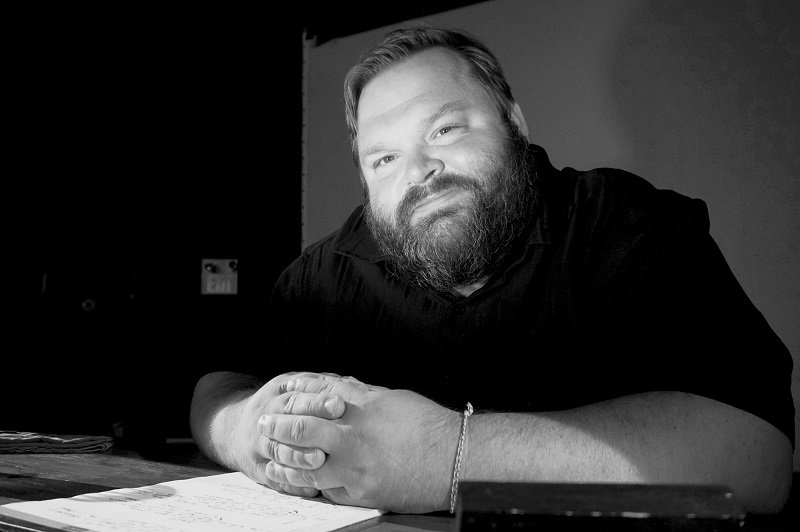
Photo of Mike Daisey from mikedaisey.com
I suppose it was inevitable, really. Monologist Mike Daisey has performed monologues about some of the greatest megalomaniacs in history (his series "Great Men of Genius" played at Berkeley Rep several years ago). And he's also been pilloried for stretching the truth (as story tellers are wont to do). So as he notes in "The Trump Card," it's kind of a miracle that he hasn't already done a monologue about Donald Trump.

But here he was, Tuesday night, at the Ashby Stage in Berkeley, at the confluence of a bunch of events. The Shotgun Players are in the middle of a run of Christopher Chen's play "Caught," which was inspired at least in part by the kerfuffle with Daisey on NPR when his piece about Steve Jobs and Apple was adapted for "This American Life." And apparently Mr. Trump is running for president. And Daisey is doing a tour of his Trump monologue, so it's only fitting that he'd sweep into town for two quick shows.

Background

I should note that I blogged several times about Daisey and the fuss with NPR back when it happened in early 2012. I think the most interesting piece is this one, because it both discusses the outcome of the show and links to several other commentaries. I won't go into detail here, since I've already written about it.

But Trump and Daisey is kind of an irresistible combination. Big, loud, guys from New York who don't just march to their own drummers, they are their own drummers.

I first became aware of Mike Daisey and his work when he came to Berkeley with his monologue (which was also published in book form), "21 Dog Years," about working in customer service for Amazon.com during the dot-com boom. We've since seen a number of his other pieces, including the controversial one about Apple. I like the fact that Daisey is always entertaining and thought-provoking, and because he has a very theatrical take on the ancient art of story telling.

The Art of the Story

Indeed, rereading my pieces from several years ago about the NPR controversy, what strikes me is that my favorite parts dealt with the role of story telling in general. Stories are the basis of culture, but also the basis of communication. We perhaps like to think we communicate with facts and ideas, but it is in fact stories that tie those together and enable human minds to absorb them.

Which (finally) brings me back to "The Trump Card." Daisey makes clear from the get-go that he is a story teller, a monologist, and a theater person, so he is, by his own admission, a professional liar. Now maybe that's just a clever disclaimer to ward off the hounds at NPR, but it also establishes his bona fides, because if it takes one to know one, he certainly recognized the professional liar and performer in Donald Trump.

He walks us through the history of the Trump family, most of which is probably familiar to anyone who has been paying attention for the last year or two. We get the stories of Trump's father, Fred, the slum lord and racist who was known for never paying people what they were owed. It becomes quite clear that the fruit didn't fall far from the tree. But always, Trump is telling his story, his version of "reality."

The Game

Among my favorite bits in the monologue is the description of Daisey hosting a big party, serving (fake) Trump Steaks to his friends while they play "Trump: The Game," which is, he says, like Monopoly for dogs. It sounds like a mind-numbingly awful game, but it also speaks volumes about the eponymous brand.

The Characters

In addition to the Trumps, of course, we also get to hear about Trump's longtime lawyer and advisor, Roy Cohn. That's pretty chilling stuff, but again, not so new.

I thought my favorite insight was when Daisey mentioned that as a monologist, he has spent much of his career developing and honing the character he plays on stage every night, "Mike Daisey." Because he says that's just what Trump has spent basically his entire career doing, too, at least since his businesses all pretty much tanked in the 1990s. It's all one long "reality" show, where Donald Trump plays the role of "Donald Trump."

And this might be the most useful insight: the fact that, no matter how much we think we know about Donald Trump, we really only know "Donald Trump." How much that distinction matters is left as an exercise for the reader, but Daisey makes it clear from the outset that we are all in deep trouble. And he also makes clear that even if "Donald Trump" is vanquished (or at least, defeated at the polls), we will eventually encounter someone who plays the role even better, and there the real trouble sets in.

The Script

I should note that if you can't get to see Daisey do the monologue, you can at least read it. You can download the whole thing here. In fact, you can read it out loud, if you like: It's open sourced. You, too, can play the role of "Mike Daisey" if you like. He has also released the script for "The Agony and Ecstasy of Steve Jobs" the same way.

If you're interested, a lot of his work is also recorded and available as a podcast, "All Stories are Fiction". It's all explained on his website.

The Evaluation

Obviously, this is a very timely work, which is why Daisey is on a whirlwind tour between now and the election. And it's clearly a work he cares a lot about. At over two hours, it's a bit long, and somewhat repetitive. It strikes me that this might be the first show I've seen since Daisey split with his wife, who used to direct and co-create a lot of his work. That might account for some of the difference. It's good, but not really his best work.

I'll drop a link here to a review of some earlier workshop performances of the piece in Washington, DC, last summer. It probably gives a better flavor of the actual content of the show.