Tuesday, November 15, 2022

"Natasha, Pierre, and the Great Comet of 1812" at Shotgun Players


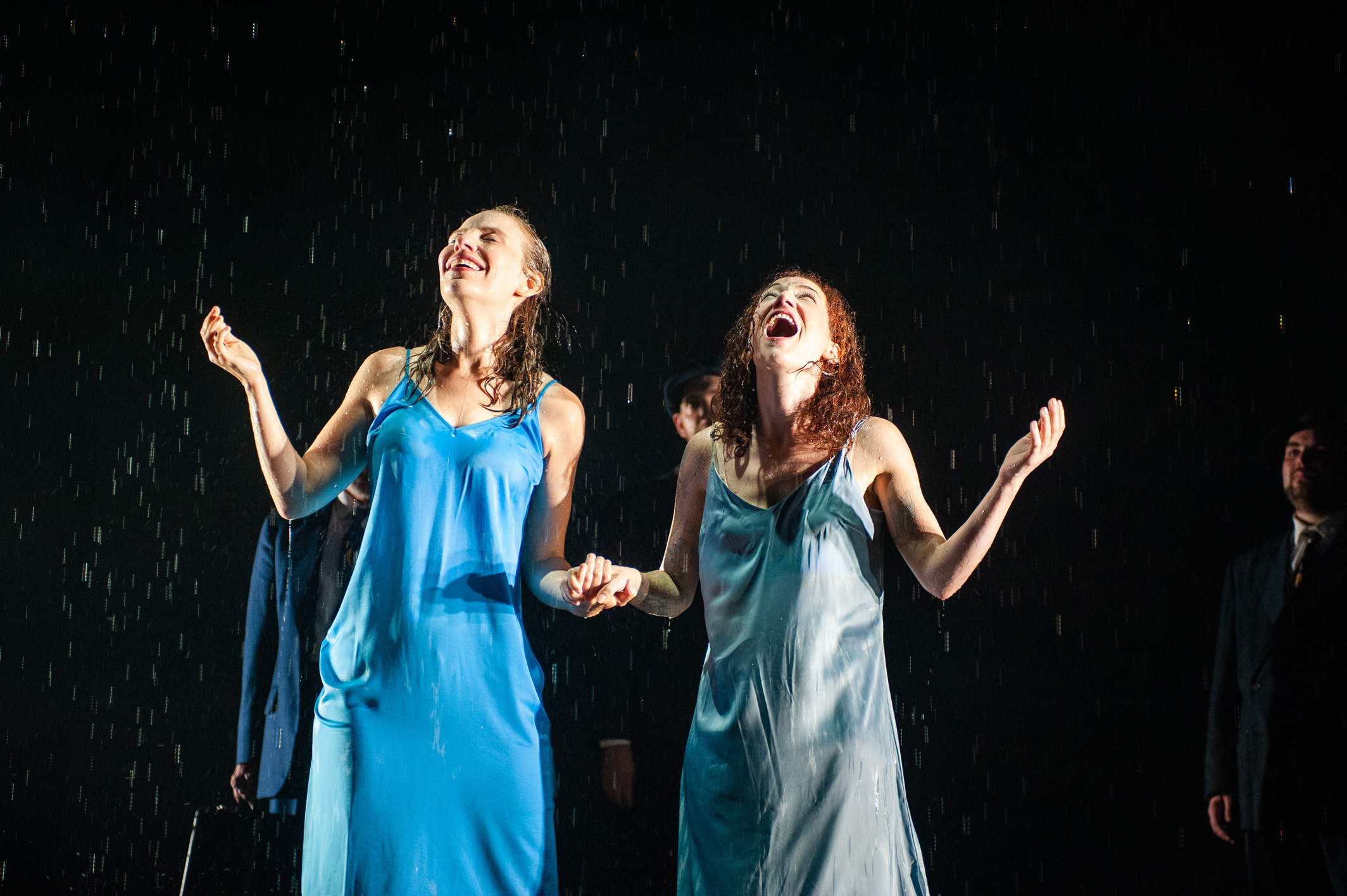
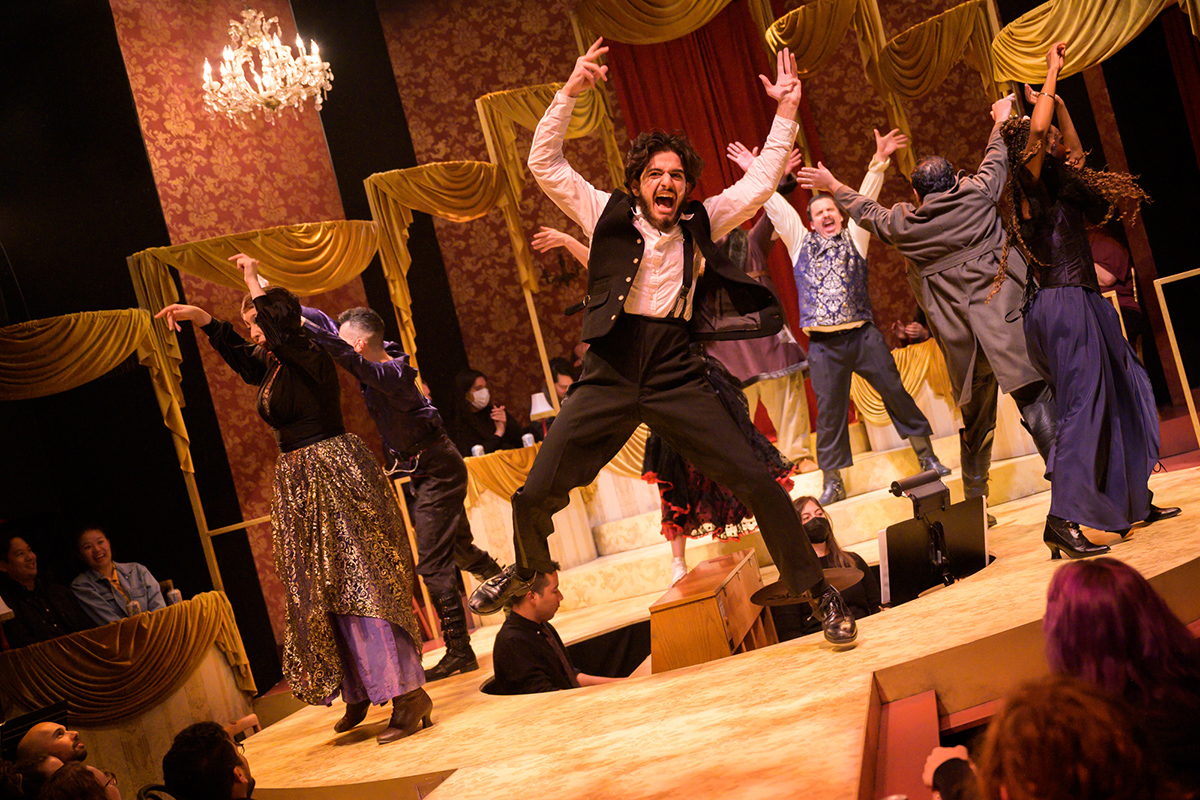
Shotgun Players production ensemble photo by Ben Krantz
I always find it a little difficult to write about shows at Shotgun, because they really are my favorite local theater. And I try to be at least reasonably objective, even though I'm a supporter/donor and board member. That's going to be tough here, because I really like this show.

I saw Natasha, Pierre, and the Great Comet of 1812 on Broadway some years back. I have to admit that I wasn't really prepared, and I didn't think the venue was all that conducive to really appreciating the show. It was a big open floor with cabaret tables where folks could drink, and lots of different entrances, so the show itself was a bit difficult to follow. So I've been looking forward to this production in the more intimate setting of the Ashby Stage, though I couldn't really imagine a cabaret setting in there.

The Play

The play itself is a most unlikely thing. Playwright Dave Malloy just doesn't do "normal" musical theater. This blog was still on hiatus last spring, or you would have seen a glowing review of Berkeley Rep's production of Malloy's Octet. And there is a long, meandering story about how Comet came about because of Malloy's production with Shotgun over a decade ago of Beowulf--a Thousand Years of Baggage. But let's just say the script is derived from a small slice in the middle of Leo Tolstoy's epic novel War and Peace. And as the first song, "Prologue", makes clear, it's a complicated Russian novel, and everyone's got nine different names, etc. But it also gives you some mnemonic devices for remembering who is who and how they relate, which is helpful (and Shotgun's program helpfully reproduces much of that).

As the title of the show suggests, Natasha and Pierre are the central characters: she young and naïve, loving her betrothed Andrey, who is off in the war, and he older, awkward, and disenchanted with life (and particularly his life, notably his loveless marriage to Helene. So we follow as Natasha careens through Russian society, wishing for Andrey to return and marry her, distracted by the appearance of the seductive Anatole. While Pierre sits, reads, studies, and drinks, all the time thinking he used to be better, and that he wants to wake up into his life.

The music is catchy, the story is actually remarkably easy to follow, and Malloy does a great job of simplifying things without losing the essence of Tolstoy's characters.

The Production

This is the west-coast premiere of the show, which has run in New York (both off and on Broadway) and a few other places in the east. But as far as I know, it's the first time it's been staged in such a small venue. And scenic designer Nina Ball outdoes herself (which is a very high bar) in reimagining the Ashby Stage as a cross between a cabaret nightclub and an opera house. The audience surrounds the stage, but with room for the actors to move around and interact with the house, and the band is spread around so it feels integral to the room. I love the way the cast sneaks into the room to do choral backup behind one or two singers on stage, adding musical depth without distracting visually. The co-directors, Patrick Dooley (Shotgun's artistic director) and Erin Mei-Ling Stuart (who also choreographed), have done a remarkable job of taking the transformed stage and making it both large enough for the whole ensemble and small enough for intimate solo and duet numbers. The lighting design by Weili Shi contributes a lot to the illusions.

Somehow this space also accommodates a remarkably big band: musical director Daniel Alley and his upright piano is in a pit in the center of the stage, along with drummer Brietta Greger and her whole kit. On one side of the house there are strings (both a cello and double bass), while on the other are woodwinds (clarinet and oboe) and a very versatile accordion/keyboard/glockenspiel player. So it's a very rich musical ensemble, but it suits the space.

The cast is very strong, starting from the title characters. Jacqueline Dennis brings both a powerful voice and a very believable sense of youth and innocence to Natasha, which Albert Hodge brings a brooding, yet explosive, mood to Pierre. There are several other particularly strong singers in the cast, most especially Danielle Cheiken (Mary and others) and Veronica Renner (Sonya). Several others bring both vocal prowess and some serious acting chops to their supporting roles, notably Angel Adedokun (Helene) and Michelle Ianiro (Marya). But even the "minor" characters have their moments in the sun, with James Mayagoitia (Old Prince Bolkonsky) doddering humorously, Roeen Nooran filling numerous servant and ensemble roles, and Weston Scott taking advantage of every second as Balaga, just for fun.

Bottom Line

For some crazy reason, I decided to read War and Peace this summer as sort of self-assigned homework leading into this play. As a result, I appreciate both how difficult it had to be for Malloy to carve a meaningful little slice out of the middle of a ponderous tome, and also how interesting it is to contemplate the characters within this slice, knowing that there is so much more to their stories, both before and after. It really is remarkable that Malloy created such a compelling, moving, and fun piece out of that source material.

And as you have already gleaned from my words above, I believe this is one of the finest pieces of theater to hit the local stages in some time. It's not the same kind of intellectual work that wowed me in This Much I Know this summer at Aurora. But to take this remarkable piece of both literature and music and create an intimate, immersive, interactive stage experience unlike anything I've encountered anywhere recently--that's an achievement. Producing a show of this scope with the quality of this production is pretty expensive, which generally means you have to stage it in a larger house. But Shotgun has managed to fit the show into its friendly confines, and the intimacy of the show really adds to the experience.

Really--go see it. It's not just me--the "little man" in the SF Chronicle's review is leaping out of his chair. You will be, too.

Comet has already been extended through January 15th at the Ashby Stage in Berkeley.

Monday, October 17, 2022

"Indecent" at San Francisco Playhouse

SF Playhouse production photo by Jessica Palopoli

 This is a play we really, really liked at Ashland, and since it was one of the last plays I actually wrote a blog about before I shut things down, I will refer you to that posting for information about the play itself, and I'll just talk about the current SF Playhouse production here.

The Production

I went into this with some trepidation. As you can see from my previous post, I really like this play, and the production at Ashland was excellent. SF Playhouse can do really good productions, but not always, and this is a particularly tricky play, what with all the Yiddish and other languages thrown in, and some obvious cultural issues one could trip over. Still, director Susi Damilano generally does a very good job, and in this case, she does not disappoint.

I'll note up front that the one role that is stable throughout the play, Lemml, the stage manager, was an understudy the night we attended. David Schiller did a terrific job, and had the program not contained an insert indicating that we had an understudy, I would never have known. And that's a good sign for the production as a whole, if one doesn't notice that a major role has been swapped out.

I liked the simple staging of the show, using suitcases as props for many things, and using the uncurtained wings as an area for actors and musicians to rest, change, and observe. I thought that fit the play very well. As with the production in Ashland, I had difficulty seeing some of the projected supertitles from my seat location at times. That seems like something that the designers could have addressed, as we were roughly in the middle of the orchestra section, and I suspect anyone closer to the stage would have had even more difficulty.

Bottom Line

This is a very good production of an excellent play. Of course you should go see it! It runs through November 5th at SF Playhouse.

I was encouraged, by the way, to see the theater much more full than it has been for other recent shows. The orchestra was nearly full, and there were people sitting up in the balcony. I suspect this is a result of both the easing of COVID restrictions (and a concurrent willingness of people to go into indoor spaces) and the quality of this show. In any case, go! See it! Bring your friends. This is the good stuff.

"Dunsinane" at Marin Theatre Company

This one sneaked up on us, so we went on a whim. I have to admit that lately I only venture over to Marin Theatre Company if there is a play or a performer I particularly want to see. I was intrigued by the concept and the playwright this week, so off we went to Mill Valley.

The Play

Superficially, the play is a kind of sequel to Shakespeare's "Scottish Play," Macbeth. It begins as English forces supporting the exiled Malcolm return to Scotland, disguising themselves using greenery from Great Burnham Wood to cover their charge on the castle at Dunsinane. The "tyrant" (i.e., Macbeth) is vanquished by Macduff, Malcolm assumes the throne. And now the fun begins. Because Scotland is not a nation at peace. It remains a collection of rival tribes with shifting alliances and much distrust of both leaders and outside forces. Add a couple of twists now: Queen Gruach (who we would know better as Lady Macbeth) is still alive, and represents a significant threat to Malcolm's rule.

And now we settle into an uneasy peacemaking/occupation/negotiation, as the English just want to settle the situation so it is not a threat to their northern border, and various factions in Scotland want to assume or retain control. The English, represented by General Siward, and the English Army, just want to pacify the situation and go home. But Siward won't leave in defeat--whatever that means to him--and presses onward.

And so we enact on stage the futility of bringing peace to a region using outside military force. Playwright David Grieg (a Scot, if you hadn't guessed) has adopted the British intervention in Scotland in ancient times to stand in for (take your pick) the current relationship of Scotland to the UK, The U.S. interventions in Afghanistan and/or Iraq, almost any situation in the modern Middle East, etc.

The play does get a bit bogged down (only a slight pun intended here), and could probably be trimmed a bit (it runs over 2.5 hours). But hey, that's kind of the point: this is what happens to outside forces trying to impose peace on rival tribes and clans. It's actually a pretty good illustration, and covers both the futility and the effects on both internal and external groups. It's not Shakespeare, and it's not meant to be. It's a contemporary play about current-but-also-timeless issues, and it's rather well written.

The Production

Marin Theatre Company produces this show in partnership with the Conservatory Theatre Ensemble at nearby Tamalpais High School. As a result, there are high school student both acting some of the parts on stage and apprenticing on the creative and production teams. In some ways this works very well. The young actors portraying both members of the invading English Army and young Scots bring a sense of authenticity to those roles. On the other hand, even at their best these teens can't really keep up with the professional actors, and the scenes where they have extensive lines tend to be the parts that drag the most.

That said, the professional cast is top-notch. Aldo Billingslea (Siward) is always strong, and his experience teaching and directing young actors definitely buoys the scenes he shares with the teens, especially early on. Josh Odsess-Rubin (Malcolm) and Michael Ray Wisely (Macduff) are really solid in their roles, and Daniel Duque-Estrada (Egham/Luss) has to cover more ground, but does so admirably. But the real stand-out is Lisa Anne Porter as Gruach. Whenever the queen is onstage, you know it, and you know she is up to something. She has a lot of nuance in her performance, and she brings out the best in those around her, particularly Billingslea.

The set itself is quite simple, which probably helps with a cast that is constantly flipping between specific roles and ensemble parts. And they probably could have found a more effective means of delineating scene changes than simply thumping a spear on the stage each time.

Bottom Line

I will admit that I was a bit befuddled by the time we got to intermission, but a bit of conversation with my friends gave me the insight that I was being a bit too literal and specific in my interpretation of the play. It's sort of mildly interesting as an examination of Scottish history, but once the light goes on and you start to see the situation as representative of other scenarios, including contemporary ones, the richness of the material starts to shine through. So perhaps a bit better job of widening the audience's view early on would help. But overall, I think they play is a good one.

The production definitely has some flaws--I wasn't really expecting to see a hybrid professional/student play when I arrived. I suppose a little more research would have cleared that up for me. I'm sure I would still have gone to see it, but might have had somewhat different expectations.

All in all, I like the play, and I think the production is worth seeing, as long as you recognize going in that this is not going to be a fully-professional show, and that it's probably best enjoyed with an eye toward it being something more/other than a sequel to Shakespeare's Scottish play. So I give it a provisional thumbs-up. Look beyond the amateurish bits and the pros have a lot to say here.

Sunday, October 16, 2022

"The Piano Lesson" at Ethel Barrymore Theatre

 Another day, another Pulitzer-Prize winner. Honest, we didn't set out to see plays based on that this trip. It just turned out that four of the seven plays we wanted to see were all winners at some point. For this final show of the trip, we went to see the star-studded revival of August Wilson's The Piano Lesson. We're big fans of Wilson's work, though we haven't quite made it through all ten of the plays in his "American Century Cycle", which has a play set in each decade of the 20th century. The Piano Lesson is set in 1936.

The Play

Siblings in conflict over their shared inheritance--shades of Topdog/Underdog a few days earlier! Only in this case, we have a piano, elaborately carved to represent family members, that is the legacy shared by Boy Willie Charles and his sister, Berniece. Berniece and the piano live with her uncle, Doaker, in Pittsburgh, where Doaker works for the railroad. Boy Willie and his friend Lyman have coaxed a truckload of watermelons up from Mississippi, intending to sell them and use the profits to buy some farmland back home. But Boy Willie needs more money, so he wants to sell the piano. Berniece doesn't want to.

As the story unfolds we learn of the importance of the piano in the family's history. The piano was a gift from a slave-owner named Sutter to his wife, purchased in exchange for two of his slaves, breaking up their family. The wife loved the piano, but missed the slaves, so one of the remaining slaves carved likenesses of them and their whole family history into the piano. These slaves are the ancestors of the present-day Charles family, and it was Boy Willie's father who stole the piano from the Sutter family, which resulted in his death. To complete the circle, it is the Sutter family from whom Boy Willie plans to buy the farmland.

The play revolves around the family members trying to deal with their different attitudes about their past and the value of family and remembrances. 

The Production

The show has a very strong cast. Samuel L. Jackson plays Doaker, and his past history with the play (originating the role of Boy Willie at Yale Rep and understudying it in the original Broadway run) gives him a definite sense of being the patriarch. Jackson's wife, Latanya Richardson Jackson, herself an award-winning actor, directs the production. John David Washington (Boy Willie) and Danielle Brooks (Berniece) bring a lot of strength and fire to the conflicted siblings. Michael Potts as Wining Boy is very strong both musically and in his acting. And Ray Fisher as Lymon is a likeable, if ineffectual, pawn to everyone else. I'm always a little worried when actors more known for their movies show up on stage, but this cast is terrific--they definitely have the chops to play in a big house.

The set is pretty simple, allowing the actors to maintain the focus, with the exception of the extremely intricately-carved piano, which is a spectacular piece and basically serves as a character itself.

Bottom Line

Good play, great cast, well produced. It was a very good ending to our week in New York. I highly recommend it. We saw a preview performance, so I suspect it will keep getting better. The show is scheduled for a 17-week run, so you have some time to catch it.

Saturday, October 15, 2022

"A Strange Loop" at Lyceum Theatre

 Another day, another Pulitzer Prize-winning play. This one, A Strange Loop, by Michael R. Jackson, is definitely different from the rest, if only because of being a musical. But we had wanted to see this ever since it took Broadway by storm and also won some Tony Awards, so it was definitely something to see.

The Play

Nothing complicated here: it's a musical about a queer, black man stuck in a job as a Disney theater usher who is writing a musical about a queer, black man writing a musical about a queer, black man writing a musical.... Which is a strange loop (or as we call it in my line of work, and infinite recursion). Usher (which is both the name and the job title of the main character) is having difficulty writing, as he is continuously blocked by Thoughts. Six of these Thoughts are personified by the other six actors in the show, and they variously portray all his hopes, fears, fantasies, and family.

So in addition to being a pretty straightforward story about a young writer trying to create something worthwhile and break into show business, it's also an exploration of Otherness, as various of Usher's attributes keep him from fitting in with what would otherwise be his peer groups. Usher is outside the mainstream in so many different dimensions that it is really difficult for him to connect, though he wants to do so desperately.

That means there is a dialogue going on between Usher's self-acceptance and his acceptance by others, and naturally, there are Thoughts.

Overall I found the play clever and touching, but it eventually got a bit too focused on a note or two (to the point that one of the Thoughts interrupts and indicates that it's too much of gospel parodies and Tyler Perry jabs).

The Production

The production was solid. Clearly the show hinges on the performer playing Usher, and the night we saw the show that was an understudy (Kyle Ramar Freeman). He was very good, and meshed well with the cast. Two of the Thoughts (2 and 6) were also understudies for our performance, but again, it all blended smoothly enough that I didn't notice anything amiss.

The set is fairly simple and bright, enabling us to focus on Usher and his Thoughts. The opening number is really solid, and sets up for a lot more to come, but the energy wanes a bit later on. Still, I was engaged and entertained throughout.

Bottom Line

I'm glad we got to see this show. It is genuinely different from anything else playing on Broadway, and its quite remarkable that it made it to Broadway at all. Perhaps there is hope yet.

Right after we saw the show, they announced that the production will close on January 15, 2023, so you can still see it for a couple more months, and I suggest it's worth it.

Sunday, October 9, 2022

"Remember This: The Lesson of Jan Karski" at Theatre for a New Audience

Not satisfied with having sat through Tom Stoppard's Holocaust-centered play Leopoldstadt two nights ago, we boldly set out to Brooklyn this afternoon to catch David Strathairn in a solo show at the Theatre for a New Audience's Polonsky Shakespeare Center. This promised to be very heavy.

The Play

 It's not exactly a monologue. The single actor portrays mostly Jan Karski, but also occasionally slips into someone Karski interacts with. It starts as a simple story about him and his background, but ends up focusing on his life in the Polish Underground during World War II, after Germany invades Poland. Karski, who has a photographic memory, becomes a witness and messenger, carrying messages in his mind to leaders of the exiled government.

At one point Karski (who is Catholic) is recruited to observe conditions in the Warsaw ghetto and one of the Nazi death camps, then report what he has learned, first to the Jewish leadership in exile in London, then to the British foreign secretary and then to officials in the U.S., up to and including President Roosevelt. His messages are ignored, and officials later claimed they had no knowledge of the actual situation.

Throughout, Karski reflects on his own life (including his later four decades on the faculty of Georgetown University), his marriage, and many other subjects. But ultimately, his message is about the capacity in every human for good or for evil, and the reluctance to believe horrors, even when irrefutable.

The script is powerful. Apparently it was originally written to have at least one other actor besides Karski, but in the hands of a terrific actor, at least, the solo performance is quite moving.

The Production

The script has been in development for several years, and David Strathairn has been involved throughout, along with a lab at Georgetown that meshes performance with politics (which sounds pretty cool!). After several smaller runs, this five-or-six week Off-Broadway run at the Theater for a New Audience is their biggest yet, and apparently will later turn into at least a limited national tour.

Strathairn is the single actor in the show, although there is a bit of film of the real Jan Karski as well. For a man in his early 70s, Strathairn still displays a lot of energy, and fills the 90 minutes without much of a break to catch his breath, changing his outfit as he goes to subtly reflect changes in Karski's circumstances.

The Karski narrative is a remarkable story, and the play depicts it without much commentary, save for tiny monologues at the start and end. Karski's story is allowed to speak for itself, with an implicit notion that we, unlike his contemporaries, need to heed his warnings.

Bottom Line

This was a tremendous piece of theater, both in the sense that it's an impressive piece of writing and a daunting challenge for the actor, all of which rolls into a simple but compelling message about our responsibility as humans to respond to reports of inhumanity in our time. Although the production does not explicitly mention the situation in Ukraine, there is clearly concern for that.

The show has been extended in Brooklyn for a week, through October 16th. The show we saw on the 9th was supposed to be the closing (and it was sold out). So this would be a good week to see it in Brooklyn. And I'm told that it will be traveling, including to the Bay Area, so watch for it--this is a piece of theater that really needs to be seen.

I would be remiss if I didn't note the conversation going on in my head between this show and Tom Stoppard's Leopoldstadt, which we saw two nights earlier. Stoppard's play talks about the denial among even those who explicitly knew the Nazi threat, and also shows the dangers of reacting too late. It is a different, but also very personal, reminder of the consequences of looking away when people threaten other people.

"Baldwin & Buckley at Cambridge" at The Public Theater

 I have seen TV clips of the debate between James Baldwin and William F. Buckley at the Cambridge Union in 1965, so I thought it would be pretty cool to see that dramatized on stage. So off we went last night to the Public Theater to see their presentation of just that: Baldwin & Buckley at Cambridge. Conceived and developed by the innovative group Elevator Repair Service (whose show Ganz, a dramatization of The Great Gatsby, was so good at Berkeley Rep a few years back (but apparently at a time when I was not blogging).

The Play

In some sense I'm hesitant to call this a play, since it's really more of a declamation of the speeches actually delivered back in 1965. But there is some staging and a bit of acting around it, so we'll just go ahead and treat it as a play, and see where that leads.

The script for the play is, with only slight modifications, a transcript of the actual Cambridge Union debate on February 18, 1965. There were four speeches that night in this "debate" on the question "Is the American Dream at the expense of the American Negro?" Cambridge students delivered the brief opening arguments to introduce the question, and then in turn, the writer James Baldwin and editor/commentator William F. Buckley took up the question in longer form.

I have to put away my expectations from my years as a debater and coach, since this form of debate is more a matter of dueling speeches than actual clash or addressing and rebutting of the statements of the other side. Essentially, Baldwin and Buckley offered separate orations on either side of the question.

At the end of the debate, there is a brief scene between Baldwin and Lorraine Hansberry, compiled from letters, interviews, and writings of the two.

On the whole, I think the debate itself is interesting, but not particularly compelling on its own. The last scene attempts to add a bit of context and interpretation, but not nearly enough to justify its inclusion in the piece. Since the whole thing comes in at about one hour, it feels somewhat minimal. I would definitely have preferred to see more material, perhaps culled from subsequent writings or interviews with Baldwin and Buckley discussing the debate and the aftermath.

The Production

The Public did a pretty good job with this. I quite liked the use of the intimate Anspacher Theater and the minimal set (two tables with lecterns, and a chair for each). Unfortunately, while Baldwin (Grieg Sargeant) spoke, all I could see was the back of the seated Buckley (Ben Jalosa Williams), so I'm not sure how much he was reacting, emoting, etc. I suspect the aloof Buckley would have reacted very little. And when Buckley spoke, I could see Baldwin reacting a bit, but only a little, seeming annoyed (with justification).

Since there is little direct clash in the debate itself (e.g., Buckley mostly addresses Baldwin's published writings, not his words or arguments in the debate), the audience is left to weigh the arguments themselves. Admittedly, that's what the audience at the actual event did, but for dramatic purposes, that's asking a lot of an audience many decades removed from the actual events and people.

And then the final scene with Baldwin having a smoke while Hansberry (Daphne Gaines) does some ironing with the radio playing quietly seems pretty inconsequential until they both break the fourth wall and address the modern audience directly, which feels a bit jarring in what has otherwise been a straight recreation. That whole little postscript feels inadequate and unfinished.

The truly odd choice, to me, however, is the way Sargeant does a genuinely high-quality impression of Baldwin's vocal and physical mannerisms, but Williams mostly does not do that with Buckley. About three times he slips into Buckley's languid, condescending cadence and upper-class accent, but then reverts again to his own voice and style. I have no idea why. It didn't seem to be done for any particular dramatic purpose. I can only suppose that a prolonged use of that style would have bored and irritated the modern audience, but then why use it at all?

Bottom line

Truly, this all felt like kind of a good idea, but not thought through very thoroughly. It's not very satisfying as a purely historical recreation, nor is it at all satisfying as a dramatic presentation based on the historical event. I can think of lots of ways this could be more interesting, and there are probably many others I haven't imagined. But there has to be something better that can be done with this material than what the Public presents here.

I walked away disappointed in both the effort and the outcome. Baldwin and Buckley both deserve better than this, and the collaboration of the Public Theater and Elevator Repair Service leads the audience to expect that there will be something more and better. But there isn't.

In short, don't bother. Maybe someone will turn this into something good, but as it is, your hour could be better spent elsewhere.