Saturday, November 25, 2017

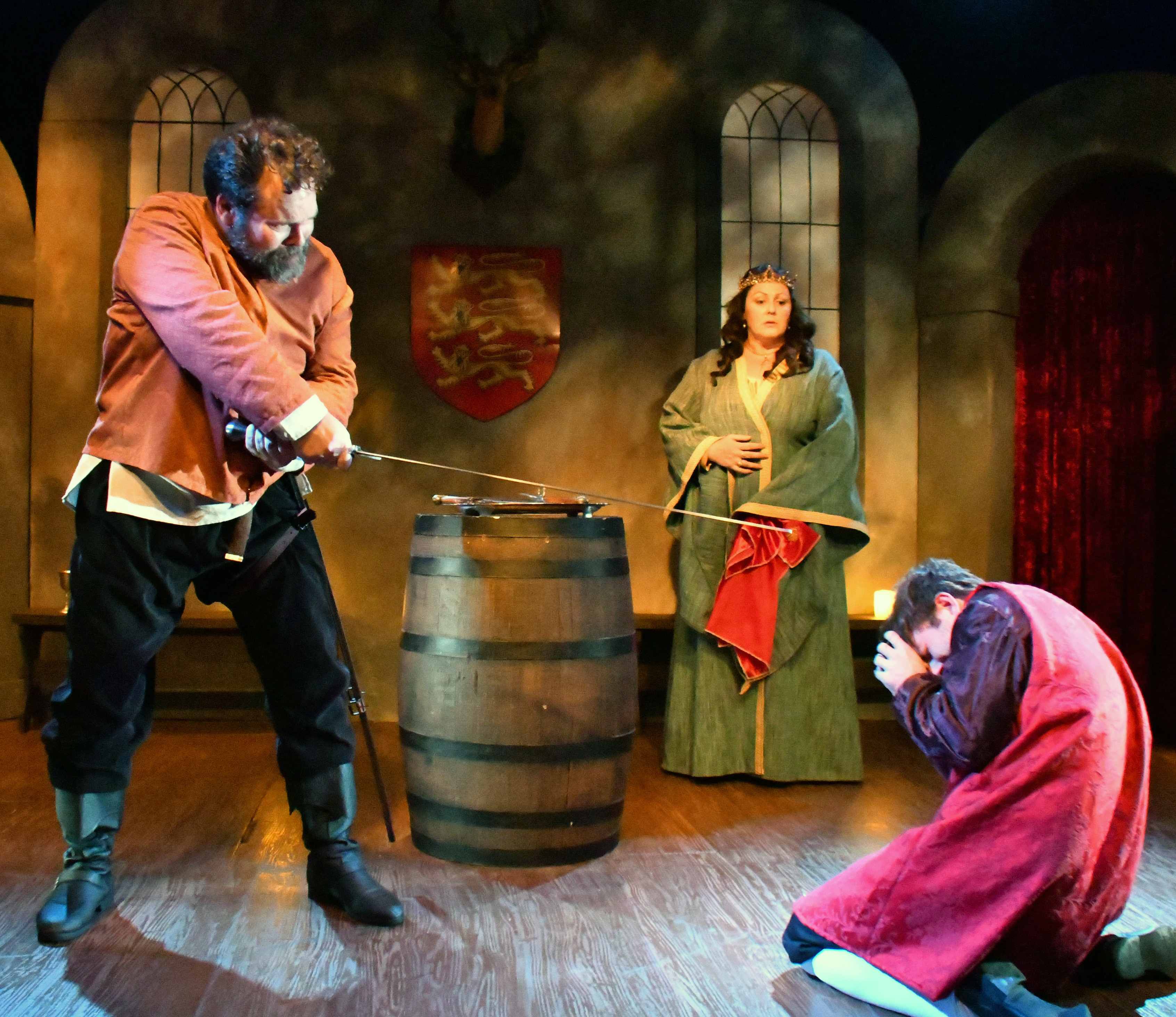
"The Lion in Winter" at Custom Made Theatre Company

Custom Made Theatre photo by Jay Yamada
I really want to like this play. I truly appreciate the fact that Custom Made Theatre Company has the sense of humor and the guts to schedule The Lion in Winter as their holiday show because it is set at Christmas in the year 1183. And it's billed as “A Medieval Who’s Afraid of Virginia Woolf?“-- that certainly seems like fun for the holidays!

It turned out that the most convenient time to see it was the weekend after Thanksgiving, at a matinee, and tickets were not exactly selling like hotcakes. But we decided to take the plunge and see what we got.

The Play

I think in the right hands, this could be a pretty interesting play. King Henry II has lost his favorite son (also named Henry) very young, and he's not terribly keen on any of his three remaining sons (Richard, Geoffrey, and John). Nor is he particularly fond anymore of his wife and queen, Eleanor of Aquitaine, who has been in prison for the last decade or so. He's quite fond of Alais, a French princess brought to his household by a treaty as a wife for Richard, though that hasn't happened yet. And Phillip, the young king of France, has come at Christmas to discuss that matter.

So Henry needs an heir, but hasn't named one. We get lots of political and family machinations around which of the sons should and will get the throne, along with a lot of verbal sparring between Henry and Eleanor, something they have clearly perfected over the years (and which draws the comparisons to Virginia Woolf).

There are plenty of twists and turns and such to keep one's interest, though the ending isn't all that satisfying (and isn't that what we want from a holiday show?).

The Production

The set is simple, which is good. It's clearly meant to be a medieval castle, or at least as muc of one as can fit on the small stage at Custom Made. But it's fine for the size of cast and amount of action. And the costumes, designed by Brooke Jennings, are excellent: not flashy, but evocative of royalty of the period. The sound, though, wasn't good. After intermission there is a small fire burning at center stage, and I heard pops and crackles coming from a speaker way off to the side, which was very distracting. And unfortunately, much of the sound design was overwhelmed by a buzzing from the lights or something overhead. So the production itself is kind of a mixed bag.

The acting covers quite a range, too. Eleanor (Catherine "Cat" Leudtke) is quite solid, and though he started our performance pretty flat, Henry (Steven Westdahl) managed to stay with her most of the way, though his range is more limited. Alais (Caitlin Evenson) started pretty strong, but kind of disappears later on. And the three competing sons don't seem to know they are in the same play. Richard (Elliot Lieberman) is stoic, yet angry. Geoffrey (Kalon Thibodeaux) is reserved and calculating. John (Luke Brady) is a whining, petulant child. Yet somehow I'm supposed to believe that they are fighting for the throne of the largest and most powerful empire in Europe.

Eleanor's favorite is Richard. Henry's (for inexplicable reasons) is John. There are valid political arguments complicating the case for either, but temperamentally, there is no question who ought to get the crown. (Hint: his nickname is "Lionheart".) In the hands of a different director, this might be an interesting struggle over geopolitics. But as staged by director Stuart Bousel, we see melodramatic arguments over important matters, but ultimately the question seems painfully obvious: Richard is suited to be a king, Geoffrey can be useful, and John is a ninny. Yet somehow we fight over whether to give John the crown, the princess, etc.

Bottom Line

This play ought to be more interesting than it is. Either a different cast or a different direction could probably take the script and turn it into something both fun and interesting. But this effort is only mildly fun or interesting. So I came away disappointed.

This isn't the holiday treat I was hoping for. It was a mildly diverting production marred by some inexplicable casting and directorial choices, plus some really bad tech in the sound department.

Still, there were a fair number of people in attendance today, and the show has been extended a week to December 9. So if you're looking for something a little different for the holidays, you have more chances to see The Lion in Winter. Just don't go in with your hopes too high.

"Small Mouth Sounds" at ACT

ACT photo by T Charles Erickson
ACT likes to use their newly-renovated Strand Theatre for smaller, more innovative productions that probably wouldn't work on the big stage in the cavernous Geary Theatre. Such is the case with Small Mouth Sounds, by Bess Wohl. As advertised (people meeting and interacting at a silent retreat), it doesn't sound like much of a play. But in fact, during much of the play there is the voice on an unseen teacher, so there is something of a narrative structure and words for the (mostly) silent characters to react to.

The Play

There's not a lot to say about the play itself beyond what I already said. A group of six people arrive at a silent retreat. Four are strangers, and two others are a couple, and we know really nothing about them except what we see. The unseen Teacher welcomes the guests and sets down some rules, at which point we really start to see various characters' personalities come out in their silent reactions. A key scene has everyone settling into their sleeping spaces, rolling out mats, undressing to one degree or another, etc. All along, little snippets of character come out.

And this goes on for five days. We get a few little interludes where people speak a bit, but that's about it. One character is permitted to ask a question, which is predictably lengthy and actually one of the most uncomfortable scenes in the play.

Ultimately, we don't learn all that much about any of the characters (though some more than others). We have essentially a character study with pretty strict limits on what the characters can reveal, and little or no plot for them to interact with. So in 100 minutes of uninterrupted performance, we get what we might get out of 15-20 minutes in a spoken play.

The difference being that you have to guess a lot more, and you end up filling in your own back stories and such. That's kind of interesting, but none of the reveals in the play are really enough to validate or invalidate much of one's speculations, so you're left with that. And I guess that's OK, but it's not really a play.

The Performance

The actors are all good, and expressive (as you might expect). Ned (Ben Beckley) ends up talking more than others (in part because of the aforementioned question scene), so we have a clearer picture of some of his issues and background. Joan (Socorro Santiago) and Judy (Cherene Snow) are the couple, so their interactions have more context, and we can interpret some of their back stories as well. Jan (Connor Barrett) has lost a child and is a magnet for mosquitoes.

Unfortunately, most of the characters are pretty one-dimensional. Rodney (Edward Chin-Lyn) is rather a show-off about his yoga and meditation practices,  but pretty self-absorbed. Alicia (Brenna Palughi) is a hot mess all around for no reason we ever discern. And the effort to insert a little personality into the unseen Teacher (Orville Mendoza) feel more like an effort to extend a scant "plot line" in the play, rather than a realistic effort to create a meaningful character of him or provide realistic prompts for the rest to react to.

In short, everyone does a good job with the material they are given. I thought Barrett and Snow and Chin-Lyn were particularly good and consistent with their portrayals. But really, there's not a lot of substance here. The "fill in your own story" aspect is kind of fun, but limited, and the one-dimensionality of the characters doesn't allow for very fulfilling stories at all.

Since it's kind of inevitable to make comparisons with other shows I've seen recently, it occurs to me that with a very similar-sized cast, Central Works' Strange Ladies managed to portray many more aspects of each character's life and personality. Admittedly, they used language, but that's kind of my point. If you're going to limit your characters to non-verbal communication, you (as writer or as director) had better provide them with more opportunities and tools for communicating. Otherwise you get flat, silent characters.

Bottom Line

It's an interesting exercise, but not a terribly fulfilling one. The actors are competent, and some manage to convey some really good, subtle emotions. I just wish there had been more to it. I'm not sure whether playwright Wohl and director Rachel Chavkin are concerned that audiences will be confused if the silent characters are more complex, or perhaps they just don't know how to do it. But for me, the main thing the show cried out (silently) for was more dimensions to the characters.

So I can't recommend it highly, but neither would I say to avoid it. The show runs through December 10 at the Strand Theatre, but there are probably better holiday shows out there.


Friday, November 17, 2017

"Strange Ladies" at Central Works

Central Works photo by J. Norrena
I hadn't been to Central Works for a while, so I was quite looking forward to seeing what this latest world premiere was all about. All I knew from reading blurbs on their website and in the paper was that Strange Ladies by Susan Sobeloff was about the American women who fought for women's suffrage, and that's a subject of great interest to me.

As always with these Central Works productions, they are world premieres, generally written by local playwrights, and they are often in somewhat raw form. In addition, the theater at the Berkeley City Club is really just a room with some seats around three sides, so the staging can't be too elaborate. On the other hand, they generally tackle issues of real interest, so even if the result isn't necessarily stellar, there is something worthwhile there.

And that's definitely the case here.

The Play

The play doesn't have a plot line per se, but rather follows a series of vignettes or episodes involving a group of six women joined together to fight for the right to vote. Some of the dialogue is a bit polemical, sounding more like they're giving each other their stump speeches than actually discussing issues or trying to persuade each other of tactics. But it's also a sort of shorthand that compresses our introductions to the characters and the issues.

So we first see the individuals, then send them off to recruit more, and then regroup together to plot a picket of the White House and President Wilson in the lead-up to the Great War. We get to see some splintering of the group over the war and how to advance (or not) their cause during it. And eventually we get to see some of the women arrested, imprisoned, and abused for demanding their rights.

Most effective in the script is the way it takes the six characters (although there are a few extras where someone fills a momentary role) with diverse backgrounds and priorities and manages to make them stand for the national coalition of women who came together over this particularly pressing matter.

Overall I thought the presentation was effective, and would probably be more so in a somewhat fancier theater with a bit fancier stage and light facilities. But on the whole, for a new work, it's quite effective.

The Production

Here again we have kind of a mixed bag. Of the six actors in the cast, three really stood out: Gwen Loeb as Rose, the New York union organizing veteran , Nicol Foster as Mary, the African American with a lot extra at stake, and Renee Rogoff as Alice, the organizer of the group. Each character has strong moments, but those actors really put something extra out there.

The costumes by Tammy Berlin are quite effective: Evocative of the era without being distractingly so. And the minimal props (by Debbie Shelley) and lights (by Gary Graves) manage to make the most out of the limited space. A "Votes for Women" banner held up represents the White House picket. A grid of dim light establishes that we are in prison. As a result, the production is pretty tight at just over an hour.

I should also call out the music, under the direction of Milissa Carey. The women frequently break into song, whether to break the monotony of picketing or to maintain their spirits in prison. It's one of the ways they bond, but also a way for the characters to establish themselves.

Again, they make the most of their limited space. The actors fairly frequently sat on the steps in the audience, making the setting all the more intimate.

Bottom Line

Strange Ladies is not, and need not, be a big play. Indeed, the small size of the cast and the stage effectively draws the audience into the already tight spaces and relationships of the characters. And we see in fair detail the efforts and the costs of the work these women undertook, the conflicts, the moments of doubt, and so on. It all seems very familiar to those who have worked on contemporary issues of social justice.

I appreciated getting some insight into the lives of the real women in the movement, although these particular women were fictionalized composites drawn from historical research. The result is quite moving as well as informative.

The play has been extended a week, and has three more performances this weekend. I'd say it's well worth going if you're in the area.

Friday, November 10, 2017

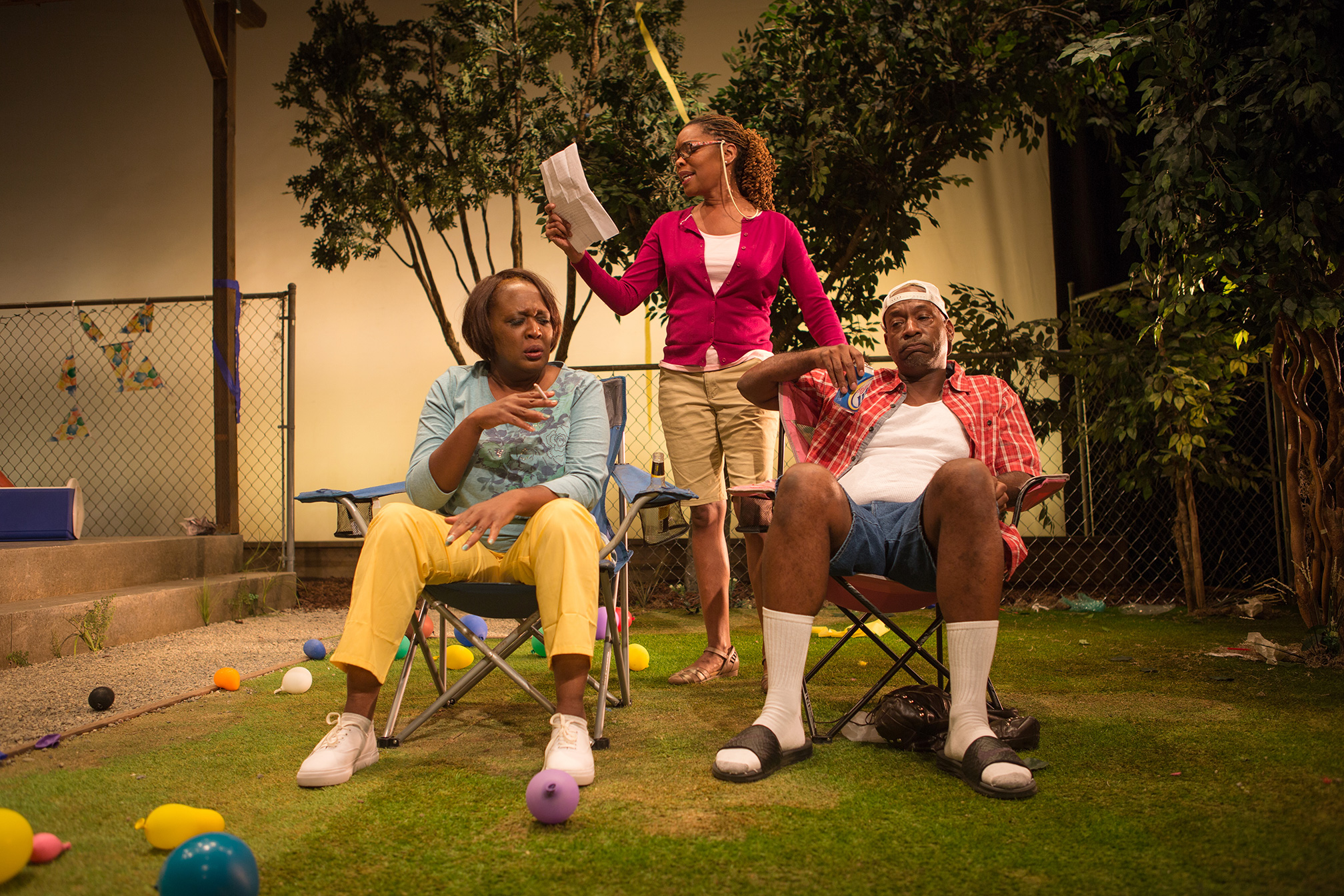
"Barbecue" at San Francisco Playhouse

SF Playhouse photo by Jessica Palopoli
This is a difficult play. I wish I had seen it a little earlier in its run, because there was a casting change for the last couple of weeks of the show, and it probably made a significant difference in the overall quality. But you go with what you got.

The play in question is Robert O'Hara's Barbecue, which takes place in a public park somewhere in Middle America around the present time. It's very clever in the way it does some things, but there are definitely some holes.

The Play

The play opens as a group of siblings begins to gather for a barbecue in the park, ostensibly as a celebration, but actually as a pretense to stage an intervention.  One of the siblings, Lillie Anne, has summoned the others (James T, Adlean, and Marie) to try to convince their sister Barbara to go into rehab. All of the siblings have issues, and many probably deserve to enter rehab themselves, but the opening scene establishes some of the background and relationships that have brought them to this stage.

As the first scene ends, the lights drop, and when they return we see exactly the same scenario, but all the actors have been replaced by doppelgangers. The obvious difference being that the first set of actors were all white, and the second all black.* The action continues as before, and we perhaps rethink some of our evaluations based on this change. Scenes alternate the two casts for the rest of the first act as we proceed into the actual intervention.

And then just as we get to the key moment at the end of the intervention (with the black family onstage), someone yells "Cut!" and everyone drops out of character, crew come onstage, and we realize that what we are seeing isn't what we thought we were seeing. We get to ponder that through intermission.

After intermission things change a bit, and we primarily see the two "Barbara" actresses interacting, starting with the white Barbara alone in the park, then joined by the black one. It becomes clear that the white Barbara is the "real" one, and the other is a famous actress who is evaluating whether to play Barbara in a film adaptation of Barbara's memoir, written in rehab.

[Spoilers here...look away if you must!] In the course of their discussion/negotiation, it becomes clear that Barbara's memoir is largely fictionalized, and was in fact inspired by reading a memoir while she was in rehab that inspired her recovery, but was also revealed to be fabricated. So we have layers on layers of fabrication and imitation and appropriation and ambition. Ultimately, everybody is trying to make a buck off of telling a story that might not be theirs, might not be true, and really, what does that matter?

I'd put this play in the trendy current genre of "gotcha" plays, where we are presented with a scenario that is ultimately revealed to be something entirely different, both within the play and to us. We've seen several plays like this over the last year or two, including Christopher Chen's Caught, Branden Jacobs-Jenkins' An Octoroon. When done right, it can be brilliant, and really make the audience evaluate their thinking and prejudices. But timing and chemistry onstage are in many ways as important as the writing, as the audience really has to buy into the set-up in order for the "gotcha" to work.

The Production

Which brings us to the production. This casting is particularly tricky, as the play needs two complete, coherent families. For the most part, this works pretty well here. The characters of Adlean (Jennie Brick and Edris Cooper-Anifowoshe) and James T (Clive Worsley and Adrian Roberts) slip back and forth pretty seamlessly. The Maries (Teri Whipple and Kehinde Koyejo) seem to have somewhat different approaches to their character. Lillie Anne (Anne Darragh and Halili Knox) is more of a problem; though both are good performances, they don't feel like the same character at all, really.

And then there is Barbara (Sally Dana and Margo Hall). The white Barbara was originally Susi Damilano, an SF Playhouse founder, producing director, and frequent performer. Damilano is a dynamic and accomplished actress who probably matched up well with the veteran Hall. Not taking anything away from Dana, but she doesn't have either the big stage presence of Damilano or the chemistry with Hall that comes from developing the roles over the course of the run. I found a lot of the post-intermission scenes just lacking in coherence and fire that seemed to be called for. It just felt off. So that's why I say I wish I'd seen the play a bit earlier, with the original casting. It's a tough call for an actor to come into the cast for the last two weeks of a run and try to maintain the quality of the production. It's not bad, but it doesn't feel like it's all it should be.

Other than that, I thought the production was quite good. Bill English's set design works well, evoking a public park that has probably seen some better days. And Hall directs as well as performing, which works pretty well because most of her scenes either don't have a lot of lines, or they have lines, but not many other characters.

Bottom Line

There is a lot going on in this play, but because each of the actors only plays about half of it, it's kind of hard to really get into any of them. And as noted above, when we do finally get two characters developing and working with each other the particular casting of this last couple of weeks has taken some of the air out of the balloon.

Still, there is plenty to think about in the play, even if the very nature of it makes it difficult to really settle in and evaluate it. We get to look at how we feel about characters of different races with exactly the same issues, for example. And we get some class consciousness as the big movie star confronts the rehabbed addict on her home turf, as well as the pretenses of the star who thinks she can just dictate who she is and what her background is; never mind what "facts" you might have read about her. Those are all pretty interesting, but all get a bit muddled. The concluding scene just adds a few more with some digs at Hollywood and the film-going public and their attitudes about race.

Ultimately I have a little trouble trying to decide which of these are actually important to the playwright and which are just incidental details that go into telling the story. And that's probably my biggest issue with these "gotcha" plays: by their nature, they are complex, and they also consciously undercut their own characters, plots, and messages. It's great to have plays that leave us asking questions, but it's also helpful to make sure we know which questions the playwright actually thinks are important.

Barbecue runs through this weekend (closes Saturday the 11th). It's worth seeing.

*I'm sure I could come up with better descriptions of the cast change than "white" and "black," but that is the essence of what we're looking at. We have the same family with essentially the same dynamics, just a different race. I will use the "black" and "white" shorthand because it's late and I'm tired.

Tuesday, October 24, 2017

"Thomas and Sally" at Marin Theatre Company

Marin Theatre Company photo by Kevin Berne
Well, everybody else is talking about this play this week. Turns out this is the right time for me to have seen it! It is highly unusual to encounter protesters trying to talk you out of going into a theater to see a play. But that was our introduction to Thomas and Sally on Saturday night at Marin Theatre Company. I had initially been indifferent to seeing this show, but my wife wanted to see it, so we did. After we bought our tickets a friend went and left at the first intermission (yes, there are two) because he didn't care for the play, which he summed up in three uncomplimentary adjectives (about the writing, not about the production).

Then today I was skimming Twitter and learned that a group of local theater artists, mostly African American, had written an open letter to Marin Theatre Company expressing their belief that this production "is an irresponsible, deeply harmful project with no accountability to black women and girls." Since I am neither a black theater artist nor affiliated with MTC, I won't get in the middle of that. But it is worth reading. I know quite a number of the writers and signers of that letter, and I respect their views.

What follows is my own thinking, based on my experience of the play, though obviously at least somewhat informed by the dialogue going on around me. It's probably safe to say this isn't the same post I would have written had I done so immediately upon coming home (which is probably good, because it was very late!), but I think most of the ideas are pretty similar.

The Play

Thomas and Sally is a very ambitious undertaking. It's a world premiere play, commissioned by MTC and written by Thomas Bradshaw. Artistic Director Jasson Minadakis (who also directed the play) hails from Virginia and has a passion for American history and particularly Jefferson and his relationship with the Hemings family, and he was really taken with Bradshaw's writing, so collaborating on this play made sense.

If you've been living under a rock (and if Minadakis is to be believed, a fair portion of his audience has been), you might not know about Thomas Jefferson and Sally Hemings. The short version is that plantation owner Jefferson had a "relationship" with Hemings, who was one of his slaves. It's a fairly big topic in historical circles.

Jefferson (Mark Anderson Phillips) was one of the "founding fathers" of the United States, primary author of the Declaration of  Independence, first Secretary of State, third president, provider of the initial stock for the Library of Congress, and so on. He was also a wealthy Virginia plantation owner, and among his possessions were over 600 slaves, including the Hemings family, including Sally. Nothing unusual there in colonial America, really. The kicker being that Jefferson had inherited the Hemings family on the death of his father-in-law, John Wayles (Robert Sicular). OK so far. But after the death of Wayles' third wife, he had taken a fancy to one of his slaves, Betty Hemings (Charlette Speigner), and fathered a number of children (eight, IIRC). Some of those children, including Sally Hemings (Tara Pacheco) survive and pass down to Jefferson. So Sally Hemings was the half-sister of Jefferson's wife, Martha (Ella Dershowitz). So even by the standards of the day, to adopt modern parlance, it's complicated.

This means Jefferson has a group of "special" slaves that his father-in-law has told him to treat well, keep out of the fields, etc. But they're still slaves, and can't be freed because then they would have to leave Virginia, among other things (it's the law; that's complicated, too). Among other things, some of the new Hemings slaves displace other slaves, such as Jefferson's long-time valet, Jupiter (played brilliantly by L. Peter Callender). That act of casual cruelty is one of the more realistic scenes in the play. And the overseer (Scott Coopwood) foresees that it will be difficult having some slaves treated almost as free servants while others slave in the fields. There is a lot going on.

Keep in mind that we have to go through the entirety of Act I to get all this. From what Minadakis explained in the after-play Q&A session, the first draft of that act was about 80 pages long, or nearly what a full play often covers. Though it has been edited considerably, it has to move at a quick clip, but it does so rather awkwardly.

But the play has three acts, and we're just getting started. Heck, we haven't even met Sally yet. As Act I turns into Act II, the recently-widowed Jefferson has been named minister to France, so he and his daughter, Patsy (normally Rosie Hallett, but read by someone else on Saturday--sorry I missed the name), and James Hemings (William Hodgson) head for Paris, where James apprentices as a chef (because...it's complicated). Later they are joined by younger daughter Polly (Dershowitz), who is accompanied by Sally Hemings.

So now lonely, widowed Thomas, much like his late father-in-law, finds himself alone, but with "needs" that can be met by...one of his slaves! So he slides into a sexual relationship with Sally, being at least somewhat discreet, at least at first. Needless to say, it's complicated. There is sex. There is seeming affection, and eventually, the inevitable pregnancy, right about the time the French Revolution breaks out, and the Jefferson/Hemings party needs to head back to Virginia. Somewhere in here we've had a super-awkward intermission break, because it happens while Thomas and Sally are in bed, and though the lights drop and the bed turns around, the actors are still visibly in it, so it doesn't really feel like one should leave. Stage hands eventually roll the bed off, but wow...uncomfortable moment.

Act III covers the (complicated, of course) decision about who goes home and when. James wants to stay in Paris where he can be free and a great chef. Thomas wants him to return to Virginia and "pay back" his apprenticeship. Sally really wants her child(ren) to be free, which pretty much means staying in France, but she also wants to be with her family, and maybe with Thomas. But with a few twists and turns, everybody ends up going home to Virginia, amidst promises of freedom for some, eventually, sort of.

The Frame Story

What I've left out here is the frame story. The play opens in a modern college dorm room, occupied by two young women, Simone and Karen (Dershowitz and Hallett-or-her-reader, respectively). Karenis writing a paper about slavery or Thomas Jefferson or something. It didn't seem that critical, so I forgot exactly what the topic was. Simone conveniently turns out to be a descendant of Jefferson and Sally Hemings, and proceeds to launch into a (three acts worth!) retelling of her family history, all the way back to the Wayles family refusing to sell Betty Hemings back to the captain (Coopwood) who fathered her on the voyage over from Africa (yes, really, three generations of these complications). All punctuated by several admonitions that "I'm not a historian." Because what this complicated story desperately needed was an unreliable narrator.

And to tie things up at the end, the two students have a little discussion about slaves and agency and love and such. Simone is quite adamant that slaves exercised all they agency they possibly could, all the time. Karen is non-committal about where she's going to come down on all this; she'll think it over. And she promises to do research to verify all the stories Simone has told her.

The Production

As with most MTC productions, the quality is high. The actors are capable, the sets well-designed and -built, good lighting, costumes, and so on. I don't have many complaints here. The bed, mentioned earlier, where Jefferson and Hemings ... er ... "sleep" is upright. As in they are standing up against an upright "bed" with bedding draped around them like a curtain. It looks really strange. It's especially awkward when Jefferson is lying in bed, having taken ill, and James comes in to talk to him, standing next to the bed. Combine that with the way Act II ends in the bed, and it's just way too weird. All the other beds (and there are a number of them, from the dorm room to Wayles' home to Monticello, to the rest of the time in Paris when Jefferson an Hemings aren't doing it) are horizontal, and we get along quite fine there.

And for some reason, the scene changes are done quite abruptly and loudly, with rumbling, sliding and squeaking and actors shove things relatively short distances. This seemed often unnecessary and quite distracting.

The play, and especially the first act, is too long. 2:45 with two intermissions. I think it actually ran long, in addition to starting late. I suspect the late start was due to whatever kept one of the actors from performing. The understudy/replacement sat in a chair off to one side of the stage and read the lines from a script. She did it pretty well, but it definitely detracted from the overall performance. I'm sure there was a good reason for all this, but it made the start of the long evening just that much odder.

And then there is the sex. Obviously, sex is an important part of the story, because if it weren't for the three generations of masters impregnating their slaves, we don't have a story at all. Fine, we get that. But the opening scene starts with a discussion of a missing/borrowed dildo and then we get a fair amount of rather juvenile taunting about penis size and then way too much detail about the highly implausible first encounter between Thomas and Sally. The last got a lot of feedback in the post-show discussion, but it was clear there was never any notion of cutting or changing that scene, though they thought of ending it a little bit sooner.

The Problems

Clearly, I have some issues with this play and production. And it's a bit hard to separate whether my issues are actually with the play as written or with the play as produced, because I haven't read it. And since this is the world premiere of a work that was commissioned and developed by this theater and this cast and creative team, it's hard to say that a problem lies on one side or the other. I take it as given that this crew knows and expresses the wishes of the playwright pretty closely.

Any writing about Jefferson and Hemings suffers from the tremendous imbalance of available information on the two subjects. Jefferson is extremely well-known and well-documented. About Hemings, very little is actually known directly. So virtually everything said or done by or about Jefferson we can weigh against what we know or believe. But with Hemings we don't have that luxury. Everything here is either an invention or an interpretation by Bradshaw, but we don't have a way to evaluate its validity.

In this story as related by Simone, we see and hear Jefferson do things that are clearly not correct. For example, there is a scene where Ben Franklin and John Adams essentially abdicate the job of writing the Declaration of Independence onto an unwilling Jefferson. But anyone who knows much about Jefferson knows that is completely out of character, and that he proudly drafted the Declaration. And in dialogue we hear him declare himself to be "the foremost abolitionist of his day." Is this Simone putting words in his mouth ironically? Or is this the family lore, that Jefferson desperately wanted abolition, but wasn't able to free his slaves because...take your pick of various reasons. Lots of signalling here that we can't take any of this at face value: Fine. But at no point does Bradshaw ever come down on any side at all. And indeed, he leaves us with Karen saying she'll think it all over before writing her college paper.

That's it? Three hours of play to leave us with "decide for yourselves"? Or, you can take Simone's strident defense of slaves acting with all they agency they could whenever they could, and take her Act III romantic scene at face value, that Sally and Thomas loved each other, that he couldn't free her because she would have to leave Virginia and basically go underground, or she would have to leave him (for example, staying in Paris during the revolution). Sure, it's complicated. But that's not a very effective message to express.

Furthermore, Jefferson was famously able to hold and profess at least two or three contrary positions on the question of slavery. So the fact that the play portrays those contradictions doesn't really do much to assist the audience is reaching any conclusion.

And then there is the language, particularly of Act I. I don't know if it's just the amount of editing that had to be done, or whether the playwright or the director really intend for all the historical characters in that act to come across as caricatures, but that is largely (yet not entirely) what happens. Are we supposed to take this as the playwright being ironic, signaling that he knows we know these are just simplistic expressions of complicated ideas? Or does the awkwardness and anachronism derive from the interpretations of the young college student (who is not, not, not a historian!). And if we don't believe the caricatures, does that mean we're supposed to believe the characters when they become more realistic in Act II?

Ultimately, the play tries to do too much, and ends up doing too little. By trying to condense the vast amount of information that is actually known about Jefferson, supplemented with all the cool research on The Wayles and Hemings families and the creative writing about Sally, and surrounding it with a fictitious frame story, Bradshaw seems to have lost track of what story he actually wanted to tell, and instead of telling a story just presents a lot of bits and pieces that never tie together. That's pretty unsatisfying.

The Q&A

I would be remiss not to talk about the Q&A session that followed the play. Director Jasson Minadakis came out on stage and took questions from the audience for a long time, and we learned a lot about the play, the development process, and some of the controversy that has surrounded the production. A lot of his stories were interesting and instructive, but ultimately not very satisfying. It doesn't feel like he's quite understanding what all the fuss is about. I was pleasantly surprised with the number of people who stayed to talk, and both the quantity and quality of questions they raised.

As with the curtain speech before the show (which was delivered by someone else), Minadakis was pretty dismissive of the protesters outside, saying they haven't seen the show, so their view is invalid. I was impressed when one African-American woman spoke up to say she had basically been deputized by her reading group to come and see what this was all about. And she had some pretty damning comments about the production that really hit home. I kind of wish she hadn't framed it as "fake news," since that term is pretty overloaded at the moment. But I think it's fair to summarize at least part of her point as being that the story as presented, whether you want to classify it as seduction or mutual attraction and affection or whatever, cannot be true. I haven't even talked about the vast age difference between Thomas and Sally when they first "hook up," never mind the vast difference in power and influence (an oh, yeah, the whole owner/property thing), but the essence of the message was that any portrayal of a relationship between a master and slave that suggests the two are even remotely in a consensual relationship is deluded. Again, my words here.

One question I asked related to the unreliable narrator, and why hand the story over to her if it's not going to result in a modern interpretation of the situation. The answer, such as it was, dealt with Bradshaw's musings over how to explain the situation to his own mixed-race children. Not very illuminating. Perhaps more disturbing was Minadakis' insistence that Bradshaw doesn't want to give us a conclusion, that he's presented us with enough clear examples to reach our own conclusions. Indeed, from the program notes from the dramaturg and an online interview with Bradshaw, the recurring message is that there is no message, that it's an exploration, that we can never really know the truth.

That feels like a serious cop out. Even if we can't reach absolute metaphysical certainty, we can certainly draw some meaningful conclusions. Or we can explore different avenues and see where they lead. But this play doesn't do that. It just presents, without comment or evaluation, a quite implausible scenario. And it has certainly irritated a lot of people, so I guess if that's what one means by "provocative," it has certainly provoked. But to what end?

The Inevitable Comparison

Here's the thing: I've already seen this "exploration" done much more provocatively, and much more effectively. Last season at Berkeley Rep, we saw An Octoroon, by Branden Jacobs-Jenkins. I won't rehash it here, since you can just click over to my earlier comments. But the point is that Jacobs-Jenkins masterfully manipulates his audience, doing things that are outlandishly offensive (and thus, "provocative"), and then stepping back and examining how that works. Time and again we got pulled into a point of view, only to have it invalidated. And the thing is, it deals with the love between a white slave owner and a woman he nominally owns. It's complicated, too, but Jacobs-Jenkins doesn't let that get in the way of really making his audience face up to the questions presented.

If I hadn't already seen An Octoroon, I might have been more impressed with Thomas and Sally. But having seen a production that not only "explores," but genuinely examines issues, taboos, and prejudices, I know that it's not enough to just present some (im)possible scenario and let people think about it. The playwright's job is to take us somewhere, and if the playwright doesn't have a point, he really doesn't have a play, he just has a bunch of people watching a show.

No wonder people get upset. There are some clear and obvious lessons one can learn from giving even cursory analysis to a situation like this. To simply ignore that and say "this isn't what I believe, it's just something to think about" is insulting to the audience and even more insulting to those whose views, agency, and very personhood are denied by the scenario presented.

The Bottom Line

It seems only reasonable to ask what the point of this endeavor really is. If the playwright and director don't want to have a point of view, why are they producing this play? I suppose the answer might lie in my initial statement about this being an ambitious undertaking. MTC saw an opportunity to raise its profile by commissioning a work from a hot New York writer, and everyone perhaps took their eyes off the finish line in the excitement of working together. There's plenty of interesting material here, but it seems irresponsible to merely stir things up if you have no actual reason for doing so, and no way to help resolve the inevitable frustrations of those who see the play and those who feel they are hurt by the presentation.

Talk-backs after the show help. Indeed, I don't know that I've ever seen a show that needed a talk-back afterward like this one did. But if you find that you have to talk people down after every show, perhaps that's a sign that you should have incorporated some of that into the show itself. And I do give Minadakis full credit for sitting up there on stage taking questions from all comers. He made it pretty clear that he was there as long as people wanted to ask. discuss, vent, or what have you. That's not easy, and he did it with equanimity. Still, I have to think that a bit of awareness earlier in the process could have saved a lot of the current angst.

Originally scheduled to end this past weekend, it appears MTC has extended the run another week, through October 29. I wish I could endorse going to see this show, as it has some good talent and some interesting bits. But on the whole, I didn't find the show itself particularly interesting. I admit that I'm glad I saw it, as it gives me better insight into the controversy. But as far as theatrical productions, I'd give it a pass. There are plenty of shows out there that are more worth your time.
Sunday, October 22, 2017

"The Farm" at TheatreFIRST

I read George Orwell's "Animal Farm" in my freshman English class in high school. The book is a very accessible introduction to a number of different aspects of literature, including political satire and extended metaphor. By portraying the characters with different kinds of animals, Orwell provides a richness to his characterizations beyond the individual personas he creates. Not only do we understand some of the sub-groupings of individuals on the farm, but we impute characteristics to those groups based on our knowledge of the animals.

This works great on the page, but I wondered how it would translate to the stage. A few years before I hooked up with the Shotgun Players, they had produced Jon Tracy's adaptation of "Animal Farm" called The Farm, but I missed it. As luck would have it, the opening show of TheatreFIRST's current season is a revived and updated rendition of The Farm.

The Play

The script stays pretty close to the story thread of the book, at least as I recall it. The animals, tired of working for the farmer only to end up slaughtered, rise up and drive out the farmer, taking over the running of the farm for themselves. They set up an egalitarian collectivist structure with a set of seven precepts or commandments, which they paint on the wall for all to see (even those who can't read). The most important and memorable of these is the dictate that "All animals are equal," along with "Four legs good; two legs bad."

As the story progresses and the ideals of the revolutionary animals meets up with the reality of running a farm, behavior seems to diverge from the commandments of Animalism, but it turns out that the commandments themselves have been altered, too. And no one can quite recall when or how that happened, but somehow there are now conditions and modifiers on the very straightforward original laws.

The longer we go, the clearer it becomes that the pigs are running the farm for their benefit, much as the humans had, even to the point that they are making deals with the neighboring human farms. And by the end of the story, the pigs have become essentially indistinguishable from the humans, and have subjugated all the other animals. Indeed, some animals are more equal than others.

The Production

On a rather dark, stark stage with some nondescript structure to suggest fencing or pens, the animals arrive. Rather than creating elaborate costumes, each type of animal has a sort of uniform suggesting their species. The horses, for example, wear tan work coveralls and boots. The sheep have woolly sweaters, and so on. What I found particularly effective was the small behaviors that each animal affected, perhaps most notably Clover the horse (Anna Joham), who had a distinctive way of tossing her head and pawing the ground that was quite equine. The designers (particularly costume designer Miyuki Bierlein) and co-directors (Michael Torres and Elena Wright) have done a terrific job of making the visuals subtle, yet evocative. That's good, because the story is a pretty blunt instrument, and trying to accurately present animals or a farm would probably distract from the point of the play.

Adapter Jon Tracy has taken the ordinary prose of Orwell's story and converted it into something more like a poem, with snappy little rhymes and rhythms that keep it flowing and show a cleverness without overwhelming the flow of the story. It's only occasionally that the language draws attention to itself, but when it does it's generally to good effect. Similarly, the insertion of little songs, chants, and raps flow pretty seamlessly. Much as the pigs' conniving to distort the messages of Animalism to their own ends is done in such as way that the other animals either don't notice or are powerless to oppose it, Tracy's adaptations of the story fit so neatly that one almost doesn't notice that some dialogue has morphed into rhyme until it goes somewhere else, and you find yourself thinking "well, that was neat!"

There are other good touches, such as the use of the revolutionary hog, Old Major (Anthony Frederick Aranda). His imposing figure introduces the animals to the idea of rising up, but his early demise removes him from the immediate action, though he remains an inspiration and a touchpoint (either his memory or his physical skull). The production handles that by having Old Major linger in the background, beating a drum off and on, maintaining his presence throughout. And every time the wise donkey, Benjamin (Dean Koya), tries to point out that the pigs are violating the precepts of Animalism, someone points out that he is an ass.

The Bottom Line

I was really impressed with this production. The acting ensemble is very strong. I haven't called out many of the individuals, largely because they function so well as a collective. It's not that there aren't good performances, but more that no one really dominate the story or the audience's attention. The ringleader of the pigs, Napolean (Tierra Allen) is very good, but not in a way that outshines the rest of the pigs or the other animals, and indeed, that's kind of the message of the story.

TheatreFIRST has done a good job of creating a balanced, diverse cast and crew, in keeping with their mission. I have a little qualm about whether "The Farm" really fits their stated goal of "amplifying marginalized stories," given how well-known the source material is. And really, critiques of communism and socialism are hardly marginalized in Berkeley! That said, it is definitely a fresh, lively take on the story, and the creativity of both the adaptation and the staging are clear.

This is a show that deserves to be seen, not so much because people need to see "Animal Farm" on stage, but more because it shows how powerfully a creative group can take a familiar story and turn it into something fresh and relevant without having to produce a giant, flashy spectacle. Indeed, it's refreshing to see the story kind of stripped down to its essence, with the effort placed on character and nuance instead of realism and flash.

And for once, I saw a show early enough in its run that I can recommend that you go to see it. The show runs through November 11, and ticket prices are very reasonable. It's well worth a trip to the Live Oak Theater to see this one.

Sunday, October 15, 2017

"Blasted" at Shotgun Players

Shotgun Players photo by Cheshire Isaacs
I've been anticipating this night for more than a year. Last September, when Shotgun announced that they were going to produce Sarah Kane's play Blasted this season, there was kind of a collective gasp from the audience from those who knew about the play. I wasn't one of those, because I didn't know about it. I have come to understand that this is kind of the third-rail of modern theater, a play so controversial because of its explicit onstage portrayal of truly awful human behavior that for the most part no theater will touch it.

Shotgun, however, is in the midst of a a couple of seasons of intentionally working to get patrons to actively react to their productions, hosting nightly talkbacks and choosing plays that really insist that the audience engage both in the auditorium and (at least intellectually) afterward. So producing Blasted is at a minimum going to invoke some strong reactions of "why are they doing this?"

And before I did too deeply into this production, I should add my usual disclaimer that I am a member of the board of the Shotgun Players, so I am involved with this theater, though not really in the artistic aspects, just on the business side. Although I often sponsor productions at Shotgun, Blasted was not one.

The Play

Sarah Kane was an extremely controversial and noteworthy playwright in the 1990s. She  was also deeply, clinically depressed, and only wrote five plays before she committed suicide in 1999. She apparently started by writing a play about an older man and younger woman meeting up in a hotel, but was distracted by the genocide going on in Bosnia at the time, and decided to tackle the issue of how people could attend theater as a distraction from the gross inhumanity taking place daily by bringing some of that inhumanity onto the stage.

And make no mistake, the play brings inhumanity in both large and small senses into an inescapable room in front of our eyes. There is no way to avoid the full range of bad human interactions from really small microaggressions in the conversation of the two lovers meeting up to the full on, physical and psychic attacks and other transgressions that follow later. There is really no way to escape the fact that our characters behave really, really badly to one another. And there are plenty of reasons that no one under 18 is admitted to the theater for this show.

It's ugly, it's cruel, and it's pretty relentless. But that is kind of the point. War is hell, and Kane wants us to know that you can't get away from that just because you're not directly in the war. It affects us all.

The play spends a considerable portion of its time allowing Ian and Cate to really descend into some bad places, tinged with some real humanity and affection, though not in a very appealing way. Only later does the larger aspect of war intrude in the person of the Soldier. And only then do we get truly blasted.

The characters are well-written and believable, though I'm not sure how relatable any of them are, perhaps with the exception of the soldier, who seems to have had a lot of this thrust upon him. The other two seem to be inexplicably drawn together in a mutually destructive relationship that can't possibly lead anywhere good for either.

The Production

If you're going to do this play at all, you have to do it well: No one wants to see an ugly unicorn. So Shotgun has recruited an excellent cast of actors, top-notch designers, and tasked company member Jon Tracy to direct. In my limited exposure, it's clear that Tracy does not shy away from a difficult challenge, so he seems an ideal candidate to tackle this play. Similarly, the three actors need to be convincing professionals, and Robert Parsons (Ian), Adrienne Kaori Walters (Cate), and Joe Estlack (Soldier) are all terrific in their portrayals. Parsons carries perhaps the heaviest load, since he is on stage virtually the whole play, and even when he is offstage, his presence dominates the mood.

The initial scene is an excellent setup for the remainder of the show. Ian and Cate come onstage separately, each silently reacting to the hotel-room set (stunningly designed, as usual, by Nina Ball) in dramatically different ways. So before anyone speaks, we know there will be some areas of conflict. The lighting by Heather Basarab and sound by Matt Stines make the whole thing work, as the hotel and its occupants get quite literally blasted along with all the emotional explosions.

Indeed, I don't really have issues with the way the show was presented. The hotel room looks quite authentic--I'd stay there. And the acting is really well done. All three actors have crawled into some very difficult characters and found a space that entirely works for them. And the intimacy of the small stage placed so close to the front row of seats makes it impossible to avoid the matters that confront the audience. It's right there, in your face.

So, What's the Big Deal?

The question, as noted earlier, is why one does this play. It's not enough to just make a big splash--the world is full of people behaving very, very badly. That's not news. The question is, why put this on stage?

And truthfully, I'm still grappling with that question. I don't question the importance of the issues. Indeed, we see those issues portrayed, albeit with less immediacy, fairly frequently. There are tons of movies that portray the horrors of war, both on the combatants and civilians, in even greater detail than this play does. There are lots of plays that portray a lot of these same issues, too, although more symbolically or metaphorically. And there are abundant sources of first-person accounts of these atrocities (Elie Weisel's Night comes to mind) and documentary films and historical documents that illustrate this behavior in real situations.

It's not like we don't know this stuff. So I'm of two minds when it comes to the question of why put this on stage. What jumps to mind is that, as with any live theater production, especially in a small house, there is an ineffable, tangible experience that is qualitatively different from other media. And that may be true for some. But for me, at least, reading accounts or seeing documentary footage is extremely visceral, and in ways that any artifice, even extremely well-done artifice, cannot duplicate.

There is probably an argument to be made that if theater wants to make a statement on this subject, this is the way it has to do it. We can't put actual holocaust survivors or historical footage on stage (although, now that I think of it, the Tracy-directed show Leni at Aurora last season did some of that quite effectively--using historical footage and artistic portrayals of historical figures, though in service of a quite different message). But there is a case to be made that this might be the closest live theater can come to the experience of a war documentary or memoir.

But another side of me ponders the notion that in fact Kane's premise is incorrect, that there is nothing per se wrong with escaping from the reality of the days news and atrocities to go to the theater. On some level, there is value in allowing oneself to remember that there is, in fact, something better out there. That one can aspire to remember and to strive to be the "better angels" that we know can inhabit us. Indeed there are many examples of people surviving periods of atrocity by engaging either in the practice or the memory of art, music, or even theater.

In short, it's not clear to me that the only way theater can address these issues is by dragging us all down into them in person. It is one way, and it is effective and thought-provoking, but it's definitely not the only way, and I'm not even sold that it's the most effective way.

Bottom Line

Regardless of whether the approach appeals to one, it is clear that the issues addressed are important and timely. And frankly, there's no reason necessarily to shy away from producing a play such as this. It will be controversial, but controversy is the key to discussion and thought. Far too many productions here in the bay area preach to a choir of the already converted, safely allowing us to land on the same side of what might be a controversial issue or presentation elsewhere. It's nice to see a theater taking on a subject and presentation that its own artistic company, staff, and audience disagree on the merits of.

In that sense, it's worth seeing to make up your own mind. I have to say that after a year of anticipation and warnings and such, I didn't find much in this play to be actually shocking, though much of it is quite disturbing, and it's hard to see it happening live in front of you on stage.

The show runs for one more week, through October 22nd.