Wednesday, April 19, 2023

"Sweat" at Center Rep

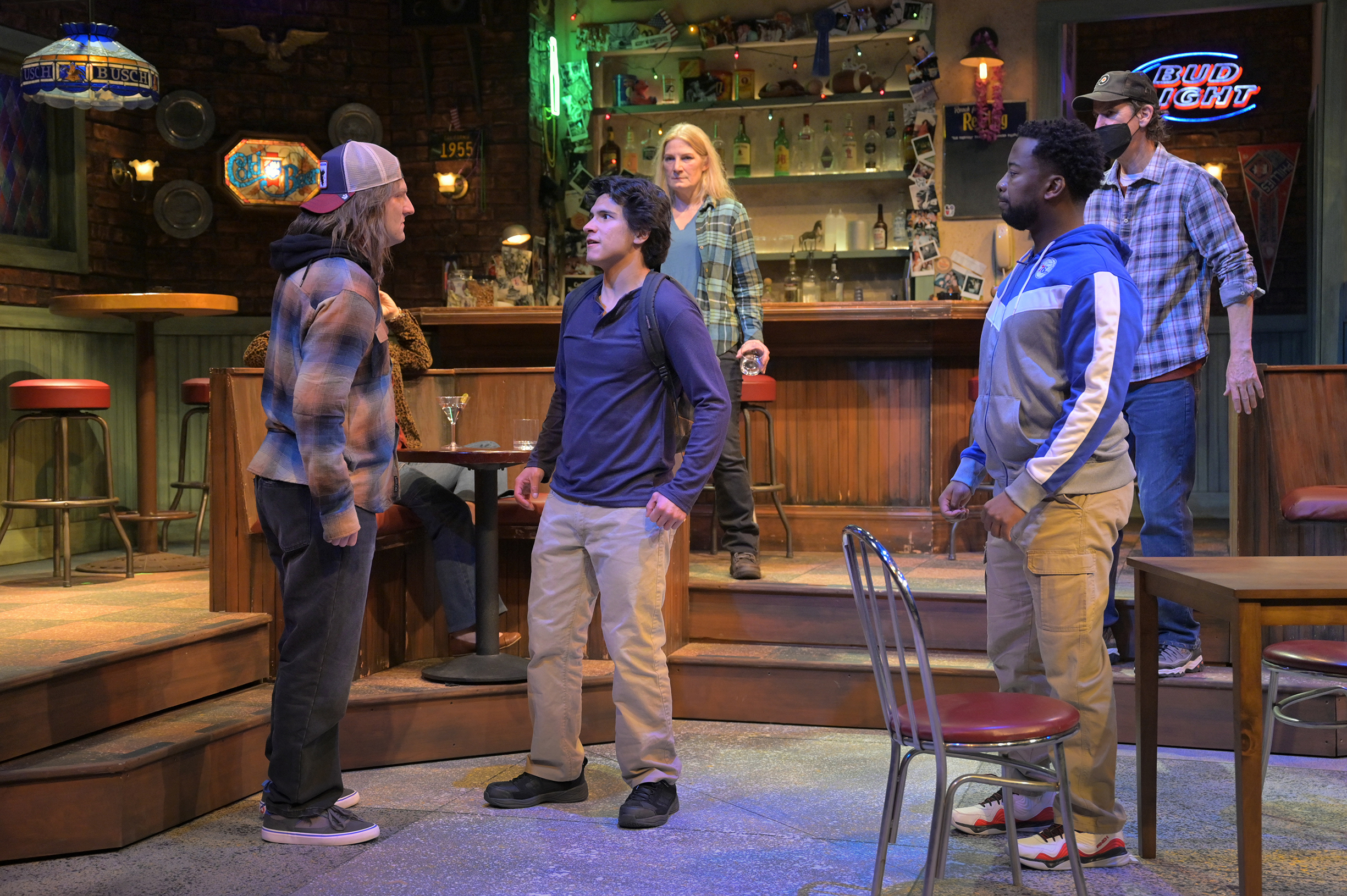
Center Rep production photo by Kevin Berne

 I feel like I never know what I'm going to get at Center Rep. I've seen some really good shows there, and then some others that feel much more like community theater productions. So I can't say I pay much attention to their offerings most of the time.

But this time it was a combination of a play I really liked several years ago at Ashland (pre-blogging, sorry!) and a couple of my friends being in the cast. So we had to go check it out.

The Play

I mentioned playwright Lynn Nottage in my recent write-up of her recent play, Clyde's. She's a great writer, and it was my first viewing of this play that really made me believe that. All the characters are quite richly developed and genuinely interesting. The situation is, too. The play takes place mostly in the year 2000, when things are looking pretty rosy unless you happen to live in the industrial northeast, such as Reading, PA, where Sweat is set. There it's a matter of working-class people trying to hold on to what they've had, but it's tough with NAFTA and similar policies.

Sweat takes place in a bar in Reading, where workers from a nearby steel plant come to blow off steam. Even the bartender is a former plant employee. Times are pretty good, and both Cynthia and Tracey are angling for a promotion. Their sons, Chris and Jason, are lifelong buddies who also work at the same plant. Things are pretty friendly until one of the women actually does get promoted, which leads to some friction, and then bad news at the plant causes things to fray even further. It becomes clear just how close everyone is to the edge, as tensions break through the facade of camaraderie and reveal simmering resentments and prejudices.

It's a clever story, very real-feeling, and bolstered with sound clips from contemporary politics and news. It was totally deserving of the Pulitzer Prize for Drama it won in 2017 (Nottage's second).

The Production

Luckily, this was one of Center Rep's better efforts. From top to bottom, it's a first-class production: great cast, design, and direction. The set is very nicely designed by Kelly James Tighe, and director Elizabeth Carter keeps all of the excellent actors on the same page to great effect. The performances are almost uniformly excellent, with particular kudos to Cathleen Riddley (Cynthia) and Lisa Anne Porter (Tracey), who really nail the friend/rival aspect of the relationship, with Porter particularly nuanced and relatable in a tough role. Eddie Ewell (Chris) and Adam KuveNiemann (Jason) also bring it home for the younger generation, doing a great job of portraying the lifelong friends who can't quite figure out why the world isn't turning out for them they way they expected, and how that impacts their friendship. And Robert Parsons is pitch-perfect in his portrayal of Stan the bartender, wisely observing from the sidelines after being disabled on the job after 28 years on the floor at the steel plant.

I could go on, but I think you get the point: this is a top-notch production all around.

The Bottom Line

My only issues with the production are really just nitpicking, and it doesn't deserve that. Even with some small things, the overall production was amazingly good. I wish I could wholeheartedly recommend that you go see it, but unfortunately we saw the closing performance, so it's done.

I will say that Sweat remains as powerful as when I first saw it at OSF in 2015. I believe there have been changes to the script since then (or certainly, there are aspects of it that I don't recall from that viewing), but it's very, very good. The writing is incredible, and the performance here was just terrific.

I will be paying closer attention to Center Rep henceforth. If they keep attracting this level of talent and put on shows this solid, it has a chance to be a much bigger part of the bay area theater scene, which is a good thing, given the struggles of some of the other, more established houses of late.


Tuesday, April 18, 2023

"Is God Is" at Oakland Theater Project


OTP production photo by Ben Krantz
We almost missed this show because we were out of the country, but friends convinced us to squeeze it into our schedule, and that's a good thing. It's a very interesting, intense play, and it features som really strong actors.

The Play

This is the Bay Area premiere of a show that has done well elsewhere, including Off Broadway and London's West End, so this is kind of a big deal for little Oakland Theater Project and their very intimate performance space. Aleshea Harris's script portrays twins, Racine and Anaia, who were badly burned and scarred as small children by a fire that killed their mother. Or so they thought, because the play opens with Racine revealing that she's had a letter from their mother, who is alive but dying, and wishes to see her daughters. So they hit the road to see her, learn the story of the fire, and receive a mission to seek vengeance on their father.

The play then follows them as they track down the father (including his new family) and come to grips with whether and how they can fulfill the quest given by their mother. The twins each have their own issues to deal with: Anaia is the more visibly scarred, as her face was terribly burned, making her more reclusive. Racine's injuries are to her back, shoulder, and arm, so it's easier for her to hide them. But she also has a much more aggressive outlook, so the two twins definitely don't see the world and their paths the same way.

It's an interesting and often intense script that involves questions about how and whether one can take control of one's life and its narrative, to shat degree one owes any allegiance to a parent who has been entirely absent from one's life, and to what lengths one will go to reach vengeance, and whether revenge can bring peace.

The Production

As noted earlier, OTP's performance space is tiny. I think it has about 60 seats, but it's basically a black box theater built in a small commercial garage. They do some pretty cool things with the space, but for this show in particular, set designer Karla Hargrave has created a backstage area, so the actual stage is quite small and surrounded on three sides by seats. So the show is very much in your face. There is no avoiding the scars on the twins and their mother, and any violent actions are right there. Director William Hodgson takes advantage of that to maximize the impact of the action scenes, but there are also a lot of tense moments between actions, and you can just see the thoughts behind the faces as the expressions change and characters wrestle with choices.

Particularly outstanding in the cast are the twins, played by two really outstanding local actors, Rolanda D. Bell (Anaia) and Jamella Cross (Racine). I've seen Bell in three very different roles over the last year, and she's been terrific in all three--very impressive range. Anthony Rollins-Mullins (Scotch/Man) is also quite impressive, particularly as "Man".

The Bottom Line

I thought the show was very powerful and intense. A friend with us who had seen the show previously in New York felt it was less effective in the up-close setting than it had been on a traditional stage. I can't speak to that, but I thought it was extremely effective here.

I don't really have a lot to add, since I can't get too specific about things without spoiling the show. But it was well worth seeing, both for the play and for some really good performances. The show runs through April 23rd, so there are still chances to catch it, and I would advise doing so if you can.

"The Triumph of Love" at Shotgun Players

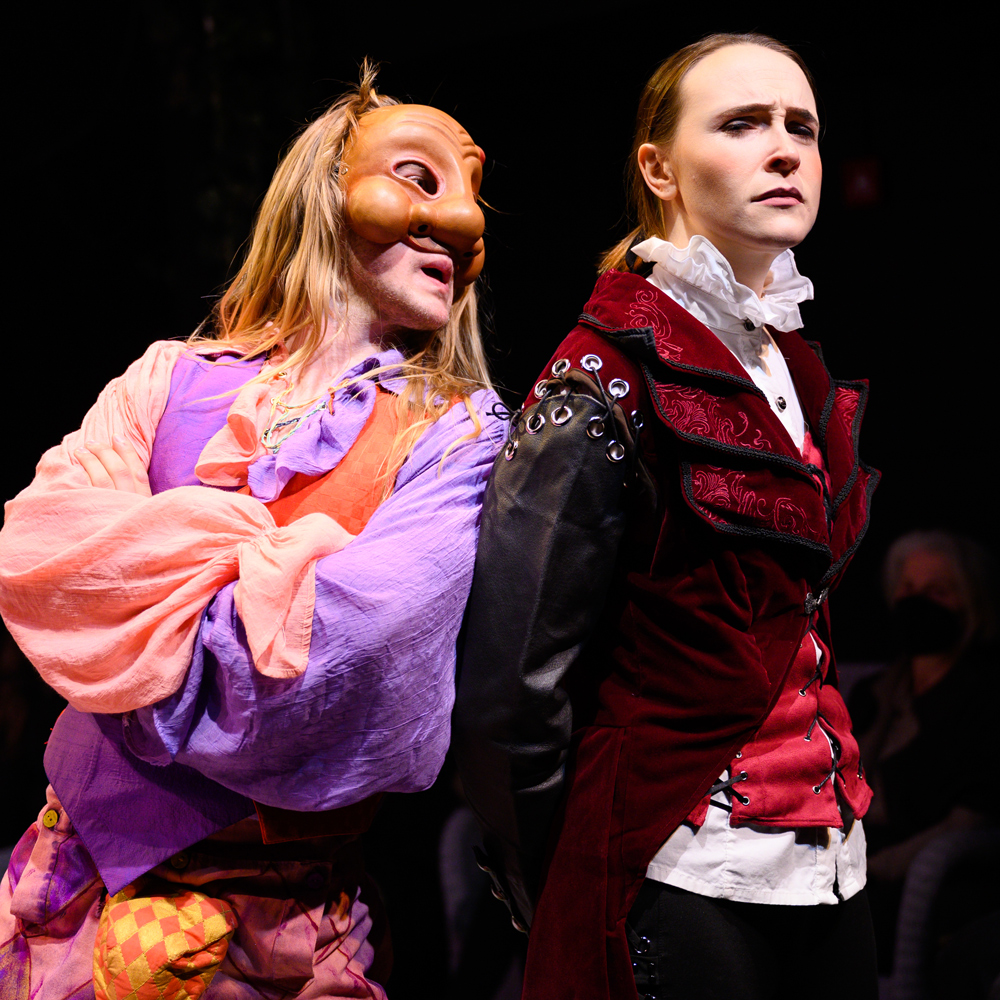
Shotgun Players production photo by Ben Krantz

 I wasn't sure what to think about this play going in. On one hand, Shotgun Artistic Director Patrick Dooley is very excited to be directing it, a friend tells me it's his favorite 18th-Century play, and when I read it, I was impressed with a lot of the word play, which is impressive for a translated work. On the other hand, I didn't feel like the play itself had a lot of substance. But it seemed like it ought to be fun, at least.

The Play

Pierre de Marivaux's script, translated by Stephen Wadsworth, is nothing if not complex. One might even call it convoluted. Princess Leonide, whose grandfather usurped the throne, has located the rightful heir to the throne, Agis, who is being raised and educated secretly by a reclusive philosopher, Hermocrate, and his equally reclusive sister, Leontine. Leonide decides to disguise herself (and her maid, Corine) as a man to gain access to Hermocrate's estate and get close to Agis. Things get complicated when Leonide falls in love with Agis from a distance, then decides to seduce both Hermocrate and Leontine to be allowed to stay. Add in Hermocrate's comical servants, Harlequin and Dimas, and there is much deception and co-option going on.

As love stories go, this one isn't terribly convincing--the whole thing takes place over a period of less than two days. But if you jut kind of go with the flow and enjoy the twists and turns and puns and malapropisms, it's a pretty fun ride.

The Production

As usual, Shotgun puts together a solid cast. Veronica Renner as Leonide has to carry a lot of the show, as that character (in one guise or another) is in nearly every scene, fast-talking and manipulating virtually everyone with layer upon layer of deception and misdirection. She handles it well, but at times she seems to lose her way, as she's so busy manipulating others that we kind of lose sight of the point of the story and who she really is.

The supporting cast is good. David Boyll and Mary Ann Rodgers, as Hermocrate and Leontine respectively, make good, stoic foils for Leonide's inventions. The servants are quite good, notably Jamin Jollo as the masked, acrobatic Harlequin and Wayne Wong as the tongue-twisting Dimas. The whole play takes place in Hermocrate's garden, designed beautifully by Malcolm Rodgers, with on-stage seats that let the actors interact a bit with the audience to good comic effect. All in all, it's a pleasing and fun performance.

The Bottom Line

I liked it. I don't love it, but I appreciate that it's a complex and difficult piece that sort of hints at having more depth to the story than is obvious at first glance. But ultimately it kind of reminds me of how my mother described her least-favorite Shakespearean comedy, which she noted was extremely aptly named: Much Ado About Nothing. Here, too, there is a great deal of convoluted plotting, and that's fun to watch and unravel, but ultimately that's in service of a fairly minor plot goal.

Still, it's a fun play and the performances are good. It's worth seeing, and it has been extended to run through April 30th.


Friday, March 17, 2023

"Cambodian Rock Band" at Berkeley Rep

Berkeley Rep production photo by Lynn Lane

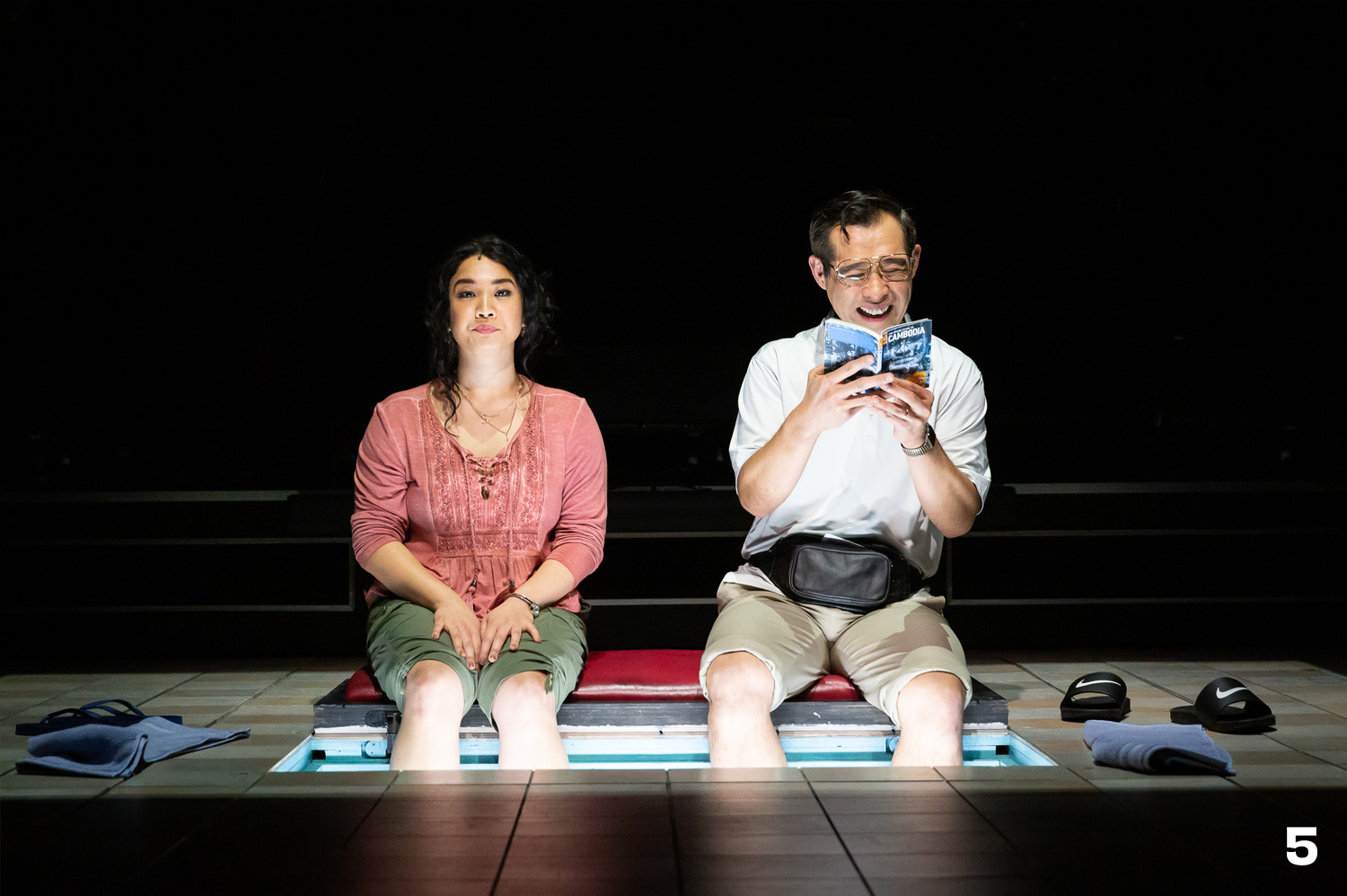
 Stop me if you've heard this one before: This is a show we saw in Ashland in 2019 (and really liked), so were looking forward to seeing it again in the Bay Area. Cambodian Rock Band is also by a local playwright, Lauren Yee, whose work we have seen at several theaters recently. So that all seems promising. Berkeley Rep has landed a number of shows from Ashland over the years, and this one was also workshopped at Berkeley Rep's Ground Floor program, so there is a lot of local history here.

The Play

There are sort of two parallel stories going in this play: one is the story of The Cyclos,  a rock band in Cambodia, disrupted by the arrival of the Khmer Rouge in 1975; the other the story of a Cambodian-American lawyer working in 2008 to prosecute one of the most notorious members of the Khmer Rouge for crimes against humanity.

Needless to say, any play that touches on the Khmer Rouge period in Cambodian history is going to be a bit grim, and this play doesn't shy away from that. It's a bit difficult to describe the intersections of the two story lines without a few spoilers. Let's just say artists and musicians didn't fare well under the Khmer Rouge regime, and trying to survive under a repressive regime can lead to extremely painful personal choices.

The Production

Also needless to say, there is a fairly limited number of actors who can also play instruments and sing and speak convincingly in Khmer, the language of Cambodia. So I shouldn't have been surprised when I recognized several actors from the 2019 OSF production. In fact, four of the six cast members were in that production (though we only saw three, as there was an understudy for the fourth).

In fact, the only change that makes a substantive difference in the play is the casting of local actor Francis Jue as Duch. Jue is a terrific actor, but his portrayal of Duch is rather odd, tending into a sort of playful prancing that diminishes the underlying threat he represents. I felt like this choice undercut the effectiveness of that character.

Joe Ngo shines in his portrayal of Chum (a role he originated, and has played in multiple productions). Moses Villarama, though, seems a bit bored with playing Ted/Leng. As much versatility as Ngo displays, Villarama seems to play all his roles as if they are the same. But overall the cast keeps the energy pretty high, the music is good, and the message of the play comes through clearly.

Bottom Line

I'm sort of torn: I think it's mostly a very effective production of a very good, very difficult play. On the other hand, it really feels like basically the same show we saw in Ashland. I kind of expected that there might have been some new development or some new takes from a different cast and director. But it's literally the same director, most of the same designers and musicians, and nearly the same cast.

So if you haven't seen it before, I'd say it's well worth seeing. If you've seen it elsewhere, there isn't really much new here. But the show runs through April 2nd, so you have more chances.

"King Lear" at Shakespeare Theatre Company


Shakespeare Theatre Company production photo by DJ Corey Photography
After not going to DC (or seeing any theater in DC) for many years, it seems a bit odd that we returned for our third trip in less than four months, but this was actually the first of the trips we planned, specifically so we could see this one play. Why seek out Yet Another King Lear? Specifically because of the actor playing Lear, Broadway star Patrick Page, who also happens to be a college friend of my wife's. We've seen him perform before (most recently in Hadestown on Broadway), but this seemed to be an ideal match between actor and role.

The Play

I don't need to spell this out. It's Shakespeare's King Lear. They've trimmed it down to only about two hours total, which should be fine, though I think it led to a couple of issues I'll touch on in the next section. Suffice it to say that it's a great play, and one that generally lives or dies by the actor playing the lead role. Lear has a really high percentage of the lines in the play, and even more so in this cut of the script. So this is very much Patrick Page's show.

The Production

This is the same, fairly small, theater where we saw Jane Anger last December, so it's a pretty intimate setting for a Shakespeare play. But that intimacy is great when it gives you a chance to see an actor like Page up close. What a treat! Page is a wonderfully nuanced actor, and watching his Lear descend into madness, fighting it all the way, is a wonder to behold. His interplay with his Fool (Michael Milligan) was just a delight. Probably the best choice made in the production was to have the Fool play his role quite straight, with almost no clowning. As the wise a restrained one, he emphasizes to Lear and the audience just how dramatically Lear declines.

Probably the other key role in the production is Matthew J. Harris as Edgar (and Poor Tom). Again showing restraint, Director Simon Godwin keeps Edgar/Tom in control, despite the machinations of his bastard brother Edmund (Julian Elijah Martinez). Craig Wallace does a good job as their father, Gloucester, who along with Kent (Shirine Babb) manages to be about the only character who stays true to himself (or anyone else), not that it does him any good.

My main issue with the choices made in the production come with the daughters (who after all are the point of conflict in the script). Between casting, costuming, and some script editing, we know from the outset that Goneril (Rosa Gilmore) and Regan (Stephanie Jean Lane) are very femme, highly sexualized, characters who are united in their opposition to both Lear and Cordelia (Cailen Fu), who never gets a chance to demonstrate the reasons why she was supposedly Lear's favorite. At least with Edmund we get to hear why he is behaving the way he is, though his shifting allegiances come across less as plans and opportunism (as I read the script) and more as kind of stumbling from one chance to another. Ultimately the only motivations left to Goneril, Regan, and Edmund are greed and kinky lust, which cheapens their part of the story considerably. I'm not sure how that sort of misogyny still creeps into a modern adaptation of this play.

The modern setting, other than the weird kinks of the daughters, works quite well. It's kind of a mystery how the one female character who initially shows any agency or power (Kent) got that, and why she then disguises herself as a man for the remainder of the play. It just feels like the gender politics of this ficton weren't thought through very completely.

Bottom Line

As I noted up front, however, a production of King Lear rests on the titular character, and Patrick Page is more than capable of carrying the show on his shoulders. Between his booming voice and his physical virtuosity, he dominates the stage as Lear ought. There is enough strength in his supporting cast to make it work, but Page's voice and body carry the show.

It's fascinating. Weird at times, but fascinating. And well worth the chance to see a master craftsman doing great work, up close.

The show has been extended through April 16th. I suspect it could go even longer if they can keep the cast together. For all the flaws in the direction of the show, the artistry of the key characters still shines through. It's a really good evening of theater. Go see it for yourself.

Saturday, March 4, 2023

"Getting There" at New Conservatory Theatre Center


NCTC production photo by Lois Tema
I don't often get to shows at NCTC, despite the fact that I used to work in the neighborhood. They seem to fly under my radar a lot, though I have quite enjoyed several shows we have seen there. One that didn't get mentioned on this blog (since I was on hiatus at the time) was their production of Head Over Heels in 2019. It was fun and very approachable. This play was also under my radar, but we got invited, so we went.

The Play

Getting There is a world premiere of a commissioned work by Dipika Guha. I have to admit it feels a bit rough at times, despite the fact that we were seeing the closing performance of the run. So I suspect those are actual holes in the script, not so much issues with the production.

Part of the issue is structural: the play eschews a linear timeline, opting to bounce among flashbacks and the present time. It's only covering a few days total, so it's unclear that there is really all that much to be gained by yanking the audience around, in ways that are indicated mostly by projections that aren't all that obvious to the viewer. I'm still not sure I caught all of the guideposts. Mostly these devices seem to be an effort to hide the (very quickly revealed, anyway) relationships among the characters. There are no big surprises there--I suspect the overall structure of the play would be enhanced by just writing the timeline straight.

There are only five characters in the play, although because of the structure of the play, it's unclear that's what we're dealing with, at least at first. The play initially seems more like a series of vignettes, though eventually we realize the actors are playing consistent characters throughout. Julie and Kai are American tourists in Paris. Julie meets a distraught Ira while Kai is off doing...something. Kai gets picked up by Radha, while Anissa is waiting for her at the train station. Radha and Anissa turn out to be married. Ira is Anissa's daughter. Julie has inexplicable feelings for Kai, who is supposed to be marrying someone else when she's not being picked up by older French women.

It's more coherent than my description makes it sound, but at the same time, the convolutions seem rather contrived and for limited reasons. Ultimately, most of the characters make a fair amount of sense, but Kai never does (to me, anyway).

The Production

It's a pretty sparse production, in NCTC's smaller theater space. Pretty much just a black box with a couple of benches and some curtains, with a few items on the walls. I kind of wished the cast had been allowed to just leave things in place, rather than rearranging the few pieces between scenes, but that seems to be director Nailah Harper-Malveaux's preference. Similarly, we have characters leave the stage by ducking behind a diaphanous curtain, so they're still quite visible to us, but apparently not to the other characters.

Most of the acting is quite good. The French characters in particular (Laura Domingo as Ira, Simone Bloch as Anissa, and Desiree M. Rogers as Radha) all feel well-rounded and coherent. Lauren Andrei Garcia as Julie is fine, if constantly exasperated (not sure that's entirely justified by the script--I'd like to have seen a little more range). Leigh M. Marshall as Kai is a kind of a nebulous cypher. She seems to wander aimlessly through life, evincing privilege and seeming utter lack of curiosity or engagement with others. There is absolutely no indication of why Julie is attracted to her at all--nothing we see in the play has Kai showing anything other than neglect or disregard for her. The script doesn't help here, but I would have hoped someone would have at least tried to add some relating to the relationship.

Anyway, the cast does pretty well with the thin script they're given. The relationship between Anissa and Radha has the core of something interesting to it, and their relationship to Ira has promise.

Bottom Line

This doesn't feel like a completed play: more like a draft that got put on stage before it was ready. That said, NCTC has done a pretty good job of staging it, but the difficulties with the script make it hard to take away much from the play overall.

I probably wouldn't recommend it very highly, but since it was the last show of the run, my recommendation wouldn't mean much anyway. There is the core of something in the play, and the production was good. I just wish they had fleshed out the story a bit more before putting it on stage.


"The Headlands" at ACT


ACT production photo by Kevin Berne
I always look forward to new work from Christopher Chen, a local playwright (and graduate of UC Berkeley--Go Bears!) who always writes complex works that misdirect and play with audience expectations. I was especially keen to see his new play, The Headlands, because it is set in San Francisco, which is always a treat.

The Play

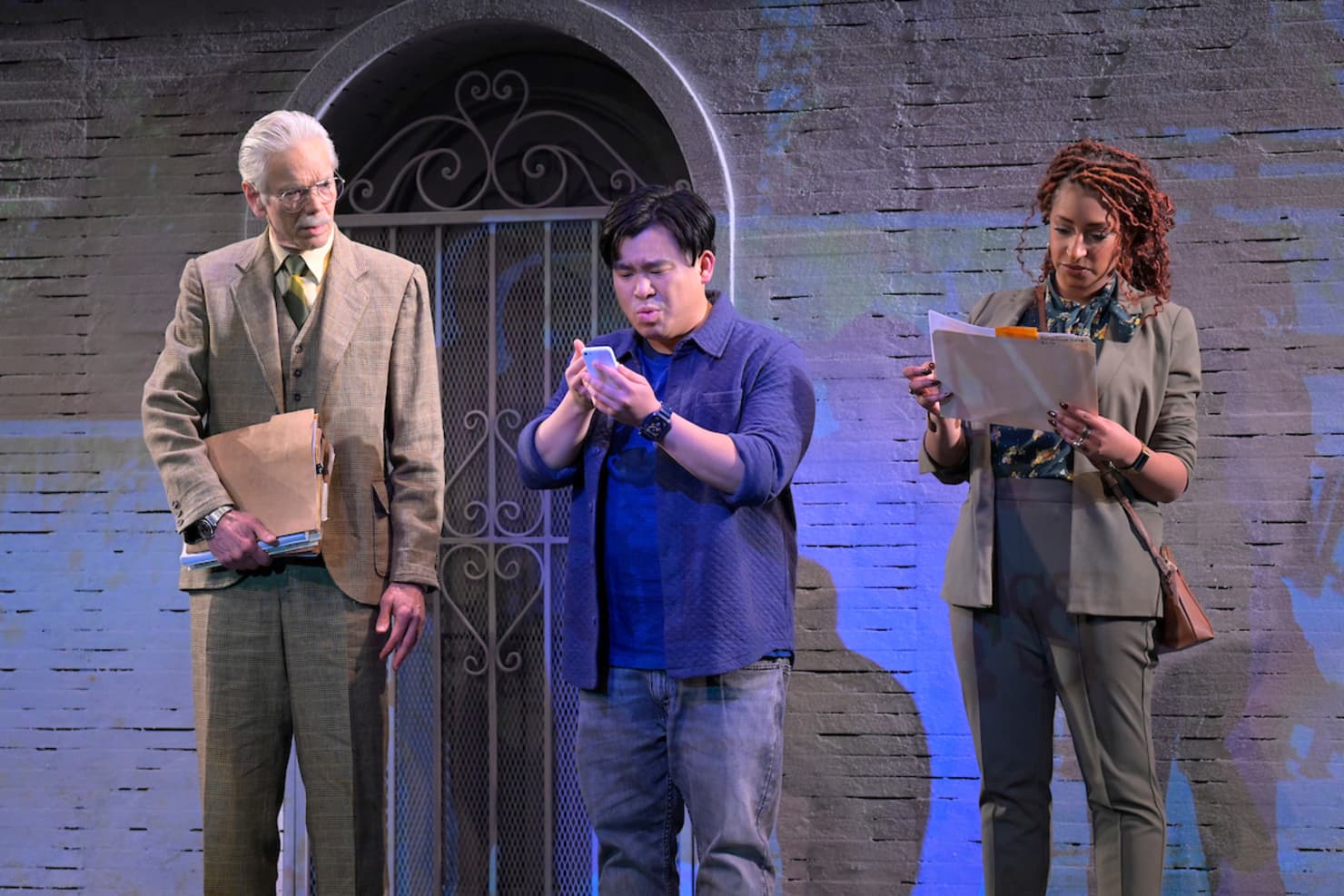
The Headlands starts out breaking the fourth wall, with the central character, Henry, addressing the audience directly and telling us about his hobby, investigating unsolved crimes. His current obsession is the unsolved death (murder?) of his own father, George, an immigrant from China who married Leena, a third-generation Chinese American whose family is very successful and assimilated. He often involves his girlfriend, Jess, in the investigation.

As the investigation turns up new information, Henry constantly pivots his view of the mystery, and also of his family's story. The twists are less abrupt than those in some of Chen's earlier works, such as Caught or You Mean to Do Me Harm, but the overall effect of constantly-shifting directions is typical of Chen's work.

The story comes to a head with the introduction of the mysterious character Tom, remembered from Henry's youth as an unknown and strange presence, who turns out to play a key role in the mystery.

Ultimately the story is less successful as a noir whodunit than it is as an exploration of the vagaries of memory and the stories families tell about themselves, but it's an interesting and engrossing yarn.

The Production

First off, solid local cast. Phil Wong as Henry is excellent. I've enjoyed his work for several years, but mostly in supporting roles. It's nice to see him in a central role. Sam Jackson as Jess is outstanding as always. Erin Mei-Ling Stuart is strong as Leena (as is Keiko Shimosato Carreiro as the older Leena and also her best friend, Pat). And Johnny M. Wu as the stoic George is terrific throughout. Tom (normally played by Jomar Tagatac, but understudied in our performance by Alex Hsu) was the only kind of miss, as the actor seemed too old for the role and not terribly comfortable in it. Charles Shaw Robinson does a wonderful, humorous turn as an aging SF detective.

The set design by Alexander V. Nichols seems simple at times, but like the plot of the play it has some very intricate aspects. I'm not generally a huge fan of revolving set pieces, but I will admit that this set mostly uses it effectively. Director Pan MacKinnon keeps the action moving nicely; I think this is the best work I've seen from her since she joined ACT.

Bottom Line

I enjoyed the play. I wouldn't say it's Chen's best work, but it does represent an advance for him, in that the plot replies less on just changing circumstances and revelations for its interest, and more on the development of characters and investigation of their thoughts and feelings.

I'm pleased to see ACT producing and supporting local work with local actors. For too long they have relied on bringing in material and performers from out of the area, which has really hurt both the theater and the local theater scene. I hope this represents a return to a more local focus.

Overall, it's an encouraging part of this season. I look forward to seeing what comes next. The Headlands runs through tomorrow (March 5th) at ACT's Toni Rembe Theatre (formerly the Geary).