Wednesday, December 14, 2016

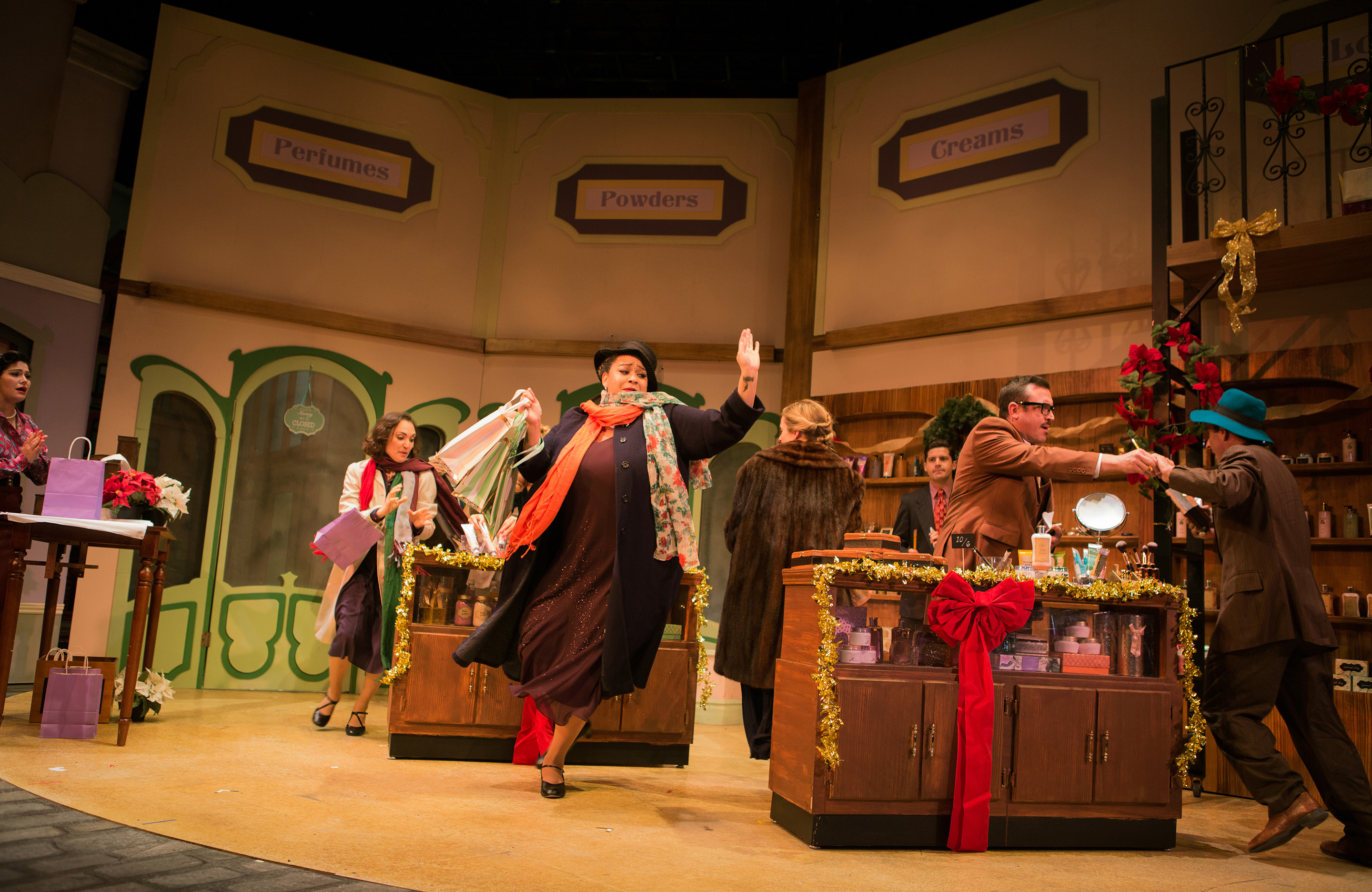
"She Loves Me" at SF Playhouse

SF Playhouse photo by Jessica Palopoli
Yes, it's the holidays, which means not only am I going to the theater again, but I'm too busy to remember to blog about it! I feel a little like the frantic shoppers in the parfumerie pictured above, but I'll try to catch up.

SF Playhouse ("the empathy gym") does a couple of musicals as part of their mainstage season every year. This one is a revival of a play written in the early sixties, though set in Hungary in 1937. The play has some serious writers behind it, with the book by Joe Masteroff (better known for "Cabaret") and music and lyrics, respectively, by Jerry Bock and Sheldon Harnick (better known for "Fiddler on the Roof," written the very next year). And it had a successful revival on Broadway last year.

The Play

Top that off with a story line that seems terribly familiar, as the original Hungarian play by Miklos Laszlo has been adapted into at least three American movies (most recently, "You've Got Mail"), as well as this musical. It's a love story about a couple of coworkers who don't realize they are in love (or that they are correspondents through a "lonely hearts" club). Plenty of misunderstandings, but eventually it all works out (because this is Broadway in the 1960s).

It's a cute, if somewhat fluffy play. I like a lot of the supporting characters, and several of the tunes are pretty catchy. I ended up liking it pretty well, and it was well done (as I'll elaborate below), but there are a couple of issues I have with the play itself.

First is that there seems to be kind of an underlying bit of cruelty. The two main characters aren't equally clueless about their situation. Georg catches on sooner, but some of his treatment of Amalia before things settle down is just not very nice, and it really colors my view of the whole story. I guess my "empathy gym" lesson here is that some characters don't display much empathy.

Second is that I just don't get much "sizzle" between the lead characters. Maybe they were just a little low on energy the evening we saw the show (Wednesday, 12/7), but there just weren't any sparks when they were interacting; it was hard to see in person any of the attraction they were displaying in the letters they wrote and their reactions to them.

And third, the "happy ending" happens so fast, you could almost miss it. There's kind of a quick realization, a little kiss, and they walk off the stage and the lights dim. That's not much of a payoff at the end of the whole play. I blame this on the book: there's just no more play for the company to play with, but it definitely feels like a let-down.

The Production

First a note on the set, because I have occasionally been a little critical of Playhouse's use of their turntable on the stage. Artistic Director Bill English and set designer Jacquelyn Scott share the scenic design credit, and I have to say it's by far the best use of the rotating set I've seen in this theater. No gimmicks, just a handy way to switch between scenes on the street outside the shop and interiors. That was really well done. The scenery itself didn't seem quite as well executed as it was designed--some of its flimsiness was apparent from the back of the audience, but overall the scenery and props were nice.

Performances were all fine, with a couple standing out. Michael Gene Sullivan as Mr. Maraczek was a bit over the top at times, but then settled into a fine and nuanced rendition of his character after the intermission. His physical presence and facial work were a real highlight of the show in the second half. Nanci Zoppi as Ilona kept the energy high, but believable. And Joe Estlack stood out in both of his supporting roles. Katrina Lauren McGraw stood out from the rest of the ensemble, bringing a tangible personality to all her shop customers. Unfortunately, as noted earlier, Jeffrey Brian Adams as Georg and Monique Hafen as Amalia just didn't light it up that night. I've seen both of them in other productions, both have terrific voices and the ability to act, but I just didn't get much feel for either character, much less for the pairing. And in a love story, that's a bit of a problem.

Bottom Line

It was fine, it was fun, it just didn't grab me as much as I thought it should have. I mean, nice designs, good music, talented cast, etc. All the pieces seemed to be there, but somehow the end product wasn't as much fun as it seemed it might have been.

The show has a good long run yet, through January 14, so perhaps it will come together. In the meantime, it does provide a pleasant alternative to yet another Nutcracker or Christmas Carol, and as long as you're willing to overlook the weakness of the central plot device, there are lots of fun bits, lines, scenes, and performances to enjoy.

Thursday, December 1, 2016

"Safe House" at Aurora Theatre Company

Aurora Theatre Company photo by David Allen
It was a busy month of November. Lots of work, lots of commitments, and almost no trips to the theater for me! Between travel and holidays and work, I've barely had time to think about the blog, either. But even as holiday madness descends on us, several theater items have sneaked onto my calendar, so there will be postings!

This week we dipped our toes back into the theater with a trip to see "Safe House" at Aurora. As a first-year subscriber at Aurora, I've been looking forward to seeing what's on offer regularly. In the past I've only attended sporadically, and for plays I was pretty sure I would like. It's an interesting little theater, with rather intimate seating around a 3/4-thrust stage that isn't very large. So you get a really close view of the action.

I've been consistently impressed with the stagecraft at Aurora: considering how little space they have to work with, they get a lot out of set design and lighting. As you can see from the photo above, Kate Boyd's scenic design transformed the stage into an 1843 Kentucky house quite effectively, and Jon Tracy's lighting design nicely managed shifts between the house and its associated shed as well as some other adjustments.

But when you're up close, it's the players that matter. There is no place for them to hide on the little stage from an audience that is no more than 4-5 rows away. Well, OK, the play is important, too. Let's start there.

The Play

This production is the West Coast premiere of a historical play by Keith Josef Adkins. Set in Kentucky in 1843, it features a family of free-born African-Americans trying to move up in the world making and selling shoes. The setting, at least, is loosely based on some of Adkins' own family history. I found it interesting to follow as it examined the interactions of the free blacks with both the white majority and enslaved blacks. It's clear where they want to associate, but much less clear that they can fit in there.

This particularly struck me after some recent reading I'd done on the history of racism and "whiteness" in America, particularly how wealthy whites had (and have) used race to keep poor whites and blacks from uniting against them. In this play we see the free-born Pedigrew family, which is kind of on legal probation for having assisted escaped slaves, involved in an uneasy dance with the unseen (white) sheriff and his avatar, deputy Bracken (Cassidy Brown). It's complicated, because Bracken is actually friendly with the Pedigrews, having been a childhood playmate of Dorcas (Dawn L. Troupe).

So the play fairly neatly encapsulates the tensions along both race and class lines. Now add upwardly-aspiring shoemaker Addison (David Everett Moore) and his rebellious brother Frank (Lance Gardner) to the mix. Addison needs everyone to play along with the sheriff's restrictions in hopes that he can become a successful businessman, accepted by the whites. Frank chafes at the restrictions, and wants to exercise his rights as a free man. The fact that virtually all the other free blacks have been forced out of the county after the most recent fugitive slave incident is highlighted by the brothers' competition over the one remaining eligible free black woman, Clarissa (Dezi Soley). And finally, things come to a head when escaped slave Roxie (Jamella Cross) appears on the scene.

The Players

As noted, the Aurora stage really puts a premium on the actors, because you can see every nuance of their performance. Here I thought Troupe and Gardner excelled in particular. Troupe's Dorcas is very tightly controlled, and you can read all the strain on her face and in subtle body movements, all of which would probably be lost in a larger space. Gardner's frustrated young man is brought out in a number of ways, and I was much more impressed with him as an actor up close than I had been in the last several plays I saw him in (the whole last season at CalShakes, plus "Proof" at Theater Works Silicon Valley). Moore's Addison needs to carry a lot of the show, but in some ways he has the least to work with. He does a fine and powerful job with it, but his character as written is probably the thinnest.

But the performances overall are strong, with the four main characters all interacting well and establishing solid characters.

The Summation

I felt the play did a good job of setting out the "Catch-22" bind that free blacks found themselves in during (and after) slavery. The writing drags a bit in parts, with Addison's character in particular getting a bit repetitious on his one note. Perhaps some judicious editing would help. But for the most part director L. Peter Callender keeps things moving pretty well. The plot has enough twists and turns to keep things interesting most of the time.

Overall, I think the production was first-rate, probably better than the play itself (and the play isn't bad). This was probably one of the more evenly balanced productions I've seen at Aurora, with the acting quality up to the standards set by the designs.

Wednesday, November 2, 2016

"weird sisters: macbeth" at Shotgun Players

Monday night: Theaters are (mostly) dark.

Halloween: People dress up and tell scary stories.

Halloween falls on a Monday? Best put together a theater workshop that's a little dark and scary!

And that's just what happened at the Ashby Stage this week, as Shotgun company member Nick Medina put on a workshop of an adaptation of Shakespeare's Scottish Play with only three actors (all of whom have worked quite a bit at Shotgun: Siobhan Doherty, Caitlyn Louchard, and Kenny Toll). It's a heavily condensed version of Macbeth, and the house was very nearly full.

The Adaptation

We start with the three "weird sisters," often known as witches. They chant and make their potion, and one drinks, convulses, passes out, and then recovers as...Macbeth. From here the characters are pretty fluid, though you can tell when it's Macbeth or Banquo speaking, though sometimes there is a chorus of witches, and sometimes an actor switches back and forth between character or witch. It's really quite compelling, as it emphasizes the "weirdness" of it all. Did we really see them? Do I believe what I think they said? What of all these prophecies? Or is it just the witches acting out a story for us? Lots of weird possibilities.

For the first 45 minutes or so, this works really well. We're invited into this sort of surreal world in which the players can't quite believe that things are happening, but they seem to be working out, so maybe it's OK. It's definitely kind of an immersive Macbeth experience for all of us, whether watching or participating.

A number of the scenes are memorized, which is nice, but for much of the play, the actors are holding scripts. That's fine, though they start tearing off pages and tossing them about, which seems to work for a while. Sometime they'll crumple and toss a particularly difficult speech or something, which serves to give a little depth to the characters' feelings, but the device gets a bit old (and the stage littered with paper becomes a bit treacherous to navigate).

Eventually we're all lost in the dark, but along come flashlights to hold under faces, which seems just a bit trite for this "weird" production. Not sure what else I would have done, but self-illumination by flashlight doesn't feel quite right here.

The Problem

For the most part we're all still on board with the whole process until about the time the porter comes in. At this point, we're mostly done with the "weird" intrusions, and we mostly have just three actors trying to juggle the somewhat larger cast of characters. We get Russian nesting dolls for dinner guests and plush toys for Macduff's family.  The whole staging becomes a lot less fluid and immersive and mostly becomes confusing. If you're not already fairly familiar with the text, it is probably pretty difficult to follow just who is saying what. Not so much in the way that earlier you might be hearing the character, or you might be hearing the voice of a witch, ping-ponging the lines such that you aren't sure whether it's dialogue, internal monologue, possession, or what. That's cool. But farther on it's more a case of "who is this talking, and why?" We catch up, but it's very different.

I haven't sorted out in my head whether this represents and intentional shift in the staging, or merely a point where the crew hasn't quite worked out yet how to continue in the original vein. We go from a very interesting, rather riveting sort of metatheatrical ride into something much more conventional, but confusing because of its necessary complexity.

Truth be told, the story itself is getting a little weird again, especially when we come back for a fresh round of prophecy. But by then we're no longer in the realm of spirits who might or might not be there. Now the sisters seem to be more like just some more characters for the cast to juggle. I'd like to see whether they could continue as the thread pulling the whole story along.

The Analysis

After such a long and varied week of theater (and a fairly stressful day at work), it's possible I wasn't in the best state of mind to evaluate this production. That said, at least the first half or so of the play really seemed promising. I was enjoying the interactions of the actors, their characters, and the witches. Talking to my friends and family, we seem to agree that midway things kind of changed course, and were definitely less clear and less compelling. We all managed to stick it out and sort through things to the conclusion, but somehow it didn't feel like the weird sisters who opened the show were still there at the end.

All in all, I thought it was a really interesting approach to the play. I really liked the way scene flowed into scene, as character flowed into character. It seemed totally plausible that a rather complete version of the play could just fit itself into 90 minutes, and perhaps with more work, this adaptation could get there. As it was, it felt like a lot of the audience fell off the bandwagon during the second half.

I thought the actors were terrific, particularly so in the scenes where they were able to work without scripts. I would have been happier if they hadn't ended up wading through a sea of discarded pages, though. I suppose there could be some kind of symbolic importance to the rising tide of chaos that is indeed enveloping the characters, but I think there might be a better way to get that message across.

By the end, I'm thinking there has to be a reason for all this. I'm unclear, though, what the position of the director/adapter is. Were the witches really running things? Were they just manifestations of the inner desires of the characters? I had hoped that somewhere in the late stages there would be some kind of clue as to what direction they wanted me to go, but all I was left with was a lot of questions. I suppose that might have been the point all along, that weird stories raise questions, not answer them.

In any case, it was a fun way to spend the evening. Certainly better than sitting at home waiting for some weird children to wander by. If it had been sold as a finished product, I would probably have been disappointed, but as a workshop of a work in progress (and early progress at that), I thought it quite fun, and it was nice to see so many people show up to share that.

Sunday, October 30, 2016

"The Rocky Horror Show" at Ray of Light Theatre

OK, let's start with this: I'm not a huge fan of Rocky Horror. I've seen the movie twice. Once in high school, a midnight show at the UC Theater when it was still a wonderful repertory cinema. Once with some friends in a suburban Maryland mall. It was fun both times, but not so much fun that I wanted to do it regularly. I realize that for many of my friends, regular attendance was a big part of their lives.

But I had never seen the stage show. In fact, I didn't even realize that there was a stage show, on which the movie was based, until a friend mentioned at some point that she had been in a production of it while in college.

Now, fast-forward to 2016, and my daughter's teen musical theater class through Berkeley Rep School of Theatre is doing scene study from "The Rocky Horror Show." She's seen the movie. She's learning the songs. And now I suddenly realize that three different local theaters are putting on productions of the stage show, right around Halloween. And we were kind of looking for something to do after seeing the matinee of "The Hard Problem" at ACT on Saturday afternoon, so what makes more sense that "Rocky Horror" in the Mission?

The Play

Seriously? I'm not going to summarize, even a little bit. If you don't know the show already, I don't think I could possibly make sense of it. It's less of a show than a cultural phenomenon. On one hand, I don't think the shock value the show had when it came out 40 years ago carries over. The whole fluid, pan-sexual, cross-dressing, gender-bending thing is pretty mainstream, at least in the Bay Area. Indeed, the real challenge is kind of the same one faced when producing any familiar, (dare I say) classic play: everyone knows it, they have expectations. You have to meet those expectations on some level, and yet you also have to do something fresh or it gets tired. You end up with Yet Another Christmas Carol or something.

This Production

I gather this play is something of an annual event for Ray of Light Theatre, a company of which I was not aware until now. Of course, if you need drag performers, San Francisco is an excellent place to look. And indeed, from the top of the bill down, you find experienced drag performers. The lead role, Dr. Frank-N-Furter, is played by D'Arcy Drollinger, who is not only an experienced drag performer, but also the proprietor of  a cabaret nightclub, Oasis. Many of the other performers are regulars there. So not only is this not your average community theater putting on a show, but they do it every year, so there is experience and continuity.

Anyway, I didn't know any of this. I came in with my expectations pretty low. The venue is the Victoria Theatre, which appears to be a converted movie theater, but it's a pretty nice house with a good sized stage, though the proscenium arch is a bit intrusive to those sitting on the side and up front, as we were. On the other hand, we had an excellent view of the sign-language interpreters, who were hilarious. The visible props (and the scenery, once the curtain opened) were a little cheesy, but then, this is Rocky Horror: just go with it.

And then the show started. From the opening moment, I was stunned by the quality of the performance. Melinda Camparo as the Usherette sings the opening number ("Science Fiction Double Feature") extremely well. And when Magenta (Andrea Dennison-Laufter) and Columbia (Alexandra Feifers) join her, it's clear that this is not your average musical ensemble. They're expressive and making contact with the audience, singing and dancing strongly.

And frankly, that's the story of the show: there really are no weak spots in the cast. They all sing and dance well. They act their parts well, even when they are background "phantoms." The choreography is pretty intricate, but well executed. So color me surprised: I enjoyed the show, and eventually decided the initial impression of cheesiness was intentional, true to the 1950s B-movie sci-fi origins of the plot. It worked.

Bottom Line

It was terrific. I didn't expect much, and I was blown away by the quality of the show. Good acting, singing, dancing, choreography, costumes. And perhaps best of all, the focus is on the show. Sure, there are some bits where the audience gets a little involved, particularly when the narrator (Steven Hess) is working. But it's nothing like the movie with a whole side show and incessant interruption from the crowd. It might have been different at the later (11 pm) show, but at our 7 pm show, there were a few clever lines and a little bit of interjection from the audience, but mostly we could enjoy the show, do the Time Warp, and just enjoy.

So I guess I have to re-evaluate my position on "Rocky Horror" in general. I would say this stage show was much more fun than either of the times I saw the movie, and from the description, more fun than my family members had at a recent midnight viewing in Albany.

One last note that I appreciated: the cast is quite diverse, gender-balanced, etc. But what I really appreciated is that not everyone was a tall, skinny dancer. There were all sorts of body types represented in the cast, and I thought that was really refreshing.

The show runs through November 5th this year. Check it out! You could do much worse than an evening with dinner in the Mission and seeing this show.

Saturday, October 29, 2016

"The Hard Problem" at ACT

[I wanted to include a production photo, but at this date, ACT has none on their website. Go figure. Too bad: It's a nice looking production.]

Let's get this out of the way right up front: Tom Stoppard is probably my favorite playwright. Full stop. My wife and I are known to go to fairly extraordinary lengths to see his plays, including trips to London and New York City. And it was our love of Stoppard that got us involved with the Shotgun Players when they undertook to produce his trilogy, "The Coast of Utopia."

Stoppard's most recent play, "The Hard Problem," was in fact the reason for our trip to London last year, although I have to admit it ended up not being the highlight of the trip. This play is not, despite the press quote on the ACT website, "Stoppard at his best." It has many of the things I love and admire in a Stoppard play, including deep ideas, playful debate, clever word play, and a respect for both sides in an argument. His plays will make you think, about important matters, while laughing at the wit and humor. His best plays will also leave you with a memorable character or scene or line (or many, of course). But truthfully, that's not this play.

This Play

The eponymous "hard problem" in this play is consciousness: how does the physical mechanism of the brain produce the conscious phenomenon of the mind? Hilary is an undergraduate in Psychology, interested in the concept of altruism and where it comes from. Her tutor, "Spike," poo-poos such notions, claiming that everything can be explained by science and especially evolutionary biology, with arguments that draw heavily from works such as Richard Dawkins's "The Selfish Gene" and its ilk.

Hilary goes on to apply for a job at a neuroscience research lab funded by a hedge-fund billionaire. Here we get to see Hilary's humanistic research in contrast with both the "hard science" research at the rest of the lab, in addition to some potential conflicts of interest with the hedge fund company, which wants research as a means toward making more money (and needless to say, altruism has no place there). Egoism versus altruism is the theme throughout.

Ultimately, things come to a head when Hilary and her assistant, Bo, come up with some unexpectedly exciting research results that might save their department.

This Production

First impression: I quite like the set design. They manage to make the stage into a deceptively large, modern building, but by sliding in smaller rooms and projecting different backgrounds, they create smaller, more intimate spaces. This breaks down a little in one of the late, climactic scenes, but there are other problems there, too. Scenery and lights are just very good, and the music and sound is fine.

The acting is mostly pretty good. Vandit Bhatt as Amal the fast-talking quant is quite good, except at times he gets a bit hard to understand, which is too bad. And Anthony Fusco's Leo seems just a little too low-key most of the time to be the leader of a renegade department in a high-powered research institute. The dynamics between Stacy Ross as Ursula and Safiya Fredericks as Julia are quite enjoyable.

The kind of inexplicable casting choice is MFA student Narea Kang as Bo. Without giving too much away, let's just say that Bo's relationship with Hilary is extremely important to the meaning of the end of the play, and when the big reveal comes in the  aforementioned climactic scene, it comes completely out of the blue: we haven't seen any of the relationship between the two that would explain the scene. It's not in the script per se, but in the acting between the lines. It was done brilliantly in London, and here it's just not there at all. So either the actor can't handle the nuance of the role, or (unlikely) the director has made a conscious choice not to include it.

In any case, the emotional impact of the end of the play is severely dampened by that particular choice. There's supposed to be this emotional payoff after all the intellectual banter earlier, and it's just not there, which is unfortunate.

Bottom Line

It's not the best Stoppard play there is, but even so, it's a far more interesting play than you're likely to see most anywhere else. And by and large, this is an excellent production, but there are some real weaknesses that seem to be self-inflicted by ACT. So it's a tribute to the material that the play is as impactful as it is. But it could be much more.

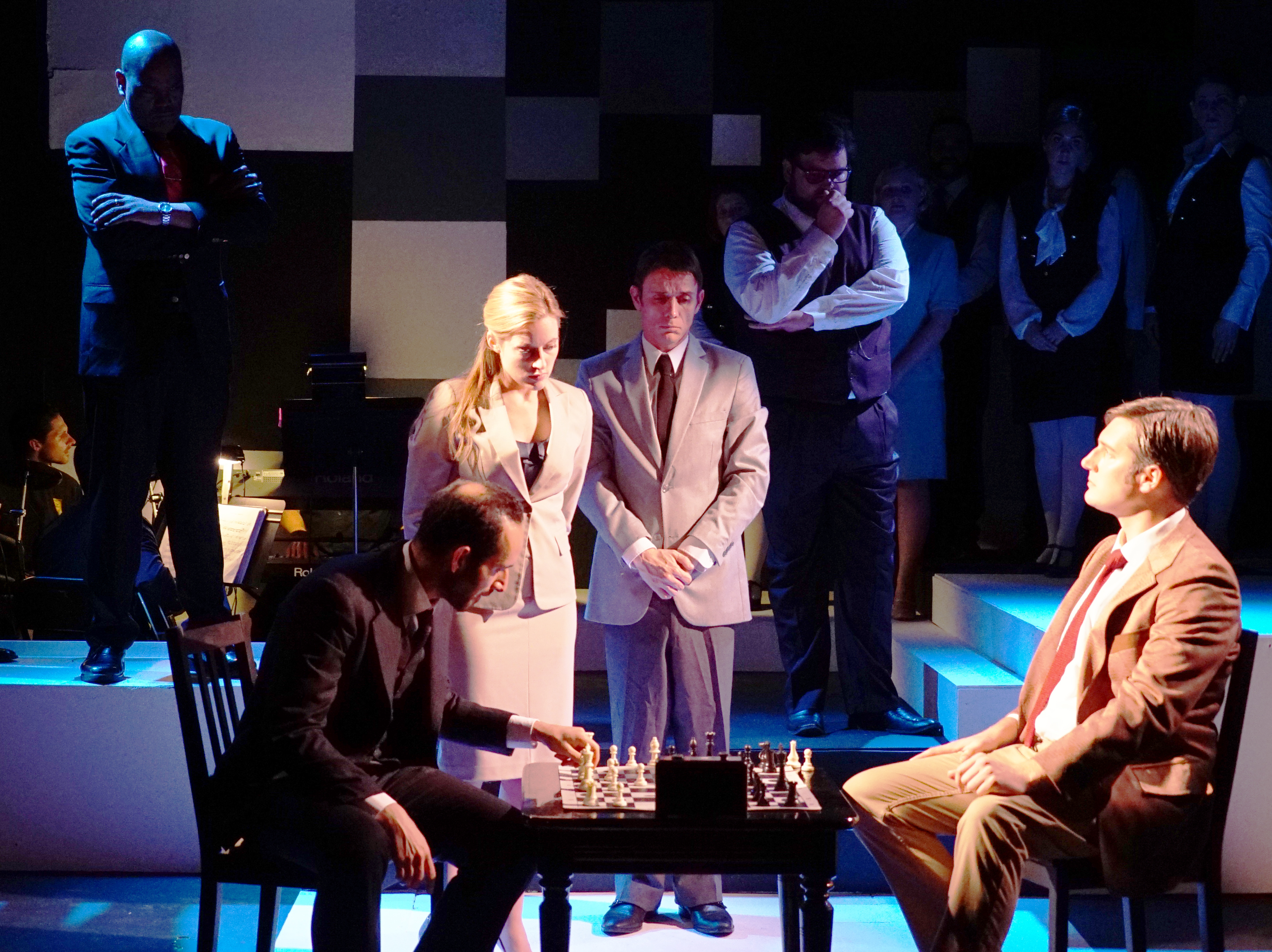
"Chess" at Custom Made Theatre Company

Custom Made Theatre Co. photo by Jay Yamada
The 1980s were a different time, in many ways. And I didn't go to a lot of theater in the 80s, largely because I was either in college and working or just out of college, working, and cash-strapped. So when some of my theater friends got very excited about a local production of "Chess," I didn't really have any points of reference for it.

The key element of the play is a world chess championship, pitting an American master against a Soviet master. Obviously, this derives from the famous 1972 match between American Bobby Fischer and Russion Boris Spassky that caught world attention. The tension of a Cold War era match between the US and USSR through the proxy of a chess competition is a plausible setting for a play. But a musical?

In its day, "Chess" was fairly revolutionary, starting with a musical concept album with lyrics by Tim Rice and music by Benny Andersson and Bjorn Ulvaeus of ABBA fame. The show was then staged in London, where it had a very successful, three-year run. A subsequent mounting on Broadway, considerably reimagined, was a tremendous flop, closing after two months. Where the London production was almost operatic, with almost no spoken words beyond the songs, the New York version added a lot of dialogue, rearranged the music, and was apparently nearly incomprehensible.

This Production

Fast-forward about 25-30 years, and the Custom Made Theatre Company decides to try their hand at a revival. The scale will necessarily be much smaller than the early productions, but Rice's introduction to the libretto give producers permission to cut, rearrange, and generally try out what works. So Artistic Director Brian Katz decided to try to make a production that is closer to the original concept album, and on a scale that fits his small theater.

Small disclaimer here: I apparently had a senior moment, and misremembered the starting time for the play. As a result, I got there late, and missed the start. The staff kindly seated us during the third scene. I admit it took me a bit to get into the flow of the play after that, but I think my comments are still relevant.

Actual world championship matches stretch out over months, but the play wisely chooses to minimize the actual playing of chess onstage. The show is much more about the machinations of the players, countries, and chess officials than it is about the match itself. And of course you have to have a love triangle, because this is after all musical theater.

The Play I Saw

I give Custom Made full credit for even attempting this. I have a warm place in my heart for small theaters that undertake ambitious works. And there was definitely a group in the audience that was wildly enthusiastic for this production, either because of a nostalgic fondness for the original production(s), such as the couple to my left who kept talking about that throughout the performance, or perhaps some attachment to either the show or the company, as evidenced by the hooting crowd to my right. All told, the show was well received.

I have to say I wasn't quite as taken up with things as they were. Maybe that's because I came in a little late. Maybe it's because I wasn't already familiar with the material. Maybe it's because the first thing I saw was a fairly complex number with lots of moving, singing people that didn't quite come off. It got better as it went on, but my initial impression was not great.

Anyway, full marks to the company for even attempting this show. And some of the players (notably Leah Shesky as Florence, Heather Orth as Svetlana, and Chris Uzelac as Anatoly) really have the voices to handle the music. Unfortunately, the music is quite complex and often requires a considerable range that most of the singers didn't possess, so a lot of the singers were straining to hit notes well beyond their range, which takes away a lot of the power and appeal of the songs.

Also, the stage is very small (especially with a portion of it taken up by the band), so there is not much room for the 14-member cast to move around. Thus, the choreography is necessarily constrained and simplified. But still, that was probably the weakest part of the production overall.

Finally, the size of the house constrains the singers considerably. They were making an effort to keep their voices balanced and not overpower each other or the audience. This had two noticeable effects: One, singers pinching off their voices. Ms. Shesky, in particular spent a lot of the show singing through her nose, which is unfortunate, because she has a lovely voice, and when she let it loose (notably in "You and I" late in the show), it comes through quite nicely. Similarly, I found that members of the ensemble would be singing and then their voices would just tail off or disappear. It was quite odd sounding. Two, during several numbers, there are a lot of singers doing different parts simultaneously. Since they aren't amplified and mixed, it's up to the director and the singers to make sure we in the audience hear the important bits, and mostly what I got was a muddle.

Finally, the lighting was pretty ineffective. I couldn't tell if the lights were just inadequate, or if the players were missing their marks, but there were a lot of instances where key players were poorly lit, back-lit, and whatnot. This made it really hard, even from fairly close up, to see facial expressions and smaller interactions.

Bottom Line

I'm sure that those who know and love the play were delighted to see it again, in any form. And there are elements of the play that really appealed. The second act was definitely better than the first. I'm glad I got to see it, and disappointed (in myself) that I didn't get to see all of it, as I think that would have improved my impression of the overall show.

But I give full credit to Custom Made for undertaking such a difficult and complex show. It clearly has an audience, and the loved it.

Unfortunately, I don't think the substance of the show stands up nearly as well as the music. Outside the setting of the Cold War, the intrigues of US vs. USSR and who is-or-isn't a spy and such really don't hold up as plot devices. So it's kind of a weird little slice of a very different time: interesting and sometimes enjoyable, but ultimately not that fulfilling.

I'm glad my friends who are fans got to see the show at last, and I'm glad Custom Made undertook the project, in spite of its flaws and limitations.

Friday, October 28, 2016

"Nogales" at Magic Theatre

Timing is everything. In humor. In theater. And Magic Theatre had great timing with their turn in the rolling world premiere of Richard Montoya's "Nogales." I don't get to the Magic very often, so I often miss out on their good stuff. I'd been hearing about this one, and since I like Montoya's work, I made a point of getting to one of the shows at the start of the closing weekend.

And as coincidences go, seeing this right after seeing "Into the Beautiful North" the previous week at Central Works was excellent. One of my thoughts while seeing the earlier show was that I would kind of like to see it handled with just a little more sharpness and polish, which I've come to expect from Montoya and his sometime collaborator Sean San Jose (who directed "Nogales" as well as appearing in it). So I kind of got my wish, in that this is their take on some of the same kinds of issues.

The Play

Nogales is a border town in the Mexican state of Sinaloa. Being on the border opposite Arizona, it is a frequent point of departure for immigrants trying to sneak over/under/through the border fence and across the Sonoran desert into the US. A key event, referenced throughout the play, is the shooting of Jose Antonio Elena Rodriguez in Nogales, by a US Border Patrol agent on the other side of the fence. Fifteen times. Indeed, Rodriguez is a silent presence throughout the play.

The other major character in the play is Maricopa County (Arizona) Sheriff Joe Arpaio, crusader against illegal immigration, currently being prosecuted in federal court for repeatedly violating court orders designed to stop his office's ongoing racial profiling.

The early part of the play is largely Arpaio (played brilliantly by Montoya) introducing himself, his office, and his work. Based on actual interviews with Arpaio, it's disarmingly funny, but disturbing all the same. Watching him dance around interview questions and dodge difficult questions is like watching a master at work: He's slippery and evasive, but so engaging that you almost feel bad for hating what he's saying.

So a lot of that part of the play is really about understanding Sheriff Joe and how he can hang on to his position for so long, despite clearly standing in opposition to federal law and court orders.

The rest of the play is less sharp, less focused. We meet various characters in and around Nogales and the Sonoran desert. One thing that becomes clear is that the border, the division between the countries, is not nearly as well defined as the wall would have you believe. And yet, there it is, turning a shooting into an international incident.

The Production

The literal center of the production is a room that serves mostly as Sheriff Joe's office, but surrounded by a diorama that is meant to be Nogales in miniature, backed by video screens that show scenes from Nogales and the desert. Unfortunately, the structure of the Magic, with four large pillars holding up the ceiling around the stage, blocks a lot of the sight lines, particularly from the side seats where we sat. So much of the video was either invisible or largely occluded. It didn't help that one of the projection screens (the one easiest for us to see) went mostly dark in the middle of the play. Ah, technology!

So I think (and indeed, know, from talking to friends who were sitting in front of the stage instead of to the side) being able to take in the video along with the acting would have been more powerful. The play is largely a collaboration between Montoya, San Jose, and video designer/photographer Joan Osato. I don't feel like I can really evaluate how much Osato's work contributed to the impact of the show.

The acting ensemble does a reasonable job, but the star of the show is definitely Montoya as the aw-shucks, have a beer, kindly but weird uncle Joe. They have clearly adapted the text to include digs from current events ("bad hombres," "nasty women," etc.), and of course the "build the wall" theme. So it's a terrific look at how the wall and the border and the whole southwestern desert shapes the dialogue not just locally, but nationwide.

Conclusion

I thought the play was worth seeing, if only to catch Montoya and San Jose working together. I love their work, and Montoya in particular shines in this role. Things go a little off the rails late, as Montoya narrates a kind of "Heart of Darkness"/"Apocalypse Now" gonzo travelogue through the desert, but the overall impact is still good. As a play, it's probably not quite as good as another Montoya/San Jose collaboration I saw a couple of years ago ("The River" at Campo Santo), but it's still worth seeing.

But I need to remember to buy tickets earlier so I can sit in a better part of the theater next time.